Strategy vault / Trend following
Quantitative Strategy of MA Strength Trend Tracking
This strategy evaluates the strength of market trends by calculating the strength of moving averages (MA) across different timeframes, and tracks trends accordingly. When short-term MAs consecutively rally upwards…
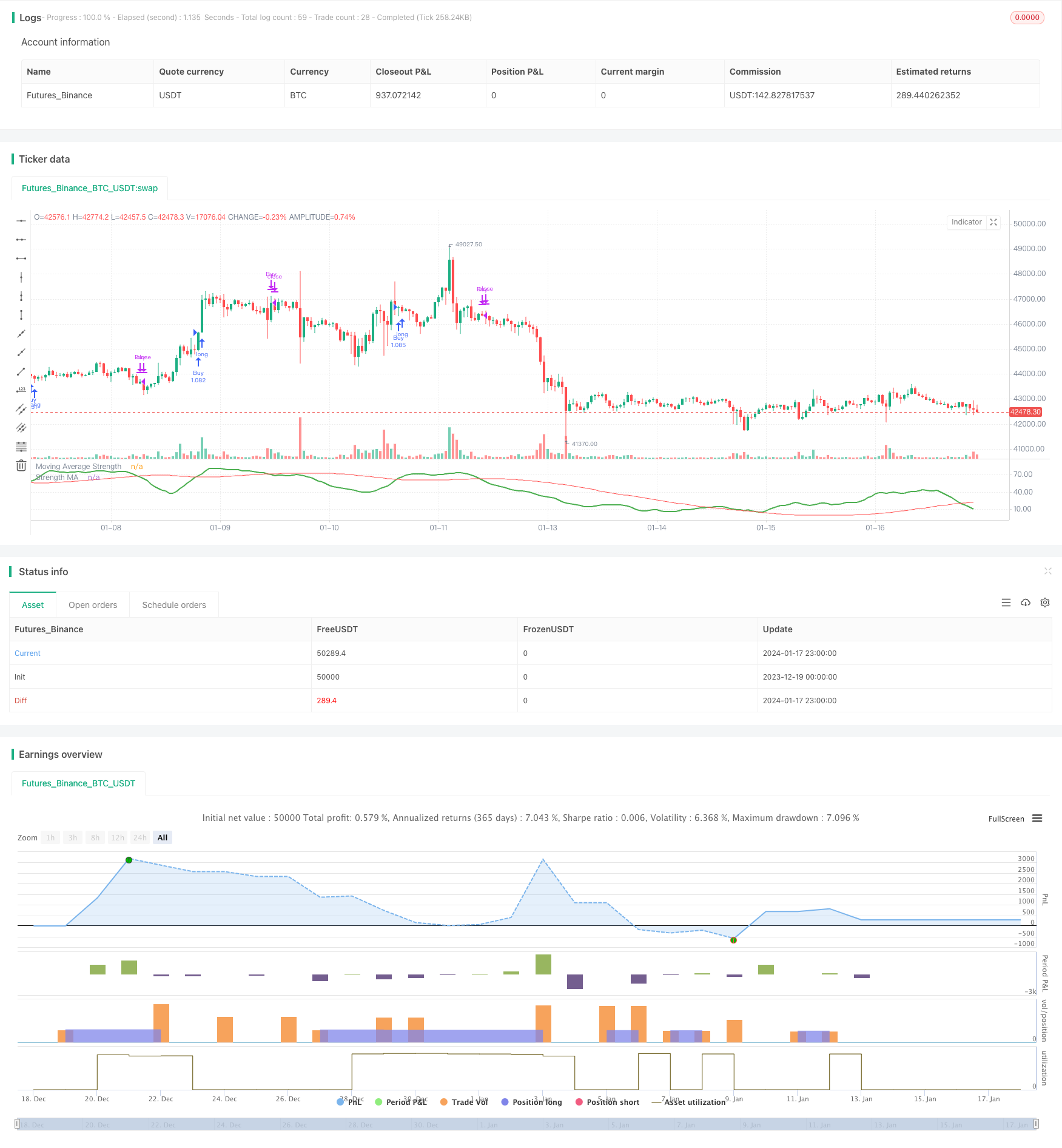
Overview
This strategy evaluates the strength of market trends by calculating the strength of moving averages (MA) across different timeframes, and tracks trends accordingly. When short-term MAs consecutively rally upwards, they score higher and form a "MA Strength" indicator. When this indicator crosses over its own long-term MA, buy signals are generated. The strategy allows users to configure MA combinations across short and long terms to track trends over customized cycles.
Strategy Logic
- Calculate the 5-day, 10-day, 20-day MAs etc. Judge if prices break above each MA, breakouts score points which accumulate into a "MA Strength" indicator.
- Apply moving average on the "MA Strength", forming a MA indicator to determine long/short signals.
- Users can configure cycle parameters like: short-term MA combination, long-term MA period, entry conditions etc.
The core of this strategy is to determine the long/short condition of the MA indicator, which reflects the average strength of the MA combination. The MA combination comprehensively judges the trend, while the MA indicator determines persistence.
Advantage Analysis
- Multi-dimensional model to evaluate trend strength. A single MA line cannot determine sufficient strength; this strategy measures multi-MA breakouts to ensure strength before signaling, ensuring reliability.
- Customizable cycle tracking. Adjusting short-term MA parameters can capture trends across different levels; adjusting long-term MA parameters controls exit pace. Users can configure cycles based on market conditions.
- Long only avoids wrong kills and tracks persistent uptrends. By only going long instead of shorting, losses from trend reversals can be avoided.
Risk Analysis
- Retracement risks exist when short-term MA crosses below long-term MA, which can be large losses. Stop loss methods should be used to limit losses.
- Reversal risks are inevitable in long-term trends, requiring timely stop loss exiting. It is recommended to judge cycle highs using techniques like channels to control reversal risks.
- Parameter risk. Improper parameter tuning can lead to wrong signals. Parameters should be optimized and stabilized for different products.
Optimization Directions
- Additional filter signals with more indicators. Volume can be used to avoid false breakouts by only signaling on volume confirmation.
- Add stop loss methods. Moving stop loss, curve stop loss can reduce retracement losses. Consider take profit methods to lock in profits and avoid reversals.
- Consider futures and forex products. MA breakouts better suit trending products. Evaluate parameter stability across products to select the optimal.
Conclusion
This strategy judges price trends by calculating a MA strength indicator and uses MA crosses as signal source to track trends. Its advantage lies in accurately determining trend strength for reliability. Main risks come from trend reversals and parameter tuning. By optimizing signal accuracy, adding stop losses, selecting suitable products, good returns can be obtained.
Parameters
| Name | Default | What it controls |
|---|---|---|
| v_input_1 | 0 | Moving Average Type: ema | sma | hma | rma | vwma | wma |
| v_input_2 | 10 | LookbackPeriod |
| v_input_3 | 0 | Moving Average Type: hma | sma | ema | rma | vwma | wma |
| v_input_4 | 200 | IndexMAPeriod |
| v_input_5 | true | considerTrendDirection |
| v_input_6 | true | considerTrendDirectionForExit |
| v_input_7 | true | offset |
| v_input_8 | 0 | Trade Direction: strategy.direction.long | strategy.direction.all | strategy.direction.short |
| v_input_9 | timestamp(01 Jan 2010 00:00 +0000) | Start Time |
| v_input_10 | timestamp(01 Jan 2099 00:00 +0000) | End Time |
Source Pine Script
/*backtest
start: 2023-12-19 00:00:00
end: 2024-01-18 00:00:00
period: 1h
basePeriod: 15m
exchanges: [{"eid":"Futures_Binance","currency":"BTC_USDT"}]
*/

// This source code is subject to the terms of the Mozilla Public License 2.0 at https://mozilla.org/MPL/2.0/
// © HeWhoMustNotBeNamed

//@version=4
strategy("MA Strength Strategy", overlay=false, initial_capital = 20000, default_qty_type = strategy.percent_of_equity, default_qty_value = 100, commission_type = strategy.commission.percent, pyramiding = 1, commission_value = 0.01)
MAType = input(title="Moving Average Type", defval="ema", options=["ema", "sma", "hma", "rma", "vwma", "wma"])
LookbackPeriod = input(10, step=10)

IndexMAType = input(title="Moving Average Type", defval="hma", options=["ema", "sma", "hma", "rma", "vwma", "wma"])
IndexMAPeriod = input(200, step=10)

considerTrendDirection = input(true)
considerTrendDirectionForExit = input(true)
offset = input(1, step=1)
tradeDirection = input(title="Trade Direction", defval=strategy.direction.long, options=[strategy.direction.all, strategy.direction.long, strategy.direction.short])
i_startTime = input(defval = timestamp("01 Jan 2010 00:00 +0000"), title = "Start Time", type = input.time)
i_endTime = input(defval = timestamp("01 Jan 2099 00:00 +0000"), title = "End Time", type = input.time)
inDateRange = true

f_getMovingAverage(source, MAType, length)=>
    ma = sma(source, length)
    if(MAType == "ema")
        ma := ema(source,length)
    if(MAType == "hma")
        ma := hma(source,length)
    if(MAType == "rma")
        ma := rma(source,length)
    if(MAType == "vwma")
        ma := vwma(source,length)
    if(MAType == "wma")
        ma := wma(source,length)
    ma


f_getMaAlignment(MAType, includePartiallyAligned)=>
    ma5 = f_getMovingAverage(close,MAType,5)
    ma10 = f_getMovingAverage(close,MAType,10)
    ma20 = f_getMovingAverage(close,MAType,20)
    ma30 = f_getMovingAverage(close,MAType,30)
    ma50 = f_getMovingAverage(close,MAType,50)
    ma100 = f_getMovingAverage(close,MAType,100)
    ma200 = f_getMovingAverage(close,MAType,200)

    upwardScore = 0.0
    upwardScore := close > ma5? upwardScore+1.10:upwardScore
    upwardScore := ma5 > ma10? upwardScore+1.10:upwardScore
    upwardScore := ma10 > ma20? upwardScore+1.10:upwardScore
    upwardScore := ma20 > ma30? upwardScore+1.10:upwardScore
    upwardScore := ma30 > ma50? upwardScore+1.15:upwardScore
    upwardScore := ma50 > ma100? upwardScore+1.20:upwardScore
    upwardScore := ma100 > ma200? upwardScore+1.25:upwardScore

    upwards = close > ma5 and ma5 > ma10 and ma10 > ma20 and ma20 > ma30 and ma30 > ma50 and ma50 > ma100 and ma100 > ma200
    downwards = close < ma5 and ma5 < ma10 and ma10 < ma20 and ma20 < ma30 and ma30 < ma50 and ma50 < ma100 and ma100 < ma200
    trendStrength = upwards?1:downwards?-1:includePartiallyAligned ? (upwardScore > 6? 0.5: upwardScore < 2?-0.5:upwardScore>4?0.25:-0.25) : 0
    [trendStrength, upwardScore]

includePartiallyAligned = true
[trendStrength, upwardScore] = f_getMaAlignment(MAType, includePartiallyAligned)

upwardSum = sum(upwardScore, LookbackPeriod)

indexSma = f_getMovingAverage(upwardSum,IndexMAType,IndexMAPeriod)

plot(upwardSum, title="Moving Average Strength", color=color.green, linewidth=2, style=plot.style_linebr)
plot(indexSma, title="Strength MA", color=color.red, linewidth=1, style=plot.style_linebr)
buyCondition = crossover(upwardSum,indexSma) and (upwardSum > upwardSum[offset] or not considerTrendDirection)
sellCondition = crossunder(upwardSum,indexSma) and (upwardSum < upwardSum[offset]  or not considerTrendDirection)

exitBuyCondition = crossunder(upwardSum,indexSma)
exitSellCondition = crossover(upwardSum,indexSma)
strategy.risk.allow_entry_in(tradeDirection)
strategy.entry("Buy", strategy.long, when= inDateRange and buyCondition, oca_name="oca_buy")
strategy.close("Buy", when = considerTrendDirectionForExit? sellCondition : exitBuyCondition)
strategy.entry("Sell", strategy.short, when= inDateRange and sellCondition, oca_name="oca_sell")
strategy.close( "Sell", when = considerTrendDirectionForExit? buyCondition : exitSellCondition)
Published by ChaoZhang on the FMZ strategy square · last modified 2024-01-19. Collected in the Quant Trading Vault. Unvalidated research: re-test with your own data and costs before trusting it.
Build this with AgenKit
A spec is not a trading system. Paste this into your coding agent and AgenKit runs a specialist team — architecture, test-first build, risk gates, review — with paper trading on by default.
/agenkit build a production-grade trading bot with a backtest engine, risk controls and paper trading by default from strategies/Quantitative-Strategy-of-MA-Strength-Trend-Tracking.md- npx agenkit install engineering-kit in your project
- Paste the command into your agent and approve each phase
- Get tests, backtest, risk controls and a paper-trading switch
Understand it first
Before you run this, read the lesson behind the idea and how to backtest it honestly. Specs like this one are the survivors of an unknown number of trials; deflate their results accordingly.
Related specs
- EMA SMA Trend Following with Swing Trading Strategy Combined Volume Filter and Percentage Take Profit Stop Loss SystemPine Script · Trend following · 1d
- Fixed Range Volume Profile And Anchored VWAP Trend Identification Strategy With Dynamic Stop LossPine Script · Trend following · 1h
- Multi Factor Trend Price Action Strategy with Dynamic Risk Management SystemPine Script · Trend following · 2h
- Multi Period Moving Average Ribbon and MACD Crossover Strategy SystemPine Script · Trend following · 1h
- Multi Period Phase Crossover with EMA Trend Following StrategyPine Script · Trend following · 1d
- Trend Following Strategy Based on Moving Average 439858Pine Script · Trend following · 1d