Strategy vault / Machine learning
Quantitative Trading Strategy Based on Modified Hull Moving Average and Ichimoku Kinko Hyo
This strategy combines two technical indicators: the modified Hull Moving Average (HMA) and Ichimoku Kinko Hyo (IKHS), aiming to capture medium to long-term market trends. The main idea is to utilize the crossover…
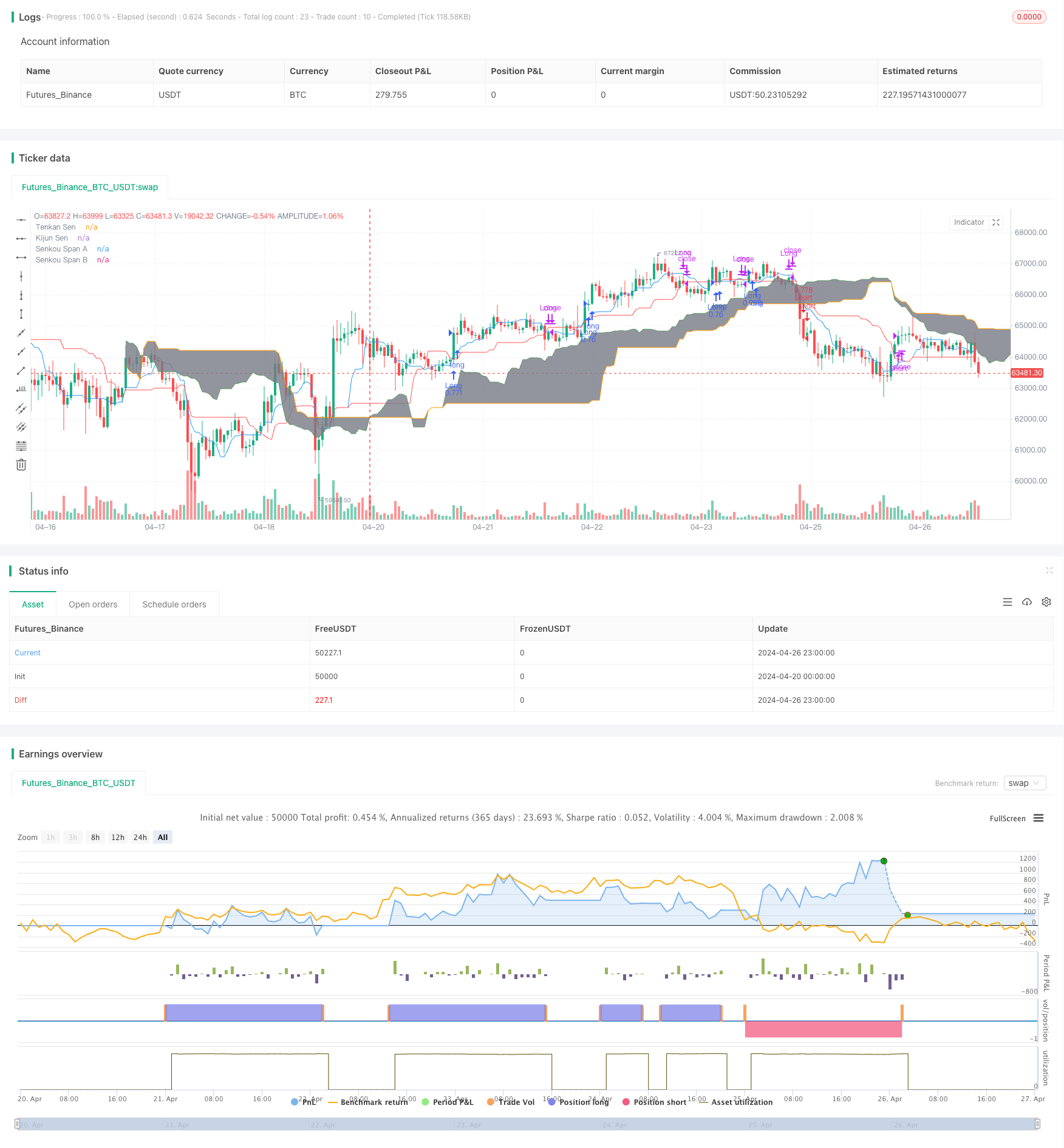
Overview
This strategy combines two technical indicators: the modified Hull Moving Average (HMA) and Ichimoku Kinko Hyo (IKHS), aiming to capture medium to long-term market trends. The main idea is to utilize the crossover signals between the HMA and the Kijun Sen (baseline) of IKHS, while using the Kumo (cloud) of IKHS as a filtering condition to determine the trend direction and make trading decisions.
Strategy Principles
- Calculate the modified Hull Moving Average (HMA)
- Calculate the Weighted Moving Average (WMA) and apply double smoothing to obtain the modified HMA
- Calculate the various indicators of Ichimoku Kinko Hyo
- Calculate the Tenkan Sen (conversion line), Kijun Sen (baseline), Senkou Span A (leading span A), and Senkou Span B (leading span B)
- Generate trading signals
- When the HMA crosses above the Kijun Sen and the closing price is above the Kumo, generate a long signal
- When the HMA crosses below the Kijun Sen and the closing price is below the Kumo, generate a short signal
- Execute trades
- Perform corresponding trading operations based on the long or short signals
- Exit trades
- When the HMA crosses the Kijun Sen in the opposite direction, exit the current position
Strategy Advantages
- Combines two effective trend-following indicators, HMA and IKHS, to better capture market trends
- Utilizes the Kumo of IKHS as a filtering condition to effectively reduce false signals and improve the win rate of trades
- The modified HMA has a faster response speed and lower lag compared to traditional moving averages, enabling timely reflection of market changes
- The strategy logic is clear, easy to understand, and implement, suitable for various markets and time frames
Strategy Risks
- During market fluctuations or unclear trends, the strategy may generate more false signals, leading to frequent trading and capital losses
- The parameter settings of the strategy have a significant impact on trading results, and different parameter combinations may lead to different performances
- The strategy does not consider market emergencies and irrational behaviors, and may face greater risks under extreme market conditions
Strategy Optimization Directions
- Introduce other technical indicators or market sentiment indicators to improve the reliability and stability of signals
- Optimize strategy parameters, such as using machine learning or genetic algorithms to find the optimal parameter combination
- Consider adding a risk management module, such as setting stop-loss and take-profit levels, position sizing, etc., to control the risk exposure of the strategy
- Based on the characteristics of different markets and time frames, make targeted adjustments and optimizations to the strategy
Summary
By combining the modified Hull Moving Average and Ichimoku Kinko Hyo, this strategy constructs a relatively stable trend-following trading system. The strategy logic is clear and easy to implement, while also having certain advantages. However, the performance of the strategy is still affected by market conditions and parameter settings, requiring further optimization and improvement. In practical applications, it is necessary to make appropriate adjustments and management based on specific market characteristics and risk preferences to obtain better trading results.
Parameters
| Name | Default | What it controls |
|---|---|---|
| v_input_1 | 12 | Double HullMA |
| v_input_2 | 9 | Tenkan Sen Periods |
| v_input_3 | 26 | Kijun Sen Periods |
| v_input_4 | 52 | Senkou Span B Periods |
| v_input_5 | 26 | Displacement |
Source Pine Script
/*backtest
start: 2024-04-20 00:00:00
end: 2024-04-27 00:00:00
period: 1h
basePeriod: 15m
exchanges: [{"eid":"Futures_Binance","currency":"BTC_USDT"}]
*/

//@version=4
strategy("Hull MA_X + Ichimoku Kinko Hyo Strategy", shorttitle="HMX+IKHS", overlay=true, default_qty_type=strategy.percent_of_equity, default_qty_value=100, pyramiding=0)

// Hull Moving Average Parameters
keh = input(12, title="Double HullMA")
n2ma = 2 * wma(close, round(keh/2)) - wma(close, keh)
sqn = round(sqrt(keh))
hullMA = wma(n2ma, sqn)

// Ichimoku Kinko Hyo Parameters
tenkanSenPeriods = input(9, title="Tenkan Sen Periods")
kijunSenPeriods = input(26, title="Kijun Sen Periods")
senkouSpanBPeriods = input(52, title="Senkou Span B Periods")
displacement = input(26, title="Displacement")

// Ichimoku Calculations
highestHigh = highest(high, max(tenkanSenPeriods, kijunSenPeriods))
lowestLow = lowest(low, max(tenkanSenPeriods, kijunSenPeriods))
tenkanSen = (highest(high, tenkanSenPeriods) + lowest(low, tenkanSenPeriods)) / 2
kijunSen = (highestHigh + lowestLow) / 2
senkouSpanA = ((tenkanSen + kijunSen) / 2)
senkouSpanB = (highest(high, senkouSpanBPeriods) + lowest(low, senkouSpanBPeriods)) / 2

// Plot Ichimoku
p1 = plot(tenkanSen, color=color.blue, title="Tenkan Sen")
p2 = plot(kijunSen, color=color.red, title="Kijun Sen")
p3 = plot(senkouSpanA, color=color.green, title="Senkou Span A", offset=displacement)
p4 = plot(senkouSpanB, color=color.orange, title="Senkou Span B", offset=displacement)
fill(p3, p4, color=color.gray, title="Kumo Shadow")

// Trading Logic
longCondition = crossover(hullMA, kijunSen) and close > senkouSpanA[displacement] and close > senkouSpanB[displacement]
shortCondition = crossunder(hullMA, kijunSen) and close < senkouSpanA[displacement] and close < senkouSpanB[displacement]

// Strategy Execution
if (longCondition)
    strategy.entry("Long", strategy.long)
if (shortCondition)
    strategy.entry("Short", strategy.short)

// Exit Logic - Exit if HullMA crosses KijunSen in the opposite direction
exitLongCondition = crossunder(hullMA, kijunSen)
exitShortCondition = crossover(hullMA, kijunSen)

if (exitLongCondition)
    strategy.close("Long")
if (exitShortCondition)
    strategy.close("Short")
Published by ChaoZhang on the FMZ strategy square · last modified 2024-04-28. Collected in the Quant Trading Vault. Unvalidated research: re-test with your own data and costs before trusting it.
Build this with AgenKit
A spec is not a trading system. Paste this into your coding agent and AgenKit runs a specialist team — architecture, test-first build, risk gates, review — with paper trading on by default.
/agenkit build a production-grade trading bot with a backtest engine, risk controls and paper trading by default from strategies/Quantitative-Trading-Strategy-Based-on-Modified-Hull-Moving-Average-and-Ichimoku-Kinko-Hyo.md- npx agenkit install engineering-kit in your project
- Paste the command into your agent and approve each phase
- Get tests, backtest, risk controls and a paper-trading switch
Understand it first
Before you run this, read the lesson behind the idea and how to backtest it honestly. Specs like this one are the survivors of an unknown number of trials; deflate their results accordingly.
Related specs
- Triple Moving Average Combined with MACD Quantitative StrategyPine Script · Machine learning · 1d
- Multi Indicator Decision Tree Strategy IMACD EMA and IchimokuPine Script · Machine learning · 30m
- Ichimoku Backtester with TP SL and Cloud ConfirmationPine Script · Machine learning · 1d
- Ichimoku Cloud Quantitative Trading StrategyPine Script · Machine learning · 1d
- AI Optimized Adaptive Stop Loss Trading System with Multiple Technical Indicator IntegrationPine Script · Machine learning · 1h
- Octa EMA and Ichimoku Cloud Quantitative Trading StrategyPine Script · Machine learning · 1d