Strategy vault / Mean reversion
Random Oscillation Strategy
The Random Oscillation Strategy integrates multiple technical indicators, including Ichimoku Kinko Hyo, MACD and Hull Moving Average, to form a systematic trading decision system. It aims to capture trend reversal…
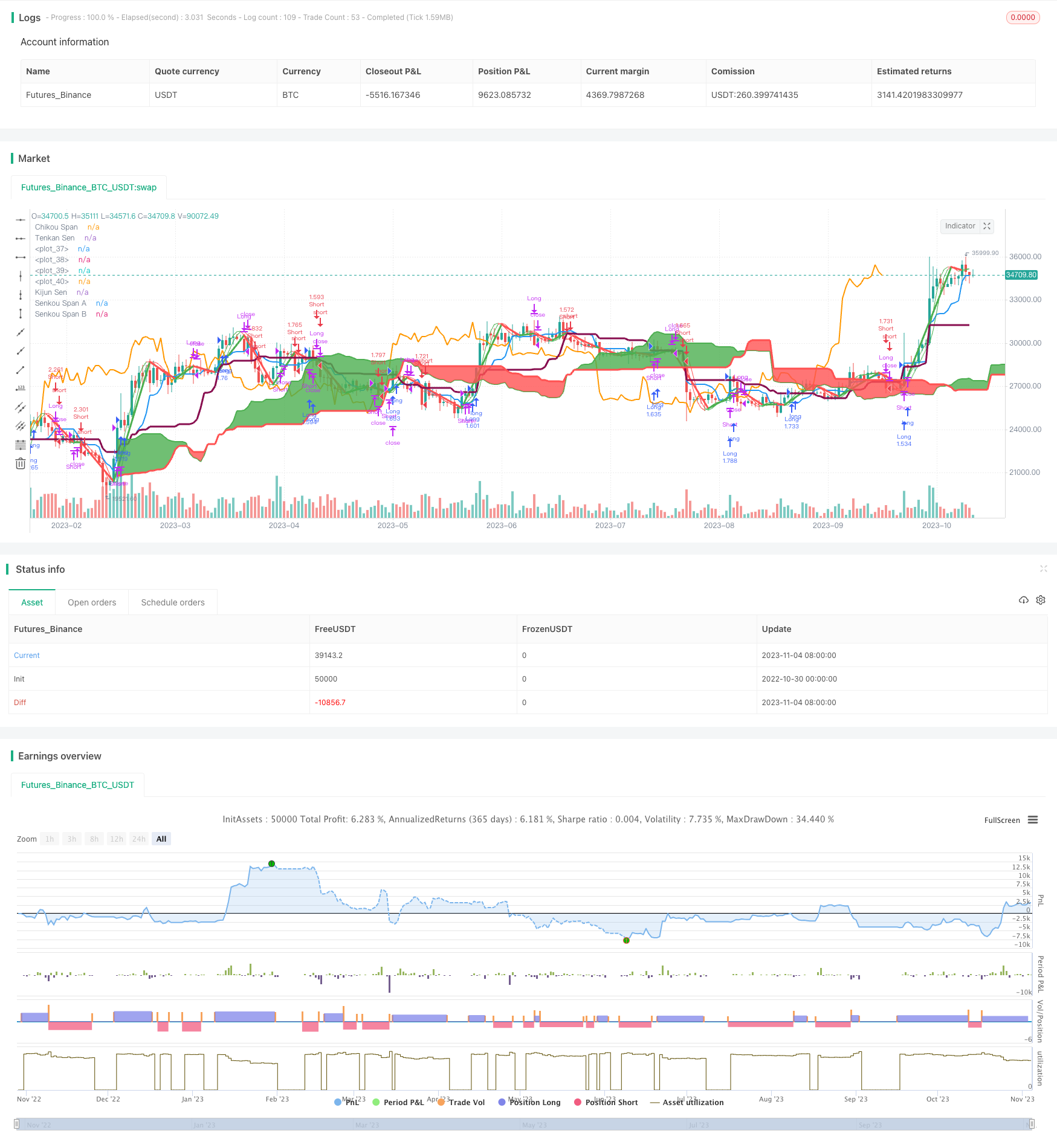
Overview
The Random Oscillation Strategy integrates multiple technical indicators, including Ichimoku Kinko Hyo, MACD and Hull Moving Average, to form a systematic trading decision system. It aims to capture trend reversal points and potential opportunities during oscillating markets.
Strategy Logic
Firstly, the Tenkan-sen and Kijun-sen of Ichimoku Kinko Hyo are adopted. Tenkan-Sen is calculated as the mean of the highest high and lowest low over the past 9 periods. Kijun-Sen is the mean of the highest high and lowest low over the past 24 periods. The crossovers of price and Kijun-sen act as trading signals.
Secondly, the MACD indicator is incorporated as an important trend-following momentum indicator. It shows the relationship between two EMAs of prices. Crossovers of MACD and its signal line generate trading signals.
Thirdly, the Hull Moving Average is introduced to improve the lagging issue of moving averages and increase sensitivity of catching price reversals. It is calculated using WMAs of half, full and square root periods. Crossovers between fast and slow Hull MAs also act as auxiliary signals.
Lastly, the strategy combines all indicators above to form a robust trading system. Actual entries and exits only occur when multiple indicators give unanimous signals.
Advantages
Diversification via multiple indicators reduces single point failure.
Integration provides stronger decision power through holistic model.
Decreased false signals as every signal is verified by others.
Improved efficiency by only acting on high-conviction signals.
Customizable parameters to adapt the strategy to changing markets.
Reduced lag and quicker response from Hull Moving Average.
Risks
Higher risk in ranging, choppy markets with increased false signals.
Ineffective if indicator parameters are not properly optimized.
Potentially misses trending moves by focusing on reversals.
Hull MA is relatively new and unproven in the long run.
Infrequent trading could miss some opportunities.
Enhancement
Adding more indicators like Bollinger Bands could further optimize the system.
Parameter tuning to find the optimal combination for different assets and timeframes.
Introduce dynamic stops to control single trade loss.
Incorporate trend filters to avoid missing trend rides.
Optimize position sizing by adjusting frequency and size based on market conditions.
Conclusion
The Random Oscillation Strategy combines multiple technical analysis techniques to capture opportunities in range-bound markets. It offers the advantages of indicator integration, reduced false signals and improved efficiency. But it also carries inherent risks that require further optimization and adaption. Overall, it represents a robust, practical approach for trading oscillating markets.
Parameters
| Name | Default | What it controls |
|---|---|---|
| v_input_1 | 12 | Double HullMA |
| v_input_2 | 9 | Tenkan Sen Periods |
| v_input_3 | 24 | Kijun Sen Periods |
| v_input_4 | 51 | Senkou Span B Periods |
| v_input_5 | 24 | Displacement |
| v_input_6 | 9 | MACD_Length |
| v_input_7 | 12 | MACD_fastLength |
| v_input_8 | 24 | MACD_slowLength |
Source Pine Script
/*backtest
start: 2022-10-30 00:00:00
end: 2023-11-05 00:00:00
period: 1d
basePeriod: 1h
exchanges: [{"eid":"Futures_Binance","currency":"BTC_USDT"}]
*/

//@version=2
strategy("Ichimoku Kinko Hyo + HULL-MA_X + MacD", shorttitle="@m", overlay=true, default_qty_type=strategy.percent_of_equity, max_bars_back=1000, default_qty_value=100, calc_on_order_fills= true, calc_on_every_tick=true, pyramiding=0)

keh=input(title="Double HullMA",defval=12, minval=1)

n2ma=2*wma(close,round(keh/2))
nma=wma(close,keh)
diff=n2ma-nma
sqn=round(sqrt(keh))
n2ma1=2*wma(close[1],round(keh/2))
nma1=wma(close[1],keh)
diff1=n2ma1-nma1
sqn1=round(sqrt(keh))
n1=wma(diff,sqn)
n2=wma(diff1,sqn)
b=n1>n2?lime:red
c=n1>n2?green:red
d=n1>n2?red:green

TenkanSenPeriods = input(9, minval=1, title="Tenkan Sen Periods")
KijunSenPeriods = input(24, minval=1, title="Kijun Sen Periods")
SenkouSpanBPeriods = input(51, minval=1, title="Senkou Span B Periods")
displacement = input(24, minval=1, title="Displacement")
donchian(len) => avg(lowest(len), highest(len))
TenkanSen = donchian(TenkanSenPeriods)
KijunSen = donchian(KijunSenPeriods)
SenkouSpanA = avg(TenkanSen, KijunSen)
SenkouSpanB = donchian(SenkouSpanBPeriods)
LS=close, offset = -displacement

MACD_Length = input(9)
MACD_fastLength = input(12)
MACD_slowLength = input(24)
MACD = ema(close, MACD_fastLength) - ema(close, MACD_slowLength)
aMACD = ema(MACD, MACD_Length)

a1=plot(n1,color=c)
a2=plot(n2,color=c)
plot(cross(n1, n2) ? n1 : na, style = circles, color=b, linewidth = 4)
plot(cross(n1, n2) ? n1 : na, style = line, color=d, linewidth = 3)
plot(TenkanSen, color=blue, title="Tenkan Sen", linewidth = 2)
plot(KijunSen, color=maroon, title="Kijun Sen", linewidth = 3)
plot(close, offset = -displacement, color=orange, title="Chikou Span", linewidth = 2)
p1=plot (SenkouSpanA, offset = displacement, color=green,  title="Senkou Span A", linewidth = 2)
p2=plot (SenkouSpanB, offset = displacement, color=red,  title="Senkou Span B", linewidth = 3)
fill(p1, p2, color = SenkouSpanA > SenkouSpanB ? green : red)

closelong = n1<n2 and close<n2 and (MACD<aMACD or TenkanSen<KijunSen or close<KijunSen)
if (closelong)
    strategy.close("Long")

closeshort = n1>n2 and close>n2 and (MACD>aMACD or TenkanSen>KijunSen or close>KijunSen)
if (closeshort)
    strategy.close("Short")

longCondition = n1>n2 and close>n2 and MACD>aMACD and (TenkanSen>KijunSen or close>KijunSen)
if (longCondition)
    strategy.entry("Long",strategy.long)

shortCondition = n1<n2 and close<n2 and MACD<aMACD and (TenkanSen<KijunSen or close<KijunSen)
if (shortCondition)
strategy.entry("Short",strategy.short)Published by ChaoZhang on the FMZ strategy square · last modified 2023-11-06. Collected in the Quant Trading Vault. Unvalidated research: re-test with your own data and costs before trusting it.
Build this with AgenKit
A spec is not a trading system. Paste this into your coding agent and AgenKit runs a specialist team — architecture, test-first build, risk gates, review — with paper trading on by default.
/agenkit build a production-grade trading bot with a backtest engine, risk controls and paper trading by default from strategies/Random-Oscillation-Strategy.md- npx agenkit install engineering-kit in your project
- Paste the command into your agent and approve each phase
- Get tests, backtest, risk controls and a paper-trading switch
Understand it first
Before you run this, read the lesson behind the idea and how to backtest it honestly. Specs like this one are the survivors of an unknown number of trials; deflate their results accordingly.
Related specs
- Ichimoku Kinko Hyo Mean Reversion StrategyPine Script · Mean reversion · 1d
- Advanced 15 Minute Chart Trading Signal StrategyPine Script · Mean reversion · 3h
- Dynamic Adaptive Multi Timeframe Trend Following and Range Reversal Hybrid StrategyPine Script · Mean reversion · 2d
- Momentum Reversal Trend Tracking StrategyPine Script · Mean reversion
- CCTBBO Reversal Tracking StrategyPine Script · Mean reversion · 45m
- Multi Indicator Options Trading StrategyPine Script · Mean reversion · 1d