Strategy vault / Mean reversion
Reversal Tracking Strategy with Double Mechanisms
This strategy combines the strengths of double mechanism indicators by using 123 pattern to determine reversal signals, and aided by Price Volume Index to determine momentum signals, in order to capture short-term…
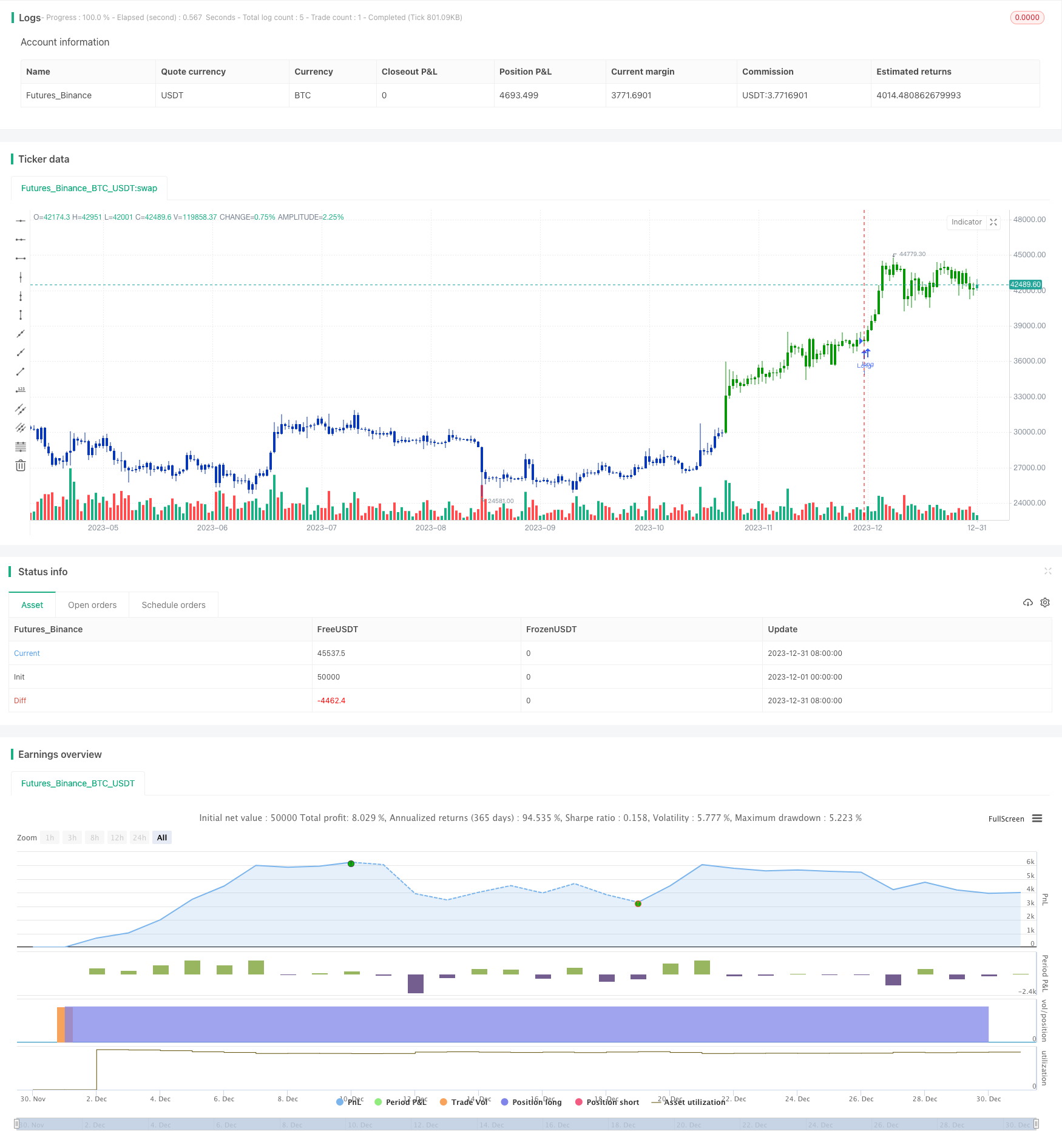
Overview
This strategy combines the strengths of double mechanism indicators by using 123 pattern to determine reversal signals, and aided by Price Volume Index to determine momentum signals, in order to capture short-term reversal trends.
Strategy Logic
123 pattern for reversal signal
Constructed with 9-day Stoch fast line and slow line
When close price falls for 2 consecutive days and rises on the 3rd day, and Stoch fast line is below 50, a buy signal is generated
When close price rises for 2 consecutive days and falls on the 3rd day, and Stoch fast line is above 50, a sell signal is generated
Price Volume Index for momentum signal
PVI judges momentum by comparing volume change between previous and current day
When PVI crosses above its N-day moving average, momentum amplifies and a buy signal is generated
When PVI crosses below its N-day moving average, momentum declines and a sell signal is generated
Dual signal combination
- Trading signals are only generated when 123 reversal and PVI momentum signals agree
In summary, this strategy leverages the advantage of dual mechanism indicators to effectively identify short-term price-volume reversal opportunities.
Advantage Analysis
123 pattern catches key short-term reversal spots
PVI momentum judges coordinated price-volume action to avoid false breakouts
Parameter optimized Stoch filters out most noise signals in turbulent zones
Dual signal reliability higher than single signals
Intraday design avoids overnight risks suitable for short-term trading
Risk Analysis
Failed reversal risk
- 123 pattern reversal signals do not always succeed with pattern failure risks
Indicator failure risks
- Stoch, PVI and other indicators can fail in certain anomalous markets
Dual signal miss risk
- Relatively stringent dual signal criteria may miss some single signal opportunities
High trading frequency risks
- Close monitoring of position sizing and risk control is needed for the high frequency strategy
Optimization Direction
Large parameter optimization space
- Windows, cycles of Stoch, PVI etc. have optimization space
Can incorporate stop loss strategies
- Mobile stop loss can ensure win rate
Consider adding filter conditions
- Tests can add moving average, volatility filters etc.
Optimize dual signal portfolio
- Test combinations of more dual indicator strategies
Summary
This strategy forms a high-reliability short-term price-volume reversal system through the combination of Stoch and PVI indicators. Compared to single indicators, it has higher win rate and positive expectancy. Sharpe ratio can be further improved via optimization and risk control. In conclusion, this strategy leverages the strengths of dual mechanism indicators to effectively capture short-term reversal opportunities in the market, and is worth live testing and optimization.
Parameters
| Name | Default | What it controls |
|---|---|---|
| v_input_1 | true | ---- 123 Reversal ---- |
| v_input_2 | 14 | Length |
| v_input_3 | true | KSmoothing |
| v_input_4 | 3 | DLength |
| v_input_5 | 50 | Level |
| v_input_6 | true | ---- Positive Volume Index ---- |
| v_input_7 | 255 | EMA_Len |
| v_input_8 | false | Trade reverse |
Source Pine Script
/*backtest
start: 2023-12-01 00:00:00
end: 2023-12-31 23:59:59
period: 1d
basePeriod: 1h
exchanges: [{"eid":"Futures_Binance","currency":"BTC_USDT"}]
*/

//@version=4
////////////////////////////////////////////////////////////
//  Copyright by HPotter v1.0 22/04/2021
// This is combo strategies for get a cumulative signal.
//
// First strategy
// This System was created from the Book "How I Tripled My Money In The
// Futures Market" by Ulf Jensen, Page 183. This is reverse type of strategies.
// The strategy buys at market, if close price is higher than the previous close
// during 2 days and the meaning of 9-days Stochastic Slow Oscillator is lower than 50.
// The strategy sells at market, if close price is lower than the previous close price
// during 2 days and the meaning of 9-days Stochastic Fast Oscillator is higher than 50.
//
// Second strategy
// The theory behind the indexes is as follows: On days of increasing volume,
// you can expect prices to increase, and on days of decreasing volume, you can
// expect prices to decrease. This goes with the idea of the market being in-gear
// and out-of-gear. Both PVI and NVI work in similar fashions: Both are a running
// cumulative of values, which means you either keep adding or subtracting price
// rate of change each day to the previous day`s sum. In the case of PVI, if today`s
// volume is less than yesterday`s, don`t add anything; if today`s volume is greater,
// then add today`s price rate of change. For NVI, add today`s price rate of change
// only if today`s volume is less than yesterday`s.
//
// WARNING:
// - For purpose educate only
// - This script to change bars colors.
////////////////////////////////////////////////////////////
Reversal123(Length, KSmoothing, DLength, Level) =>
    vFast = sma(stoch(close, high, low, Length), KSmoothing)
    vSlow = sma(vFast, DLength)
    pos = 0.0
    pos := iff(close[2] < close[1] and close > close[1] and vFast < vSlow and vFast > Level, 1,
	         iff(close[2] > close[1] and close < close[1] and vFast > vSlow and vFast < Level, -1, nz(pos[1], 0)))
	pos


PVI(EMA_Len) =>
    pos = 0.0
    xROC = roc(close, 1)
    nRes = 0.0
    nResEMA = 0.0
    nRes := iff(volume > volume[1], nz(nRes[1], 0) + xROC, nz(nRes[1], 0))
    nResEMA := ema(nRes, EMA_Len)
    pos := iff(nRes > nResEMA, 1,
        	 iff(nRes < nResEMA, -1, nz(pos[1], 0)))
    pos

strategy(title="Combo Backtest 123 Reversal & Positive Volume Index", shorttitle="Combo", overlay = true)
line1 = input(true, "---- 123 Reversal ----")
Length = input(14, minval=1)
KSmoothing = input(1, minval=1)
DLength = input(3, minval=1)
Level = input(50, minval=1)
//-------------------------
line2 = input(true, "---- Positive Volume Index ----")
EMA_Len = input(255, minval=1)
reverse = input(false, title="Trade reverse")
posReversal123 = Reversal123(Length, KSmoothing, DLength, Level)
posPVI = PVI(EMA_Len)
pos = iff(posReversal123 == 1 and posPVI == 1 , 1,
	   iff(posReversal123 == -1 and posPVI == -1, -1, 0))
possig = iff(reverse and pos == 1, -1,
          iff(reverse and pos == -1 , 1, pos))
if (possig == 1 )
    strategy.entry("Long", strategy.long)
if (possig == -1 )
    strategy.entry("Short", strategy.short)
if (possig == 0)
    strategy.close_all()
barcolor(possig == -1 ? #b50404: possig == 1 ? #079605 : #0536b3 )Published by ChaoZhang on the FMZ strategy square · last modified 2024-01-05. Collected in the Quant Trading Vault. Unvalidated research: re-test with your own data and costs before trusting it.
Build this with AgenKit
A spec is not a trading system. Paste this into your coding agent and AgenKit runs a specialist team — architecture, test-first build, risk gates, review — with paper trading on by default.
/agenkit build a production-grade trading bot with a backtest engine, risk controls and paper trading by default from strategies/Reversal-Tracking-Strategy-with-Double-Mechanisms.md- npx agenkit install engineering-kit in your project
- Paste the command into your agent and approve each phase
- Get tests, backtest, risk controls and a paper-trading switch
Understand it first
Before you run this, read the lesson behind the idea and how to backtest it honestly. Specs like this one are the survivors of an unknown number of trials; deflate their results accordingly.
Related specs
- Advanced 15 Minute Chart Trading Signal StrategyPine Script · Mean reversion · 3h
- Dynamic Adaptive Multi Timeframe Trend Following and Range Reversal Hybrid StrategyPine Script · Mean reversion · 2d
- Multi Strategy Technical Analysis Trading SystemPine Script · Mean reversion · 1d
- Oma and Apollo Dual Rail Trading StrategyPine Script · Mean reversion · 5m
- Stochastic Moving Average StrategyPine Script · Mean reversion · 1h
- 3EMA with Stochastic RSI StrategyPine Script · Mean reversion · 1h