Strategy vault / Mean reversion
RSI Fibonacci Retracement Strategy
The RSI Fibonacci Retracement strategy generates trading signals based on the crossover between the RSI indicator and the set Fibonacci retracement levels, taking positions when reversals occur in overbought and…
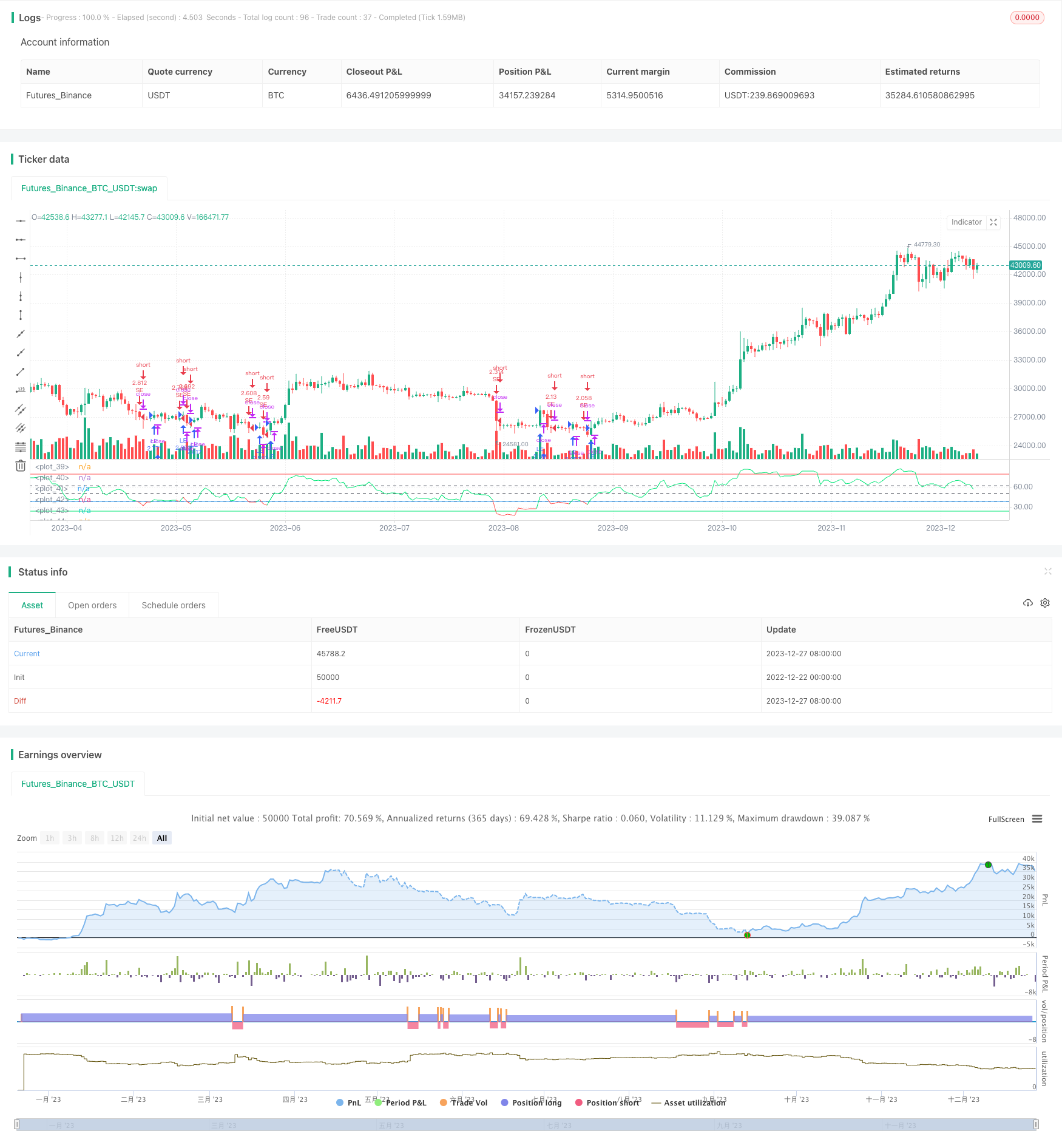
Overview
The RSI Fibonacci Retracement strategy generates trading signals based on the crossover between the RSI indicator and the set Fibonacci retracement levels, taking positions when reversals occur in overbought and oversold areas. It belongs to the trend following strategies.
Principle
This strategy is implemented based on the crossover between the RSI indicator and the Fibonacci retracement levels. First calculate the value of RSI indicator, then set the Fibonacci retracement levels (38.2%, 50%, 61.8%). When the RSI indicator crosses above the Fibonacci level, a buy signal is generated. When it crosses below, a sell signal is generated.
The RSI indicator is used to judge whether the market is overbought or oversold. RSI above 70 indicates an overbought area and below 30 indicates an oversold area. When RSI drops from the overbought area to the Fibonacci retracement zone, it is a reversal signal to go long. When RSI rises from the oversold area to the Fibonacci retracement zone, it is a reversal signal to go short.
The Fibonacci retracement levels in this strategy mainly serve as a reference, forming trading signals with RSI. In trending markets, continued running after retracements often touches Fibonacci retracement levels, which act like supports and resistances. Taking crossover with RSI as trading signals can capture reversal opportunities.
Advantages
Using RSI to identify overbought and oversold formations, combined with Fibonacci retracement area to capture reversal opportunities, can filter out some noise.
Trend following in nature, can capture mid-to-long term trends.
Can adapt to different market situations by adjusting the Fibonacci retracement area.
Risks
Long or short positions may last for a long time, requiring sufficient capital support.
Retracement process may exhibit probing highs and lows again, requiring stop loss to control risks.
Improper parameter settings may lead to excessive trading or insufficient capturing of reversal opportunities.
Optimization Directions
Consider incorporating other indicators to filter entry timing, such as MACD, Bollinger Bands to judge trend direction.
Parameters like RSI periods and Fibonacci retracement levels can be optimized.
Set up dynamic stop loss to lock in profits.
Summary
The RSI Fibonacci Retracement strategy has good stability in general as a trend following strategy. Compared to single RSI strategies, adding the Fibonacci retracement area can effectively filter out some noisy trades. By parameter optimization it can adapt to different trading instruments across various markets. In conclusion this is a reliable and easy-to-optimize strategy idea.
Parameters
| Name | Default | What it controls |
|---|---|---|
| v_input_1 | 14 | Rsi Periods |
| v_input_2 | 0 | Fibonacci Level: 38.2 | 50 | 61.8 |
| v_input_3 | 2010 | From Year |
| v_input_4 | true | From Month |
| v_input_5 | 2020 | To Year |
| v_input_6 | true | To Month |
Source Pine Script
/*backtest
start: 2022-12-22 00:00:00
end: 2023-12-28 00:00:00
period: 1d
basePeriod: 1h
exchanges: [{"eid":"Futures_Binance","currency":"BTC_USDT"}]
*/

// (c) ReduX_o, 2019. All rights reserved.
//
// How to trade:
// The indicator is more reliable in longer time frames
// Choose a fibonacci level as reference
// Buy when the RSI line turns green
// Sell when the RSI line turns red


//@version=4
strategy("RSI Fibonacci Levels", overlay=false, initial_capital=2000, currency=currency.USD, commission_value=0.1, slippage=0, commission_type=strategy.commission.percent, pyramiding=0, default_qty_type=strategy.percent_of_equity, default_qty_value=100)


len = input(14, minval=1, title="Rsi Periods")
f1 = input(title="Fibonacci Level", defval="38.2", options=["38.2", "50", "61.8"])

// === BACKTEST RANGE ===
FromYear = input(defval=2010, title="From Year", minval=2010)
FromMonth = input(defval=1, title="From Month", minval=1)

ToYear = input(defval=2020, title="To Year", minval=2010)
ToMonth = input(defval=1, title="To Month", minval=1)


src = hl2
fi= (f1 == "38.2") ? 38.2 : (f1 == "50")? 50 : 61.8


up = rma(max(change(src), 0), len)
down = rma(-min(change(src), 0), len)
rsi = down == 0 ? 100 : up == 0 ? 0 : 100 - 100 / (1 + up / down)


//***************************************************
rcolor = rsi >= fi ? color.lime : color.red

plot(rsi, title="RSI", color=rcolor, transp=0)
band1 = hline(78.6, color=color.red, linestyle= hline.style_solid,  editable= false)
band0 = hline(23.6, color=color.lime, linestyle= hline.style_solid, editable= false)
band2 = hline(61.8, color=color.gray, editable= false)
band3 = hline(50, color=color.black, editable= false)
band4 = hline(38.2, color=color.gray, editable= false)
band5 = hline(fi, color=color.blue, linestyle= hline.style_solid, editable= false)

strategy.entry("LE", strategy.long, comment="L", when=rsi >= fi )
strategy.entry("SE", strategy.short, comment="S", when=rsi < fi )
Published by ChaoZhang on the FMZ strategy square · last modified 2023-12-29. Collected in the Quant Trading Vault. Unvalidated research: re-test with your own data and costs before trusting it.
Build this with AgenKit
A spec is not a trading system. Paste this into your coding agent and AgenKit runs a specialist team — architecture, test-first build, risk gates, review — with paper trading on by default.
/agenkit build a production-grade trading bot with a backtest engine, risk controls and paper trading by default from strategies/RSI-Fibonacci-Retracement-Strategy.md- npx agenkit install engineering-kit in your project
- Paste the command into your agent and approve each phase
- Get tests, backtest, risk controls and a paper-trading switch
Understand it first
Before you run this, read the lesson behind the idea and how to backtest it honestly. Specs like this one are the survivors of an unknown number of trials; deflate their results accordingly.
Related specs
- Multi Timeframe Gold Reversal Tracking StrategyPine Script · Mean reversion · 2h
- Multi Indicator Synergistic Trading Strategy with Bollinger Bands Fibonacci MACD and RSIPine Script · Mean reversion · 2h
- Fibonacci Golden Ratio and Relative Strength RSI StrategyPine Script · Mean reversion · 1m
- Advanced 15 Minute Chart Trading Signal StrategyPine Script · Mean reversion · 3h
- Momentum Reversal Trend Tracking StrategyPine Script · Mean reversion
- Quantitative Trading Strategy Based on Bollinger Bands and RSIPine Script · Mean reversion · 1h