short term trading strategy
This is a short-term trading strategy based on channel breakouts. It uses the breakouts of channel's upper and lower rail to determine the start and end of trends, and make trading decisions accordingly. In strong…
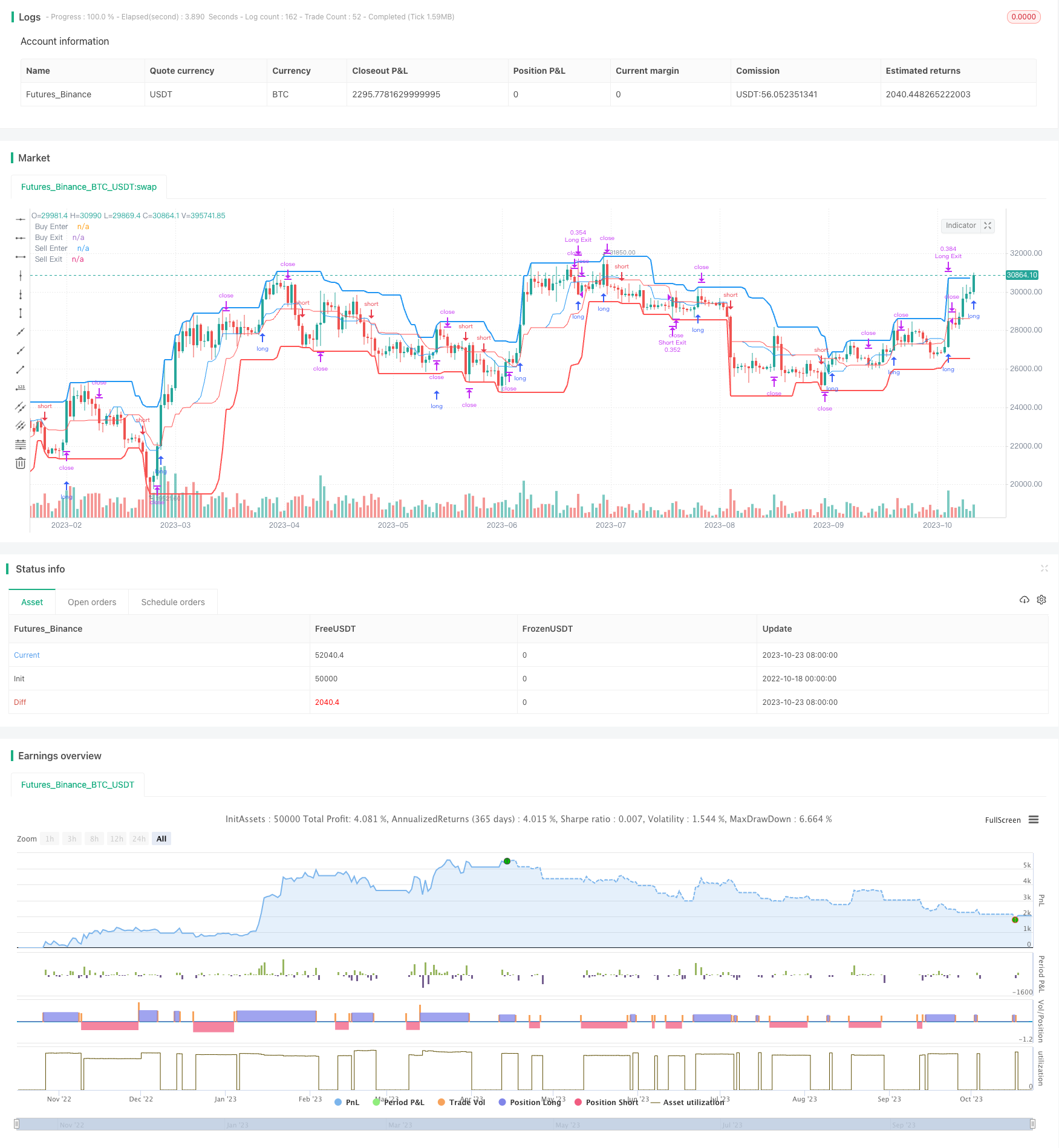
Overview
This is a short-term trading strategy based on channel breakouts. It uses the breakouts of channel's upper and lower rail to determine the start and end of trends, and make trading decisions accordingly. In strong trending markets, this breakout strategy can generate decent profits.
Strategy Logic
The strategy first calculates the highest high and lowest low over a certain period to build the upper and lower rail of the channel.
If price breaks out above the upper rail, go long. If price breaks below the lower rail, go short.
Use a moving stop loss to control risks. The stop loss is set at the middle line of the channel.
There are two optional exit rules: revert to the middle line or follow the moving stop loss. The former realizes profit quickly while the latter controls risks.
The channel period and other parameters can be tuned to optimize the strategy for different market conditions.
Advantage Analysis
Simple to implement. Just monitor the price-channel relationship and follow the rules to trade.
Trade along the trend, no counter-trend risks.
Clear and intuitive channel gives explicit entry signals.
Good profit margin, can achieve satisfactory returns in most cases.
Many adjustable parameters for optimization across different markets.
Risk Analysis
Breakout may fail, risks of being trapped exist. Timely stop loss needed.
Channel needs a period to form, not suitable for range-bound markets.
Revert to middle stop loss may be too conservative, unable to hold trends.
Parameter optimization needs historical data, overfitting possible in live trading.
Mechanical trading of breakout points may increase trade frequency and slippage costs.
Optimization Directions
Evaluate channels of different periods and select the optimal one.
Test reverting to middle and moving stop loss to find a better exit mechanism.
Optimize the stop loss percentage to reduce chances of being stopped out.
Add trend filter to avoid inappropriate breakout trades.
Consider increasing position size but control risks.
Summary
Overall this is a mature short-term breakout strategy. It has clear entry rules, proper risk control, and works well in general. Further improvement can be achieved through parameter tuning. But inherent limitations should be noted, adjustments needed for different markets. If used systematically, it should deliver consistent overall profits.
Parameters
| Name | Default | What it controls |
|---|---|---|
| v_input_1 | 13 | Channel Period for Long position |
| v_input_2 | 18 | Channel Period for Short position |
| v_input_3 | true | Is exit on Base Line? |
| v_input_4 | 46 | Take Profit (%) for position |
| v_input_5 | 9 | Stop Loss (%) for position |
| v_input_6 | 2005 | Test Start Year |
| v_input_7 | true | Test Start Month |
| v_input_8 | true | Test Start Day |
| v_input_9 | 2050 | Test End Year |
| v_input_10 | 12 | Test End Month |
| v_input_11 | 30 | Test End Day |
Source Pine Script
/*backtest
start: 2022-10-18 00:00:00
end: 2023-10-24 00:00:00
period: 1d
basePeriod: 1h
exchanges: [{"eid":"Futures_Binance","currency":"BTC_USDT"}]
*/

// This source code is subject to the terms of the Mozilla Public License 2.0 at https://mozilla.org/MPL/2.0/
// Strategy testing and optimisation for free Bitmex trading bot
// © algotradingcc

//@version=4
strategy("Channel Break [for free bot]", overlay=true, default_qty_type= strategy.percent_of_equity, initial_capital = 1000, default_qty_value = 20, commission_type=strategy.commission.percent, commission_value=0.075)

//Options
buyPeriod = input(13, "Channel Period for Long position")
sellPeriod = input(18, "Channel Period for Short position")
isMiddleExit = input(true, "Is exit on Base Line?")
takeProfit = input(46, "Take Profit (%) for position")
stopLoss = input(9, "Stop Loss (%) for position")

// Test Start
startYear = input(2005, "Test Start Year")
startMonth = input(1, "Test Start Month")
startDay = input(1, "Test Start Day")
startTest = timestamp(startYear,startMonth,startDay,0,0)

//Test End
endYear = input(2050, "Test End Year")
endMonth = input(12, "Test End Month")
endDay = input(30, "Test End Day")
endTest = timestamp(endYear,endMonth,endDay,23,59)

timeRange = time > startTest and time < endTest ? true : false

// Long&Short Levels
BuyEnter = highest(buyPeriod)
BuyExit = isMiddleExit ? (highest(buyPeriod) + lowest(buyPeriod)) / 2: lowest(buyPeriod)

SellEnter = lowest(sellPeriod)
SellExit = isMiddleExit ? (highest(sellPeriod) + lowest(sellPeriod)) / 2: highest(sellPeriod)

// Plot Data
plot(BuyEnter, style=plot.style_line, linewidth=2, color=color.blue, title="Buy Enter")
plot(BuyExit, style=plot.style_line, linewidth=1, color=color.blue, title="Buy Exit", transp=50)
plot(SellEnter, style=plot.style_line, linewidth=2, color=color.red, title="Sell Enter")
plot(SellExit, style=plot.style_line, linewidth=1, color=color.red, title="Sell Exit", transp=50)

// Calc Take Profits & Stop Loss
TP = 0.0
SL = 0.0
if strategy.position_size > 0
    TP := strategy.position_avg_price*(1 + takeProfit/100)
    SL := strategy.position_avg_price*(1 - stopLoss/100)

if strategy.position_size > 0 and SL > BuyExit
    BuyExit := SL

if strategy.position_size < 0
    TP := strategy.position_avg_price*(1 - takeProfit/100)
    SL := strategy.position_avg_price*(1 + stopLoss/100)

if strategy.position_size < 0 and SL < SellExit
    SellExit := SL


// Long Position
if timeRange and strategy.position_size <= 0
    strategy.entry("Long", strategy.long, stop = BuyEnter)
strategy.exit("Long Exit", "Long", stop=BuyExit, limit = TP, when = strategy.position_size > 0)


// Short Position
if timeRange and strategy.position_size >= 0
    strategy.entry("Short", strategy.short, stop = SellEnter)

strategy.exit("Short Exit", "Short", stop=SellExit, limit = TP, when = strategy.position_size < 0)

// Close & Cancel when over End of the Test
if time > endTest
    strategy.close_all()
    strategy.cancel_all()
Published by ChaoZhang on the FMZ strategy square · last modified 2023-10-25. Collected in the Quant Trading Vault. Unvalidated research: re-test with your own data and costs before trusting it.
Build this with AgenKit
A spec is not a trading system. Paste this into your coding agent and AgenKit runs a specialist team — architecture, test-first build, risk gates, review — with paper trading on by default.
/agenkit build a production-grade trading bot with a backtest engine, risk controls and paper trading by default from strategies/short-term-trading-strategy.md- npx agenkit install engineering-kit in your project
- Paste the command into your agent and approve each phase
- Get tests, backtest, risk controls and a paper-trading switch
Understand it first
Before you run this, read the lesson behind the idea and how to backtest it honestly. Specs like this one are the survivors of an unknown number of trials; deflate their results accordingly.
Related specs
- 5 Day Moving Average Channel Breakout Strategy Combined With Mileage ConceptPine Script · Breakout · 1d
- ATR Trailing Stops StrategyPine Script · Breakout · 1h
- ATR Trend Breakout StrategyPine Script · Breakout · 1d
- Adaptive Bollinger Breakout with Moving Average Quantitative Strategy SystemPine Script · Breakout · 1h
- Adaptive Channel Breakout StrategyPine Script · Breakout · 1d
- Adaptive Multi Period Trading Strategy Based on Wave Trend Momentum BreakoutPine Script · Breakout · 2h