Strategy vault / Machine learning
This is an experimental quantitative trading strategy
This is an experimental quantitative trading strategy that combines moving average indicators and kNN machine learning algorithms to generate trading signals. It uses the crossovers of two VWMA lines with different…
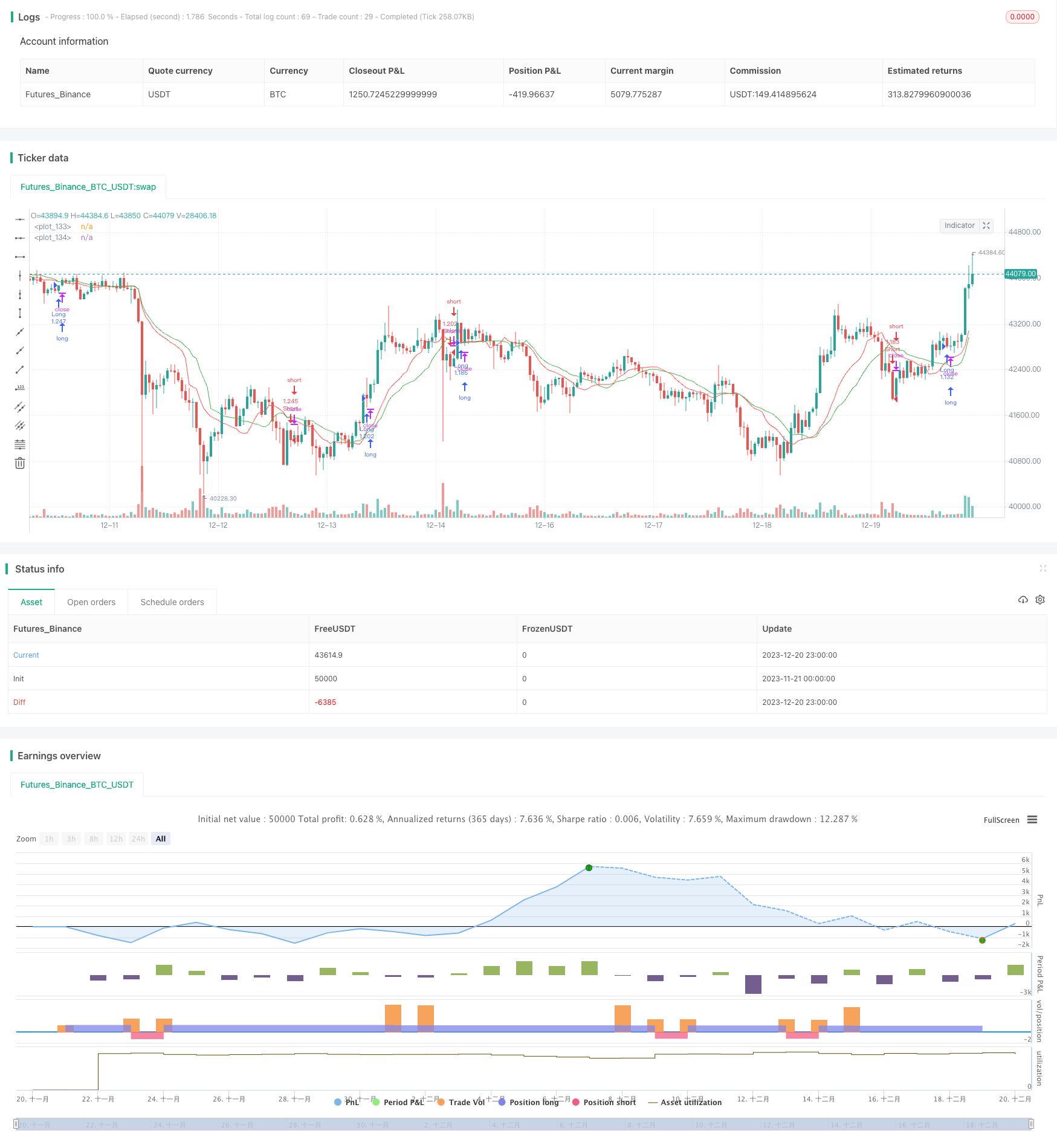
Overview
This is an experimental quantitative trading strategy that combines moving average indicators and kNN machine learning algorithms to generate trading signals. It uses the crossovers of two VWMA lines with different periods to determine the trend direction, and uses MFI and ADX indicators to filter the signals through kNN algorithm to improve the reliability of the signals.
Strategy Principles
The core indicators of this strategy are two VWMA lines with different parameters, namely fast line and slow line. When the fast line crosses above the slow line, a buy signal is generated. When the fast line crosses below the slow line, a sell signal is generated. In addition, this strategy introduces two auxiliary indicators, MFI and ADX, to judge the reliability of the current signal under the current market conditions through the kNN classification algorithm.
The idea behind kNN algorithm is to compare new data with historical data to determine the results corresponding to the k most similar historical data, and categorize based on the majority vote of these k historical results. This strategy uses MFI and ADX as two input parameters of the kNN algorithm to determine the historical price movement (uptrend or downtrend) under this combination of indicators, thereby filtering the current signal to improve the signal quality.
Advantages
- Utilize the trend following capability of VWMA and generate trading signals through moving average crossovers
- Apply MFI and ADX indicators for multi-dimensional feature extraction to assist in determining trend direction
- Leverage kNN machine learning algorithm to dynamically optimize and filter trading signals
- Experimental strategy with large room for improvement through more data verification and optimization
Risks and Mitigations
- VWMA lines tend to lag
- MFI and ADX have some lagging, which may misjudge market conditions
- kNN algorithm parameters (e.g. k value) can have significant impact on results
- Experimental strategy may underperform in live trading
Mitigations:
- Adjust MA parameters to reduce lag
- Improve indicators to judge trends more accurately
- Optimize kNN parameters to improve fitness
- Verify strategy via backtest and paper trading
Optimization Directions
There is large room for optimizing this strategy:
- Add more MA indicators to construct MA combinations
- Try different auxiliary indicators like MACD, KDJ etc
- Improve kNN algorithm e.g. using different distance metrics
- Try other machine learning algorithms like SVM, Random Forest etc
- Parameter tuning to find optimal parameter sets
Introducing more indicators and machine learning algorithms may further improve the stability and profitability of the strategy.
Summary
This is an experimental quantitative trading strategy based on VWMA indicators and kNN machine learning algorithms. It has the advantage of strong trend following capability while filtering signals via machine learning. The strategy has large room for expansion by introducing more features and optimization algorithms for better results. But as a novel strategy there are also risks that require further verification and improvement. Overall this strategy has great innovation potential.
Parameters
| Name | Default | What it controls |
|---|---|---|
| v_input_1_open | 0 | Source: open | high | low | close | hl2 | hlc3 | hlcc4 | ohlc4 |
| v_input_2 | 13 | Fast Length |
| v_input_3 | 19 | Slow Length |
| v_input_4 | 13 | Filter Length |
| v_input_5 | 6 | Filter Smoothing |
| v_input_6 | 23 | kNN nearest neighbors (k) |
| v_input_7 | false | Draw background |
Source Pine Script
/*backtest
start: 2023-11-21 00:00:00
end: 2023-12-21 00:00:00
period: 1h
basePeriod: 15m
exchanges: [{"eid":"Futures_Binance","currency":"BTC_USDT"}]
*/

// This source code is subject to the terms of the Mozilla Public License 2.0 at https://mozilla.org/MPL/2.0/
// © lastguru

//@version=4
strategy(title="VWMA with kNN Machine Learning: MFI/ADX", shorttitle="VWMA + kNN: MFI/ADX", overlay=true, default_qty_type=strategy.percent_of_equity, default_qty_value=100)

/////////
// kNN //
/////////

// Define storage arrays for: parameter 1, parameter 2, price, result (up = 1; down = -1)
var knn1 = array.new_float(1, 0)
var knn2 = array.new_float(1, 0)
var knnp = array.new_float(1, 0)
var knnr = array.new_float(1, 0)

// Store the previous trade; buffer the current one until results are in
_knnStore (p1, p2, src) =>
    var prevp1 = 0.0
    var prevp2 = 0.0
    var prevsrc = 0.0

    array.push(knn1, prevp1)
    array.push(knn2, prevp2)
    array.push(knnp, prevsrc)
    array.push(knnr, src >= prevsrc ? 1 : -1)

    prevp1 := p1
    prevp2 := p2
    prevsrc := src

// Sort two arrays (MUST be of the same size) based on the first.
// In other words, when an element in the first is moved, the element in the second moves as well.
_knnGet(arr1, arr2, k) =>
    sarr = array.copy(arr1)
    array.sort(sarr)
    ss = array.slice(sarr, 0, min(k, array.size(sarr)))
    m = array.max(ss)
    out = array.new_float(0)
    for i = 0 to array.size(arr1) - 1
        if (array.get(arr1, i) <= m)
            array.push(out, array.get(arr2, i))
    out

// Create a distance array from the two given parameters
_knnDistance(p1, p2) =>
    dist = array.new_float(0)
    n = array.size(knn1) - 1
    for i = 0 to n
        d = sqrt( pow(p1 - array.get(knn1, i), 2) + pow(p2 - array.get(knn2, i), 2) )
        array.push(dist, d)
    dist

// Make a prediction, finding k nearest neighbours
_knn(p1, p2, k) =>
    slice = _knnGet(_knnDistance(p1, p2), array.copy(knnr), k)
    knn = array.sum(slice)

////////////
// Inputs //
////////////

SRC = input(title="Source", type=input.source, defval=open)
FAST = input(title="Fast Length", type=input.integer, defval=13)
SLOW = input(title="Slow Length", type=input.integer, defval=19)
FILTER = input(title="Filter Length", type=input.integer, defval=13)
SMOOTH = input(title="Filter Smoothing", type=input.integer, defval=6)
KNN = input(title="kNN nearest neighbors (k)", type=input.integer, defval=23)
BACKGROUND = input(false,title = "Draw background")

////////
// MA //
////////
fastMA = vwma(SRC, FAST)
slowMA = vwma(SRC, SLOW)

/////////
// DMI //
/////////

// Wilder's Smoothing (Running Moving Average)
_rma(src, length) =>
    out = 0.0
    out := ((length - 1) * nz(out[1]) + src) / length

// DMI (Directional Movement Index)
_dmi (len, smooth) =>
    up = change(high)
    down = -change(low)
    plusDM = na(up) ? na : (up > down and up > 0 ? up : 0)
    minusDM = na(down) ? na : (down > up and down > 0 ? down : 0)
    trur = _rma(tr, len)
    plus = fixnan(100 * _rma(plusDM, len) / trur)
    minus = fixnan(100 * _rma(minusDM, len) / trur)
    sum = plus + minus
    adx = 100 * _rma(abs(plus - minus) / (sum == 0 ? 1 : sum), smooth)
    [plus, minus, adx]

[diplus, diminus, adx] = _dmi(FILTER, SMOOTH)

/////////
// MFI //
/////////

// common RSI function
_rsi(upper, lower) =>
    if lower == 0
        100
    if upper == 0
        0
	100.0 - (100.0 / (1.0 + upper / lower))

mfiUp = sum(volume * (change(ohlc4) <= 0 ? 0 : ohlc4), FILTER)
mfiDown = sum(volume * (change(ohlc4) >= 0 ? 0 : ohlc4), FILTER)
mfi = _rsi(mfiUp, mfiDown)

////////////
// Filter //
////////////

longCondition = crossover(fastMA, slowMA)
shortCondition = crossunder(fastMA, slowMA)

if (longCondition or shortCondition)
    _knnStore(adx, mfi, SRC)
filter = _knn(adx, mfi, KNN)

/////////////
// Actions //
/////////////

bgcolor(BACKGROUND ? filter >= 0 ? color.green : color.red : na)
plot(fastMA, color=color.red)
plot(slowMA, color=color.green)

if (longCondition and filter >= 0)
    strategy.entry("Long", strategy.long)
if (shortCondition and filter < 0)
strategy.entry("Short", strategy.short)Published by ChaoZhang on the FMZ strategy square · last modified 2023-12-22. Collected in the Quant Trading Vault. Unvalidated research: re-test with your own data and costs before trusting it.
Build this with AgenKit
A spec is not a trading system. Paste this into your coding agent and AgenKit runs a specialist team — architecture, test-first build, risk gates, review — with paper trading on by default.
/agenkit build a production-grade trading bot with a backtest engine, risk controls and paper trading by default from strategies/This-is-an-experimental-quantitative-trading-strategy.md- npx agenkit install engineering-kit in your project
- Paste the command into your agent and approve each phase
- Get tests, backtest, risk controls and a paper-trading switch
Understand it first
Before you run this, read the lesson behind the idea and how to backtest it honestly. Specs like this one are the survivors of an unknown number of trials; deflate their results accordingly.
Related specs
- Triple Moving Average Combined with MACD Quantitative StrategyPine Script · Machine learning · 1d
- SMA RSI Sudden Buy Sell StrategyPine Script · Machine learning · 3m
- ADX EFI 50 Moving Average Channel Pullback StrategyPine Script · Machine learning · 1h
- Multi indicator Combination StrategyPine Script · Machine learning · 1d
- EMA and RSI Quantitative Trading StrategyPine Script · Machine learning · 1h
- MACD Robot Trading StrategyPine Script · Machine learning · 1d