Strategy vault / Trend following
Trend Following Strategy with Moving Averages and SuperTrend
This strategy combines Moving Average indicators and SuperTrend indicator to implement a trend following strategy with trailing stop loss. It takes full advantage of Moving Averages' trend judging capability and…
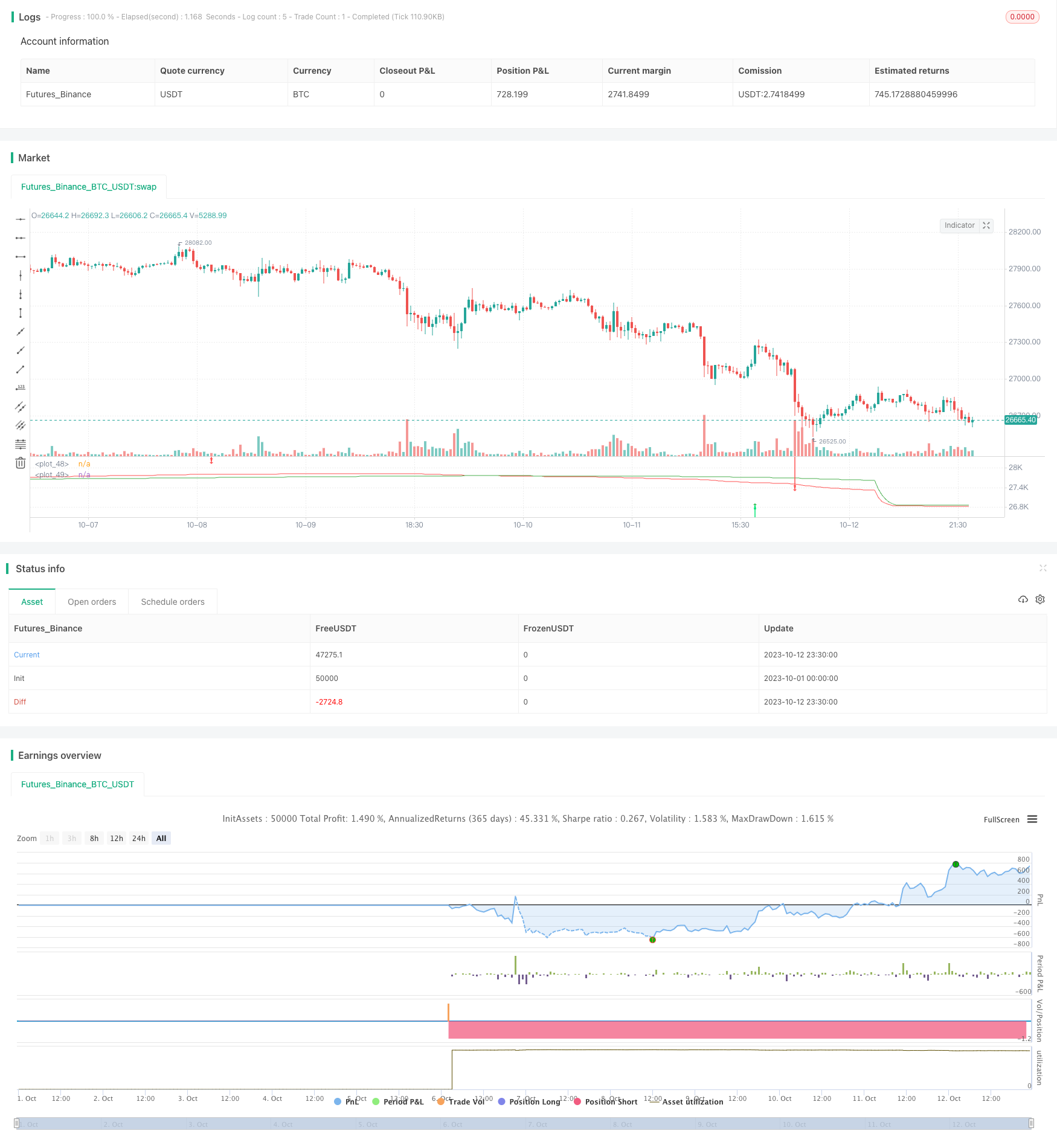
Overview
This strategy combines Moving Average indicators and SuperTrend indicator to implement a trend following strategy with trailing stop loss. It takes full advantage of Moving Averages' trend judging capability and SuperTrend's stop loss function to effectively track trends and control risks.
Strategy Logic
The strategy uses two FRAMA moving averages for trading signals and SuperTrend indicator for filtering.
Specifically, when the fast line crosses above the slow line, a buy signal is generated. When the fast line crosses below the slow line, a sell signal is generated. To avoid false breaks, the strategy adds a filter requiring SuperTrend indicator to align. Trades are only taken when SuperTrend agrees with signal direction.
For position management, the strategy uses SuperTrend direction change as a stop loss signal. When SuperTrend reverses direction, the position will be stopped out.
In addition, trailing stop loss can be enabled as an option. After certain profit target is reached, trailing stop can be used to lock in profits.
Advantage Analysis
- Utilizes Moving Averages to determine trend direction, able to filter out market noise and precisely judge trends
- Combining with SuperTrend filter avoids wrong trades from false breakouts
- SuperTrend direction change acts as stop loss point, allowing quick stop loss and effective risk control
- Optional trailing stop loss can maximize profits
Risk Analysis
- As a trend following strategy, it's vulnerable to whipsaws in ranging markets. Position sizing needs to be controlled.
- Moving Averages have lagging effect, may cause premature or late entry
- Improper SuperTrend parameters may lead to too aggressive or too conservative stop loss
- When enabling trailing stop, trailing width needs to be set properly to avoid overactive stop loss
These risks can be reduced by adjusting Moving Average parameters, optimizing SuperTrend settings, and using trailing stop loss appropriately.
Optimization Directions
The strategy can be optimized in the following aspects:
- Optimize Moving Average parameters to find best parameter combination
Different period combinations can be tested to find the optimal balance of smoothness and sensitivity.
- Customize SuperTrend parameters
Different ATR periods and multipliers can be tested to optimize stop loss effect.
- Add other indicator filters
Additional filters like Donchian Channel, Volatility indicator can be tested.
- Optimize trailing stop parameters
Different trailing widths can be tested to maximize profit and control risk.
- Combine with other stop loss strategies
Combinations with fixed stop, volatility stop, adaptive stop can be tested.
Conclusion
The strategy integrates Moving Averages' trend analysis and SuperTrend's stop management into a complete trend following strategy with trailing stop loss. Further enhancements on risk management and parameter optimization can improve its stability and profitability. It is suitable for quantitative traders with some experience.
Parameters
| Name | Default | What it controls |
|---|---|---|
| v_input_1_close | 0 | MA FRAMA Source: close | high | low | open | hl2 | hlc3 | hlcc4 | ohlc4 |
| v_input_2 | 12 | MA FRAMA Length |
| v_input_3 | 1W | Resolution |
| v_input_4 | true | * Fractal Adjusted (FRAMA) Only - FC |
| v_input_5 | 200 | * Fractal Adjusted (FRAMA) Only - SC |
| v_input_6 | false | Use supertrend for enter |
| v_input_7 | false | Use supertrend for exit |
| v_input_8 | 3 | Factor |
| v_input_9 | 7 | Pd |
| v_input_10 | false | Take Profit Points |
| v_input_11 | false | Stop Loss Points |
| v_input_12 | false | Trailing Stop Loss Points |
| v_input_13 | false | Trailing Stop Loss Offset Points |
| v_input_14 | false | Custom Backtesting Dates |
| v_input_15 | 2020 | Backtest Start Year |
| v_input_16 | true | Backtest Start Month |
| v_input_17 | true | Backtest Start Day |
| v_input_18 | false | Backtest Start Hour |
| v_input_19 | 2020 | Backtest Stop Year |
| v_input_20 | 12 | Backtest Stop Month |
| v_input_21 | 31 | Backtest Stop Day |
| v_input_22 | 23 | Backtest Stop Hour |
Source Pine Script
/*backtest
start: 2023-10-01 00:00:00
end: 2023-10-13 00:00:00
period: 30m
basePeriod: 15m
exchanges: [{"eid":"Futures_Binance","currency":"BTC_USDT"}]
*/

// This source code is subject to the terms of the Mozilla Public License 2.0 at https://mozilla.org/MPL/2.0/
// © 03.freeman

//@version=4
// strategy("FRAMA strategy", overlay=true,precision=6, initial_capital=1000,calc_on_every_tick=true, pyramiding=0, default_qty_type=strategy.fixed, default_qty_value=10000, currency=currency.EUR)
ma_src = input(title="MA FRAMA Source", type=input.source, defval=close)
ma_frama_len = input(title="MA FRAMA Length", type=input.integer, defval=12)
res = input(title="Resolution", type=input.resolution, defval="1W")
frama_FC = input(defval=1,minval=1, title="* Fractal Adjusted (FRAMA) Only - FC")
frama_SC = input(defval=200,minval=1, title="* Fractal Adjusted (FRAMA) Only - SC")
High = security(syminfo.tickerid, res, high)
Low = security(syminfo.tickerid, res, low)
source = security(syminfo.tickerid, res, ma_src)
enterRule = input(false,title = "Use supertrend for enter")
exitRule = input(false,title = "Use supertrend for exit")

ma(src, len) =>
    float result = 0
    int len1 = len/2
    e = 2.7182818284590452353602874713527
    w = log(2/(frama_SC+1)) / log(e) // Natural logarithm (ln(2/(SC+1))) workaround
    H1 = highest(High,len1)
    L1 = lowest(Low,len1)
    N1 = (H1-L1)/len1
    H2_ = highest(High,len1)
    H2 = H2_[len1]
    L2_ = lowest(Low,len1)
    L2 = L2_[len1]
    N2 = (H2-L2)/len1
    H3 = highest(High,len)
    L3 = lowest(Low,len)
    N3 = (H3-L3)/len
    dimen1 = (log(N1+N2)-log(N3))/log(2)
    dimen = iff(N1>0 and N2>0 and N3>0,dimen1,nz(dimen1[1]))
    alpha1 = exp(w*(dimen-1))
    oldalpha = alpha1>1?1:(alpha1<0.01?0.01:alpha1)
    oldN = (2-oldalpha)/oldalpha
    N = (((frama_SC-frama_FC)*(oldN-1))/(frama_SC-1))+frama_FC
    alpha_ = 2/(N+1)
    alpha = alpha_<2/(frama_SC+1)?2/(frama_SC+1):(alpha_>1?1:alpha_)
    frama = 0.0
    frama :=(1-alpha)*nz(frama[1]) + alpha*src
    result := frama
    result

frama = ma(sma(source,1),ma_frama_len)
signal = ma(frama,ma_frama_len)
plot(frama, color=color.red)
plot(signal, color=color.green)


longCondition = crossover(frama,signal)
shortCondition = crossunder(frama,signal)

Factor=input(3, minval=1,maxval = 100)
Pd=input(7, minval=1,maxval = 100)


Up=hl2-(Factor*atr(Pd))
Dn=hl2+(Factor*atr(Pd))

TrendUp = 0.0
TrendDown = 0.0
Trend = 0.0
Tsl = 0.0
TrendUp :=close[1]>TrendUp[1]? max(Up,TrendUp[1]) : Up
TrendDown :=close[1]<TrendDown[1]? min(Dn,TrendDown[1]) : Dn

Trend := close > TrendDown[1] ? 1: close< TrendUp[1]? -1: nz(Trend[1],1)
Tsl := Trend==1? TrendUp: TrendDown

linecolor = Trend == 1 ? color.green : color.red

//plot(Tsl, color = linecolor , style =  plot.style_line , linewidth = 2,title = "SuperTrend")

plotshape(cross(close,Tsl) and close>Tsl , "Up Arrow", shape.triangleup,location.belowbar,color.green,0,0)
plotshape(cross(Tsl,close) and close<Tsl , "Down Arrow", shape.triangledown , location.abovebar, color.red,0,0)

plotarrow(Trend == 1 and Trend[1] == -1 ? Trend : na, title="Up Entry Arrow", colorup=color.lime, maxheight=60, minheight=50, transp=0)
plotarrow(Trend == -1 and Trend[1] == 1 ? Trend : na, title="Down Entry Arrow", colordown=color.red, maxheight=60, minheight=50, transp=0)


//  Strategy: (Thanks to JayRogers)
// === STRATEGY RELATED INPUTS ===
//tradeInvert     = input(defval = false, title = "Invert Trade Direction?")
// the risk management inputs
inpTakeProfit   = input(defval = 0, title = "Take Profit Points", minval = 0)
inpStopLoss     = input(defval = 0, title = "Stop Loss Points", minval = 0)
inpTrailStop    = input(defval = 0, title = "Trailing Stop Loss Points", minval = 0)
inpTrailOffset  = input(defval = 0, title = "Trailing Stop Loss Offset Points", minval = 0)

// === RISK MANAGEMENT VALUE PREP ===
// if an input is less than 1, assuming not wanted so we assign 'na' value to disable it.
useTakeProfit   = inpTakeProfit  >= 1 ? inpTakeProfit  : na
useStopLoss     = inpStopLoss    >= 1 ? inpStopLoss    : na
useTrailStop    = inpTrailStop   >= 1 ? inpTrailStop   : na
useTrailOffset  = inpTrailOffset >= 1 ? inpTrailOffset : na

// === STRATEGY - LONG POSITION EXECUTION ===
enterLong() => enterRule? (longCondition and Trend ==1):longCondition                                             // functions can be used to wrap up and work out complex conditions
exitLong() => exitRule and Trend == -1

strategy.entry(id = "Buy", long = true, when = enterLong() )             // use function or simple condition to decide when to get in
strategy.close(id = "Buy", when = exitLong() )                         // ...and when to get out

// === STRATEGY - SHORT POSITION EXECUTION ===
enterShort() => enterRule? (shortCondition and Trend ==-1):shortCondition
exitShort() => exitRule and Trend == 1

strategy.entry(id = "Sell", long = false, when = enterShort())
strategy.close(id = "Sell", when = exitShort() )

// === STRATEGY RISK MANAGEMENT EXECUTION ===
// finally, make use of all the earlier values we got prepped
strategy.exit("Exit Buy", from_entry = "Buy", profit = useTakeProfit, loss = useStopLoss, trail_points = useTrailStop, trail_offset = useTrailOffset)
strategy.exit("Exit Sell", from_entry = "Sell", profit = useTakeProfit, loss = useStopLoss, trail_points = useTrailStop, trail_offset = useTrailOffset)

// === Backtesting Dates === thanks to Trost

testPeriodSwitch = input(false, "Custom Backtesting Dates")
testStartYear = input(2020, "Backtest Start Year")
testStartMonth = input(1, "Backtest Start Month")
testStartDay = input(1, "Backtest Start Day")
testStartHour = input(0, "Backtest Start Hour")
testPeriodStart = timestamp(testStartYear,testStartMonth,testStartDay,testStartHour,0)
testStopYear = input(2020, "Backtest Stop Year")
testStopMonth = input(12, "Backtest Stop Month")
testStopDay = input(31, "Backtest Stop Day")
testStopHour = input(23, "Backtest Stop Hour")
testPeriodStop = timestamp(testStopYear,testStopMonth,testStopDay,testStopHour,0)
testPeriod() =>
    time >= testPeriodStart and time <= testPeriodStop ? true : false
isPeriod = true
// === /END

if not isPeriod
    strategy.cancel_all()
strategy.close_all()Published by ChaoZhang on the FMZ strategy square · last modified 2023-10-20. Collected in the Quant Trading Vault. Unvalidated research: re-test with your own data and costs before trusting it.
Build this with AgenKit
A spec is not a trading system. Paste this into your coding agent and AgenKit runs a specialist team — architecture, test-first build, risk gates, review — with paper trading on by default.
/agenkit build a production-grade trading bot with a backtest engine, risk controls and paper trading by default from strategies/Trend-Following-Strategy-with-Moving-Averages-and-SuperTrend.md- npx agenkit install engineering-kit in your project
- Paste the command into your agent and approve each phase
- Get tests, backtest, risk controls and a paper-trading switch
Understand it first
Before you run this, read the lesson behind the idea and how to backtest it honestly. Specs like this one are the survivors of an unknown number of trials; deflate their results accordingly.
Related specs
- Triple Supertrend Ichimoku Cloud Quantitative Trading StrategyPine Script · Trend following · 1d
- TrendHunter w MF Multi Timeframe Trend StrategyPine Script · Trend following · 1h
- Multi Indicator Dynamic Trend Following Strategy Based on EMA and SMAPine Script · Trend following · 1d
- Super trend BPine Script · Trend following · 4h
- SuperTrend Dual Direction StrategyPine Script · Trend following · 3d
- Supertrend Advance StrategyPine Script · Trend following · 5m