Turtle Breakout Strategy
This is a short-term trading strategy based on the breakout theory. It uses moving average indicators and highest/lowest price indicators to identify breakout signals and capture profits from short-term trends.
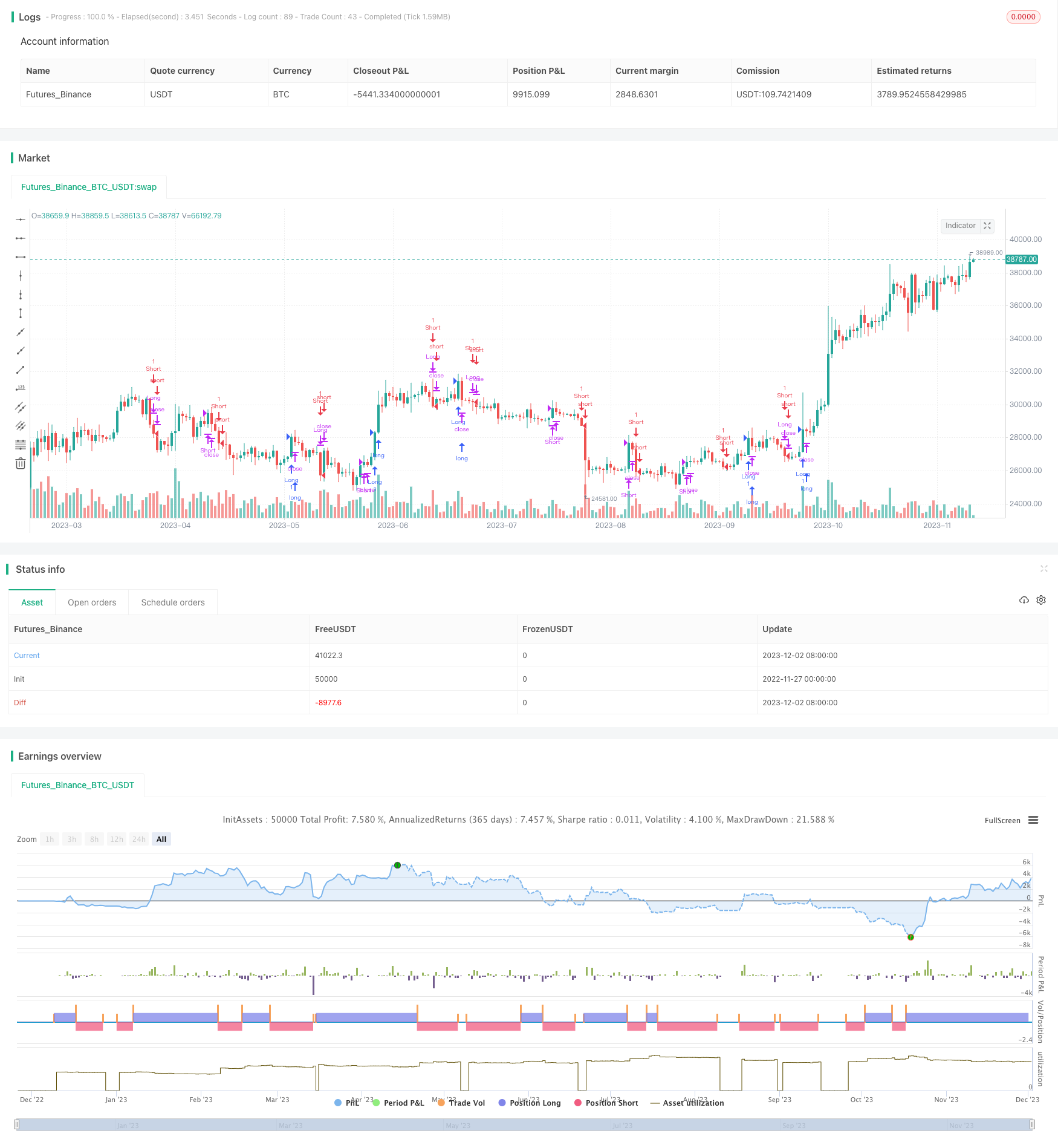
Overview
This is a short-term trading strategy based on the breakout theory. It uses moving average indicators and highest/lowest price indicators to identify breakout signals and capture profits from short-term trends.
Strategy Logic
The strategy uses 20-day highest price to identify uptrends. When the closing price breaks above the 20-day high, it goes long. It uses 10-day lowest price to identify downtrends. When the closing price breaks below the 10-day low, it goes short. It also uses a 10-day highest price as a stop loss exit signal for short trades.
Specifically, the strategy includes the following rules:
- Enter long when closing price is above 20-day high;
- Enter short when closing price is below 10-day low;
- Close short position when closing price is above 10-day high;
- Close long position when closing price is below 10-day low.
By comparing closing price with highest/lowest prices of different periods, it catches trend breakouts within short-term cycles and makes short-term trades.
Advantage Analysis
The strategy has the following advantages:
- Simple and clear logic, easy to understand and implement;
- Catch short-term trends timely based on breakout theory;
- Identify both long and short opportunities for two-way trading;
- Flexible adjustment of holding period by setting different parameter ranges.
Risk Analysis
There are also some risks:
- Breakout trading tends to be trapped, stop loss is needed to control risk;
- Frequent switching between long and short increases trading cost and slippage;
- Improper parameter settings may lead to over-trading or lagging.
We can set stop loss to limit per trade loss, or adjust parameter ranges to control trading frequency.
Optimization
The strategy can be optimized from the following aspects:
- Adding other filters to avoid false breakouts;
- Setting dynamic exit methods to trail stop loss with profit;
- Adding trend determination rules to avoid counter-trend trading;
- Optimizing parameter ranges to adapt to different cycles and market conditions.
Conclusion
In conclusion, this is a simple and practical short-term breakout strategy. It helps to capture short-cycle trend opportunities. But there are risks of being trapped and high trading frequency. By adding filters, stop loss, parameter optimization, we can control risks and improve efficiency. The strategy suits traders focusing on short-term chances and pursuing high turnover rate.
Parameters
| Name | Default | What it controls |
|---|---|---|
| v_input_1 | true | From Month |
| v_input_2 | true | From Day |
| v_input_3 | 2016 | From Year |
| v_input_4 | true | To Month |
| v_input_5 | true | To Day |
| v_input_6 | 9999 | To Year |
| v_input_7 | 20 | enter_fast |
| v_input_8 | 10 | exit_fast |
| v_input_9 | 10 | exit_fast_short |
Source Pine Script
/*backtest
start: 2022-11-27 00:00:00
end: 2023-12-03 00:00:00
period: 1d
basePeriod: 1h
exchanges: [{"eid":"Futures_Binance","currency":"BTC_USDT"}]
*/

//@version=3
strategy("TurtleBC Strategy v2 V.Troussel", shorttitle="TurtleBC-V.Troussel", overlay=true, pyramiding=0)

// === BACKTEST RANGE ===
FromMonth = input(defval = 1, title = "From Month", minval = 1)
FromDay   = input(defval = 1, title = "From Day", minval = 1)
FromYear  = input(defval = 2016, title = "From Year", minval = 2016)
ToMonth   = input(defval = 1, title = "To Month", minval = 1)
ToDay     = input(defval = 1, title = "To Day", minval = 1)
ToYear    = input(defval = 9999, title = "To Year", minval = 9999)

enter_fast = input(20, minval=1)
exit_fast = input(10, minval=1)
exit_fast_short=input(10,minval=1)


fastL = highest(close, enter_fast)
fastS = highest(close ,exit_fast_short)
fastLC = lowest(close, exit_fast)
//Sortie pour le short
exitS=close>fastS[1]


enterL1 = close > fastL[1]
exitL1 = close <= fastLC[1]


strategy.entry("Long", strategy.long, when = enterL1 and (time > timestamp(FromYear, FromMonth, FromDay, 00, 00)) and (time < timestamp(ToYear, ToMonth, ToDay, 23, 59)))
strategy.close("Long", when = exitL1 and (time < timestamp(ToYear, ToMonth, ToDay, 23, 59)))

//le trigger de sortie est
strategy.entry("Short", strategy.short, when = exitL1 and (time > timestamp(FromYear, FromMonth, FromDay, 00, 00)) and (time < timestamp(ToYear, ToMonth, ToDay, 23, 59)))
strategy.close("Short", when = exitS and (time < timestamp(ToYear, ToMonth, ToDay, 23, 59)))
Published by ChaoZhang on the FMZ strategy square · last modified 2023-12-04. Collected in the Quant Trading Vault. Unvalidated research: re-test with your own data and costs before trusting it.
Build this with AgenKit
A spec is not a trading system. Paste this into your coding agent and AgenKit runs a specialist team — architecture, test-first build, risk gates, review — with paper trading on by default.
/agenkit build a production-grade trading bot with a backtest engine, risk controls and paper trading by default from strategies/Turtle-Breakout-Strategy.md- npx agenkit install engineering-kit in your project
- Paste the command into your agent and approve each phase
- Get tests, backtest, risk controls and a paper-trading switch
Understand it first
Before you run this, read the lesson behind the idea and how to backtest it honestly. Specs like this one are the survivors of an unknown number of trials; deflate their results accordingly.
Related specs
- 5 Day Moving Average Channel Breakout Strategy Combined With Mileage ConceptPine Script · Breakout · 1d
- ATR Trailing Stops StrategyPine Script · Breakout · 1h
- ATR Trend Breakout StrategyPine Script · Breakout · 1d
- Adaptive Bollinger Breakout with Moving Average Quantitative Strategy SystemPine Script · Breakout · 1h
- Adaptive Channel Breakout StrategyPine Script · Breakout · 1d
- Adaptive Multi Period Trading Strategy Based on Wave Trend Momentum BreakoutPine Script · Breakout · 2h