Volatility Breakout Trading Strategy
The Volatility Breakout Trading Strategy is a single price action based strategy. It generates buy and sell signals by analyzing price and volume changes. This strategy can also be combined with alerts to trigger…
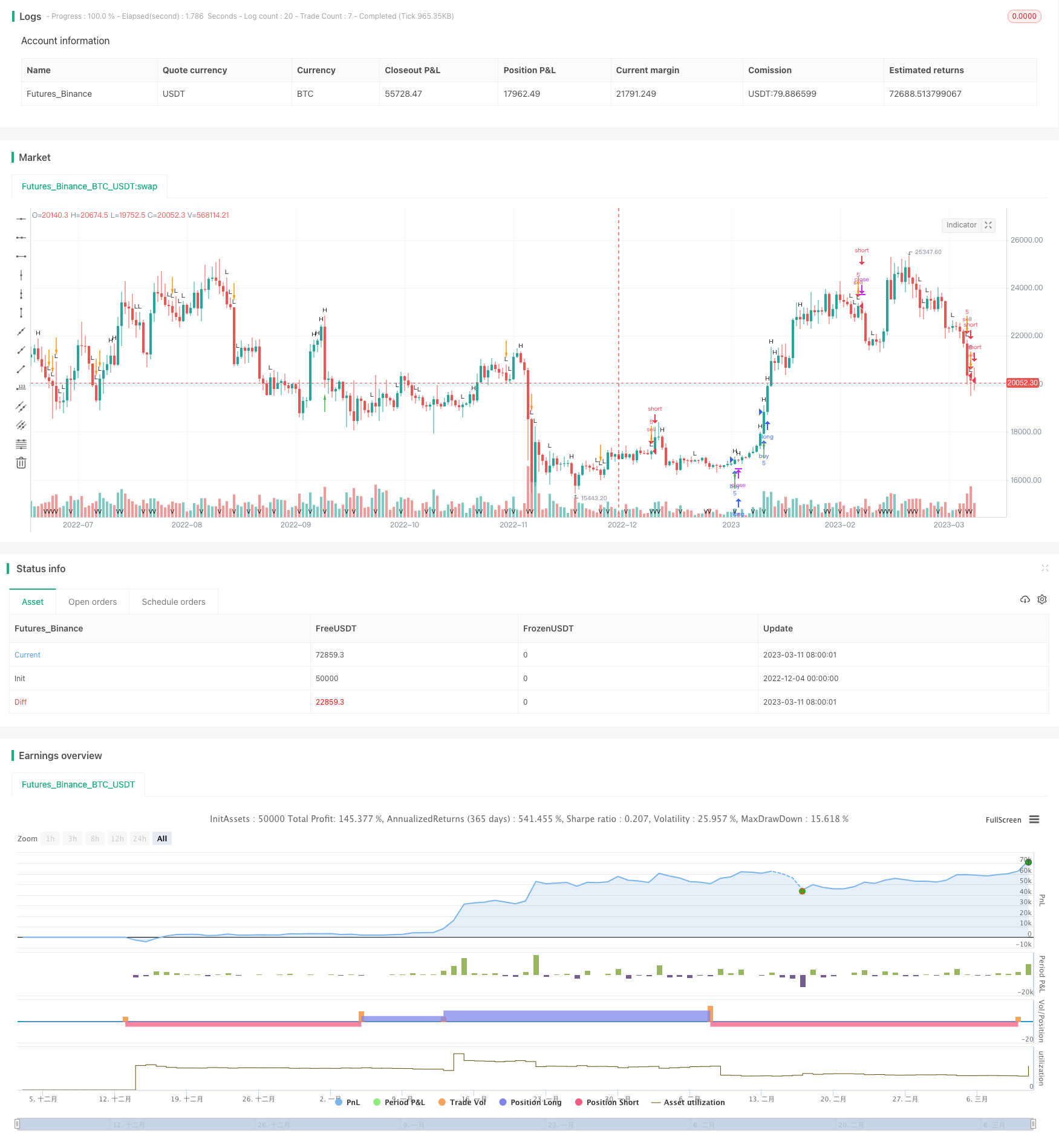
Overview
The Volatility Breakout Trading Strategy is a single price action based strategy. It generates buy and sell signals by analyzing price and volume changes. This strategy can also be combined with alerts to trigger orders on other exchanges or systems.
Strategy Logic
This strategy analyzes the close, open, high and low prices of candlesticks to determine price trends and momentum.
Specifically, it checks if the closing prices of the most recent 3 candlesticks are continuously higher or lower than the opening prices. If so, it indicates prices are breaking out up or down consecutively, generating a trending market.
In addition, this strategy tracks the maximum volume over a certain period. If the current candlestick's volume exceeds the maximum value over the recent period, it suggests surging trading volume and strong forces entering the market.
When price breaks out on three consecutive candlesticks and trading volume expands, the strategy will produce buy or sell signals.
Advantages
This is a simple yet effective strategy utilizing price action and volume signals. The main advantages are:
- Clear logic, easy to understand and implement
- Highly sensitive to volatile market changes, catching shifts timely
- Requires only basic candlestick and volume data, no complex algorithms
- Flexible parameters adaptable to different products and timeframes
- Low cost, suitable for small account investors
Risk Analysis
There are also some potential risks:
- No price forecasting, some blindness exists
- Prone to false signals from accidental touches
- May generate improper signals in range-bound markets
- No stop loss mechanism, risks expanding losses
To mitigate these risks, one may consider adding moving stop loss, optimizing parameter combinations, or combining with other indicators or strategies.
Optimization Directions
As a basic strategy, there is still large room for optimization:
- Add stop loss mechanisms to control losses
- Optimize parameters to suit more products and periods
- Add other indicators to filter signals
- Combine with trend tracking strategies for automatic trend adjustment
- Incorporate machine learning algorithms for dynamic parameter and signal optimization
- Build in quantitative research and feedback modules for continuous evolution
Conclusion
In conclusion, this is a very practical price action based strategy. It has the merits of being intuitive, easy to understand and implement at low costs. Meanwhile, it also has certain blindness and needs further optimizations and combinations for enhanced performance. Overall this is a valuable strategy concept worthy of in-depth research and application.
Parameters
| Name | Default | What it controls |
|---|---|---|
| v_input_1 | 3 | Volume length |
Source Pine Script
/*backtest
start: 2022-12-04 00:00:00
end: 2023-03-12 00:00:00
period: 1d
basePeriod: 1h
exchanges: [{"eid":"Futures_Binance","currency":"BTC_USDT"}]
*/

//@version=4
strategy("SPAS", overlay=true, pyramiding=5, calc_on_order_fills=true)

int signal_hh = 0
int signal_ll = 0

if close[1] >= open[1] and close[2] >= open[2] and close[3] >= open[3]
    signal_hh := 1

if close[1] <= open[1] and close[2] <= open[2] and close[3] <= open[3]
    signal_ll := 1

plotchar(signal_hh, char='H', size=size.tiny, location=location.abovebar)
plotchar(signal_ll, char='L', size=size.tiny, location=location.abovebar)

int signal_vol = 0
float max_volume = 0.0
int vol_length = input(title="Volume length", type=input.integer, defval=3)

for i = vol_length to 1
    if volume[i] > max_volume
        max_volume := volume[i]

if volume[0] > max_volume
    signal_vol := 1

plotchar(signal_vol, char='V', size=size.tiny, location=location.bottom)

int signal_buy = 0
int signal_sell = 0

if signal_hh and signal_vol
    signal_buy := 1
    label.new(bar_index, high, "B", color=color.green)
    strategy.entry("buy", strategy.long, 5)//, when=strategy.position_size <= 0)

if signal_ll and signal_vol
    signal_sell := 1
    label.new(bar_index, low, "S", color=color.red)
    strategy.entry("sell", strategy.short, 5)//, when=strategy.position_size > 0)

//plotchar(signal_buy, char='B', color=color.green, size=size.tiny, location=location.abovebar)
plotarrow(signal_buy, colorup=color.green, colordown=color.orange, transp=0, maxheight=20)

//plotchar(signal_sell, char='S', color=color.red, size=size.tiny, location=location.abovebar)
plotarrow(signal_sell * -1, colorup=color.green, colordown=color.orange, transp=0, maxheight=20)
Published by ChaoZhang on the FMZ strategy square · last modified 2023-12-11. Collected in the Quant Trading Vault. Unvalidated research: re-test with your own data and costs before trusting it.
Build this with AgenKit
A spec is not a trading system. Paste this into your coding agent and AgenKit runs a specialist team — architecture, test-first build, risk gates, review — with paper trading on by default.
/agenkit build a production-grade trading bot with a backtest engine, risk controls and paper trading by default from strategies/Volatility-Breakout-Trading-Strategy.md- npx agenkit install engineering-kit in your project
- Paste the command into your agent and approve each phase
- Get tests, backtest, risk controls and a paper-trading switch
Understand it first
Before you run this, read the lesson behind the idea and how to backtest it honestly. Specs like this one are the survivors of an unknown number of trials; deflate their results accordingly.
Related specs
- 5 Day Moving Average Channel Breakout Strategy Combined With Mileage ConceptPine Script · Breakout · 1d
- ATR Trailing Stops StrategyPine Script · Breakout · 1h
- ATR Trend Breakout StrategyPine Script · Breakout · 1d
- Adaptive Bollinger Breakout with Moving Average Quantitative Strategy SystemPine Script · Breakout · 1h
- Adaptive Channel Breakout StrategyPine Script · Breakout · 1d
- Adaptive Multi Period Trading Strategy Based on Wave Trend Momentum BreakoutPine Script · Breakout · 2h