Strategy vault / Trend following
Volume based Trend Following Trading Strategy
This is a trend following trading strategy based on a modified volume oscillator indicator. It utilizes volume moving averages to identify increasing volume Signals and determines entries or exits. Meanwhile, it…
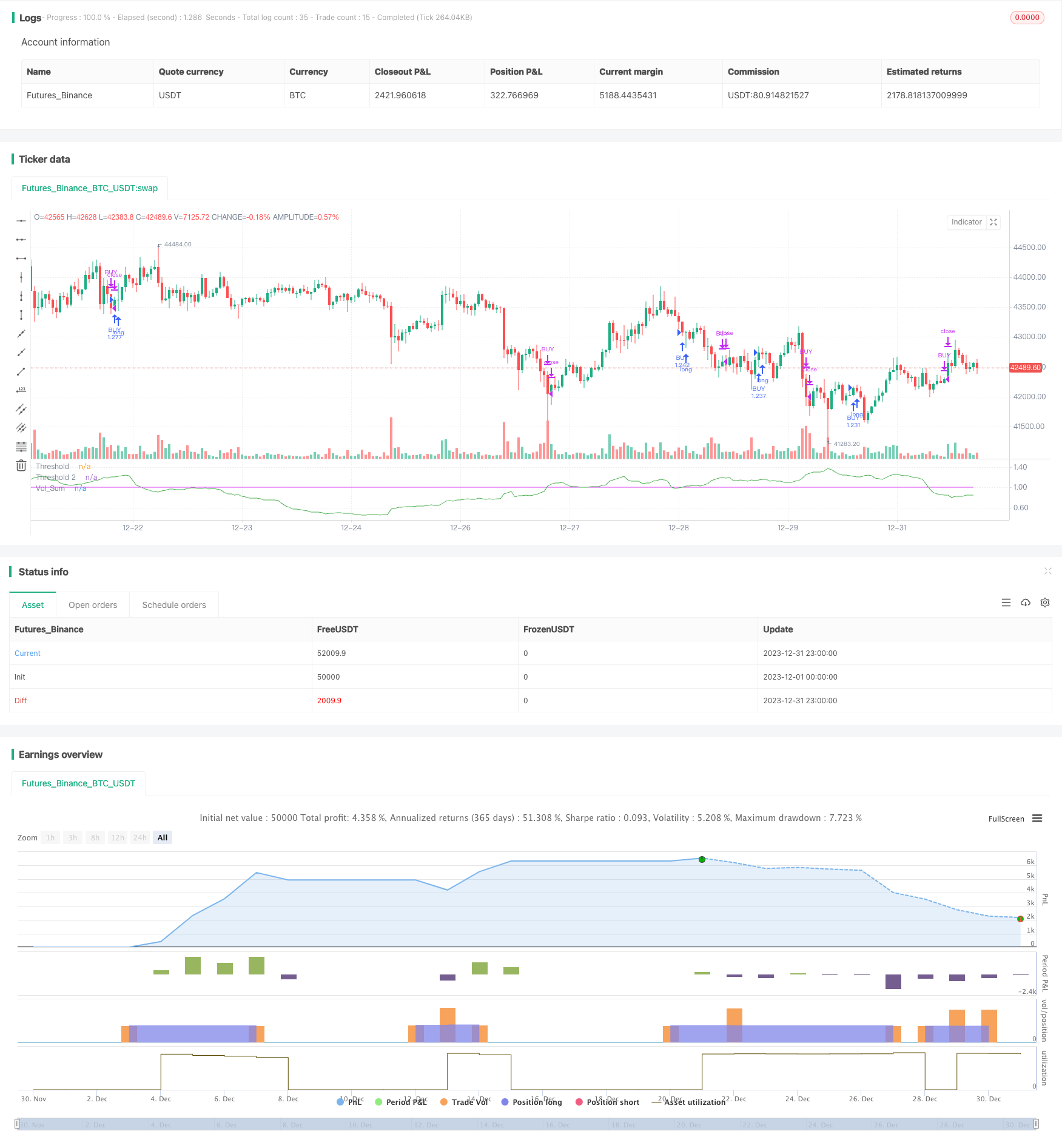
Overview
This is a trend following trading strategy based on a modified volume oscillator indicator. It utilizes volume moving averages to identify increasing volume Signals and determines entries or exits. Meanwhile, it incorporates price trend judgment to avoid wrong Signals during price oscillations.
Strategy Logic
- Calculate volume moving average vol_sum with length of vol_length and smooth it by vol_smooth period moving average.
- Generate long Signals when vol_sum rises above threshold and short Signals when vol_sum falls below threshold.
- To filter false Signals, only take long when price trend checked in past direction bars is up and vice versa.
- Set two threshold values threshold and threshold2. threshold generates trade Signals while threshold2 acts as a stop loss.
- Manage open/close orders through a state machine logic.
Advantage Analysis
- Volume indicator captures changes in market buying/selling power for more accurate Signals.
- Combining with price trend avoids wrong Signals during price swings.
- Two threshold values better control risks.
Risk Analysis
- Volume indicator has lag and may miss price turning points.
- Wrong parameter settings lead to over-trading or signal delays.
- Stop loss may be hit during spikes in trading volumes.
Risks can be mitigated by tuning parameters, optimizing indicator calculation, and combining other confirmations.
Optimization Directions
- Adaptive optimization of parameters based on market conditions.
- Incorporate other indicators like volatility index to further verify Signals.
- Research applying machine learning models to improve signal accuracy.
Conclusion
This strategy utilizes an improved volume oscillator with price trend to determine entries and exits with two stop loss threshold values. It is a stable trend following system with optimization space in parameter tuning, signal filtering and stop loss strategies. Overall it has practical value worth further research and optimization.
Parameters
| Name | Default | What it controls |
|---|---|---|
| v_input_1 | 2017 | Start Year |
| v_input_2 | 12 | Start Month |
| v_input_3 | 17 | Start Day |
| v_input_4 | 9999 | End Year |
| v_input_5 | true | End Month |
| v_input_6 | true | End Day |
| v_input_7 | 34 | Volume - Length |
| v_input_8 | 200 | Volume - Smoothing |
| v_input_9 | 21 | Volume - Risinglength |
| v_input_10 | 13 | Volume - Fallinglength |
| v_input_11 | true | threshold |
| v_input_12 | 1.2 | Threshold 2 |
| v_input_13 | 13 | amount of bars |
Source Pine Script
/*backtest
start: 2023-12-01 00:00:00
end: 2023-12-31 23:59:59
period: 1h
basePeriod: 15m
exchanges: [{"eid":"Futures_Binance","currency":"BTC_USDT"}]
*/

//@version=4
strategy('Volume Advanced', default_qty_type=strategy.percent_of_equity, default_qty_value=100, commission_type=strategy.commission.percent, commission_value=0.075, currency='USD')
startP = timestamp(input(2017, "Start Year"), input(12, "Start Month"), input(17, "Start Day"), 0, 0)
end    = timestamp(input(9999, "End Year"),   input(1, "End Month"),   input(1, "End Day"),   0, 0)
_testPeriod() =>
    iff(time >= startP and time <= end, true, false)

source = close
vol_length  = input(34, title = "Volume - Length")
vol_smooth  = input(200,title = "Volume - Smoothing")
volriselen  = input(21,  title = "Volume - Risinglength")
volfalllen  = input(13, title = "Volume - Fallinglength")
threshold   = input(1,"threshold")
threshold2  = input(1.2,step=0.1, title="Threshold 2")
direction = input(13,"amount of bars")


volsum  = sum(volume, vol_length) / (sum(volume, vol_smooth) / (vol_smooth / vol_length))


LongEntry  = (rising(volsum, volriselen) or crossover (volsum, threshold)) and close > close[direction]
ShortEntry = (rising(volsum, volriselen) or crossover (volsum, threshold)) and close < close[direction]
LongExit1  = falling (volsum,volfalllen)
ShortExit1 = falling (volsum,volfalllen)
LongExit2= (crossover(volsum, threshold2) and close < close[direction])


_state = 0
_prev = nz(_state[1])
_state := _prev

if _prev == 0
    if LongEntry
        _state := 1
        _state
    if ShortEntry
        _state := 2
        _state
if _prev == 1
    if ShortEntry or LongExit1
        _state := 0
        _state
if _prev == 2
    if LongEntry or ShortExit1
        _state := 0
        _state

_bLongEntry = _state == 1
_bLongClose = _state == 0

long_condition = _bLongEntry and close > close[direction]
strategy.entry('BUY', strategy.long, when=long_condition)

short_condition =  _bLongClose or LongExit2
strategy.close('BUY', when=short_condition)

plot(volsum,      color = color.green,    title="Vol_Sum")
plot(threshold, color = color.fuchsia, transp=50, title="Threshold")
plot(threshold2, color=color.white, transp = 50, title="Threshold 2")Published by ChaoZhang on the FMZ strategy square · last modified 2024-01-29. Collected in the Quant Trading Vault. Unvalidated research: re-test with your own data and costs before trusting it.
Build this with AgenKit
A spec is not a trading system. Paste this into your coding agent and AgenKit runs a specialist team — architecture, test-first build, risk gates, review — with paper trading on by default.
/agenkit build a production-grade trading bot with a backtest engine, risk controls and paper trading by default from strategies/Volume-based-Trend-Following-Trading-Strategy.md- npx agenkit install engineering-kit in your project
- Paste the command into your agent and approve each phase
- Get tests, backtest, risk controls and a paper-trading switch
Understand it first
Before you run this, read the lesson behind the idea and how to backtest it honestly. Specs like this one are the survivors of an unknown number of trials; deflate their results accordingly.
Related specs
- 200 EMA VWAP MFI Trend Following StrategyPine Script · Trend following · 1d
- 4 EMA Trend StrategyPine Script · Trend following · 1d
- ADX MA and EMA Long Only Trend Tracking StrategyPine Script · Trend following · 1d
- ATR Dynamic Profit Target and Stop Loss StrategyPine Script · Trend following · 1d
- ATR Dynamic Trend Following and EMA Crossover Trading StrategyPine Script · Trend following · 1d
- ATR and Moving Average Crossover Hybrid StrategyPine Script · Trend following · 1h