Strategy vault / Trend following
Williams Alligator Strategy
Williams' Alligator Strategy is a trend following strategy that uses three moving average lines of different periods to form "alligator jaws" to determine the trend direction. When the fast line is above the middle…
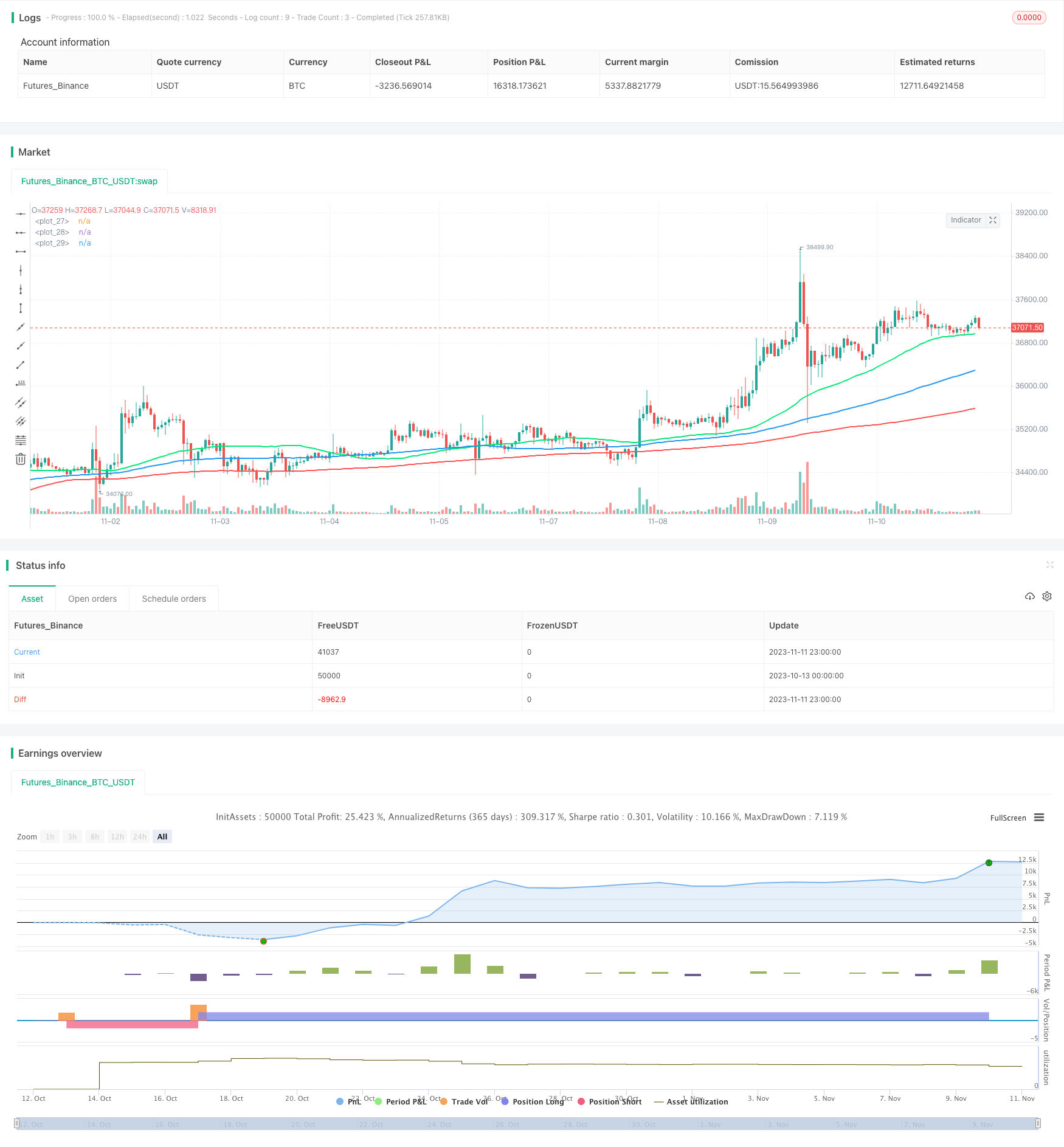
Overview
Williams' Alligator Strategy is a trend following strategy that uses three moving average lines of different periods to form "alligator jaws" to determine the trend direction. When the fast line is above the middle line and the middle line is above the slow line, an upward trend alligator mouth is formed to go long. When the fast line is below the middle line and the middle line is below the slow line, a downward trend alligator mouth is formed to go short. It was invented by Bill Williams and combines the trend judging ability of moving averages to effectively capture market trends.
How it Works
The strategy uses three SMAs of different period lengths - fast line sma1, middle line sma2, and slow line sma3, where sma1 has the shortest period and sma3 has the longest.
When sma1 crosses above sma2, and sma2 crosses above sma3, it indicates the market is in an upward trend and forms an upward alligator mouth. According to trend trading theory, a long position should be entered.
Conversely, when sma1 crosses below sma2, and sma2 crosses below sma3, it indicates the market is in a downward trend and forms a downward alligator mouth. A short position should be entered.
The exit condition is when the three lines re-align, with the fast line below the middle line or the middle line below the slow line. Positions should be closed out.
The strategy also draws background colors to identify the trend direction - green for uptrend and red for downtrend.
In summary, the strategy utilizes the strengths of moving averages and "alligator mouth" patterns to determine trend direction and trade accordingly. It is a typical trend following strategy.
Advantage Analysis
- Alligator mouth effectively identifies trend direction.
- Combination of different period lines improves pattern accuracy.
- Trading with the trend aligns with trend trading theory.
- Background colors assist visual judgement.
- Simple and clear logic, easy to implement.
Risk Analysis
- Multiple whipsaw risks in ranging markets.
- High risk when lines re-align to close out positions.
- Unable to determine trend strength, may incorrectly enter trends.
- No stop loss, high drawdown risk.
- Fixed periods cannot adapt to market changes.
To address the risks, the following improvements can be made:
Add trend filter to avoid whipsaws in ranging markets.
Optimize exit conditions using trend indicators.
Add stop loss strategy to control single trade loss.
Use adaptive moving averages so periods adjust dynamically.
Improvement Directions
The strategy can be further optimized in the following aspects:
Add trend strength filter to avoid premature entry in weak trends. Indicators like MACD, KDJ can help.
Optimize moving average periods to find best combinations through backtesting.
Use adaptive moving averages so periods adapt based on market momentum.
Add stop loss strategies like trailing stop loss, account balance stop loss to control risks.
Improve entry conditions using volume, Bollinger Bands etc to increase accuracy.
Improve exit conditions by judging trend reversal probability with indicators when lines cross.
Conclusion
Williams' Alligator Strategy is a typical trend following strategy. It uses the alligator mouth formed by three moving averages to determine trend and trade accordingly. The advantages are its simple and clear logic. The disadvantages are weaker trend accuracy and risk control. Future improvements can be made by incorporating additional indicators, optimizing parameters, adding stop loss to make it more robust for complex market conditions.
Parameters
| Name | Default | What it controls |
|---|---|---|
| v_input_1 | true | Long |
| v_input_2 | true | Short |
| v_input_3 | 100 | Lot |
| v_input_4 | 50 | MA 1 Length |
| v_input_5 | 100 | MA 2 Length |
| v_input_6 | 200 | MA 3 Length |
| v_input_7_close | 0 | Source: close | high | low | open | hl2 | hlc3 | hlcc4 | ohlc4 |
| v_input_8 | false | Show Background |
| v_input_9 | 1900 | From Year |
| v_input_10 | 2100 | To Year |
| v_input_11 | true | From Month |
| v_input_12 | 12 | To Month |
| v_input_13 | true | From day |
| v_input_14 | 31 | To day |
Source Pine Script
/*backtest
start: 2023-10-13 00:00:00
end: 2023-11-12 00:00:00
period: 1h
basePeriod: 15m
exchanges: [{"eid":"Futures_Binance","currency":"BTC_USDT"}]
*/

//Noro
//2019

//@version=3
strategy(title = "Noro's Alligator Strategy by Bill Williams", shorttitle = "Alligator", overlay = true, default_qty_type = strategy.percent_of_equity, default_qty_value = 100, pyramiding = 0)

//Settings
needlong = input(true, defval = true, title = "Long")
needshort = input(true, defval = true, title = "Short")
capital = input(100, defval = 100, minval = 1, maxval = 10000, title = "Lot")
len1 = input(50, defval = 50, minval = 1, title = "MA 1 Length")
len2 = input(100, defval = 100, minval = 1, title = "MA 2 Length")
len3 = input(200, defval = 200, minval = 1, title = "MA 3 Length")
src = input(close, title = "Source")
showbg = input(false, title = "Show Background")
fromyear = input(1900, defval = 1900, minval = 1900, maxval = 2100, title = "From Year")
toyear = input(2100, defval = 2100, minval = 1900, maxval = 2100, title = "To Year")
frommonth = input(01, defval = 01, minval = 01, maxval = 12, title = "From Month")
tomonth = input(12, defval = 12, minval = 01, maxval = 12, title = "To Month")
fromday = input(01, defval = 01, minval = 01, maxval = 31, title = "From day")
today = input(31, defval = 31, minval = 01, maxval = 31, title = "To day")

//MAs
sma1 = sma(src, len1)
sma2 = sma(src, len2)
sma3 = sma(src, len3)
plot(sma1, color = lime, linewidth = 2)
plot(sma2, color = blue, linewidth = 2)
plot(sma3, color = red, linewidth = 2)

//Signals
up = sma1 > sma2 and sma2 > sma3
dn = sma1 < sma2 and sma2 < sma3

//Background
trend = 0
trend := up ? 1 : dn ? -1 : trend[1]
col = showbg == false ? na : trend == 1 ? lime : red
bgcolor(col)

//Trading
size = strategy.position_size
lot = 0.0
lot := size != size[1] ? strategy.equity / close * capital / 100 : lot[1]
if up
    strategy.entry("Long", strategy.long, needlong ? lot : 0, when = (time > timestamp(fromyear, frommonth, fromday, 00, 00) and time < timestamp(toyear, tomonth, today, 23, 59)))
if dn
    strategy.entry("Short", strategy.short, needshort ? lot : 0, when = (time > timestamp(fromyear, frommonth, fromday, 00, 00) and time < timestamp(toyear, tomonth, today, 23, 59)))

if time > timestamp(toyear, tomonth, today, 23, 59)
    strategy.close_all()
Published by ChaoZhang on the FMZ strategy square · last modified 2023-11-13. Collected in the Quant Trading Vault. Unvalidated research: re-test with your own data and costs before trusting it.
Build this with AgenKit
A spec is not a trading system. Paste this into your coding agent and AgenKit runs a specialist team — architecture, test-first build, risk gates, review — with paper trading on by default.
/agenkit build a production-grade trading bot with a backtest engine, risk controls and paper trading by default from strategies/Williams-Alligator-Strategy.md- npx agenkit install engineering-kit in your project
- Paste the command into your agent and approve each phase
- Get tests, backtest, risk controls and a paper-trading switch
Understand it first
Before you run this, read the lesson behind the idea and how to backtest it honestly. Specs like this one are the survivors of an unknown number of trials; deflate their results accordingly.
Related specs
- ADX MA and EMA Long Only Trend Tracking StrategyPine Script · Trend following · 1d
- ATR and Moving Average Crossover Hybrid StrategyPine Script · Trend following · 1h
- Adaptive FVG Detection and MA Trend Trading Strategy with Dynamic ResistancePine Script · Trend following · 1d
- Adaptive Risk Management Strategy Based on Dynamic ATR and Moving Average CrossoverPine Script · Trend following · 2h
- Adaptive Trading Strategy Based on Stochastic RSI Dual Line CrossoverPine Script · Trend following · 4h
- Adaptive Volatility Based Trend Following Short Strategy with Time Delay and Stop Loss ProtectionPine Script · Trend following · 2m