Adaptive Take Profit and Stop Loss Strategy Based on Dual Time Frames and Momentum Indicators
This strategy combines dual time frames and momentum indicators to achieve adaptive take profit and stop loss. The main time frame monitors the trend direction, while the secondary time frame is used to confirm…
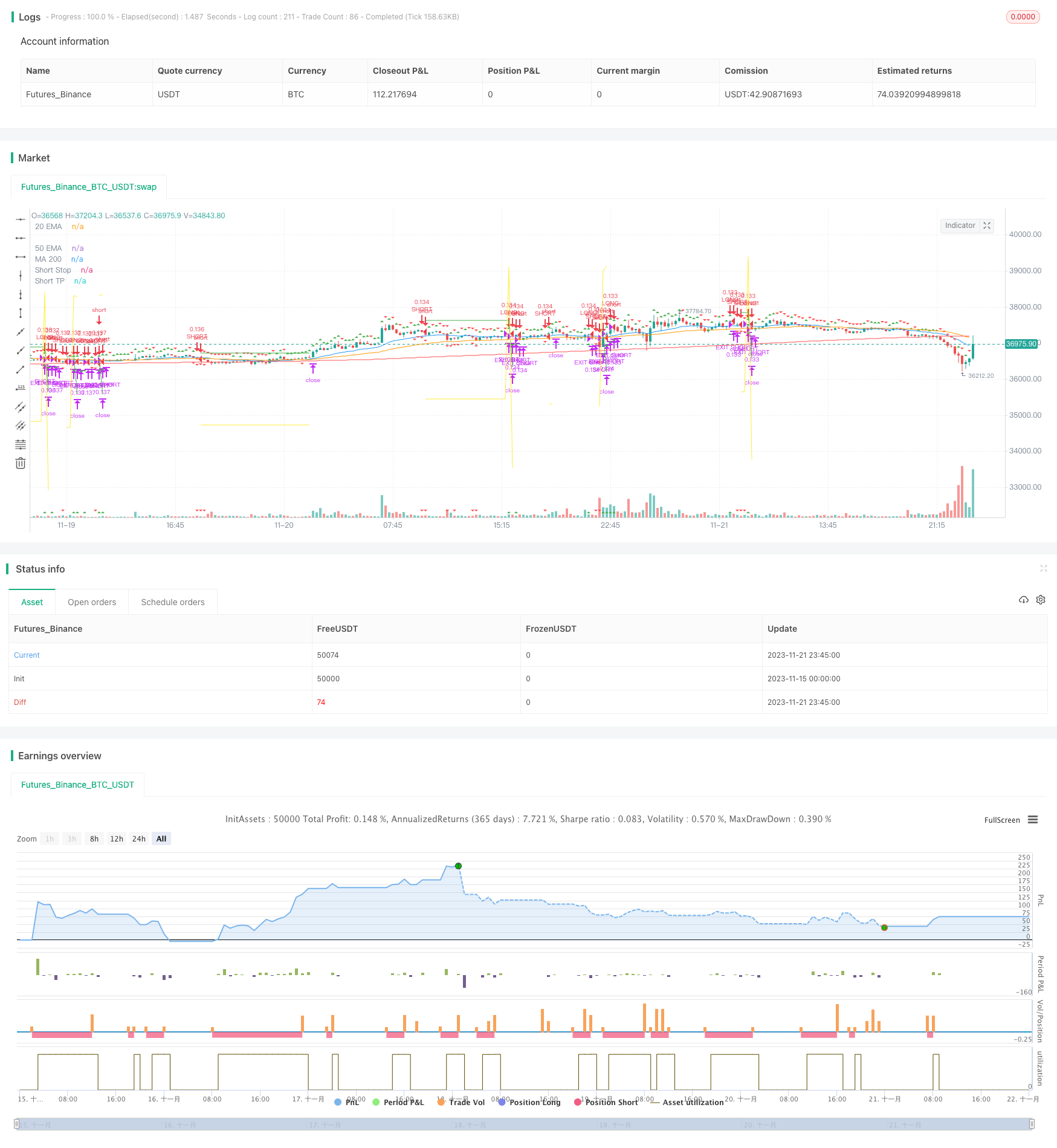
Overview
This strategy combines dual time frames and momentum indicators to achieve adaptive take profit and stop loss. The main time frame monitors the trend direction, while the secondary time frame is used to confirm signals. Trading signals are generated when the directions of both align. After entering the market, take profit and stop loss levels are updated progressively.
Strategy Logic
The main time frame uses the Squeeze Momentum (SQM) linear regression indicator to determine the trend. The secondary time frame uses an EMA combination on the SQM indicator to filter false signals.
When the main chart SQM breaks out upwards and the secondary chart SQM also goes up, a long position is taken. When the main chart SQM breaks downwards and the secondary chart SQM also goes down, a short position is taken.
After entering the market, initial take profit and stop loss levels are set based on input parameters. When price reaches the take profit level, both take profit and stop loss levels are updated. Specifically, the take profit level is increased progressively and the stop loss level is tightened, achieving gradual profit taking.
Advantages
Dual time frames filter false signals and ensure accuracy.
The SQM indicator determines trend direction, avoiding market noise.
The adaptive take profit and stop loss mechanism locks in profits to the maximum extent and effectively controls risk.
Risk Analysis
Improper SQM parameter settings may miss trend turning points, leading to losses.
An improper secondary time frame may fail to filter noise effectively, causing erroneous trades.
If the stop loss amplitude is set too wide, the per trade loss can be substantial.
Enhancement Opportunities
SQM parameters need to be tuned for different markets to ensure sensitivity.
Different secondary time frame periods should be tested to find the best noise filtering effect.
Instead of a fixed value, the stop loss amplitude can have a range set dynamically based on market volatility.
Summary
Overall this is a very practical strategy. The combination of dual time frames with a momentum indicator to determine trends, together with the adaptive take profit and stop loss method can generate stable profits. By optimizing the SQM parameters, secondary time frame period, and stop loss amplitude, strategy results can be further improved for productive live application and enhancement.
Parameters
| Name | Default | What it controls |
|---|---|---|
| v_input_1 | 11 | Fast EMA |
| v_input_2 | 34 | Slow EMA |
| v_input_3 | 20 | SQM KC Length |
| v_input_4 | 20 | Kauf Period |
| v_input_5 | 2 | Kauf Mult factor |
| v_input_6 | 5 | Min profit to start moving SL [%] |
| v_input_7 | 10 | Maximum possible of SL [%] |
| v_input_8 | 0.5 | Take profit factor |
| v_input_9 | 11 | CMF length |
| v_input_10 | true | Show plots |
Source Pine Script
/*backtest
start: 2023-11-15 00:00:00
end: 2023-11-22 00:00:00
period: 15m
basePeriod: 5m
exchanges: [{"eid":"Futures_Binance","currency":"BTC_USDT"}]
*/

//@version=4
strategy("SQZ Multiframe Strategy", overlay=true, default_qty_type=strategy.percent_of_equity, default_qty_value=10)
fast_ema_len = input(11, minval=5, title="Fast EMA")
slow_ema_len = input(34, minval=20, title="Slow EMA")
sqm_lengthKC = input(20, title="SQM KC Length")
kauf_period = input(20, title="Kauf Period")
kauf_mult = input(2,title="Kauf Mult factor")
min_profit_sl = input(5.0, minval=1, maxval=100, title="Min profit to start moving SL [%]")
longest_sl = input(10, minval=1, maxval=100, title="Maximum possible of SL [%]")
sl_step = input(0.5, minval=0.0, maxval=1.0, title="Take profit factor")
// ADMF
CMF_length = input(11, minval=1, title="CMF length") // EMA27 = SMMA/RMA14 ~ lunar month
show_plots = input(true, title="Show plots")

lower_resolution = timeframe.period=='1'?'5':timeframe.period=='5'?'15':timeframe.period=='15'?'30':timeframe.period=='30'?'60':timeframe.period=='60'?'240':timeframe.period=='240'?'D':timeframe.period=='D'?'W':'M'
higher_resolution = timeframe.period=='5'?'1':timeframe.period=='15'?'5':timeframe.period=='30'?'15':timeframe.period=='60'?'30':timeframe.period=='240'?'60':timeframe.period=='D'?'240':timeframe.period=='W'?'D':'W'

// Calculate Squeeze Momentum
sqm_val = linreg(close - avg(avg(highest(high, sqm_lengthKC), lowest(low, sqm_lengthKC)),sma(close,sqm_lengthKC)), sqm_lengthKC,0)
sqm_val_high = security(syminfo.tickerid, higher_resolution, linreg(close - avg(avg(highest(high, sqm_lengthKC), lowest(low, sqm_lengthKC)),sma(close,sqm_lengthKC)), sqm_lengthKC,0), lookahead=barmerge.lookahead_on)
sqm_val_low = security(syminfo.tickerid, lower_resolution, linreg(close - avg(avg(highest(high, sqm_lengthKC), lowest(low, sqm_lengthKC)),sma(close,sqm_lengthKC)), sqm_lengthKC,0), gaps=barmerge.gaps_off, lookahead=barmerge.lookahead_on)

// Emas
high_close = security(syminfo.tickerid, higher_resolution, close, lookahead=barmerge.lookahead_on)
high_fast_ema = security(syminfo.tickerid, higher_resolution, ema(close, fast_ema_len), lookahead=barmerge.lookahead_on)
high_slow_ema = security(syminfo.tickerid, higher_resolution, ema(close, slow_ema_len), lookahead=barmerge.lookahead_on)
//low_fast_ema = security(syminfo.tickerid, lower_resolution, ema(close, fast_ema_len), lookahead=barmerge.lookahead_on)
//low_slow_ema = security(syminfo.tickerid, lower_resolution, ema(close, slow_ema_len), lookahead=barmerge.lookahead_on)

// CMF
ad = close==high and close==low or high==low ? 0 : ((2*close-low-high)/(high-low))*volume
money_flow = sum(ad, CMF_length) / sum(volume, CMF_length)


// Entry conditions
low_condition_long  = (sqm_val_low > sqm_val_low[1])
low_condition_short = (sqm_val_low < sqm_val_low[1])
money_flow_min = (money_flow[4] > money_flow[3]) and (money_flow[3] > money_flow[2]) and (money_flow[2] < money_flow[1])  and (money_flow[1] < money_flow)
money_flow_max = (money_flow[4] < money_flow[3]) and (money_flow[3] < money_flow[2]) and (money_flow[2] > money_flow[1])  and (money_flow[1] > money_flow)
condition_long = ((sqm_val > sqm_val[1]))  and (money_flow_min or money_flow_min[1] or money_flow_min[2] or money_flow_min[3]) and lowest(sqm_val, 5) < 0
condition_short = ((sqm_val < sqm_val[1])) and (money_flow_max or money_flow_max[1] or money_flow_max[2] or money_flow_max[3]) and highest(sqm_val, 5) > 0
high_condition_long =  true//high_close > high_fast_ema and high_close > high_slow_ema //(high_fast_ema > high_slow_ema) //and (sqm_val_low > sqm_val_low[1])
high_condition_short = true//high_close < high_fast_ema and high_close < high_slow_ema//(high_fast_ema < high_slow_ema) //and (sqm_val_low < sqm_val_low[1])
enter_long = low_condition_long and condition_long and high_condition_long
enter_short = low_condition_short and condition_short and high_condition_short

// Stop conditions
var current_target_price = 0.0
var current_sl_price = 0.0 // Price limit to take profit
var current_target_per = 0.0
var current_profit_per = 0.0

set_targets(isLong, min_profit, current_target_per, current_profit_per) =>
    target = 0.0
    sl = 0.0
    if isLong
        target := close * (1.0 + current_target_per)
        sl := close * (1.0 - (longest_sl/100.0)) // Longest SL
    else
        target := close * (1.0 - current_target_per)
        sl := close * (1.0 + (longest_sl/100.0)) // Longest SL
    [target, sl]

target_reached(isLong, min_profit, current_target_per, current_profit_per) =>
    target = 0.0
    sl = 0.0
    profit_per = 0.0
    target_per = 0.0
    if current_profit_per == 0
        profit_per := (min_profit*sl_step) / 100.0
    else
        profit_per := current_profit_per +  ((min_profit*sl_step) / 100.0)
    target_per := current_target_per + (min_profit / 100.0)
    if isLong
        target := strategy.position_avg_price * (1.0 + target_per)
        sl := strategy.position_avg_price * (1.0 + profit_per)
    else
        target := strategy.position_avg_price * (1.0 - target_per)
        sl := strategy.position_avg_price * (1.0 - profit_per)
    [target, sl, profit_per, target_per]

hl_diff = sma(high - low, kauf_period)
stop_condition_long = 0.0
new_stop_condition_long = low - (hl_diff * kauf_mult)
if (strategy.position_size > 0)
    if (close > current_target_price)
        [target, sl, profit_per, target_per] = target_reached(true, min_profit_sl, current_target_per, current_profit_per)
        current_target_price := target
        current_sl_price := sl
        current_profit_per := profit_per
        current_target_per := target_per


    stop_condition_long := max(stop_condition_long[1], current_sl_price)
else
    stop_condition_long := new_stop_condition_long
stop_condition_short = 99999999.9
new_stop_condition_short = high + (hl_diff * kauf_mult)
if (strategy.position_size < 0)
    if (close < current_target_price)
        [target, sl, profit_per, target_per] = target_reached(false, min_profit_sl, current_target_per, current_profit_per)
        current_target_price := target
        current_sl_price := sl
        current_profit_per := profit_per
        current_target_per := target_per
    stop_condition_short := min(stop_condition_short[1], current_sl_price)
else
    stop_condition_short := new_stop_condition_short


// Submit entry orders
if (enter_long and (strategy.position_size <= 0))
    if (strategy.position_size < 0)
        strategy.close(id="SHORT")
    current_target_per := (min_profit_sl / 100.0)
    current_profit_per := 0.0
    [target, sl] = set_targets(true, min_profit_sl, current_target_per, current_profit_per)
    current_target_price := target
    current_sl_price := sl
    strategy.entry(id="LONG", long=true)
    // if show_plots
    //     label.new(bar_index, high, text=tostring("LONG\nSL: ") + tostring(stop_condition_long), style=label.style_labeldown, color=color.green)

if (enter_short and (strategy.position_size >= 0))
    if (strategy.position_size > 0)
        strategy.close(id="LONG")
    current_target_per := (min_profit_sl / 100.0)
    current_profit_per := 0.0
    [target, sl] = set_targets(false, min_profit_sl, current_target_per, current_profit_per)
    current_target_price := target
    current_sl_price := sl
    strategy.entry(id="SHORT", long=false)
    // if show_plots
        // label.new(bar_index, high, text=tostring("SHORT\nSL: ") + tostring(stop_condition_short), style=label.style_labeldown, color=color.red)

if (strategy.position_size > 0)
    strategy.exit(id="EXIT LONG", stop=stop_condition_long)

if (strategy.position_size < 0)
    strategy.exit(id="EXIT SHORT", stop=stop_condition_short)

// Plot anchor trend
plotshape(low_condition_long, style=shape.triangleup,
                 location=location.abovebar, color=color.green)
plotshape(low_condition_short, style=shape.triangledown,
                 location=location.abovebar, color=color.red)

plotshape(condition_long, style=shape.triangleup,
                 location=location.belowbar, color=color.green)
plotshape(condition_short, style=shape.triangledown,
                 location=location.belowbar, color=color.red)

//plotshape((close < profit_target_short) ? profit_target_short : na, style=shape.triangledown,
//                 location=location.belowbar, color=color.yellow)
plotshape(enter_long, style=shape.triangleup,
                 location=location.bottom, color=color.green)
plotshape(enter_short, style=shape.triangledown,
                 location=location.bottom, color=color.red)

// Plot emas
plot(ema(close, 20), color=color.blue, title="20 EMA")
plot(ema(close, 50), color=color.orange, title="50 EMA")
plot(sma(close, 200), color=color.red, title="MA 200")

// Plot stop loss values for confirmation
plot(series=(strategy.position_size > 0) and show_plots ? stop_condition_long : na,
     color=color.green, style=plot.style_linebr,
     title="Long Stop")
plot(series=(strategy.position_size < 0) and show_plots ? stop_condition_short : na,
     color=color.green, style=plot.style_linebr,
     title="Short Stop")
plot(series=(strategy.position_size < 0) and show_plots ? current_target_price : na,
     color=color.yellow, style=plot.style_linebr,
     title="Short TP")
plot(series=(strategy.position_size > 0) and show_plots ? current_target_price : na,
     color=color.yellow, style=plot.style_linebr,
     title="Long TP")
//plot(series=(strategy.position_size < 0) ? profit_sl_short : na,
//     color=color.gray, style=plot.style_linebr,
//     title="Short Stop")
Published by ChaoZhang on the FMZ strategy square · last modified 2023-11-23. Collected in the Quant Trading Vault. Unvalidated research: re-test with your own data and costs before trusting it.
Build this with AgenKit
A spec is not a trading system. Paste this into your coding agent and AgenKit runs a specialist team — architecture, test-first build, risk gates, review — with paper trading on by default.
/agenkit build a production-grade trading bot with a backtest engine, risk controls and paper trading by default from strategies/Adaptive-Take-Profit-and-Stop-Loss-Strategy-Based-on-Dual-Time-Frames-and-Momentum-Indicators.md- npx agenkit install engineering-kit in your project
- Paste the command into your agent and approve each phase
- Get tests, backtest, risk controls and a paper-trading switch
Understand it first
Before you run this, read the lesson behind the idea and how to backtest it honestly. Specs like this one are the survivors of an unknown number of trials; deflate their results accordingly.
Related specs
- ADX Momentum Trend StrategyPine Script · Momentum · 10m
- Bollinger Bands Momentum Trend Following Quantitative StrategyPine Script · Momentum · 1d
- KST EMA Momentum Trend Following StrategyPine Script · Momentum · 1d
- MACD Momentum Indicator Backtest StrategyPine Script · Momentum · 1h
- MACD of Relative Strength StrategyPine Script · Momentum · 1d
- Momentum Strategy Based on DEMA and EMA Crossover with ATR Volatility FilterPine Script · Momentum · 1h