Adaptive Trend Following Strategy Based on Momentum Oscillator
This strategy is a trend-following trading system based on the Chande Momentum Oscillator (CMO). It seeks buying opportunities in oversold regions and selling opportunities in overbought regions, while incorporating…
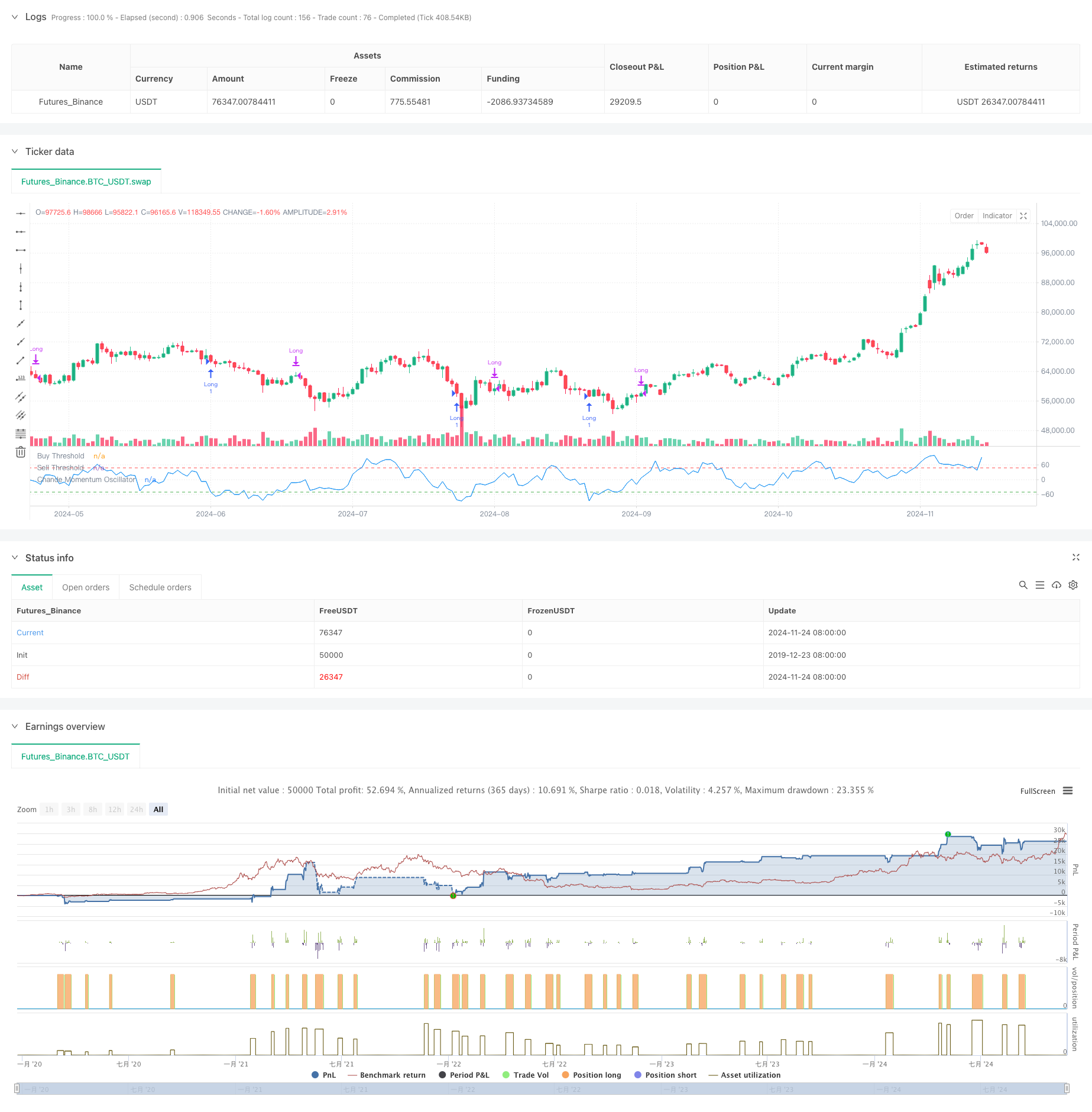
This strategy is a trend-following trading system based on the Chande Momentum Oscillator (CMO). It seeks buying opportunities in oversold regions and selling opportunities in overbought regions, while incorporating position holding time limits for risk management. This approach allows for capturing price reversals while avoiding frequent trading in ranging markets.
Strategy Principles
The core of the strategy uses the CMO indicator to measure market momentum. CMO generates an oscillator ranging from -100 to 100 by calculating the ratio of the difference between upward and downward movements to their sum. The system generates a long signal when CMO falls below -50, indicating an oversold market condition. Positions are closed when CMO exceeds 50 or when the holding period exceeds 5 cycles. This design captures price rebound opportunities while implementing timely profit-taking and stop-loss measures.
Strategy Advantages
- Clear Signals: Uses fixed CMO thresholds (-50 and 50) as trading signals, providing clear entry and exit rules.
- Risk Control: Implements position holding time limits to avoid maintaining unprofitable positions.
- Trend Following: Effectively tracks market trends by entering during oversold conditions and exiting when momentum weakens.
- Simple Calculation: CMO indicator calculation is intuitive and easy to understand and implement.
- Adaptability: Strategy parameters can be adjusted for different market conditions, showing good adaptability.
Strategy Risks
- False Breakout Risk: Frequent false signals may occur in ranging markets.
- Slippage Impact: Actual execution prices may significantly deviate from signal prices in fast markets.
- Parameter Sensitivity: Strategy performance is highly dependent on CMO period and threshold selections.
- Market Condition Dependency: May underperform in markets without clear trends.
- Delay Risk: CMO as a lagging indicator may result in slightly delayed entry and exit timing.
Strategy Optimization Directions
- Dynamic Thresholds: Implement dynamic adjustment of CMO entry and exit thresholds based on market volatility.
- Multiple Timeframes: Introduce CMO indicators from multiple timeframes to improve signal reliability.
- Stop-Loss Optimization: Add trailing stop-loss functionality for better profit protection.
- Position Management: Adjust position sizes based on CMO strength for more refined position control.
- Market Filtering: Add trend filters to only trade in clearly trending markets.
Summary
This momentum-based trend following strategy captures market overbought and oversold opportunities using the CMO indicator. The strategy design is rational, with clear trading rules and risk control mechanisms. While inherent risks exist, optimization can further enhance strategy stability and profitability. The strategy is particularly suitable for highly volatile markets and can achieve good returns during clear trending phases.
Source Pine Script
/*backtest
start: 2019-12-23 08:00:00
end: 2024-11-25 08:00:00
period: 1d
basePeriod: 1d
exchanges: [{"eid":"Futures_Binance","currency":"BTC_USDT"}]
*/

//@version=5
strategy("Chande Momentum Oscillator Strategy", overlay=false)

// Input for the CMO period
cmoPeriod = input.int(9, minval=1, title="CMO Period")

// Calculate price changes
priceChange = ta.change(close)

// Separate positive and negative changes
up = priceChange > 0 ? priceChange : 0
down = priceChange < 0 ? -priceChange : 0

// Calculate the sum of ups and downs using a rolling window
sumUp = ta.sma(up, cmoPeriod) * cmoPeriod
sumDown = ta.sma(down, cmoPeriod) * cmoPeriod

// Calculate the Chande Momentum Oscillator (CMO)
cmo = 100 * (sumUp - sumDown) / (sumUp + sumDown)

// Define the entry and exit conditions
buyCondition = cmo < -50
sellCondition1 = cmo > 50
sellCondition2 = ta.barssince(buyCondition) >= 5

// Track if we are in a long position
var bool inTrade = false

if (buyCondition and not inTrade)
    strategy.entry("Long", strategy.long)
    inTrade := true

if (sellCondition1 or sellCondition2)
    strategy.close("Long")
    inTrade := false

// Plot the Chande Momentum Oscillator
plot(cmo, title="Chande Momentum Oscillator", color=color.blue)
hline(-50, "Buy Threshold", color=color.green)
hline(50, "Sell Threshold", color=color.red)
Published by ChaoZhang on the FMZ strategy square · last modified 2024-11-27. Collected in the Quant Trading Vault. Unvalidated research: re-test with your own data and costs before trusting it.
Build this with AgenKit
A spec is not a trading system. Paste this into your coding agent and AgenKit runs a specialist team — architecture, test-first build, risk gates, review — with paper trading on by default.
/agenkit build a production-grade trading bot with a backtest engine, risk controls and paper trading by default from strategies/Adaptive-Trend-Following-Strategy-Based-on-Momentum-Oscillator.md- npx agenkit install engineering-kit in your project
- Paste the command into your agent and approve each phase
- Get tests, backtest, risk controls and a paper-trading switch
Understand it first
Before you run this, read the lesson behind the idea and how to backtest it honestly. Specs like this one are the survivors of an unknown number of trials; deflate their results accordingly.
Related specs
- ADX Momentum Trend StrategyPine Script · Momentum · 10m
- Bollinger Bands Momentum Trend Following Quantitative StrategyPine Script · Momentum · 1d
- Confirmed SMA Crossover Momentum StrategyPine Script · Momentum · 1d
- Cross Momentum Trend Following Strategy SMA RSI Cross Momentum SystemPine Script · Momentum · 1h
- Dual Moving Average Momentum Trading Strategy Time Optimized Trend Following SystemPine Script · Momentum · 2m
- Dual Rate of Change Momentum Indicator Trading StrategyPine Script · Momentum · 1h