Delta RSI Oscillator Strategy
Delta-RSI Oscillator Strategy: This strategy illustrates the use of the recently published Delta-RSI Oscillator as a stand-alone indicator. Delta-RSI represents a smoothed time derivative of the RSI , plotted as a…
Delta-RSI Oscillator Strategy:
This strategy illustrates the use of the recently published Delta-RSI Oscillator as a stand-alone indicator.
Delta-RSI represents a smoothed time derivative of the RSI , plotted as a histogram and serving as a momentum indicator .
There are three optional conditions to generate trading signals (set separately for Buy, Sell and Exit signals): Zero-crossing: bullish when D-RSI crosses zero from negative to positive values ( bearish otherwise) Signal Line Crossing: bullish when D-RSI crosses from below to above the signal line ( bearish otherwise) Direction Change: bullish when D-RSI was negative and starts ascending ( bearish otherwise) Since D-RSI oscillator is based on polynomial fitting of the RSI curve, there is also an option to filter trade signal by means of the root mean-square error of the fit (normalized by the sample average).
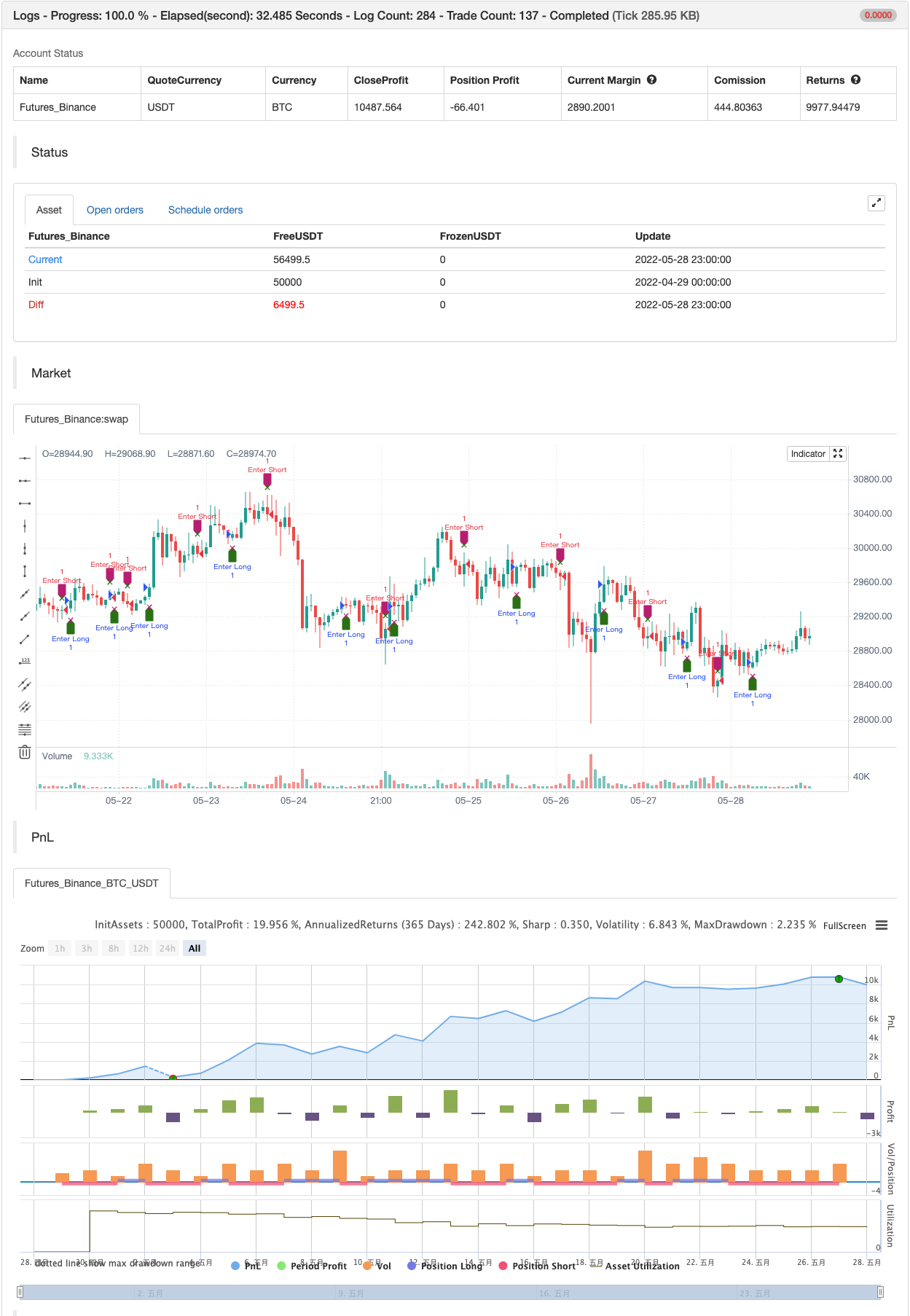
backtest
Parameters
| Name | Default | What it controls |
|---|---|---|
| v_input_1 | 2 | (?Model Parameters:)Polynomial Order |
| v_input_2 | 21 | RSI Length |
| v_input_3 | 21 | Length ( > Order) |
| v_input_4 | 9 | Signal Length |
| v_input_5 | true | (?Show Signals:)Buy |
| v_input_6 | true | Sell |
| v_input_7 | true | Exit |
| v_input_8 | Zero-Crossing | (?Entry and Exit Conditions:)Buy |
| v_input_9 | Zero-Crossing | Sell |
| v_input_10 | Zero-Crossing | Exit |
| v_input_11 | false | (?Filter by Means of Root-Mean-Square Error of RSI Fitting:)usenrmse |
| v_input_12 | 10 | RSI fitting Error Threshold, % |
Source Pine Script
/*backtest
start: 2022-04-29 00:00:00
end: 2022-05-28 23:59:00
period: 1h
basePeriod: 15m
exchanges: [{"eid":"Futures_Binance","currency":"BTC_USDT"}]
*/

// This source code is subject to the terms of the Mozilla Public License 2.0 at https://mozilla.org/MPL/2.0/
// © tbiktag
//
// Delta-RSI Oscillator Strategy
//
// A strategy that uses Delta-RSI Oscillator (© tbiktag) as a stand-alone indicator:
// https://www.tradingview.com/script/OXQVFTQD-Delta-RSI-Oscillator/
//
// Delta-RSI is a smoothed time derivative of the RSI, plotted as a histogram
// and serving as a momentum indicator.
//
// Input parameters:
// RSI Length: The timeframe of the RSI that serves as an input to D-RSI.
// Length: The length of the lookback frame used for local regression.
// Polynomial Order: The order of the local polynomial function used to interpolate the RSI.
// Signal Length: The length of a EMA of the D-RSI series that is used as a signal line.
// Trade signals are generated based on three optional conditions:
// - Zero-crossing: bullish when D-RSI crosses zero from negative to positive values (bearish otherwise)
// - Signal Line Crossing: bullish when D-RSI crosses from below to above the signal line (bearish otherwise)
// - Direction Change: bullish when D-RSI was negative and starts ascending (bearish otherwise)
//
// Since D-RSI oscillator is based on polynomial fitting of the RSI curve, there is also an option
// to filter trade signal by means of the root mean-square error of the fit (normalized by the sample average).
//
//@version=4
study(title="Delta-RSI Oscillator Strategy", shorttitle = "D-RSI", overlay = true)

// ---Subroutines---
matrix_get(_A,_i,_j,_nrows) =>
    // Get the value of the element of an implied 2d matrix
    //input:
    // _A :: array: pseudo 2d matrix _A = [[column_0],[column_1],...,[column_(n-1)]]
    // _i :: integer: row number
    // _j :: integer: column number
    // _nrows :: integer: number of rows in the implied 2d matrix
    array.get(_A,_i+_nrows*_j)

matrix_set(_A,_value,_i,_j,_nrows) =>
    // Set a value to the element of an implied 2d matrix
    //input:
    // _A :: array, changed on output: pseudo 2d matrix _A = [[column_0],[column_1],...,[column_(n-1)]]
    // _value :: float: the new value to be set
    // _i :: integer: row number
    // _j :: integer: column number
    // _nrows :: integer: number of rows in the implied 2d matrix
    array.set(_A,_i+_nrows*_j,_value)

transpose(_A,_nrows,_ncolumns) =>
    // Transpose an implied 2d matrix
    // input:
    // _A :: array: pseudo 2d matrix _A = [[column_0],[column_1],...,[column_(n-1)]]
    // _nrows :: integer: number of rows in _A
    // _ncolumns :: integer: number of columns in _A
    // output:
    // _AT :: array: pseudo 2d matrix with implied dimensions: _ncolums x _nrows
    var _AT = array.new_float(_nrows*_ncolumns,0)
    for i = 0 to _nrows-1
        for j = 0 to _ncolumns-1
            matrix_set(_AT, matrix_get(_A,i,j,_nrows),j,i,_ncolumns)
    _AT

multiply(_A,_B,_nrowsA,_ncolumnsA,_ncolumnsB) =>
    // Calculate scalar product of two matrices
    // input:
    // _A :: array: pseudo 2d matrix
    // _B :: array: pseudo 2d matrix
    // _nrowsA :: integer: number of rows in _A
    // _ncolumnsA :: integer: number of columns in _A
    // _ncolumnsB :: integer: number of columns in _B
    // output:
    // _C:: array: pseudo 2d matrix with implied dimensions _nrowsA x _ncolumnsB
    var _C = array.new_float(_nrowsA*_ncolumnsB,0)
    int _nrowsB = _ncolumnsA
    float elementC= 0.0
    for i = 0 to _nrowsA-1
        for j = 0 to _ncolumnsB-1
            elementC := 0
            for k = 0 to _ncolumnsA-1
                elementC := elementC + matrix_get(_A,i,k,_nrowsA)*matrix_get(_B,k,j,_nrowsB)
            matrix_set(_C,elementC,i,j,_nrowsA)
    _C

vnorm(_X,_n) =>
    //Square norm of vector _X with size _n
    float _norm = 0.0
    for i = 0 to _n-1
        _norm := _norm + pow(array.get(_X,i),2)
    sqrt(_norm)

qr_diag(_A,_nrows,_ncolumns) =>
    //QR Decomposition with Modified Gram-Schmidt Algorithm (Column-Oriented)
    // input:
    // _A :: array: pseudo 2d matrix _A = [[column_0],[column_1],...,[column_(n-1)]]
    // _nrows :: integer: number of rows in _A
    // _ncolumns :: integer: number of columns in _A
    // output:
    // _Q: unitary matrix, implied dimenstions _nrows x _ncolumns
    // _R: upper triangular matrix, implied dimansions _ncolumns x _ncolumns
    var _Q = array.new_float(_nrows*_ncolumns,0)
    var _R = array.new_float(_ncolumns*_ncolumns,0)
    var _a = array.new_float(_nrows,0)
    var _q = array.new_float(_nrows,0)
    float _r = 0.0
    float _aux = 0.0
    //get first column of _A and its norm:
    for i = 0 to _nrows-1
        array.set(_a,i,matrix_get(_A,i,0,_nrows))
    _r := vnorm(_a,_nrows)
    //assign first diagonal element of R and first column of Q
    matrix_set(_R,_r,0,0,_ncolumns)
    for i = 0 to _nrows-1
        matrix_set(_Q,array.get(_a,i)/_r,i,0,_nrows)
    if _ncolumns != 1
        //repeat for the rest of the columns
        for k = 1 to _ncolumns-1
            for i = 0 to _nrows-1
                array.set(_a,i,matrix_get(_A,i,k,_nrows))
            for j = 0 to k-1
                //get R_jk as scalar product of Q_j column and A_k column:
                _r := 0
                for i = 0 to _nrows-1
                    _r := _r + matrix_get(_Q,i,j,_nrows)*array.get(_a,i)
                matrix_set(_R,_r,j,k,_ncolumns)
                //update vector _a
                for i = 0 to _nrows-1
                    _aux := array.get(_a,i) - _r*matrix_get(_Q,i,j,_nrows)
                    array.set(_a,i,_aux)
            //get diagonal R_kk and Q_k column
            _r := vnorm(_a,_nrows)
            matrix_set(_R,_r,k,k,_ncolumns)
            for i = 0 to _nrows-1
                matrix_set(_Q,array.get(_a,i)/_r,i,k,_nrows)
    [_Q,_R]

pinv(_A,_nrows,_ncolumns) =>
    //Pseudoinverse of matrix _A calculated using QR decomposition
    // Input:
    // _A:: array: implied as a (_nrows x _ncolumns) matrix _A = [[column_0],[column_1],...,[column_(_ncolumns-1)]]
    // Output:
    // _Ainv:: array implied as a (_ncolumns x _nrows) matrix _A = [[row_0],[row_1],...,[row_(_nrows-1)]]
    // ----
    // First find the QR factorization of A: A = QR,
    // where R is upper triangular matrix.
    // Then _Ainv = R^-1*Q^T.
    // ----
    [_Q,_R] = qr_diag(_A,_nrows,_ncolumns)
    _QT = transpose(_Q,_nrows,_ncolumns)
    // Calculate Rinv:
    var _Rinv = array.new_float(_ncolumns*_ncolumns,0)
    float _r = 0.0
    matrix_set(_Rinv,1/matrix_get(_R,0,0,_ncolumns),0,0,_ncolumns)
    if _ncolumns != 1
        for j = 1 to _ncolumns-1
            for i = 0 to j-1
                _r := 0.0
                for k = i to j-1
                    _r := _r + matrix_get(_Rinv,i,k,_ncolumns)*matrix_get(_R,k,j,_ncolumns)
                matrix_set(_Rinv,_r,i,j,_ncolumns)
            for k = 0 to j-1
                matrix_set(_Rinv,-matrix_get(_Rinv,k,j,_ncolumns)/matrix_get(_R,j,j,_ncolumns),k,j,_ncolumns)
            matrix_set(_Rinv,1/matrix_get(_R,j,j,_ncolumns),j,j,_ncolumns)
    //
    _Ainv = multiply(_Rinv,_QT,_ncolumns,_ncolumns,_nrows)
    _Ainv

norm_rmse(_x, _xhat) =>
    // Root Mean Square Error normalized to the sample mean
    // _x.   :: array float, original data
    // _xhat :: array float, model estimate
    // output
    // _nrmse:: float
    float _nrmse = 0.0
    if array.size(_x) != array.size(_xhat)
        _nrmse := na
    else
        int _N = array.size(_x)
        float _mse = 0.0
        for i = 0 to _N-1
            _mse := _mse + pow(array.get(_x,i) - array.get(_xhat,i),2)/_N
        _xmean = array.sum(_x)/_N
        _nrmse := sqrt(_mse) /_xmean
    _nrmse


diff(_src,_window,_degree) =>
    // Polynomial differentiator
    // input:
    // _src:: input series
    // _window:: integer: wigth of the moving lookback window
    // _degree:: integer: degree of fitting polynomial
    // output:
    // _diff :: series: time derivative
    // _nrmse:: float: normalized root mean square error
    //
    // Vandermonde matrix with implied dimensions (window x degree+1)
    // Linear form: J = [ [z]^0, [z]^1, ... [z]^degree], with z = [ (1-window)/2 to (window-1)/2 ]
    var _J = array.new_float(_window*(_degree+1),0)
    for i = 0 to _window-1
        for j = 0 to _degree
            matrix_set(_J,pow(i,j),i,j,_window)
    // Vector of raw datapoints:
    var _Y_raw = array.new_float(_window,na)
    for j = 0 to _window-1
        array.set(_Y_raw,j,_src[_window-1-j])
    // Calculate polynomial coefficients which minimize the loss function
    _C = pinv(_J,_window,_degree+1)
    _a_coef = multiply(_C,_Y_raw,_degree+1,_window,1)
    // For first derivative, approximate the last point (i.e. z=window-1) by
    float _diff = 0.0
    for i = 1 to _degree
        _diff := _diff + i*array.get(_a_coef,i)*pow(_window-1,i-1)
    // Calculates data estimate (needed for rmse)
    _Y_hat = multiply(_J,_a_coef,_window,_degree+1,1)
    float _nrmse = norm_rmse(_Y_raw,_Y_hat)
    [_diff,_nrmse]

/// --- main ---
degree = input(title="Polynomial Order", group = "Model Parameters:",
              inline = "linepar1", type = input.integer, defval=2, minval = 1)
rsi_l = input(title = "RSI Length", group = "Model Parameters:",
              inline = "linepar1", type = input.integer, defval = 21, minval = 1,
              tooltip="The period length of RSI that is used as input.")
window = input(title="Length ( > Order)", group = "Model Parameters:",
              inline = "linepar2", type = input.integer, defval=21, minval = 2)
signalLength = input(title="Signal Length", group = "Model Parameters:",
              inline = "linepar2", type=input.integer, defval=9,
              tooltip="The signal line is a EMA of the D-RSI time series.")
islong = input(title = "Buy", group = "Show Signals:",
              inline = "lineent",type = input.bool, defval = true)
isshort = input(title = "Sell", group = "Show Signals:",
              inline = "lineent", type = input.bool, defval= true)
showendlabels = input(title = "Exit", group = "Show Signals:",
              inline = "lineent", type = input.bool, defval= true)
buycond = input(title="Buy", group = "Entry and Exit Conditions:",
              inline = "linecond",type = input.string, defval="Zero-Crossing",
              options=["Zero-Crossing", "Signal Line Crossing","Direction Change"])
sellcond = input(title="Sell", group = "Entry and Exit Conditions:",
              inline = "linecond",type = input.string, defval="Zero-Crossing",
              options=["Zero-Crossing", "Signal Line Crossing","Direction Change"])
endcond = input(title="Exit", group = "Entry and Exit Conditions:",
              inline = "linecond",type = input.string, defval="Zero-Crossing",
              options=["Zero-Crossing", "Signal Line Crossing","Direction Change"])
usenrmse = input(title = "", group = "Filter by Means of Root-Mean-Square Error of RSI Fitting:",
              inline = "linermse",type = input.bool, defval = false)
rmse_thrs = input(title = "RSI fitting Error Threshold, %", type = input.float,
              group = "Filter by Means of Root-Mean-Square Error of RSI Fitting:",
              inline = "linermse", defval = 10, minval = 0.0) /100


src = rsi(close,rsi_l)
[drsi,nrmse] = diff(src,window,degree)
signalline = ema(drsi, signalLength)

// Conditions and filters
filter_rmse = usenrmse?nrmse<rmse_thrs:true
dirchangeup = (drsi>drsi[1]) and (drsi[1]<drsi[2]) and drsi[1]<0.0
dirchangedw = (drsi<drsi[1]) and (drsi[1]>drsi[2]) and drsi[1]>0.0
crossup = crossover(drsi,0.0)
crossdw = crossunder(drsi,0.0)
crosssignalup = crossover(drsi,signalline)
crosssignaldw = crossunder(drsi,signalline)

//Signals
golong = (buycond=="Direction Change"?dirchangeup:(buycond=="Zero-Crossing"?crossup:crosssignalup)) and  filter_rmse
goshort= (sellcond=="Direction Change"?dirchangedw:(sellcond=="Zero-Crossing"?crossdw:crosssignaldw)) and  filter_rmse
endlong = (endcond=="Direction Change"?dirchangedw:(endcond=="Zero-Crossing"?crossdw:crosssignaldw)) and filter_rmse
endshort= (endcond=="Direction Change"?dirchangeup:(endcond=="Zero-Crossing"?crossup:crosssignalup)) and filter_rmse
plotshape((golong and islong)  ? low : na, location=location.belowbar, style=shape.labelup,   color=#2E7C13,  size=size.small, title='Buy')
plotshape((goshort and isshort) ? high: na, location=location.abovebar, style=shape.labeldown, color=#BF217C, size=size.small, title='Sell')
plotshape((showendlabels and endlong and islong)  ? high: na, location=location.abovebar, style=shape.xcross,   color=#2E7C13,  size=size.tiny, title='Exit Long')
plotshape((showendlabels and endshort and isshort) ? low : na, location=location.belowbar, style=shape.xcross, color=#BF217C, size=size.tiny, title='Exit Short')

alertcondition(golong, title='Long Signal', message='D-RSI: Long Signal')
alertcondition(goshort, title='Short Signal', message='D-RSI: Short Signal')
alertcondition(endlong, title='Exit Long Signal', message='D-RSI: Exit Long')
alertcondition(endshort, title='Exit Short Signal', message='D-RSI: Exit Short')


if golong
    strategy.entry("Enter Long", strategy.long)
else if goshort
strategy.entry("Enter Short", strategy.short)Published by ChaoZhang on the FMZ strategy square · last modified 2022-05-30. Collected in the Quant Trading Vault. Unvalidated research: re-test with your own data and costs before trusting it.
Build this with AgenKit
A spec is not a trading system. Paste this into your coding agent and AgenKit runs a specialist team — architecture, test-first build, risk gates, review — with paper trading on by default.
/agenkit build a production-grade trading bot with a backtest engine, risk controls and paper trading by default from strategies/Delta-RSI-Oscillator-Strategy.md- npx agenkit install engineering-kit in your project
- Paste the command into your agent and approve each phase
- Get tests, backtest, risk controls and a paper-trading switch
Understand it first
Before you run this, read the lesson behind the idea and how to backtest it honestly. Specs like this one are the survivors of an unknown number of trials; deflate their results accordingly.
Related specs
- ADX Momentum Trend StrategyPine Script · Momentum · 10m
- Advanced Multi Indicator Trend Following and Momentum Quantitative Trading StrategyPine Script · Momentum · 1h
- Bollinger Bands Momentum Trend Following Quantitative StrategyPine Script · Momentum · 1d
- Cross Period Momentum EMA Strategy with RSI and Dynamic ATR Stop LossPine Script · Momentum · 1d
- Dual EMA Crossover with RSI Momentum Enhanced Trading StrategyPine Script · Momentum · 1d
- Dynamic Trend Channel and Relative Strength Momentum Trading StrategyPine Script · Momentum · 3h