Strategy vault / Trend following
Dual Moving Average Following Strategy
The dual moving average following strategy is a trend following strategy based on moving averages. It determines the trend direction by calculating moving averages of different periods and generates trading signals…
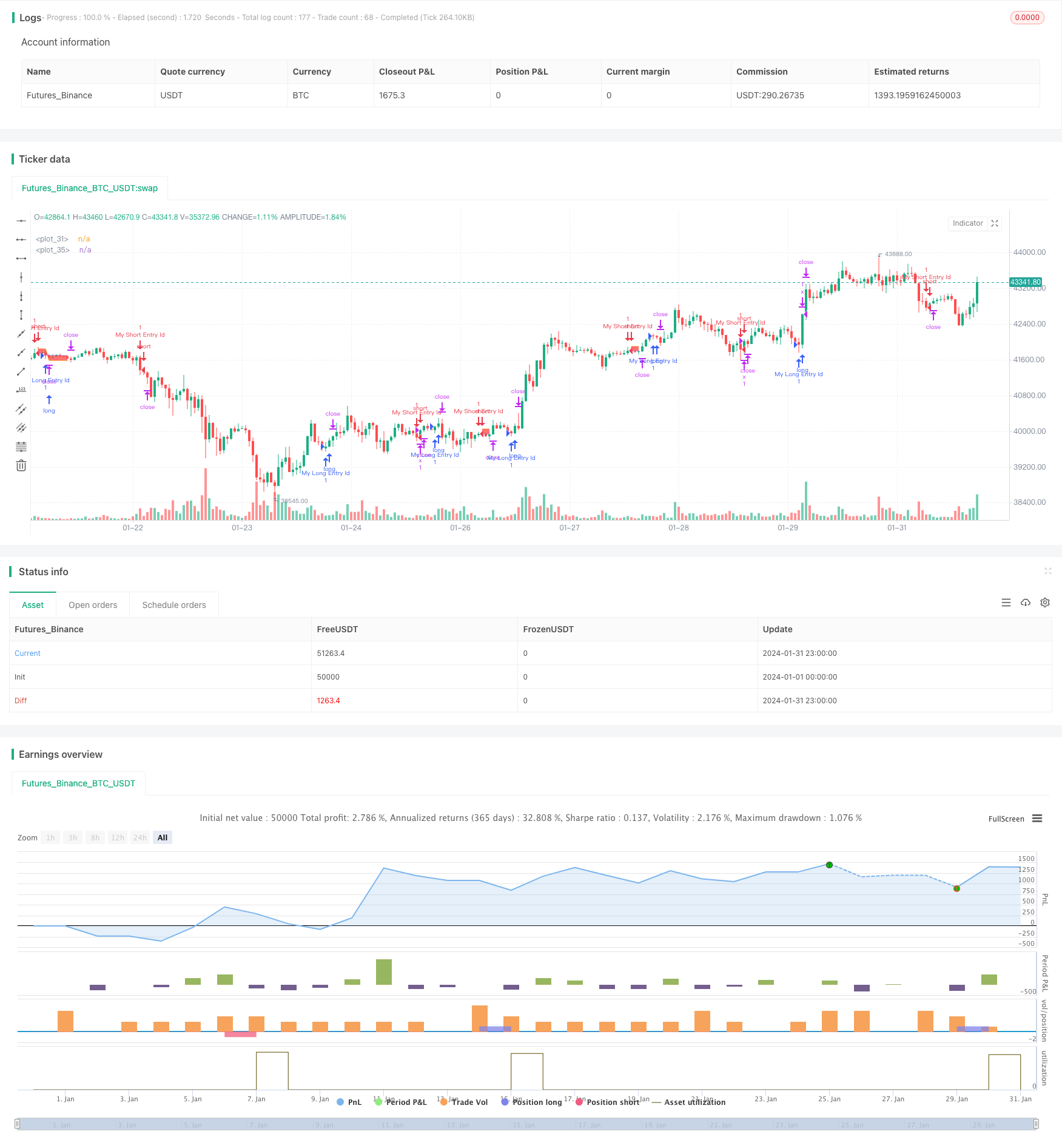
Overview
The dual moving average following strategy is a trend following strategy based on moving averages. It determines the trend direction by calculating moving averages of different periods and generates trading signals accordingly. It goes long when the short-term moving average crosses over the long-term one, and goes short when the short-term moving average crosses below the long-term one. The strategy follows the trend to profit.
Strategy Logic
The dual moving average following strategy judges the trend direction by calculating the 14-period and 28-period simple moving averages (SMA) of the closing price. Specifically, it calculates the 14-period SMA and 28-period SMA of close price at the end of each period. When the 14-period SMA crosses over the 28-period SMA, it sends out a long signal and opens a long position. When the 14-period SMA crosses below the 28-period SMA, it sends out a short signal and opens a short position.
After entering positions, it manages risks by setting take profit and stop loss levels. The take profit and stop loss points are converted to prices based on the input parameters. It also plots the take profit line, stop loss line and entry average price line on the chart for visual judgment of profit and risk.
Advantage Analysis
The dual moving average following strategy has the following advantages:
- Simple to implement and operate.
- Follows the trend with lower drawdown risks.
- Trading frequency can be controlled by adjusting the cycle parameters.
- Flexible take profit and stop loss settings to control risks.
Risk Analysis
The dual moving average following strategy also has some risks:
- Significant loss may occur if sudden events interrupt the market trend.
- Premature stop loss may happen if the stop loss point is set too small.
- Loss range could be enlarged if the stop loss point is set too big.
- Trading frequency may be too high or too low, impacting capital efficiency.
The risks can be managed from the following aspects:
- Set stop loss point dynamically based on volatility.
- Optimize the moving average cycle parameters.
- Add trend filter to avoid false signals near trend turning points.
Optimization Directions
The dual moving average following strategy can be optimized in the following ways:
Add volatility indicators for dynamic stop loss point. For example, combine with ATR to expand stop loss when volatility rises to avoid premature exit.
Optimize moving average cycle parameters by testing more combinations and selecting proper periods with suitable frequency of trading signals.
Add trend filter indicator, such as MACD, DMI to avoid false signals near trend turning points, reducing unnecessary trades.
Increase machine learning models to predict price trend and replace traditional rules. LSTM, GRU deep learning models may generate better results.
Diversify trading varieties utilizing low correlation to reduce overall drawdown.
Conclusion
In conclusion, the dual moving average following strategy is a simple and practical trend following system. It moves along the trend thus having lower drawdown risks, and is easy to implement. We can optimize it by adjusting cycle parameters, setting stop loss and take profit, adding trend judging indicators, to adapt to more market environments and earn more steady returns.
Parameters
| Name | Default | What it controls |
|---|---|---|
| v_input_1 | 200 | Take Profit $$ |
| v_input_2 | 100 | Stop Loss $$ |
Source Pine Script
/*backtest
start: 2024-01-01 00:00:00
end: 2024-01-31 23:59:59
period: 1h
basePeriod: 15m
exchanges: [{"eid":"Futures_Binance","currency":"BTC_USDT"}]
*/

// This Pine Script™ code is subject to the terms of the Mozilla Public License 2.0 at https://mozilla.org/MPL/2.0/
// © coinilandBot
// This source code is subject to the terms of the Mozilla Public License 2.0 at https://mozilla.org/MPL/2.0/
// © adolgov

// @description
//

//@version=4
strategy("coiniland  copy trading platform", overlay=true)

// random entry condition

longCondition = crossover(sma(close, 14), sma(close, 28))
if (longCondition)
    strategy.entry("My Long Entry Id", strategy.long)

shortCondition = crossunder(sma(close, 14), sma(close, 28))
if (shortCondition)
    strategy.entry("My Short Entry Id", strategy.short)

moneyToSLPoints(money) =>
    strategy.position_size !=0 ? (money / syminfo.pointvalue / abs(strategy.position_size)) / syminfo.mintick : na

p = moneyToSLPoints(input(200, title = "Take Profit $$"))
l = moneyToSLPoints(input(100, title = "Stop Loss $$"))
strategy.exit("x", profit = p, loss = l)

// debug plots for visualize SL & TP levels
pointsToPrice(pp) =>
    na(pp) ? na : strategy.position_avg_price + pp * sign(strategy.position_size) * syminfo.mintick

pp = plot(pointsToPrice(p), style = plot.style_linebr )
lp = plot(pointsToPrice(-l), style = plot.style_linebr )
avg = plot( strategy.position_avg_price, style = plot.style_linebr )
fill(pp, avg, color = color.green)
fill(avg, lp, color = color.red)
Published by ChaoZhang on the FMZ strategy square · last modified 2024-02-27. Collected in the Quant Trading Vault. Unvalidated research: re-test with your own data and costs before trusting it.
Build this with AgenKit
A spec is not a trading system. Paste this into your coding agent and AgenKit runs a specialist team — architecture, test-first build, risk gates, review — with paper trading on by default.
/agenkit build a production-grade trading bot with a backtest engine, risk controls and paper trading by default from strategies/Dual-Moving-Average-Following-Strategy.md- npx agenkit install engineering-kit in your project
- Paste the command into your agent and approve each phase
- Get tests, backtest, risk controls and a paper-trading switch
Understand it first
Before you run this, read the lesson behind the idea and how to backtest it honestly. Specs like this one are the survivors of an unknown number of trials; deflate their results accordingly.
Related specs
- ATR and Moving Average Crossover Hybrid StrategyPine Script · Trend following · 1h
- Adaptive Risk Management Strategy Based on Dynamic ATR and Moving Average CrossoverPine Script · Trend following · 2h
- Adaptive Volatility Based Trend Following Short Strategy with Time Delay and Stop Loss ProtectionPine Script · Trend following · 2m
- BB Percentage Index Trend Fading StrategyPine Script · Trend following · 1h
- Bollinger Bands and RSI Trend Following StrategyPine Script · Trend following · 1h
- Dual ATR Channel Trend Following StrategyPine Script · Trend following · 15m