Strategy vault / Trend following
Dual Moving Average Supertrend Quantitative Trading Strategy
This strategy combines the dual moving average and Supertrend indicators to construct trading signals and judges the trend direction through different cycle combinations to achieve high profitability.
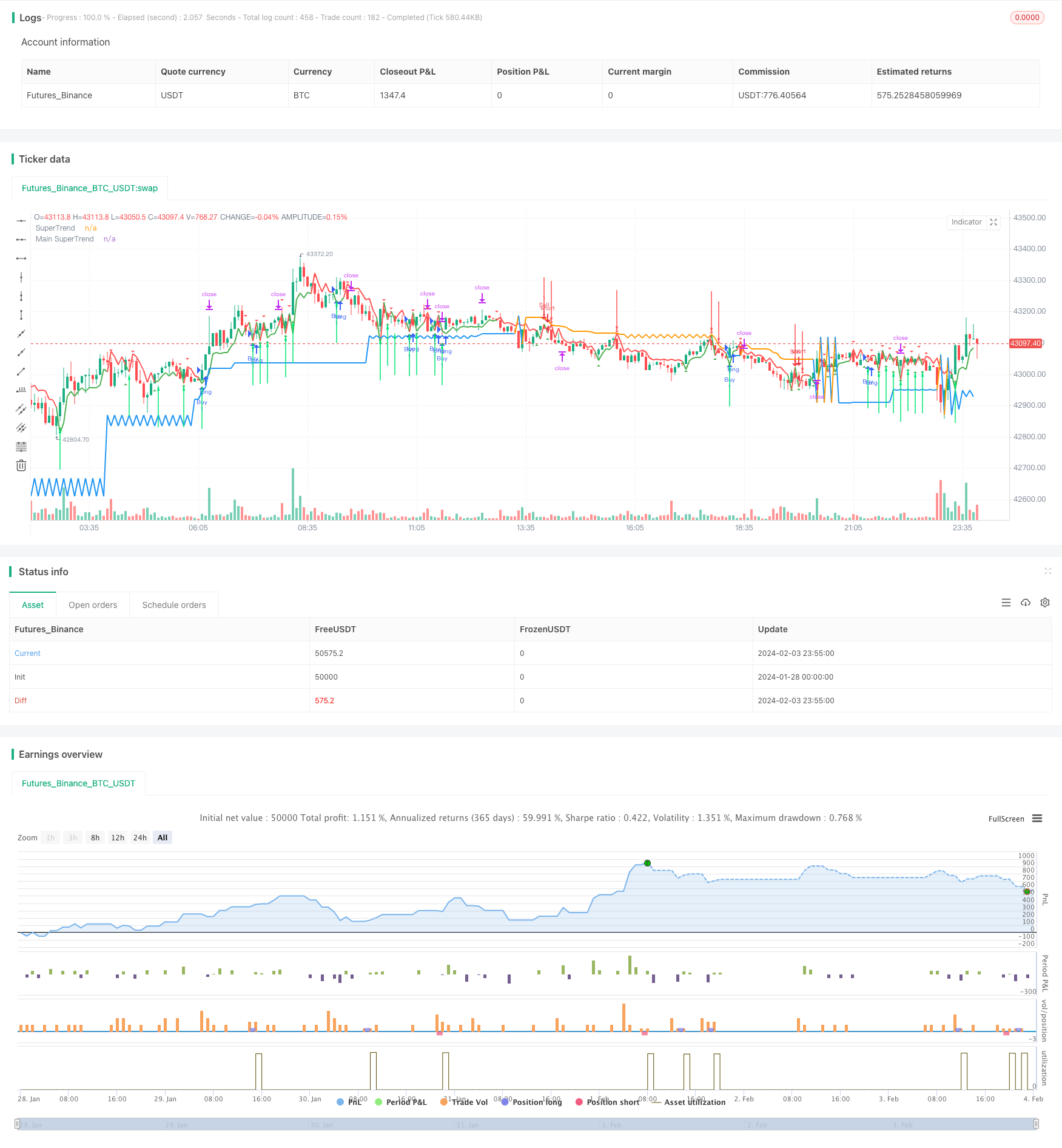
Overview
This strategy combines the dual moving average and Supertrend indicators to construct trading signals and judges the trend direction through different cycle combinations to achieve high profitability.
Principle
This strategy uses the MACD and Supertrend indicators to determine market entry timing. MACD dual moving averages determine short-term trend direction, while Supertrend determines medium-to-long-term trend direction.
When the fast line breaks through the slow line upward, it is a buy signal. At this time, if the medium-to-long-term Supertrend is also an upward trend, the final buy signal is generated to go long. On the contrary, when the fast line breaks through the slow line downward, it is a sell signal. At this time, if the medium-to-long term Supertrend is also a downward trend, the final sell signal is generated to go short.
The stop loss and take profit are set to fixed values.
Advantage Analysis
The biggest advantage of this strategy is that it uses both double moving averages and Supertrend to determine market direction, combining medium-short-term and medium-long-term analyses to significantly improve decision efficiency and avoid false breakouts. In addition, Supertrend can adjust parameters according to market volatility to adapt to a wider range of market environments.
Risk Analysis
The main risk of this strategy is that fixed stop loss and take profit settings may miss greater profit opportunities. In addition, if there is divergence between medium-short-term and medium-long-term judgments, the strategy will not work properly. We can reduce this risk through floating stop loss and take profit settings.
Optimization Directions
This strategy can be optimized in the following aspects:
Increase the dynamic adjustment mechanism for stop loss and take profit, and set stop loss and take profit according to market volatility and trends.
Optimize MACD parameters to find moving average parameters more suitable for the target variety.
Optimize Supertrend parameters to adjust its sensitivity to the market.
Increase other indicators for judgment to provide more dimensional signals and improve strategy performance.
Summary
This strategy successfully combines the advantages of dual moving averages and Supertrend indicators. By combining different cycle judgments, it filters out wrong signals and obtains better returns in trending markets. We can further enhance the stability and profitability of this strategy through parameter optimization and mechanism adjustments.
Parameters
| Name | Default | What it controls |
|---|---|---|
| v_input_1_close | 0 | source: close | high | low | open | hl2 | hlc3 | hlcc4 | ohlc4 |
| v_input_2 | 12 | MACD fast moving average |
| v_input_3 | 26 | MACD slow moving average |
| v_input_4 | 9 | MACD signal line moving average |
| v_input_5 | 120 | Main SuperTrend Time Frame |
| v_input_6 | true | Factor |
| v_input_7 | true | Pd |
| v_input_8 | 500 | Take Profit |
| v_input_9 | 400 | Stop Loss |
Source Pine Script
/*backtest
start: 2024-01-28 00:00:00
end: 2024-02-04 00:00:00
period: 5m
basePeriod: 1m
exchanges: [{"eid":"Futures_Binance","currency":"BTC_USDT"}]
*/

//@version=2
//Supertrend Strategy by breizh29 using *rajandran.r* Supertrend Indicator

strategy("Super Trend 2 MACD", overlay=true)
// MACD input
source = input(close)
fastLength = input(12, minval=1, title="MACD fast moving average")
slowLength=input(26,minval=1, title="MACD slow moving average")
signalLength=input(9,minval=1, title="MACD signal line moving average")

// Calculation
fastMA = sma(source, fastLength)
slowMA = sma(source, slowLength)

Macd = fastMA - slowMA
Signal = sma(Macd, signalLength)


res = input(title="Main SuperTrend Time Frame",  defval="120")
Factor=input(1, minval=1,maxval = 100)
Pd=input(1, minval=1,maxval = 100)

tp = input(500,title="Take Profit")
sl = input(400,title="Stop Loss")


Up=hl2-(Factor*atr(Pd))
Dn=hl2+(Factor*atr(Pd))
MUp=request.security(syminfo.tickerid,res,hl2-(Factor*atr(Pd)))
MDn=request.security(syminfo.tickerid,res,hl2+(Factor*atr(Pd)))

Mclose=request.security(syminfo.tickerid,res,close)

TrendUp=close[1]>TrendUp[1]? max(Up,TrendUp[1]) : Up
TrendDown=close[1]<TrendDown[1]? min(Dn,TrendDown[1]) : Dn

MTrendUp=Mclose[1]>MTrendUp[1]? max(MUp,MTrendUp[1]) : MUp
MTrendDown=Mclose[1]<MTrendDown[1]? min(MDn,MTrendDown[1]) : MDn

Trend = close > TrendDown[1] ? 1: close< TrendUp[1]? -1: nz(Trend[1],1)
Tsl = Trend==1? TrendUp: TrendDown

MTrend = Mclose > MTrendDown[1] ? 1: Mclose< MTrendUp[1]? -1: nz(MTrend[1],1)
MTsl = MTrend==1? MTrendUp: MTrendDown

linecolor = Trend == 1 ? green : red
plot(Tsl, color = linecolor , style = line , linewidth = 2,title = "SuperTrend")

Mlinecolor = MTrend == 1 ? blue : orange
plot(MTsl, color = Mlinecolor , style = line , linewidth = 2,title = "Main SuperTrend")

plotshape(cross(close,Tsl) and close>Tsl , "Up Arrow", shape.triangleup,location.belowbar,green,0,0)
plotshape(cross(Tsl,close) and close<Tsl , "Down Arrow", shape.triangledown , location.abovebar, red,0,0)

up = Trend == 1 and Trend[1] == -1 and MTrend == 1
down = Trend == -1 and Trend[1] == 1 and MTrend == -1
plotarrow(up ? Trend : na, title="Up Entry Arrow", colorup=lime, maxheight=60, minheight=50, transp=0)
plotarrow(down ? Trend : na, title="Down Entry Arrow", colordown=red, maxheight=60, minheight=50, transp=0)


golong = Trend == 1 and Trend[1] == -1 and MTrend == 1 and Macd > Signal
goshort = Trend == -1 and Trend[1] == 1 and MTrend == -1 and Macd < Signal

strategy.entry("Buy", strategy.long,when=golong)
strategy.exit("Close Buy","Buy",profit=tp,loss=sl)


strategy.entry("Sell", strategy.short,when=goshort)
strategy.exit("Close Sell","Sell",profit=tp,loss=sl)
Published by ChaoZhang on the FMZ strategy square · last modified 2024-02-05. Collected in the Quant Trading Vault. Unvalidated research: re-test with your own data and costs before trusting it.
Build this with AgenKit
A spec is not a trading system. Paste this into your coding agent and AgenKit runs a specialist team — architecture, test-first build, risk gates, review — with paper trading on by default.
/agenkit build a production-grade trading bot with a backtest engine, risk controls and paper trading by default from strategies/Dual-Moving-Average-Supertrend-Quantitative-Trading-Strategy.md- npx agenkit install engineering-kit in your project
- Paste the command into your agent and approve each phase
- Get tests, backtest, risk controls and a paper-trading switch
Understand it first
Before you run this, read the lesson behind the idea and how to backtest it honestly. Specs like this one are the survivors of an unknown number of trials; deflate their results accordingly.
Related specs
- Multi Indicator Dynamic Trend Following Strategy Based on EMA and SMAPine Script · Trend following · 1d
- Supertrend Advance StrategyPine Script · Trend following · 5m
- Supertrend and Moving Average Crossover StrategyPine Script · Trend following · 2h
- Advanced Quantitative Trading Strategy Multi Dimensional Super Trend ATR Dynamic Tracking SystemPine Script · Trend following · 1h
- Dual EMA Crossover Trend Following Strategy with ATR and ADX FiltersPine Script · Trend following · 1d
- Dual SuperTrend with MACD Combination Trading StrategyPine Script · Trend following · 30m