Strategy vault / Trend following
Dual Moving Average Trend Following Strategy with ATR Based Risk Management System
This strategy combines classic dual moving average trend following with ATR-based dynamic risk management. It offers two trading modes: a basic mode using simple moving average crossovers for trend following, and an…
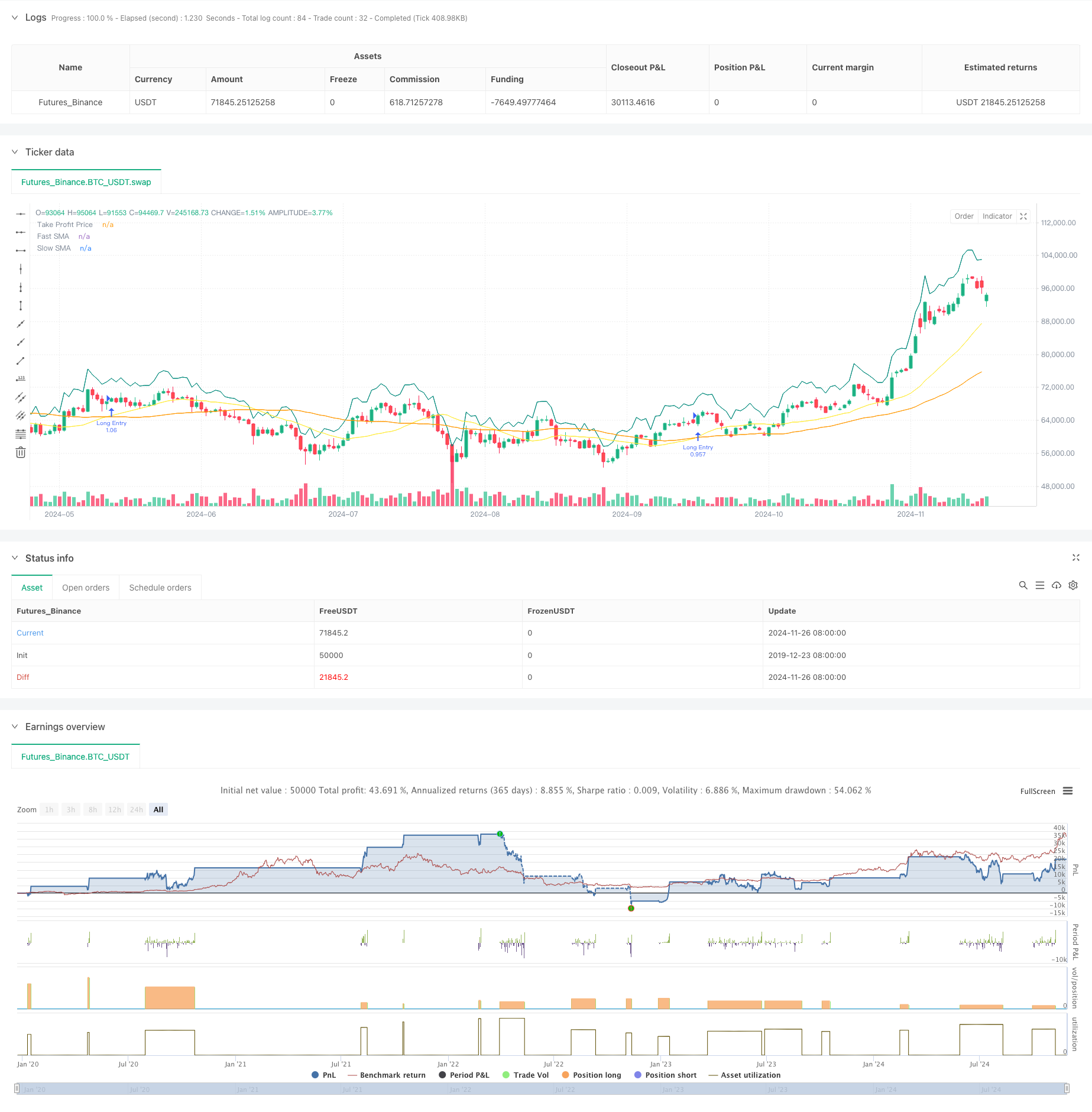
Overview
This strategy combines classic dual moving average trend following with ATR-based dynamic risk management. It offers two trading modes: a basic mode using simple moving average crossovers for trend following, and an advanced mode incorporating higher timeframe trend filtering and ATR-based dynamic stop-loss mechanisms. Traders can switch between modes via a simple dropdown menu, catering to both beginners' ease of use and experienced traders' risk management needs.
Strategy Principles
Strategy 1 (Basic Mode) employs a 21 and 49-day dual moving average system, generating long signals when the fast MA crosses above the slow MA. Take profit targets can be set either as percentage or points, with an optional trailing stop to lock in profits. Strategy 2 (Advanced Mode) adds daily timeframe trend filtering, allowing entries only when price is above the higher timeframe moving average. It incorporates a 14-period ATR-based dynamic stop-loss that adjusts with market volatility, and includes partial profit-taking functionality to protect gains.
Strategy Advantages
- Highly adaptable strategy that can flex with trader experience and market conditions
- Multi-timeframe analysis in advanced mode improves signal quality
- ATR-based dynamic stops adapt to varying market volatility
- Partial profit-taking balances profit protection with trend continuation
- Flexible parameter configuration for different market characteristics
Strategy Risks
- Dual MA system may generate frequent false signals in ranging markets
- Trend filtering may cause signal lag, missing some trading opportunities
- ATR stops may not adjust quickly enough to volatility spikes
- Partial profit-taking might reduce position size too early in strong trends
Strategy Optimization Directions
- Add volume and volatility indicators to filter false signals
- Consider implementing dynamic parameter adaptation based on market conditions
- Optimize ATR calculation period to balance sensitivity and stability
- Add market state recognition module for automatic strategy mode selection
- Introduce more stop-loss options like trailing stops and time-based exits
Summary
This is a well-designed and comprehensive trading system. The combination of dual moving average trend following and ATR-based risk management ensures both reliability and effective risk control. The dual-mode design meets the needs of different trader levels, while rich parameter settings provide ample optimization opportunities. Traders are advised to start with conservative parameters in live trading and gradually optimize for best results.
Source Pine Script
/*backtest
start: 2019-12-23 08:00:00
end: 2024-11-27 08:00:00
period: 1d
basePeriod: 1d
exchanges: [{"eid":"Futures_Binance","currency":"BTC_USDT"}]
*/

// This Pine Script™ code is subject to the terms of the Mozilla Public License 2.0 at https://mozilla.org/MPL/2.0/
// © shaashish1

//@version=5
strategy("Dual Strategy Selector V2 - Cryptogyani", overlay=true, pyramiding=0,
         default_qty_type=strategy.percent_of_equity, default_qty_value=100, initial_capital=100000)

//#region STRATEGY SELECTION
strategyOptions = input.string(title="Select Strategy", defval="Strategy 1", options=["Strategy 1", "Strategy 2"], group="Strategy Selection")
//#endregion STRATEGY SELECTION

// ####################### STRATEGY 1: Original Logic ########################
//#region STRATEGY 1 INPUTS
s1_fastMALen = input.int(defval=21, title="Fast SMA Length (S1)", minval=1, group="Strategy 1 Settings", inline="S1 MA")
s1_slowMALen = input.int(defval=49, title="Slow SMA Length (S1)", minval=1, group="Strategy 1 Settings", inline="S1 MA")
s1_takeProfitMode = input.string(defval="Percentage", title="Take Profit Mode (S1)", options=["Percentage", "Pips"], group="Strategy 1 Settings")
s1_takeProfitPerc = input.float(defval=7.0, title="Take Profit % (S1)", minval=0.05, step=0.05, group="Strategy 1 Settings") / 100
s1_takeProfitPips = input.float(defval=50, title="Take Profit Pips (S1)", minval=1, step=1, group="Strategy 1 Settings")
s1_trailingTakeProfitEnabled = input.bool(defval=false, title="Enable Trailing (S1)", group="Strategy 1 Settings")
//#endregion STRATEGY 1 INPUTS

// ####################### STRATEGY 2: Enhanced with Recommendations ########################
//#region STRATEGY 2 INPUTS
s2_fastMALen = input.int(defval=20, title="Fast SMA Length (S2)", minval=1, group="Strategy 2 Settings", inline="S2 MA")
s2_slowMALen = input.int(defval=50, title="Slow SMA Length (S2)", minval=1, group="Strategy 2 Settings", inline="S2 MA")
s2_atrLength = input.int(defval=14, title="ATR Length (S2)", group="Strategy 2 Settings", inline="ATR")
s2_atrMultiplier = input.float(defval=1.5, title="ATR Multiplier for Stop-Loss (S2)", group="Strategy 2 Settings", inline="ATR")
s2_partialTakeProfitPerc = input.float(defval=50.0, title="Partial Take Profit % (S2)", minval=10, maxval=100, step=10, group="Strategy 2 Settings")
s2_timeframeTrend = input.timeframe(defval="1D", title="Higher Timeframe for Trend Filter (S2)", group="Strategy 2 Settings")
//#endregion STRATEGY 2 INPUTS

// ####################### GLOBAL VARIABLES ########################
var float takeProfitPrice = na
var float stopLossPrice = na
var float trailingStopPrice = na
var float fastMA = na
var float slowMA = na
var float higherTimeframeTrendMA = na
var bool validOpenLongPosition = false

// Precalculate higher timeframe values (global scope for Strategy 2)
higherTimeframeTrendMA := request.security(syminfo.tickerid, s2_timeframeTrend, ta.sma(close, s2_slowMALen))

// ####################### LOGIC ########################
if (strategyOptions == "Strategy 1")
    // Strategy 1 Logic (Original Logic Preserved)
    fastMA := ta.sma(close, s1_fastMALen)
    slowMA := ta.sma(close, s1_slowMALen)
    openLongPosition = ta.crossover(fastMA, slowMA)
    validOpenLongPosition := openLongPosition and strategy.opentrades.size(strategy.opentrades - 1) == 0

    // Take Profit Price
    takeProfitPrice := if (s1_takeProfitMode == "Percentage")
        close * (1 + s1_takeProfitPerc)
    else
        close + (s1_takeProfitPips * syminfo.mintick)

    // Trailing Stop Price (if enabled)
    if (strategy.position_size > 0 and s1_trailingTakeProfitEnabled)
        trailingStopPrice := high - (s1_takeProfitPips * syminfo.mintick)
    else
        trailingStopPrice := na

else if (strategyOptions == "Strategy 2")
    // Strategy 2 Logic with Recommendations
    fastMA := ta.sma(close, s2_fastMALen)
    slowMA := ta.sma(close, s2_slowMALen)
    openLongPosition = ta.crossover(fastMA, slowMA) and close > higherTimeframeTrendMA
    validOpenLongPosition := openLongPosition and strategy.opentrades.size(strategy.opentrades - 1) == 0

    // ATR-Based Stop-Loss
    atr = ta.atr(s2_atrLength)
    stopLossPrice := close - (atr * s2_atrMultiplier)

    // Partial Take Profit Logic
    takeProfitPrice := close * (1 + (s2_partialTakeProfitPerc / 100))
//#endregion STRATEGY LOGIC

// ####################### PLOTTING ########################
plot(series=fastMA, title="Fast SMA", color=color.yellow, linewidth=1)
plot(series=slowMA, title="Slow SMA", color=color.orange, linewidth=1)
plot(series=takeProfitPrice, title="Take Profit Price", color=color.teal, linewidth=1, style=plot.style_linebr)

// Trailing Stop and ATR Stop-Loss Plots (Global Scope)
plot(series=(strategyOptions == "Strategy 1" and s1_trailingTakeProfitEnabled) ? trailingStopPrice : na, title="Trailing Stop", color=color.red, linewidth=1, style=plot.style_linebr)
plot(series=(strategyOptions == "Strategy 2") ? stopLossPrice : na, title="ATR Stop-Loss", color=color.red, linewidth=1, style=plot.style_linebr)
//#endregion PLOTTING

// ####################### POSITION ORDERS ########################
//#region POSITION ORDERS
if (validOpenLongPosition)
    strategy.entry(id="Long Entry", direction=strategy.long)

if (strategyOptions == "Strategy 1")
    if (strategy.position_size > 0)
        if (s1_trailingTakeProfitEnabled)
            strategy.exit(id="Trailing Take Profit", from_entry="Long Entry", stop=trailingStopPrice)
        else
            strategy.exit(id="Take Profit", from_entry="Long Entry", limit=takeProfitPrice)

else if (strategyOptions == "Strategy 2")
    if (strategy.position_size > 0)
        strategy.exit(id="Partial Take Profit", from_entry="Long Entry", qty_percent=s2_partialTakeProfitPerc, limit=takeProfitPrice)
        strategy.exit(id="Stop Loss", from_entry="Long Entry", stop=stopLossPrice)
//#endregion POSITION ORDERS
Published by ChaoZhang on the FMZ strategy square · last modified 2024-11-29. Collected in the Quant Trading Vault. Unvalidated research: re-test with your own data and costs before trusting it.
Build this with AgenKit
A spec is not a trading system. Paste this into your coding agent and AgenKit runs a specialist team — architecture, test-first build, risk gates, review — with paper trading on by default.
/agenkit build a production-grade trading bot with a backtest engine, risk controls and paper trading by default from strategies/Dual-Moving-Average-Trend-Following-Strategy-with-ATR-Based-Risk-Management-System.md- npx agenkit install engineering-kit in your project
- Paste the command into your agent and approve each phase
- Get tests, backtest, risk controls and a paper-trading switch
Understand it first
Before you run this, read the lesson behind the idea and how to backtest it honestly. Specs like this one are the survivors of an unknown number of trials; deflate their results accordingly.
Related specs
- ATR and Moving Average Crossover Hybrid StrategyPine Script · Trend following · 1h
- Adaptive Risk Management Strategy Based on Dynamic ATR and Moving Average CrossoverPine Script · Trend following · 2h
- Adaptive Volatility Based Trend Following Short Strategy with Time Delay and Stop Loss ProtectionPine Script · Trend following · 2m
- BB Percentage Index Trend Fading StrategyPine Script · Trend following · 1h
- Bollinger Bands and RSI Trend Following StrategyPine Script · Trend following · 1h
- Dual ATR Channel Trend Following StrategyPine Script · Trend following · 15m