Strategy vault / Trend following
Dual Moving Average Trend Tracking Strategy 440999
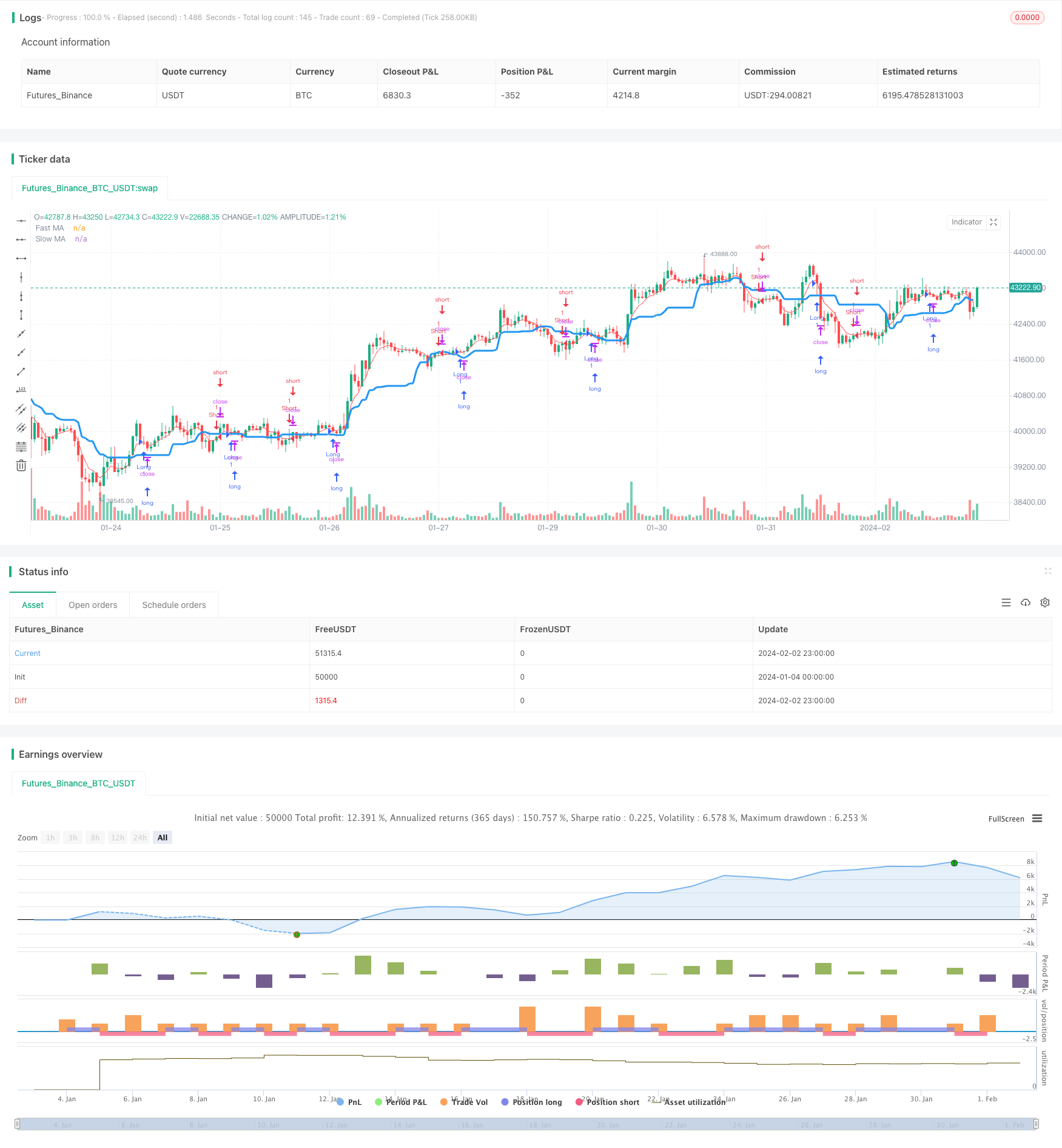
The Dual Moving Average Trend Tracking strategy utilizes a combination of fast and slow moving averages to determine trend direction, along with candlestick body color as entry signals. This strategy has both trend…
Overview
The Dual Moving Average Trend Tracking strategy utilizes a combination of fast and slow moving averages to determine trend direction, along with candlestick body color as entry signals. This strategy has both trend following and mean reversion characteristics.
Principle
The strategy uses a 20-period slow moving average to define overall trend. Upward crossover suggests an uptrend while downward crossover suggests a downtrend. A 5-period fast MA serves as an entry filter. Trades are triggered only when price breaks the fast MA. In addition, recent N candle body colors are checked. Long signals are triggered when body color turns red in an uptrend. Short signals are triggered when body color turns green in a downtrend. This helps avoid false breakouts.
The strategy examines price action using three dimensions - trend, short-term MA and candlestick body, improving signal reliability. Signals are generated only when all three align, filtering out some noise.
Advantages
Combines trend following and mean reversion, adaptable across market environments.
Multi-factor review prior signals improves win rate by avoiding false signals.
Optimizable using MA lengths, candle colors checked etc.
Clear, concise logic, beginner friendly.
Risks
Whipsaws during rangy markets can lead to losses/drawdowns. Consider loss limits or optimizing MA parameters.
Potential whipsaws during sideways may result in losses. Try tweaking number of candles checked or disabling mean reversion.
Extensive backtesting needed to validate parameters and performance.
Enhancement
Explore other MA types e.g. EMA, KAMA etc.
Add position sizing rules e.g fixed quantity or % equity based.
Build in stop loss mechanism. Consider exiting longs if price closes below slow MA.
Test across different instruments to verify stability.
Conclusion
The Dual MA strategy profits from trend trades while extracting mean reversion alpha in shorter time frames. Performance and profit potential can be improved further through optimization. Despite its simplicity, it allows beginners to grasp key concepts around combining trend and mean reversion. Comprehensive validation is must across instruments and parameters.
Parameters
| Name | Default | What it controls |
|---|---|---|
| v_input_1 | true | long |
| v_input_2 | true | short |
| v_input_3 | 7 | Type of Slow MA |
| v_input_4_close | 0 | Source of Slow MA: close | high | low | open | hl2 | hlc3 | hlcc4 | ohlc4 |
| v_input_5 | true | Use fast MA Filter |
| v_input_6 | 5 | fast MA Period |
| v_input_7 | 20 | slow MA Period |
| v_input_8 | 2 | Bars Q |
Source Pine Script
/*backtest
start: 2024-01-04 00:00:00
end: 2024-02-03 00:00:00
period: 1h
basePeriod: 15m
exchanges: [{"eid":"Futures_Binance","currency":"BTC_USDT"}]
*/

//@version=2
strategy(title = "Noro's Trend MAs 1.5", shorttitle = "Trend MAs 1.5", overlay=true, default_qty_type = strategy.percent_of_equity, default_qty_value=100.0, pyramiding=0)

//Settings
needlong = input(true, "long")
needshort = input(true, "short")
type = input(7, defval = 7, minval = 1, maxval = 7, title = "Type of Slow MA")
src = input(close, defval = close, title = "Source of Slow MA")
usefastsma = input(true, "Use fast MA Filter")
fastlen = input(5, defval = 5, minval = 1, maxval = 50, title = "fast MA Period")
len = input(20, defval = 20, minval = 2, maxval = 200, title = "slow MA Period")
bars = input(2, defval = 2, minval = 0, maxval = 3, title = "Bars Q")

fastsma = ema(src, fastlen)

//DEMA
dema = 2 * ema(src, len) - ema(ema(close, len), len)

//TEMA
xPrice = close
xEMA1 = ema(src, len)
xEMA2 = ema(xEMA1, len)
xEMA3 = ema(xEMA2, len)
tema = 3 * xEMA1 - 3 * xEMA2 + xEMA3

//KAMA
xvnoise = abs(src - src[1])
nfastend = 0.20
nslowend = 0.05
nsignal = abs(src - src[len])
nnoise = sum(xvnoise, len)
nefratio = iff(nnoise != 0, nsignal / nnoise, 0)
nsmooth = pow(nefratio * (nfastend - nslowend) + nslowend, 2)
kama = nz(kama[1]) + nsmooth * (src - nz(kama[1]))

//PriceChannel
lasthigh = highest(src, len)
lastlow = lowest(src, len)
center = (lasthigh + lastlow) / 2

//Trend
ma = type == 1 ? sma(src, len) : type == 2 ? ema(src, len) : type == 3 ? vwma(src, len) : type == 4 ? dema : type == 5 ? tema : type == 6 ? kama : type == 7 ? center : 0
trend = low > ma ? 1 : high < ma ? -1 : trend[1]

//Bars
bar = close > open ? 1 : close < open ? -1 : 0
redbars = bars == 0 ? 1 : bars == 1 and bar == -1 ? 1 : bars == 2 and bar == -1 and bar[1] == -1 ? 1 : bars == 3 and bar == -1 and bar[1] == -1 and bar[2] == -1 ? 1 : 0
greenbars = bars == 0 ? 1 : bars == 1 and bar == 1 ? 1 : bars == 2 and bar == 1 and bar[1] == 1 ? 1 : bars == 3 and bar == 1 and bar[1] == 1 and bar[2] == 1 ? 1 : 0

//Signals
up = trend == 1 and (low < fastsma or usefastsma == false) and redbars == 1 ? 1 : 0
dn = trend == -1 and (high > fastsma or usefastsma == false) and greenbars == 1 ? 1 : 0

//Lines
colorfastsma = usefastsma == true ? red : na
plot(fastsma, color = colorfastsma, title = "Fast MA")
plot(ma, color = blue, linewidth = 3, transp = 0, title = "Slow MA")

//Trading
longCondition = up == 1
if (longCondition)
    strategy.entry("Long", strategy.long, needlong == false ? 0 : na)

shortCondition = dn == 1
if (shortCondition)
strategy.entry("Short", strategy.short, needshort == false ? 0 : na)Published by ChaoZhang on the FMZ strategy square · last modified 2024-02-04. Collected in the Quant Trading Vault. Unvalidated research: re-test with your own data and costs before trusting it.
Build this with AgenKit
A spec is not a trading system. Paste this into your coding agent and AgenKit runs a specialist team — architecture, test-first build, risk gates, review — with paper trading on by default.
/agenkit build a production-grade trading bot with a backtest engine, risk controls and paper trading by default from strategies/Dual-Moving-Average-Trend-Tracking-Strategy-440999.md- npx agenkit install engineering-kit in your project
- Paste the command into your agent and approve each phase
- Get tests, backtest, risk controls and a paper-trading switch
Understand it first
Before you run this, read the lesson behind the idea and how to backtest it honestly. Specs like this one are the survivors of an unknown number of trials; deflate their results accordingly.
Related specs
- ADX MA and EMA Long Only Trend Tracking StrategyPine Script · Trend following · 1d
- ATR and Moving Average Crossover Hybrid StrategyPine Script · Trend following · 1h
- Bollinger Band Moving Average Crossover StrategyPine Script · Trend following · 1h
- Bollinger Bands and EMA Trend Following StrategyPine Script · Trend following · 1h
- Bollinger Bands and RSI Trend Following StrategyPine Script · Trend following · 1h
- Candlestick Pattern Trend Filter StrategyPine Script · Trend following · 1d