Strategy vault / Mean reversion
Dual Reversion Balance Strategy
The dual reversion balance strategy is a combination strategy that utilizes both reversal strategies and empirical mode decomposition (EMD) filtering. It first generates trading signals using the 123 reversal system…
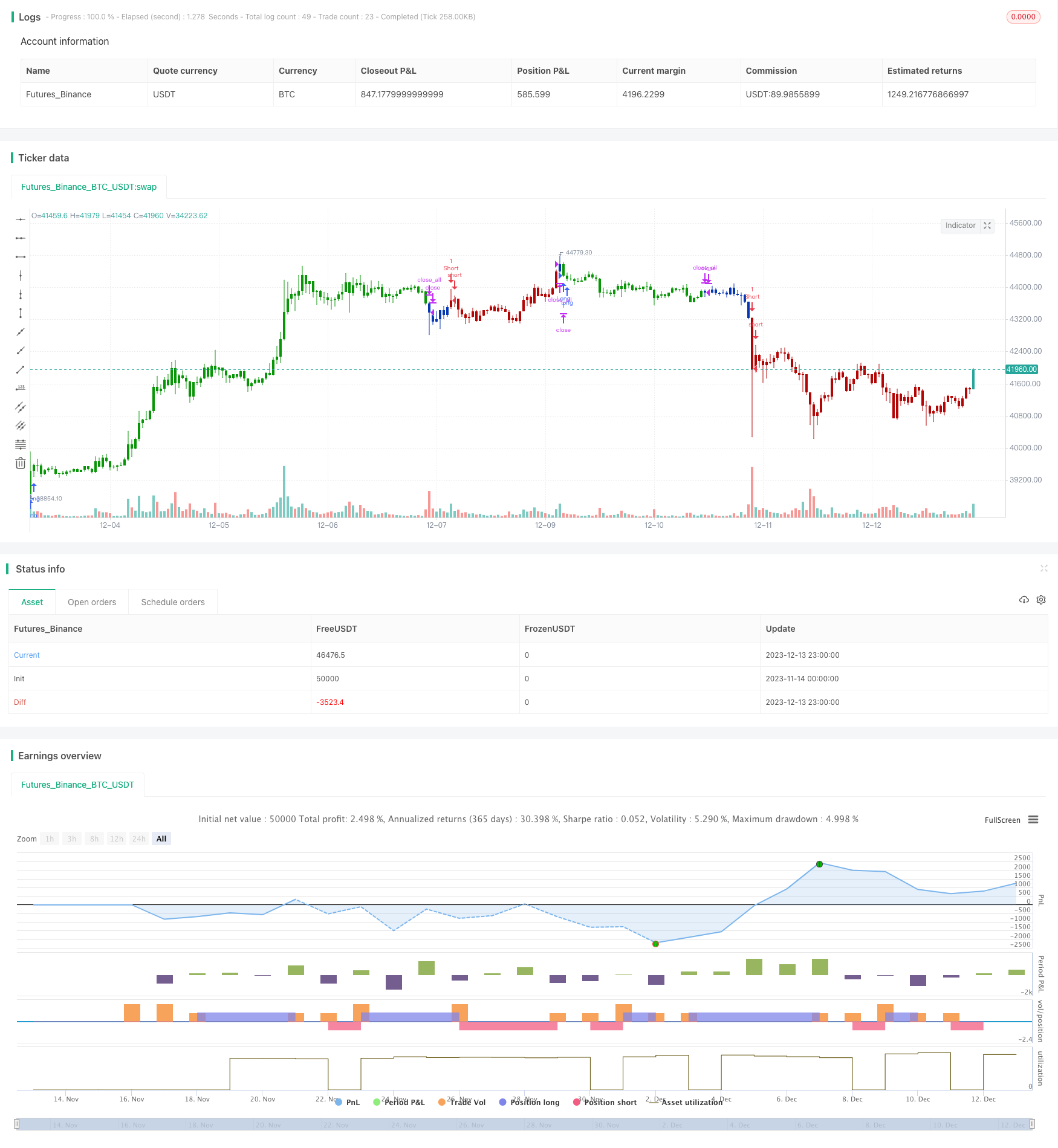
Overview
The dual reversion balance strategy is a combination strategy that utilizes both reversal strategies and empirical mode decomposition (EMD) filtering. It first generates trading signals using the 123 reversal system, then processes the signals with EMD filtering, and finally combines the signals from both to confirm entries and exits. This hybrid approach can improve the win rate.
Strategy Principle
123 Reversal System
The 123 reversal system originates from the book "How I Tripled My Money in the Futures Market" by Ulf Jensen. It belongs to reversal type of strategies. It goes long when the close price is higher than previous close for 2 consecutive days and the 9-day slow stochastic is below 50. It goes short when opposite setup happens.
Empirical Mode Decomposition (EMD)
The EMD is an adaptive data analysis method. It can effectively decompose data into different frequency components and extract the long term trend. Here we set length to 20, delta to 0.5 and fraction to 0.1 to generate trading signals based on the price frequency components.
Signal Combination
The dual reversion balance strategy combines the trading signals from both 123 reversal system and EMD. It confirms entries only when signals from both systems agree. This hybrid approach improves the win rate.
Advantage Analysis
The dual reversion balance strategy leverages the advantages from both reversal strategies and digital signal processing techniques. The reversal system captures short-term reversal opportunities while the EMD filters catch long term trends. Using both systems together can improve the stability.
It also introduces the 123 pattern to avoid undesirable whipsaws. And the properly configured EMD parameters help filter out some noise. All these factors contribute to higher winning rate.
Risk Analysis
The biggest risk of this strategy comes from reversal failure. Although the 123 pattern reduces such probability, the uncertainty of reversal trading remains high. Also, the EMD method can break down during extreme volatile markets.
To control such risks, parameters of the reversal system can be adjusted to produce more reliable signals. Different filtering methods can also be tested instead of EMD to achieve better filtering performance. In addition, keeping small position sizes to limit losses is necessary.
Optimization Directions
The strategy can be optimized in the following aspects:
Test different parameter sets for the reversal system to find optimum
Try different digital filtering methods, e.g, wavelet transform, Hilbert transform etc.
Add stop loss to control single trade loss
Incorporate other indicators to ensure higher directional accuracy
Optimize money management models like position sizing
Summary
The dual reversion balance strategy combines the strengths of reversal strategies and digital signal processing techniques. With proper parameter tuning and risk control, it generates stable trading performance. The strategy is highly extensible and worth recommending.
Parameters
| Name | Default | What it controls |
|---|---|---|
| v_input_1 | 14 | Length |
| v_input_2 | true | KSmoothing |
| v_input_3 | 3 | DLength |
| v_input_4 | 50 | Level |
| v_input_5 | 20 | LengthEMD |
| v_input_6 | 0.5 | Delta |
| v_input_7 | 0.1 | Fraction |
| v_input_8 | false | Trade reverse |
Source Pine Script
/*backtest
start: 2023-11-14 00:00:00
end: 2023-12-14 00:00:00
period: 1h
basePeriod: 15m
exchanges: [{"eid":"Futures_Binance","currency":"BTC_USDT"}]
*/

//@version=4
////////////////////////////////////////////////////////////
//  Copyright by HPotter v1.0 30/06/2020
// This is combo strategies for get a cumulative signal.
//
// First strategy
// This System was created from the Book "How I Tripled My Money In The
// Futures Market" by Ulf Jensen, Page 183. This is reverse type of strategies.
// The strategy buys at market, if close price is higher than the previous close
// during 2 days and the meaning of 9-days Stochastic Slow Oscillator is lower than 50.
// The strategy sells at market, if close price is lower than the previous close price
// during 2 days and the meaning of 9-days Stochastic Fast Oscillator is higher than 50.
//
// Second strategy
// The related article is copyrighted material from Stocks & Commodities Mar 2010
//
// WARNING:
// - For purpose educate only
// - This script to change bars colors.
////////////////////////////////////////////////////////////
Reversal123(Length, KSmoothing, DLength, Level) =>
    vFast = sma(stoch(close, high, low, Length), KSmoothing)
    vSlow = sma(vFast, DLength)
    pos = 0.0
    pos := iff(close[2] < close[1] and close > close[1] and vFast < vSlow and vFast > Level, 1,
	         iff(close[2] > close[1] and close < close[1] and vFast > vSlow and vFast < Level, -1, nz(pos[1], 0)))
	pos

Empirical(Length,Delta,Fraction) =>
    pos = 0
    xBandpassFilter = 0.0
    xPeak = 0.0
    xValley =0.0
    xPrice = hl2
    beta = cos(3.1415 * (360 / Length) / 180)
    gamma = 1 / cos(3.1415 * (720 * Delta / Length) / 180)
    alpha = gamma - sqrt(gamma * gamma - 1)
    xBandpassFilter := 0.5 * (1 - alpha) * (xPrice - xPrice[2]) + beta * (1 + alpha) * nz(xBandpassFilter[1]) - alpha * nz(xBandpassFilter[2])
    xMean = sma(xBandpassFilter, 2 * Length)
    xPeak :=  iff (xBandpassFilter[1] > xBandpassFilter and xBandpassFilter[1] > xBandpassFilter[2], xBandpassFilter[1], nz(xPeak[1]))
    xValley :=  iff (xBandpassFilter[1] < xBandpassFilter and xBandpassFilter[1] < xBandpassFilter[2], xBandpassFilter[1], nz(xValley[1]))
    xAvrPeak = sma(xPeak, 50)
    xAvrValley = sma(xValley, 50)
    nAvrPeak = Fraction * xAvrPeak
    nAvrValley = Fraction * xAvrValley
    pos := iff(xMean > nAvrPeak and xMean > nAvrValley, 1,
    	   iff(xMean < nAvrPeak and xMean < nAvrValley, -1, nz(pos[1], 0)))
    pos

strategy(title="Combo Backtest 123 Reversal & Empirical Mode Decomposition", shorttitle="Combo", overlay = true)
Length = input(14, minval=1)
KSmoothing = input(1, minval=1)
DLength = input(3, minval=1)
Level = input(50, minval=1)
//-------------------------
LengthEMD = input(20, minval=1)
Delta = input(0.5)
Fraction = input(0.1)
reverse = input(false, title="Trade reverse")
posReversal123 = Reversal123(Length, KSmoothing, DLength, Level)
posEmpirical = Empirical(LengthEMD,Delta,Fraction)
pos = iff(posReversal123 == 1 and posEmpirical == 1 , 1,
	   iff(posReversal123 == -1 and posEmpirical == -1, -1, 0))
possig = iff(reverse and pos == 1, -1,
          iff(reverse and pos == -1 , 1, pos))
if (possig == 1)
    strategy.entry("Long", strategy.long)
if (possig == -1)
    strategy.entry("Short", strategy.short)
if (possig == 0)
    strategy.close_all()
barcolor(possig == -1 ? #b50404: possig == 1 ? #079605 : #0536b3 )Published by ChaoZhang on the FMZ strategy square · last modified 2023-12-15. Collected in the Quant Trading Vault. Unvalidated research: re-test with your own data and costs before trusting it.
Build this with AgenKit
A spec is not a trading system. Paste this into your coding agent and AgenKit runs a specialist team — architecture, test-first build, risk gates, review — with paper trading on by default.
/agenkit build a production-grade trading bot with a backtest engine, risk controls and paper trading by default from strategies/Dual-Reversion-Balance-Strategy.md- npx agenkit install engineering-kit in your project
- Paste the command into your agent and approve each phase
- Get tests, backtest, risk controls and a paper-trading switch
Understand it first
Before you run this, read the lesson behind the idea and how to backtest it honestly. Specs like this one are the survivors of an unknown number of trials; deflate their results accordingly.
Related specs
- Adaptive Trading Strategy Combining Dynamic Trend Reversal and Stochastic IndicatorPine Script · Mean reversion · 1d
- Advanced 15 Minute Chart Trading Signal StrategyPine Script · Mean reversion · 3h
- Bollinger Bands Stochastic RSI Extreme Strategy BBSR Extreme StrategyPine Script · Mean reversion · 1h
- BuySell Strategy depends on AOStochRSIATRPine Script · Mean reversion · 30m
- Byron Serpent Cloud Quant StrategyPine Script · Mean reversion · 1h
- Dual Momentum Trend Reversal Strategy Based on RSI and Stochastic RSIPine Script · Mean reversion · 1h