Strategy vault / Trend following
Dual SSL Strategy with EMA Stop Loss
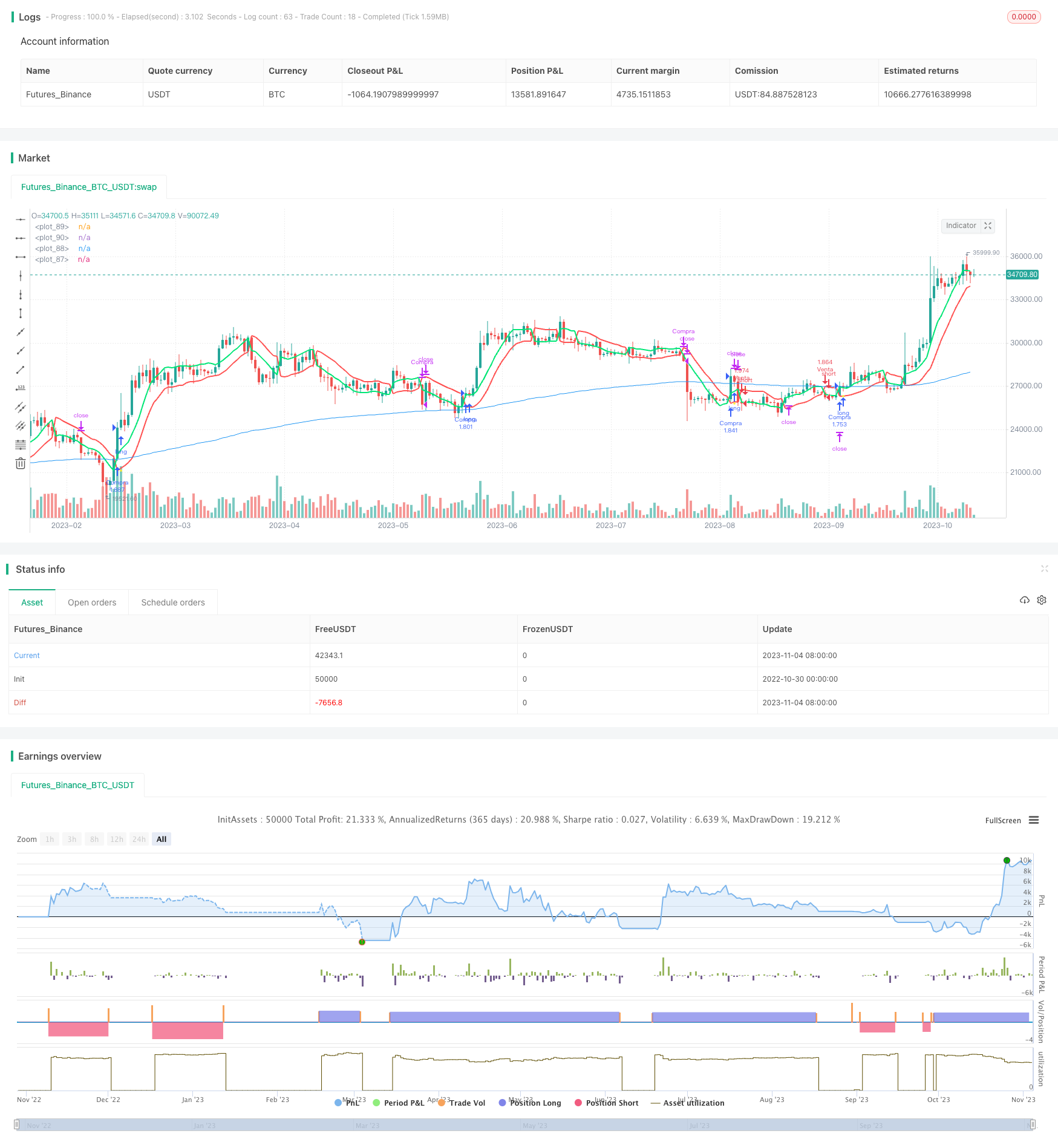
This strategy integrates the Dual SSL indicator and moving average indicator, using the Dual SSL indicator to determine market trend direction, and moving averages for trend confirmation. It belongs to a trend…
Overview
This strategy integrates the Dual SSL indicator and moving average indicator, using the Dual SSL indicator to determine market trend direction, and moving averages for trend confirmation. It belongs to a trend following strategy. With the addition of a stop loss to control risk, it is a relatively stable strategy.
Strategy Logic
Calculate the upper rail by taking the SMA of the highest price over a specified period vs. yesterday's close. Calculate the lower rail by taking the SMA of the lowest price over a specified period vs. yesterday's close.
Compare the current closing price with the upper and lower rails to determine the current trend direction. If the closing price is above the upper rail, the trend is determined as bullish. If the closing price is below the lower rail, the trend is determined as bearish.
Calculate the 200-period SMA of closing prices as a benchmark for medium to long term trends.
When bullish, if the closing price breaks above the SMA from below, a buy signal is generated. When bearish, if the closing price breaks below the SMA from above, a sell signal is generated.
After entering a long position, if the closing price breaks below the upper rail, it is a close signal. After entering a short position, if the closing price breaks above the lower rail, it is a close signal.
Set a fixed percentage stop loss point. If the closing price breaks below the stop loss point, the stop loss order is triggered.
Advantages
Using the Dual SSL indicator to determine trend direction can effectively identify trends and increase the probability of entering in the right direction.
Adding moving averages can filter out some noise signals and avoid wrong trades in choppy markets.
Using a stop loss to control single trade risk can effectively avoid excessive losses.
The strategy logic is relatively simple and easy to understand, suitable for beginners to practice on.
Risks
The Dual SSL indicator is sensitive to parameter tuning, different period combinations can lead to very different results. Parameters should be carefully optimized.
A MA that is too long filters out too many trading opportunities, while one too short fails to denoise effectively. A balanced MA period should be used.
A stop loss range set too wide fails to control risk effectively, while one too tight may be triggered by normal price fluctuations. The stop loss range needs to be set carefully.
The strategy relies heavily on parameter optimization. Incorrect parameters may fail to identify trends correctly, leading to wrong trading decisions.
Optimization Directions
Test different period combinations to find parameters that can improve trend determination accuracy for the Dual SSL indicator.
Test different period MAs to find the optimal balance between denoising and preserving signals.
Explore adaptive stop losses that adjust based on market volatility to make the stop loss more responsive.
Incorporate other indicators for confirmation, such as volume, multi-timeframe confluence, to improve robustness.
Walk forward analysis should be conducted on the optimized strategy to ensure robustness.
Conclusion
This strategy combines the strengths of the Dual SSL indicator and moving averages. With significant potential for parameter optimization, it is a trend following strategy. With reasonable parameter tuning and optimization, good results can be achieved. However, the risk of overfitting should be controlled to ensure robustness. Overall, this strategy serves as a good example for exploration and learning.
Parameters
| Name | Default | What it controls |
|---|---|---|
| v_input_float_1 | 2 | Stop Loss |
| v_input_1 | 10 | Period |
| v_input_2 | 10 | Period |
Source Pine Script
/*backtest
start: 2022-10-30 00:00:00
end: 2023-11-05 00:00:00
period: 1d
basePeriod: 1h
exchanges: [{"eid":"Futures_Binance","currency":"BTC_USDT"}]
*/

//@version=5
//@Isaac
//Estrategia vista en ▼▼
//YT: Trading Zone
strategy('SSL Strategy + EMA 200 AND Stop Loss', overlay=true)

ema = ta.ema(close, 200)

stop_loss = input.float(2.00, title='Stop Loss', step=0.10)

period = input(title='Period', defval=10)
len = input(title='Period', defval=10)
smaHigh = ta.sma(high, len)
smaLow = ta.sma(low, len)
Hlv = int(na)
Hlv := close > smaHigh ? 1 : close < smaLow ? -1 : Hlv[1]
sslDown = Hlv < 0 ? smaHigh : smaLow
sslUp = Hlv < 0 ? smaLow : smaHigh


cruceArriba = ta.crossover(sslUp, sslDown)
cruceAbajo = ta.crossunder(sslUp, sslDown)

alcista = (close > ema ) and (cruceArriba)
bajista = (close < ema) and (cruceAbajo)

var SL = 0.0
//Cerrar compra por cruce
por_cruce = ta.crossunder(sslUp, sslDown)

//Cerrar venta por cruce
por_cruceAB = ta.crossunder(sslDown, sslUp)

//Cerrar compra y venta por stop loss
Stop = SL

comprado = strategy.position_size > 0
vendido = strategy.position_size < 0

UTmpconvertL = strategy.position_avg_price * (1 + 0.1)
UTmpdefineL = (UTmpconvertL > close and strategy.openprofit > 0.1)
UTSPL = UTmpdefineL

SPL = UTSPL

///////////////////////////////////////////////////////////////////////

UTmpconvertLS = strategy.position_avg_price * (1 + 0.1)
UTmpdefineLS = (UTmpconvertLS > close and strategy.openprofit > 0.1)
UTSPLS = UTmpdefineLS

SPLS = UTSPLS

////////////////////////////////////////////////////////////////////////

if not comprado and not vendido and alcista
    cantidad = (strategy.equity / close)
    strategy.entry('Compra', strategy.long, qty=cantidad, comment="Long")
    SL := sslDown


if comprado and not vendido and por_cruce and SPL
    strategy.close("Compra", comment="Exit Long")
    SL := 0

if comprado and not vendido and Stop
    strategy.exit('Compra', stop=Stop, comment="SL")
    SL := 0

///////////////////////////////////////////////////////////////////

if not comprado and not vendido and bajista
    cantidad = (strategy.equity / close)
    strategy.entry('Venta', strategy.short, qty=cantidad, comment="Short")
    SL := sslDown

if not comprado and vendido and por_cruceAB and SPLS
    strategy.close("Venta", comment="Exit Short")
    SL := 0

if not comprado and vendido and Stop
    strategy.exit('Venta', stop=Stop, comment="SLS")
    SL := 0


plot(Stop > 0 ? Stop : na, style=plot.style_circles, color=color.new(color.yellow,0))
plot(ema)
plot(sslDown, linewidth=2, color=color.new(color.red, 0))
plot(sslUp, linewidth=2, color=color.new(color.lime, 0))
Published by ChaoZhang on the FMZ strategy square · last modified 2023-11-06. Collected in the Quant Trading Vault. Unvalidated research: re-test with your own data and costs before trusting it.
Build this with AgenKit
A spec is not a trading system. Paste this into your coding agent and AgenKit runs a specialist team — architecture, test-first build, risk gates, review — with paper trading on by default.
/agenkit build a production-grade trading bot with a backtest engine, risk controls and paper trading by default from strategies/Dual-SSL-Strategy-with-EMA-Stop-Loss.md- npx agenkit install engineering-kit in your project
- Paste the command into your agent and approve each phase
- Get tests, backtest, risk controls and a paper-trading switch
Understand it first
Before you run this, read the lesson behind the idea and how to backtest it honestly. Specs like this one are the survivors of an unknown number of trials; deflate their results accordingly.
Related specs
- ADX MA and EMA Long Only Trend Tracking StrategyPine Script · Trend following · 1d
- ATR and Moving Average Crossover Hybrid StrategyPine Script · Trend following · 1h
- Bollinger Band Moving Average Crossover StrategyPine Script · Trend following · 1h
- Bollinger Bands and EMA Trend Following StrategyPine Script · Trend following · 1h
- Bollinger Bands and RSI Trend Following StrategyPine Script · Trend following · 1h
- Candlestick Pattern Trend Filter StrategyPine Script · Trend following · 1d