Strategy vault / Trend following
Dynamic Dual EMA Crossover Strategy with Adaptive Profit Loss Control
This is a quantitative trading strategy based on dual EMA crossover signals, which uses the intersection of fast and slow Exponential Moving Averages (EMA) to determine market trends, combined with dynamic…
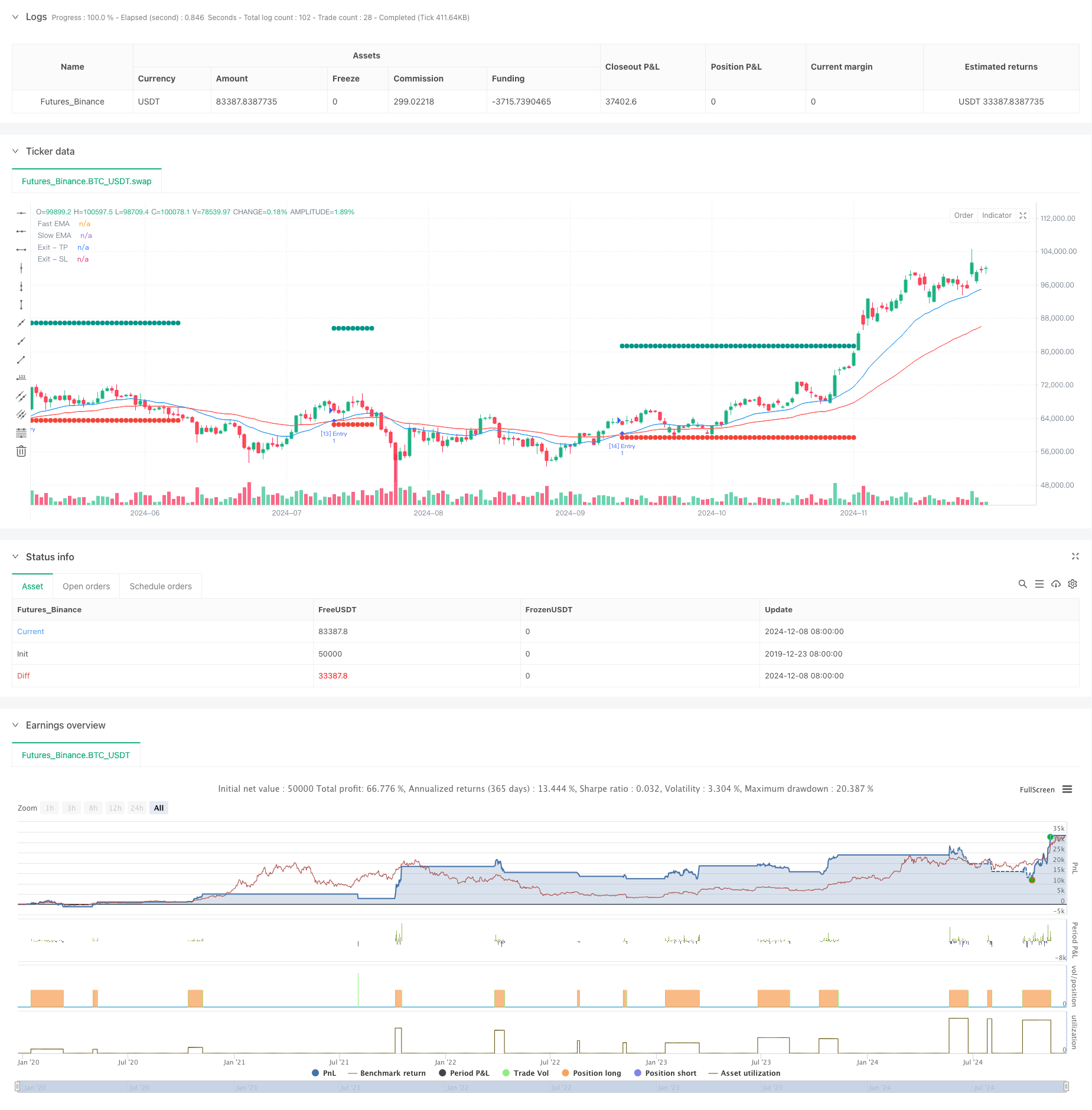
Overview
This is a quantitative trading strategy based on dual EMA crossover signals, which uses the intersection of fast and slow Exponential Moving Averages (EMA) to determine market trends, combined with dynamic take-profit and stop-loss controls for risk management. The strategy employs percentage-based position management, defaulting to 10% of capital per trade, and implements dynamic profit targets and stop-loss levels for protection.
Strategy Principles
The core logic revolves around monitoring crossovers between 20-period and 50-period EMAs to identify trend changes. A long position is initiated when the fast EMA crosses above the slow EMA. Upon entry, the system automatically sets take-profit levels (1.3 times entry price) and stop-loss levels (0.95 times entry price). This dynamic profit/loss control design adapts to different market conditions, enhancing strategy flexibility.
Strategy Advantages
- Signal Stability - Uses EMA instead of SMA, providing faster response to price changes while filtering market noise.
- Comprehensive Risk Management - Implements dynamic take-profit and stop-loss mechanisms that adjust with entry prices.
- Rational Capital Management - Uses fixed proportion position sizing, avoiding high-risk full position trading.
- High Automation - Automates everything from signal generation to position management, reducing human intervention.
- Strong Adaptability - Strategy can adapt to different market conditions with adjustable parameters.
Strategy Risks
- EMA Lag - Despite being faster than SMA, EMA still has some inherent lag, potentially causing delayed entries.
- Poor Performance in Ranging Markets - May generate frequent false breakout signals during sideways market conditions.
- Fixed Multiplier for Profit/Loss - Using fixed multipliers for take-profit and stop-loss may not suit all market conditions.
- Drawdown Risk - 5% stop-loss might not be sufficient in highly volatile markets.
Optimization Directions
- Incorporate Volatility Indicators - Suggest adding ATR to dynamically adjust profit/loss multipliers for better market adaptation.
- Add Trend Confirmation - Consider incorporating RSI, MACD for signal filtering to improve win rate.
- Optimize Position Sizing - Implement dynamic position sizing based on market volatility for finer risk control.
- Add Time Filters - Consider adding trading time windows to avoid highly volatile periods.
- Enhance Profit-Taking - Implement trailing stops to capture more profit in strong trends.
Conclusion
This is a well-designed trend-following strategy with clear logic, using dual EMA crossovers for trend capture and dynamic profit/loss controls for risk management. The strategy's strengths lie in its clear rules and controlled risk, making it suitable as a foundation for medium to long-term trading systems. There's significant room for optimization through additional filters and enhanced profit/loss mechanisms. Traders should validate the strategy through backtesting across different market conditions and adjust parameters according to their risk tolerance before live implementation.
Source Pine Script
/*backtest
start: 2019-12-23 08:00:00
end: 2024-12-09 08:00:00
period: 1d
basePeriod: 1d
exchanges: [{"eid":"Futures_Binance","currency":"BTC_USDT"}]
*/

// This source code is subject to the terms of the Mozilla Public License 2.0 at https://mozilla.org/MPL/2.0/
// © Pineify

//======================================================================//
//                    ____  _            _  __                          //
//                   |  _ \(_)_ __   ___(_)/ _|_   _                    //
//                   | |_) | | '_ \ / _ \ | |_| | | |                   //
//                   |  __/| | | | |  __/ |  _| |_| |                   //
//                   |_|   |_|_| |_|\___|_|_|  \__, |                   //
//                                             |___/                    //
//======================================================================//

//@version=5
strategy(title="TQQQ EMA Strategy", overlay=true)

//#region -------------------------------------------------- Common Dependence

p_comm_time_range_to_unix_time(string time_range, int date_time = time, string timezone = syminfo.timezone) =>
    int start_unix_time = na
    int end_unix_time = na
    int start_time_hour = na
    int start_time_minute = na
    int end_time_hour = na
    int end_time_minute = na
    if str.length(time_range) == 11
        // Format: hh:mm-hh:mm
        start_time_hour := math.floor(str.tonumber(str.substring(time_range, 0, 2)))
        start_time_minute := math.floor(str.tonumber(str.substring(time_range, 3, 5)))
        end_time_hour := math.floor(str.tonumber(str.substring(time_range, 6, 8)))
        end_time_minute := math.floor(str.tonumber(str.substring(time_range, 9, 11)))
    else if str.length(time_range) == 9
        // Format: hhmm-hhmm
        start_time_hour := math.floor(str.tonumber(str.substring(time_range, 0, 2)))
        start_time_minute := math.floor(str.tonumber(str.substring(time_range, 2, 4)))
        end_time_hour := math.floor(str.tonumber(str.substring(time_range, 5, 7)))
        end_time_minute := math.floor(str.tonumber(str.substring(time_range, 7, 9)))
    start_unix_time := timestamp(timezone, year(date_time, timezone), month(date_time, timezone), dayofmonth(date_time, timezone), start_time_hour, start_time_minute, 0)
    end_unix_time := timestamp(timezone, year(date_time, timezone), month(date_time, timezone), dayofmonth(date_time, timezone), end_time_hour, end_time_minute, 0)
    [start_unix_time, end_unix_time]

p_comm_time_range_to_start_unix_time(string time_range, int date_time = time, string timezone = syminfo.timezone) =>
    int start_time_hour = na
    int start_time_minute = na
    if str.length(time_range) == 11
        // Format: hh:mm-hh:mm
        start_time_hour := math.floor(str.tonumber(str.substring(time_range, 0, 2)))
        start_time_minute := math.floor(str.tonumber(str.substring(time_range, 3, 5)))
    else if str.length(time_range) == 9
        // Format: hhmm-hhmm
        start_time_hour := math.floor(str.tonumber(str.substring(time_range, 0, 2)))
        start_time_minute := math.floor(str.tonumber(str.substring(time_range, 2, 4)))
    timestamp(timezone, year(date_time, timezone), month(date_time, timezone), dayofmonth(date_time, timezone), start_time_hour, start_time_minute, 0)

p_comm_time_range_to_end_unix_time(string time_range, int date_time = time, string timezone = syminfo.timezone) =>
    int end_time_hour = na
    int end_time_minute = na
    if str.length(time_range) == 11
        end_time_hour := math.floor(str.tonumber(str.substring(time_range, 6, 8)))
        end_time_minute := math.floor(str.tonumber(str.substring(time_range, 9, 11)))
    else if str.length(time_range) == 9
        end_time_hour := math.floor(str.tonumber(str.substring(time_range, 5, 7)))
        end_time_minute := math.floor(str.tonumber(str.substring(time_range, 7, 9)))
    timestamp(timezone, year(date_time, timezone), month(date_time, timezone), dayofmonth(date_time, timezone), end_time_hour, end_time_minute, 0)

p_comm_timeframe_to_seconds(simple string tf) =>
    float seconds = 0
    tf_lower = str.lower(tf)
    value = str.tonumber(str.substring(tf_lower, 0, str.length(tf_lower) - 1))
    if str.endswith(tf_lower, 's')
        seconds := value
    else if str.endswith(tf_lower, 'd')
        seconds := value * 86400
    else if str.endswith(tf_lower, 'w')
        seconds := value * 604800
    else if str.endswith(tf_lower, 'm')
        seconds := value * 2592000
    else
        seconds := str.tonumber(tf_lower) * 60
    seconds

p_custom_sources() =>
    [open, high, low, close, volume]

//#endregion -----------------------------------------------------------------


//#region -------------------------------------------------- Ta Dependence


//#endregion -------------------------------------------------------------


//#region -------------------------------------------------- Constants

// Input Groups
string P_GP_1      =      ""

//#endregion ---------------------------------------------------------


//#region -------------------------------------------------- Inputs

// Default
int p_inp_1        =      input.int(defval=20, title="Fast EMA Length", group=P_GP_1)
int p_inp_2        =      input.int(defval=50, title="Slow EMA Length", group=P_GP_1)
float p_inp_3      =      input.float(defval=1.3, title="Take Profit Price Multiplier", group=P_GP_1, step=0.01)
float p_inp_4      =      input.float(defval=0.95, title="Stop Loss Price Multiplier", group=P_GP_1, step=0.01)


//#endregion -------------------------------------------------------


//#region -------------------------------------------------- Price Data


//#endregion -----------------------------------------------------------


//#region -------------------------------------------------- Indicators

p_ind_1      =      ta.ema(close, p_inp_1) // Fast EMA
p_ind_2      =      ta.ema(close, p_inp_2) // Slow EMA


//#endregion -----------------------------------------------------------


//#region -------------------------------------------------- Conditions

p_cond_1      =      (ta.crossover(p_ind_1, p_ind_2))


//#endregion -----------------------------------------------------------


//#region -------------------------------------------------- Strategy

// Strategy Order Variables
string p_st_name_1                       =      "Entry"
string p_st_name_2                       =      "Exit"
var float p_st_name_2_tp                 =      na
var bool p_st_name_2_tp_can_drawing      =      true
var float p_st_name_2_sl                 =      na
var bool p_st_name_2_sl_can_drawing      =      true

// Strategy Global
open_trades_number = strategy.opentrades
pre_bar_open_trades_number = na(open_trades_number[1]) ? 0 : open_trades_number[1]
var p_entry_order_id = 1
p_can_place_entry_order() =>
    strategy.equity > 0
get_entry_id_name(int current_order_id, string name) =>
    "[" + str.tostring(current_order_id) + "] " + name
is_entry_order(string order_id, string name) =>
    str.startswith(order_id, "[") and str.endswith(order_id, "] " + name)
get_open_trades_entry_ids() =>
    int p_open_trades_count = strategy.opentrades
    string[] p_entry_ids = array.new_string(0, "")
    if p_open_trades_count > 0
        for i = 0 to p_open_trades_count - 1
            array.push(p_entry_ids, strategy.opentrades.entry_id(i))
    p_entry_ids

// Entry (Entry)
if p_cond_1 and p_can_place_entry_order()
    p_st_name_1_id = get_entry_id_name(p_entry_order_id, p_st_name_1)
    p_entry_order_id := p_entry_order_id + 1
    string entry_message = ""
    strategy.entry(id=p_st_name_1_id, direction=strategy.long, alert_message=entry_message, comment=p_st_name_1_id)

    // TP/SL Exit (Exit)
    float p_st_name_2_limit = close * p_inp_3
    if p_st_name_2_tp_can_drawing
        p_st_name_2_tp_can_drawing := false
        p_st_name_2_tp := p_st_name_2_limit
    float p_st_name_2_stop = close * p_inp_4
    if p_st_name_2_sl_can_drawing
        p_st_name_2_sl_can_drawing := false
        p_st_name_2_sl := p_st_name_2_stop
    string p_st_name_2_alert_message = ""
    strategy.exit(id=p_st_name_1_id + "_0", from_entry=p_st_name_1_id, qty_percent=100, limit=p_st_name_2_limit, stop=p_st_name_2_stop, comment_profit=p_st_name_2 + " - TP", comment_loss=p_st_name_2 + " - SL", alert_message=p_st_name_2_alert_message)


if high >= p_st_name_2_tp or (pre_bar_open_trades_number > 0 and open_trades_number == 0)
    p_st_name_2_tp_can_drawing := true
    p_st_name_2_sl_can_drawing := true
    p_st_name_2_tp := na
    p_st_name_2_sl := na
plot(p_st_name_2_tp, title="Exit - TP", color=color.rgb(0, 150, 136, 0), linewidth=1, style = plot.style_circles)
if low <= p_st_name_2_sl or (pre_bar_open_trades_number > 0 and open_trades_number == 0)
    p_st_name_2_sl_can_drawing := true
    p_st_name_2_tp_can_drawing := true
    p_st_name_2_sl := na
    p_st_name_2_tp := na
plot(p_st_name_2_sl, title="Exit - SL", color=color.rgb(244, 67, 54, 0), linewidth=1, style = plot.style_circles)
//#endregion ---------------------------------------------------------


//#region -------------------------------------------------- Indicator Plots

// Fast EMA
plot(p_ind_1, "Fast EMA", color.rgb(33, 150, 243, 0), 1)

// Slow EMA
plot(p_ind_2, "Slow EMA", color.rgb(255, 82, 82, 0), 1)

//#endregion ----------------------------------------------------------------


//#region -------------------------------------------------- Custom Plots

//#endregion -------------------------------------------------------------


//#region -------------------------------------------------- Alert

//#endregion ------------------------------------------------------
Published by ChaoZhang on the FMZ strategy square · last modified 2024-12-11. Collected in the Quant Trading Vault. Unvalidated research: re-test with your own data and costs before trusting it.
Build this with AgenKit
A spec is not a trading system. Paste this into your coding agent and AgenKit runs a specialist team — architecture, test-first build, risk gates, review — with paper trading on by default.
/agenkit build a production-grade trading bot with a backtest engine, risk controls and paper trading by default from strategies/Dynamic-Dual-EMA-Crossover-Strategy-with-Adaptive-Profit-Loss-Control.md- npx agenkit install engineering-kit in your project
- Paste the command into your agent and approve each phase
- Get tests, backtest, risk controls and a paper-trading switch
Understand it first
Before you run this, read the lesson behind the idea and how to backtest it honestly. Specs like this one are the survivors of an unknown number of trials; deflate their results accordingly.
Related specs
- Bollinger Bands and RSI Trend Following StrategyPine Script · Trend following · 1h
- Dual ATR Channel Trend Following StrategyPine Script · Trend following · 15m
- EMA and RSI Trend Trading StrategyPine Script · Trend following · 1d
- Fixed Range Volume Profile And Anchored VWAP Trend Identification Strategy With Dynamic Stop LossPine Script · Trend following · 1h
- Multi Moving Average Trend Capture and Crossover Confirmation Trading SystemPine Script · Trend following · 1m
- Multi Timeframe Trend Following with ATR Volatility Based Dynamic Risk Management System StrategyPine Script · Trend following · 1h