Dynamic Market Sentiment Threshold Trading Strategy
The Dynamic Market Sentiment Threshold Trading Strategy is an automated trading system that capitalizes on market fear and greed emotions to make trading decisions. The strategy utilizes dynamic changes in the Fear…
Overview
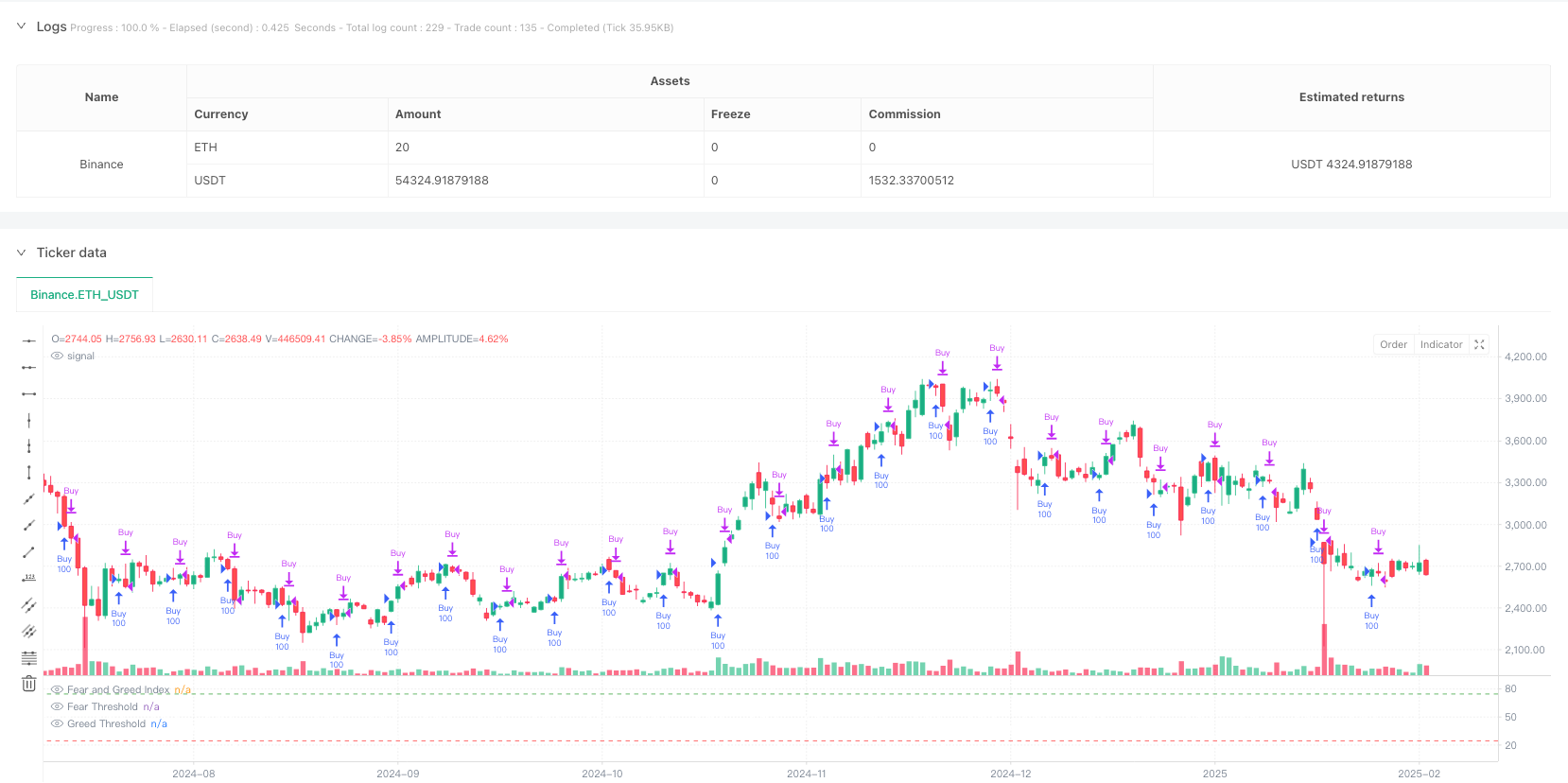
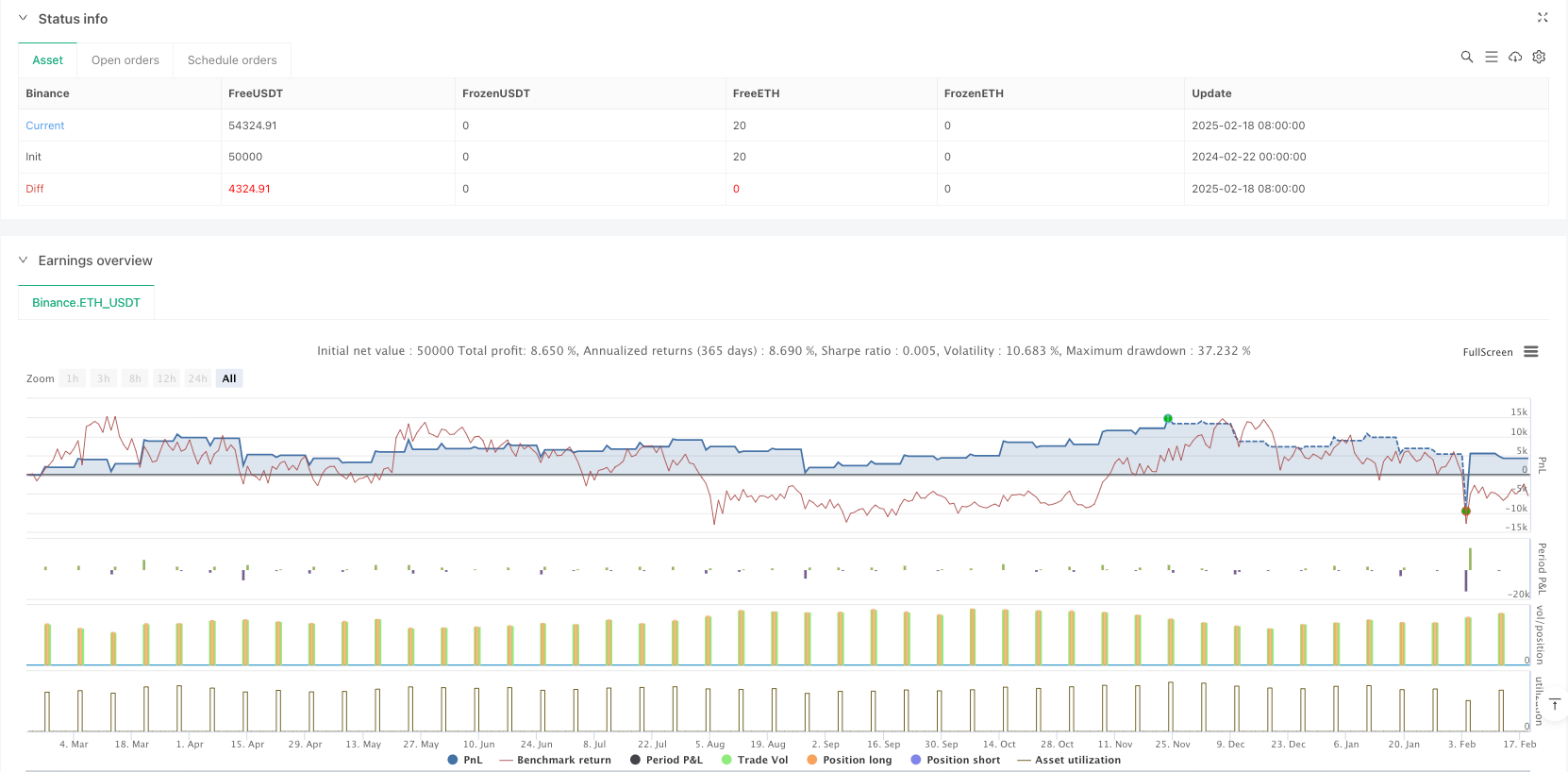
The Dynamic Market Sentiment Threshold Trading Strategy is an automated trading system that capitalizes on market fear and greed emotions to make trading decisions. The strategy utilizes dynamic changes in the Fear and Greed Index, entering positions during extreme fear and exiting during extreme greed, aiming to capture trading opportunities through market psychology.
Strategy Principles
The core mechanism monitors dynamic changes in the Fear and Greed Index to identify market sentiment turning points. Specifically:
- Strategy sets two key thresholds: fear threshold (25) and greed threshold (75)
- When the index transitions into the greed zone (>75), the system automatically generates a buy signal
- When the index transitions into the fear zone (<25), the system automatically generates a sell signal
- Trade volume is fixed at 100 units for risk control purposes
- Strategy stores historical data in arrays and uses modulo operation to locate current period index values
Strategy Advantages
- High Automation: Strategy executes trades automatically, reducing emotional interference
- Psychological Quantification: Converts market sentiment into quantifiable trading indicators
- Robust Risk Control: Manages risk through fixed trading volume and clear entry/exit mechanisms
- Strong Visualization: Provides clear graphical interface and trade signal markers
- High Adaptability: Applicable across multiple markets including stocks, cryptocurrencies, and forex
Strategy Risks
- Lag Risk: Sentiment indicators may have inherent lag, affecting signal timeliness
- False Breakout Risk: Short-term sentiment fluctuations may trigger false trading signals
- Market Environment Dependency: May generate frequent trades in highly volatile markets
- Parameter Sensitivity: Strategy performance heavily depends on threshold settings
- Data Dependency: Strategy effectiveness relies on accuracy and timeliness of sentiment data
Strategy Optimization Directions
- Implement Multiple Confirmation Mechanisms: Combine with other technical indicators like RSI or MACD
- Dynamic Threshold Adjustment: Automatically adjust fear and greed thresholds based on market volatility
- Enhanced Position Management: Introduce dynamic position sizing to replace fixed trading volume
- Optimize Signal Filtering: Add signal filtering mechanisms to reduce false breakout trades
- Improve Backtesting System: Add more backtesting metrics to evaluate strategy stability
Summary
This innovative trading strategy based on market psychology captures trading opportunities by quantifying market sentiment. While there are potential risks, continuous optimization and refinement suggest promising potential for stable performance in actual trading. Traders are advised to conduct thorough backtesting and parameter optimization before live implementation.
Source Pine Script
/*backtest
start: 2024-02-22 00:00:00
end: 2025-02-19 08:00:00
period: 1d
basePeriod: 1d
exchanges: [{"eid":"Binance","currency":"ETH_USDT"}]
*/

//@version=6
strategy("Fear and Greed Trading Strategy", overlay=false)

// Manually input Fear and Greed Index data (example values for demo)
fear_and_greed = array.from(40, 35, 50, 60, 45, 80, 20, 10)  // Replace with your data points

// Get the current bar index within the array bounds
current_index = bar_index % array.size(fear_and_greed)

// Extract data for the current bar
fgi_value = array.get(fear_and_greed, current_index)

// Initialize variables for previous index and value
var float fgi_prev = na
if (current_index > 0)
    fgi_prev := array.get(fear_and_greed, current_index - 1)

// Set thresholds
fear_threshold = 25
greed_threshold = 75

// Determine current and previous states
state_prev = na(fgi_prev) ? "neutral" : fgi_prev < fear_threshold ? "fear" : fgi_prev > greed_threshold ? "greed" : "neutral"
state_curr = fgi_value < fear_threshold ? "fear" : fgi_value > greed_threshold ? "greed" : "neutral"

// Buy and sell conditions
buy_condition = state_prev != "greed" and state_curr == "greed"
sell_condition = state_prev != "fear" and state_curr == "fear"

// Execute trades
if (buy_condition)
    strategy.entry("Buy", strategy.long, qty=100)
if (sell_condition)
    strategy.close("Buy")

// Plotting for visualization
plot(fgi_value, color=color.new(color.white, 0), linewidth=2, title="Fear and Greed Index")
hline(fear_threshold, "Fear Threshold", color=color.red, linestyle=hline.style_dashed)
hline(greed_threshold, "Greed Threshold", color=color.green, linestyle=hline.style_dashed)

// Add labels for actions
if (buy_condition)
    label.new(bar_index, fgi_value, "Buy", style=label.style_label_down, color=color.green, textcolor=color.white)
if (sell_condition)
    label.new(bar_index, fgi_value, "Sell", style=label.style_label_up, color=color.red, textcolor=color.white)
Published by ianzeng123 on the FMZ strategy square · last modified 2025-02-21. Collected in the Quant Trading Vault. Unvalidated research: re-test with your own data and costs before trusting it.
Build this with AgenKit
A spec is not a trading system. Paste this into your coding agent and AgenKit runs a specialist team — architecture, test-first build, risk gates, review — with paper trading on by default.
/agenkit build a production-grade trading bot with a backtest engine, risk controls and paper trading by default from strategies/Dynamic-Market-Sentiment-Threshold-Trading-Strategy.md- npx agenkit install engineering-kit in your project
- Paste the command into your agent and approve each phase
- Get tests, backtest, risk controls and a paper-trading switch
Understand it first
Before you run this, read the lesson behind the idea and how to backtest it honestly. Specs like this one are the survivors of an unknown number of trials; deflate their results accordingly.
Related specs
- Bollinger Bands Dynamic Breakout StrategyPine Script · Breakout · 1h
- Bull Market Tracking SystemPine Script · Breakout · 1h
- Cross boundary Dynamic Range Quantitative Trading Strategy Based on Bollinger BandsPine Script · Breakout · 3h
- Darvas Box Breakout and Risk Management Strategy DarvasPine Script · Breakout · 1d
- MA Trendline Breakthrough StrategyPine Script · Breakout · 1d
- Momentum Breakout Moving Average StrategyPine Script · Breakout · 1d