Strategy vault / Machine learning
Ehlers Fisher Stochastic Relative Vigor Index Strategy
This strategy is based on the Ehlers Fisher Stochastic Relative Vigor Index indicator proposed by John Ehlers in his book "Cybernetic Analysis for Stocks and Futures". The strategy utilizes the Ehlers Fisher…
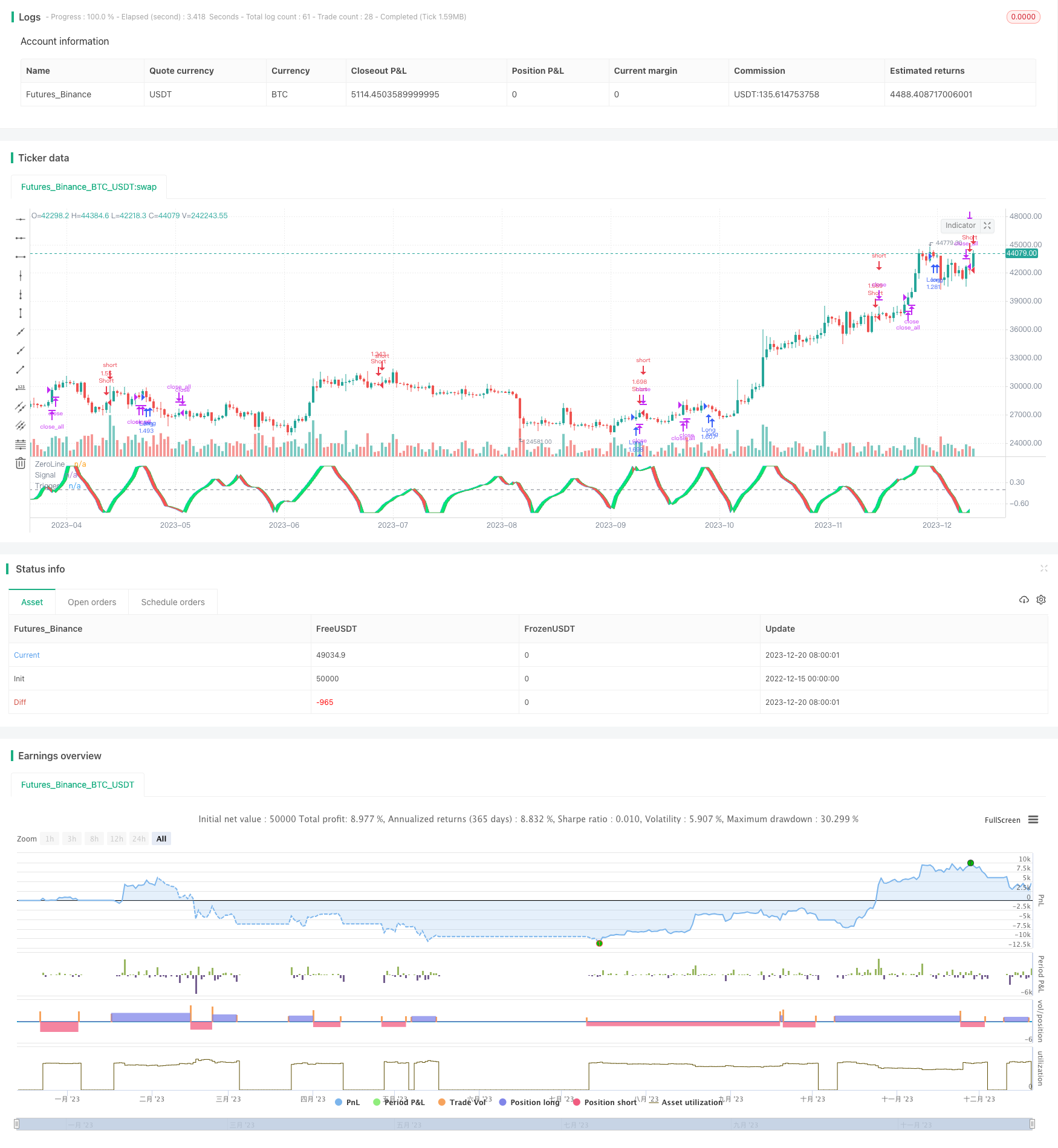
Overview
This strategy is based on the Ehlers Fisher Stochastic Relative Vigor Index indicator proposed by John Ehlers in his book "Cybernetic Analysis for Stocks and Futures". The strategy utilizes the Ehlers Fisher indicator to judge the relative strength of stocks and combines it with custom trading rules for entries and exits.
Strategy Logic
The strategy first calculates the closing price - opening price, which is the body of the candlestick. Then it calculates the high price - low price, which is the shadow of the candlestick. By taking sum and average of these two parts respectively, it obtains the momentum of the stock. Then by dividing the momentum with the volatility of the stock, it gets the Relative Vigor Index (RVI).
Next, the Ehlers Fisher formula is applied on RVI to get the signal value. It goes long when signal crosses over trigger, and goes short when signal crosses below trigger. In addition, fixed stop loss and trailing stop loss are implemented to control risks.
Advantage Analysis
This strategy integrates the momentum characteristics and stochastic indicator of stocks, which can effectively determine the relative strength in the market. The design of Ehlers Fisher indicator can reduce the impact of noise and generate relatively reliable trading signals. The vigor index reflects the trending quality and volatility of a stock itself, making it a dynamic indicator.
Compared with using a single momentum indicator or stochastic indicator, this strategy combines indicators and models organically, which can improve the quality of signals. The strict stop loss rules also enable the strategy to control risks while ensuring profitability.
Risk Analysis
This strategy mainly relies on the Ehlers Fisher indicator. When there are drastic changes in the market, the parameters of the indicator need to be optimized to adapt to the new environment. If the parameters are set improperly, it may generate incorrect signals or lagging signals.
In addition, there is some degree of curve fitting risk intrinsically in the strategy itself. If the market environment in backtesting and live trading changes greatly, the performance of the strategy may deviate largely. In this case, strategy parameters need to be adjusted and trading rules require optimization for fitting the new market conditions.
Optimization Directions
This strategy can be further optimized in the following aspects:
Optimize the parameters of the Ehlers Fisher indicator for higher sensitivity or noise filtering.
Model the indicator with machine learning algorithms like LSTM to generate more reliable trading signals.
Incorporate market volatility indicators like ATR to dynamically adjust the stop loss distance.
Add support for multi-factor models, combining other technical and fundamental indicators to improve signal quality.
Optimize the open/close positions logic with dynamic entry/exit criteria. Introduce adaptive stop loss and take profit techniques.
Conclusion
This strategy utilizes the Ehlers Fisher Stochastic RVI indicator to determine market trend and strength, and sets reasonable stop loss mechanisms to control risks. Compared with single indicators, this strategy combines multiple indicators and models organically, which can filter out noise and provide high quality signals. There is still room for further improvement in strategy performance through parameters optimization, model fusion, adaptive adjustment and other means.
Parameters
| Name | Default | What it controls |
|---|---|---|
| v_input_1 | 10 | Length |
| v_input_2 | true | oppositeTrade |
Source Pine Script
/*backtest
start: 2022-12-15 00:00:00
end: 2023-12-21 00:00:00
period: 1d
basePeriod: 1h
exchanges: [{"eid":"Futures_Binance","currency":"BTC_USDT"}]
*/

//@version=3
strategy("Ehlers Fisher Stochastic Relative Vigor Index Strategy", overlay = false, default_qty_type = strategy.percent_of_equity, default_qty_value = 100.0, pyramiding = 1, commission_type = strategy.commission.percent, commission_value = 0.1)
p = input(10, title = "Length")
FisherStoch(src, len) =>
    val1 = stoch(src, src, src, len) / 100
    val2 = (4 * val1 + 3 * val1[1] + 2 * val1[2] + val1[3]) / 10
    FisherStoch = 0.5 * log((1 + 1.98 * (val2 - 0.5)) / (1 - 1.98 * (val2 - 0.5))) / 2.64

CO = close - open
HL = high - low

value1 = (CO + 2 * CO[1] + 2 * CO[2] + CO[3]) / 6
value2 = (HL + 2 * HL[1] + 2 * HL[2] + HL[3]) / 6

num = sum(value1, p)
denom = sum(value2, p)

RVI = denom != 0 ? num / denom : 0

signal = FisherStoch(RVI, p)
trigger = signal[1]
oppositeTrade = input(true)
barsSinceEntry = 0
barsSinceEntry := nz(barsSinceEntry[1]) + 1
if strategy.position_size == 0
    barsSinceEntry := 0
if ((crossover(signal, trigger) and not oppositeTrade) or (oppositeTrade and crossunder(signal, trigger))) and abs(signal) > 2 / 2.64
    strategy.entry("Long", strategy.long)
    barsSinceEntry := 0
if ((crossunder(signal, trigger) and not oppositeTrade) or (oppositeTrade and crossover(signal, trigger))) and abs(signal) > 2 / 2.64
    strategy.entry("Short", strategy.short)
    barsSinceEntry := 0
if strategy.openprofit < 0 and barsSinceEntry > 8
    strategy.close_all()
    barsSinceEntry := 0

hline(0, title="ZeroLine", color=gray)
signalPlot = plot(signal, title = "Signal", color = blue)
triggerPlot = plot(trigger, title = "Trigger", color = green)
fill(signalPlot, triggerPlot, color = signal < trigger ? red : lime, transp = 50)
Published by ChaoZhang on the FMZ strategy square · last modified 2023-12-22. Collected in the Quant Trading Vault. Unvalidated research: re-test with your own data and costs before trusting it.
Build this with AgenKit
A spec is not a trading system. Paste this into your coding agent and AgenKit runs a specialist team — architecture, test-first build, risk gates, review — with paper trading on by default.
/agenkit build a production-grade trading bot with a backtest engine, risk controls and paper trading by default from strategies/Ehlers-Fisher-Stochastic-Relative-Vigor-Index-Strategy.md- npx agenkit install engineering-kit in your project
- Paste the command into your agent and approve each phase
- Get tests, backtest, risk controls and a paper-trading switch
Understand it first
Before you run this, read the lesson behind the idea and how to backtest it honestly. Specs like this one are the survivors of an unknown number of trials; deflate their results accordingly.
Related specs
- High Frequency Hybrid Technical Analysis Quantitative StrategyPine Script · Machine learning · 15m
- KRK aDa Stochastic Slow Mean Reversion Strategy with AI Enhancements KRK aDaPine Script · Machine learning · 1h
- Pure Stochastic Long Only StrategyPine Script · Machine learning · 5m
- Triple Moving Average Combined with MACD Quantitative StrategyPine Script · Machine learning · 1d
- Double K Crossbow StrategyPine Script · Machine learning · 1h
- Dual Indicator Stochastic RSI and EMA Trading StrategyPine Script · Machine learning · 1d