Strategy vault / Trend following
EMA RSI Hidden Divergence Trend Following Strategy
This strategy opens long positions based on the EMA crossover and RSI hidden bullish divergence signals to identify the beginning of an upward trend. The combination of EMA lines, RSI indicator, and K-line closing…
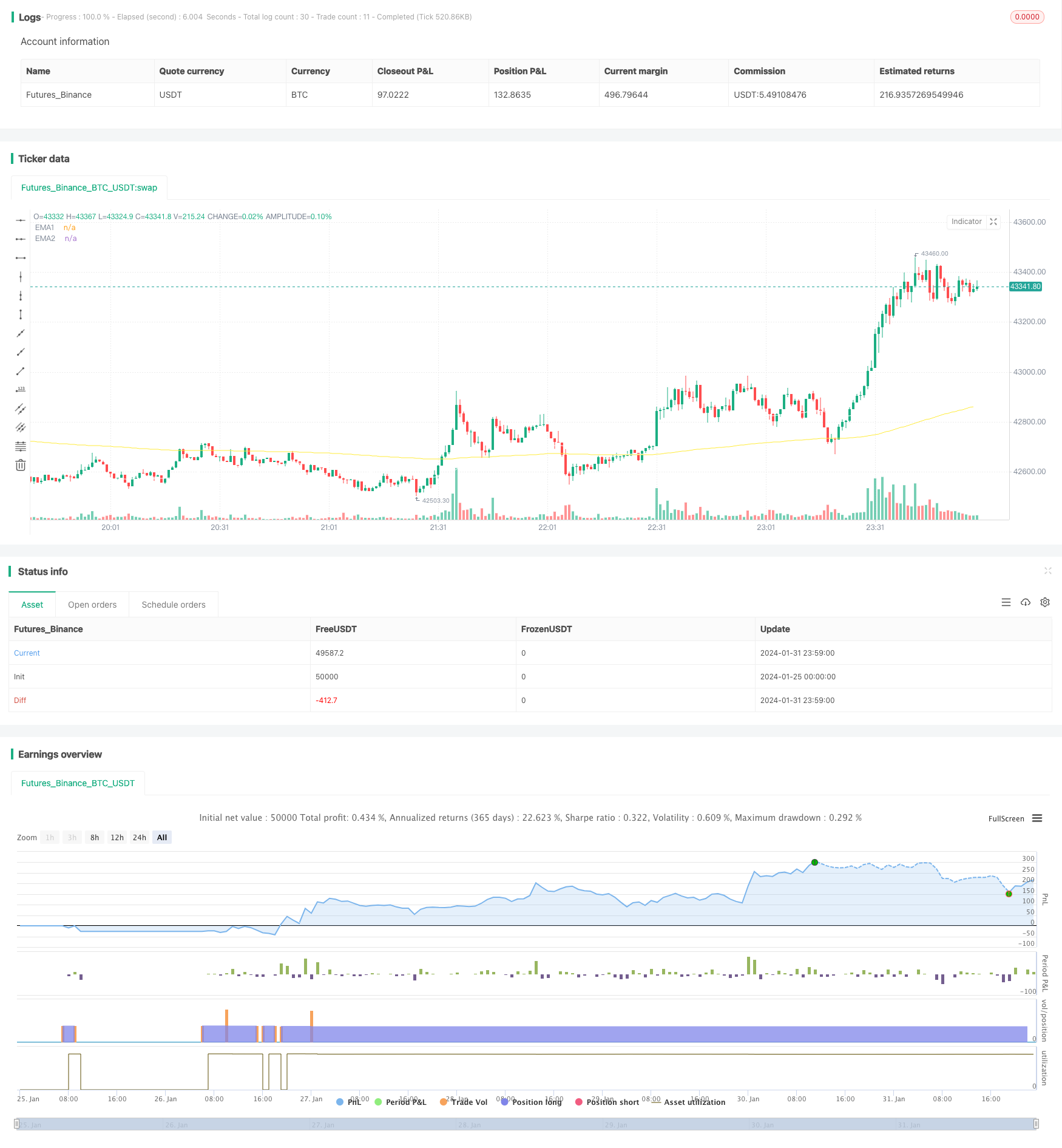
Overview
This strategy opens long positions based on the EMA crossover and RSI hidden bullish divergence signals to identify the beginning of an upward trend. The combination of EMA lines, RSI indicator, and K-line closing prices provides double confirmation for ensuring an upward momentum. This strategy is suitable to follow mid-long term trends and open long positions after price consolidations.
Strategy Logic
EMA Strategy: Using the golden cross of 50-period EMA and 250-period EMA to determine the trend direction. A close above the 50 EMA gives a long signal.
RSI Hidden Divergence Strategy: The RSI forms lower lows while price forms higher lows, signaling a trend reversal at the beginning. Limiting the number of pivot points filters out false signals.
K-line Closing Strategy: Go long when the closing price is above the 50 EMA line.
The combination of the above three strategies identifies the start of an upward trend and opens long positions accordingly.
Advantage Analysis
Using EMA lines to determine trend direction along with RSI reversal signals allows early entry at the beginning of trends.
The dual confirmation from EMA lines, RSI indicator, and K-line closing prices effectively filters out false signals.
Following mid-long term trends makes it suitable to identify new up trends after consolidations.
Risk Analysis
Close positions when the EMA lines have a death cross.
Identifying RSI hidden divergences needs experience, improper parameter tuning could lead to missing or false signals.
Parameters need optimization for different trading instruments.
Optimization Directions
Dynamically adjust EMA parameters for better trend determination accuracy.
Fine tune RSI parameters for better hidden divergence signal accuracy.
Add stop loss mechanisms like ATR or percentage stops to control risks.
Develop strategies for short positions to trade downward trends.
Conclusion
This strategy combines EMA lines for trend determination and RSI signals for increase accuracy. It identifies new upward trends after consolidations. With proper parameter tuning and risk management, it could achieve good results. Compared to simple moving average strategies, it has higher accuracy in catching trends with better win rates. Overall it is a practical trend following strategy.
Parameters
| Name | Default | What it controls |
|---|---|---|
| v_input_1 | true | FromMonth |
| v_input_2 | true | FromDay |
| v_input_3 | 2020 | FromYear |
| v_input_4 | true | ToMonth |
| v_input_5 | true | ToDay |
| v_input_6 | 9999 | ToYear |
| v_input_7 | 50 | EMA1 |
| v_input_8 | 250 | EMA2 |
| v_input_9 | 4 | K |
| v_input_10 | 4 | D |
| v_input_11 | 3 | Smooth |
| v_input_12 | 14 | RSI Period |
| v_input_13_close | 0 | RSI Source: close | high | low | open | hl2 | hlc3 | hlcc4 | ohlc4 |
| v_input_14 | true | Pivot Lookback Right |
| v_input_15 | 19 | Pivot Lookback Left |
| v_input_16 | 20 | Max of Lookback Range |
| v_input_17 | 4 | Min of Lookback Range |
| v_input_18 | 1.6 | Profitfactor |
| v_input_19 | 38 | Lowest Low Lookback |
Source Pine Script
/*backtest
start: 2024-01-25 00:00:00
end: 2024-02-01 00:00:00
period: 1m
basePeriod: 1m
exchanges: [{"eid":"Futures_Binance","currency":"BTC_USDT"}]
*/

//@version=4

strategy(title="EMA RSI ATR Hidden Div Strat", shorttitle="Hidden Div Strat", overlay = true, pyramiding = 0, max_bars_back=3000, calc_on_order_fills = false, commission_type =  strategy.commission.percent, commission_value = 0, default_qty_type = strategy.percent_of_equity, default_qty_value = 10, initial_capital=5000, currency=currency.USD)

// Time Range
FromMonth=input(defval=1,title="FromMonth",minval=1,maxval=12)
FromDay=input(defval=1,title="FromDay",minval=1,maxval=31)
FromYear=input(defval=2020,title="FromYear",minval=2016)
ToMonth=input(defval=1,title="ToMonth",minval=1,maxval=12)
ToDay=input(defval=1,title="ToDay",minval=1,maxval=31)
ToYear=input(defval=9999,title="ToYear",minval=2017)
start=timestamp(FromYear,FromMonth,FromDay,00,00)
finish=timestamp(ToYear,ToMonth,ToDay,23,59)
window()=>true

// Bar's time happened on/after start date?
afterStartDate = time >= start and time<=finish?true:false

//EMA'S
emasrc = close

len1 = input(50, minval=1, title="EMA1")
ema1 = ema(emasrc, len1)
col1 = color.white

len2 = input(250, minval=1, title="EMA2")
ema2 = ema(emasrc, len2)
col2 = color.yellow

//Plots
plot(ema1, title="EMA1", linewidth=1, color=col1)
plot(ema2, title="EMA2", linewidth=1, color=col2)

//Stoch
periodK = input(4, title="K", minval=1)
periodD = input(4, title="D", minval=1)
smoothK = input(3, title="Smooth", minval=1)
k = sma(stoch(close, high, low, periodK), smoothK)
d = sma(k, periodD)

//Hidden Divergence Indikator

len = input(title="RSI Period", minval=1, defval=14)
src = input(title="RSI Source", defval=close)
lbR = input(title="Pivot Lookback Right", defval=1)
lbL = input(title="Pivot Lookback Left", defval=19)
rangeUpper = input(title="Max of Lookback Range", defval=20)
rangeLower = input(title="Min of Lookback Range", defval=4)
hiddenBullColor = color.new(color.green, 80)
textColor = color.white
noneColor = color.new(color.white, 100)
osc = rsi(src, len)

plFound = na(pivotlow(osc, lbL, lbR)) ? false : true
phFound = na(pivothigh(osc, lbL, lbR)) ? false : true
_inRange(cond) =>
	bars = barssince(cond == true)
	rangeLower <= bars and bars <= rangeUpper

//------------------------------------------------------------------------------
// Hidden Bullish
// Osc: Lower Low

oscLL = osc[lbR] < valuewhen(plFound, osc[lbR], 1) and _inRange(plFound[1])

// Price: Higher Low

priceHL = low[lbR] > valuewhen(plFound, low[lbR], 1)
hiddenBullCond = priceHL and oscLL and plFound

//buy Conditions
buyhiddenbull = hiddenBullCond[1] or hiddenBullCond[2] or hiddenBullCond[3] or hiddenBullCond[4] or hiddenBullCond[5] or hiddenBullCond[6] or hiddenBullCond[7] or hiddenBullCond[8] or hiddenBullCond[9] or hiddenBullCond[10]
emacondition = ema1 > ema2
upcondition = close[1] > ema1[1] and ema2[1] and close[2] > ema1[2] and ema2[2] and close[3] > ema1[3] and ema2[3]
crossup = k[0] >= d[0] and k[1] <= d[1]
longcondition = emacondition and upcondition and crossup and buyhiddenbull

if (afterStartDate)
    strategy.entry("Long", strategy.long, when = longcondition)

//TakeProfit, StopLoss lowest low
profitfactor = input(title="Profitfactor", type=input.float, step=0.1, defval=1.6)
loLen = input(title="Lowest Low Lookback", type=input.integer,
  defval=38, minval=2)
stop_level = lowest(low, loLen)[1]
bought = strategy.position_size[1] < strategy.position_size
barsbought = barssince(bought)

if strategy.position_size>0
    profit_level = strategy.position_avg_price + ((strategy.position_avg_price - stop_level[barsbought])*profitfactor)
strategy.exit(id="TP/ SL", stop=stop_level[barsbought], limit=profit_level)Published by ChaoZhang on the FMZ strategy square · last modified 2024-02-02. Collected in the Quant Trading Vault. Unvalidated research: re-test with your own data and costs before trusting it.
Build this with AgenKit
A spec is not a trading system. Paste this into your coding agent and AgenKit runs a specialist team — architecture, test-first build, risk gates, review — with paper trading on by default.
/agenkit build a production-grade trading bot with a backtest engine, risk controls and paper trading by default from strategies/EMA-RSI-Hidden-Divergence-Trend-Following-Strategy.md- npx agenkit install engineering-kit in your project
- Paste the command into your agent and approve each phase
- Get tests, backtest, risk controls and a paper-trading switch
Understand it first
Before you run this, read the lesson behind the idea and how to backtest it honestly. Specs like this one are the survivors of an unknown number of trials; deflate their results accordingly.
Related specs
- Kifiers Hidden MFI STOCH Divergence Trend Breaker Trading StrategyPine Script · Trend following · 1h
- EMA AROON ASHPine Script · Trend following · 3m
- EMA200 and Stochastic RSI StrategyPine Script · Trend following · 1h
- Fixed Range Volume Profile And Anchored VWAP Trend Identification Strategy With Dynamic Stop LossPine Script · Trend following · 1h
- Trend Tracking and Short term Trading Strategy Based on ADX IndicatorPine Script · Trend following · 1d
- Mini Pullback Supertrend StrategyPine Script · Trend following · 1h