Strategy vault / Machine learning
Extremum Reversion Tracking Strategy
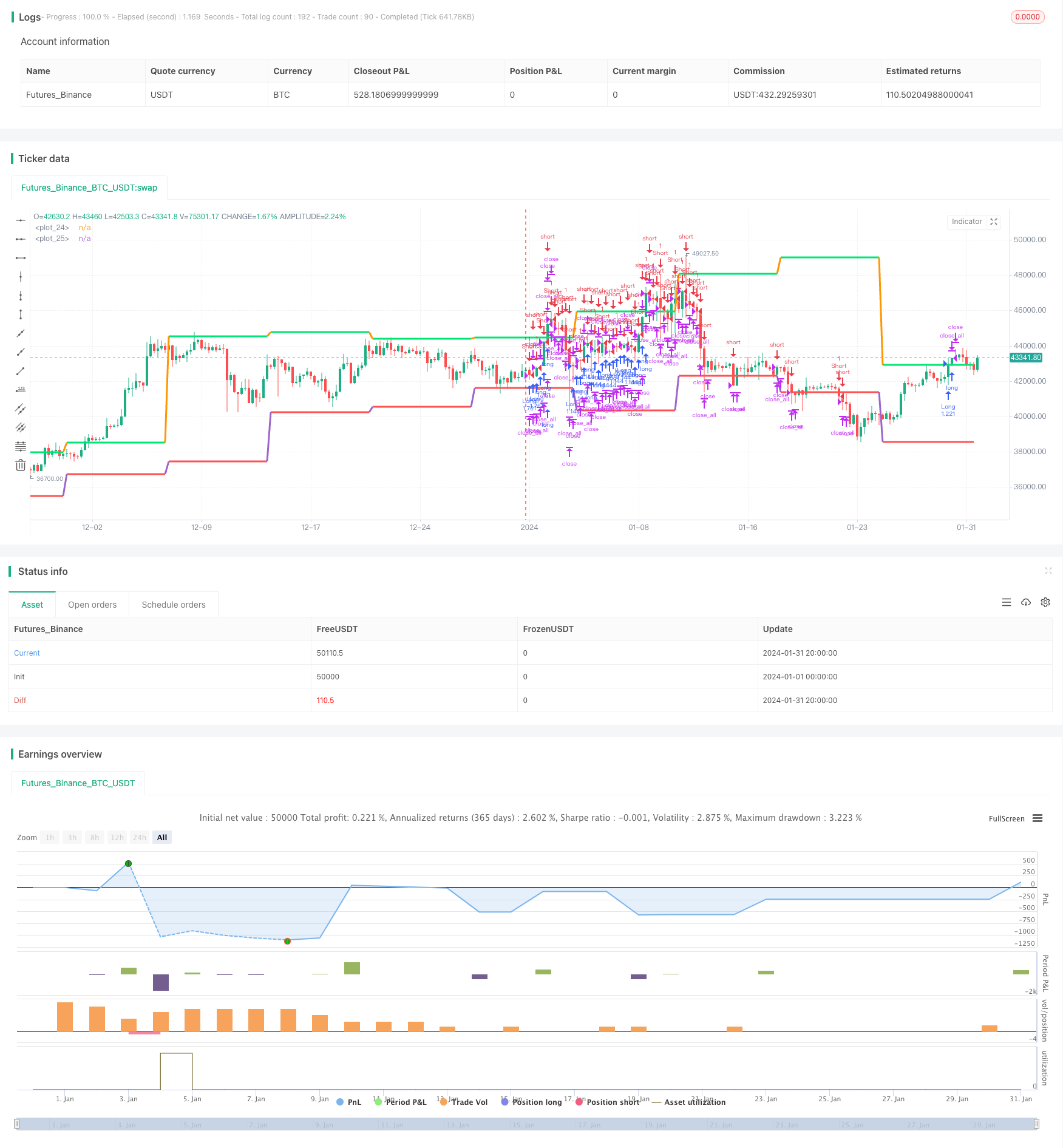
The extremum reversion tracking strategy tracks the extremum points of price fluctuation range and makes reversal long/short positions at extremum points to track trends.
Overview
The extremum reversion tracking strategy tracks the extremum points of price fluctuation range and makes reversal long/short positions at extremum points to track trends.
Strategy Principle
The strategy is mainly based on the following principles:
Use security function to obtain high and low prices of different cycle K-lines to detect whether they are equal to previous ones, so as to judge if new extremum points are reached.
When new extremum points are detected, make short position if it is currently a bull market, and make long position if it is currently a bear market.
Set stop loss point as the new extremum point formed after long/short position is made to track trends with stop loss.
Set the effective time range of the strategy by configuring start year, month and date to make adjustments for different time periods.
Advantages
The main advantages of this strategy are:
Effectively capture extremum points of price changes and make reversal positions to track trends.
Configure time and risk management to control usage time and capital of the strategy to reduce risks.
Use new extremum points as stop loss points to dynamically adjust stop loss positions based on new price fluctuation range.
Simple and clear strategy logic for easy understanding, debugging and optimization.
Risks
There are also some risks for this strategy:
There could be misjudgement in determining extremum points, causing errors in long/short positions. The logic can be optimized.
Stop loss position is close to entry point, increasing the probability of stop loss being triggered. Floating stop loss can be used.
No consideration on pyramiding positions along trends and reverse positions, less profitable in trending markets. Related logics can be added.
Currency and time range configuration is quite rigid, cannot make dynamic adjustments. Parameter optimization system can be introduced.
Optimization Directions
The strategy can be optimized in the following aspects:
Optimize extremum point logic with more filters to avoid misjudgement.
Add floating stop loss mechanism based on price and volatility changes to adjust stop loss distance.
Introduce pyramiding and reverse position modules based on trends and volatility to improve profitability.
Establish parameter optimization mechanism for automatic testing and parameter tuning.
Incorporate machine learning models to assist strategy decision making.
Summary
The extremum reversion tracking strategy works by capturing price extremums and tracking trends, adaptable and profitable. Further optimizations on extremum judgement, stop loss mechanism, position opening rules etc. could shape it into a solid quantitative trading strategy.
Parameters
| Name | Default | What it controls |
|---|---|---|
| v_input_1 | true | Long |
| v_input_2 | false | Short |
| v_input_3 | 100 | Capital, % |
| v_input_4 | W | Timeframe for extremums |
| v_input_5 | 1900 | From Year |
| v_input_6 | 2100 | To Year |
| v_input_7 | true | From Month |
| v_input_8 | 12 | To Month |
| v_input_9 | true | From day |
| v_input_10 | 31 | To day |
Source Pine Script
/*backtest
start: 2024-01-01 00:00:00
end: 2024-01-31 23:59:59
period: 6h
basePeriod: 15m
exchanges: [{"eid":"Futures_Binance","currency":"BTC_USDT"}]
*/

//Noro
//2018

//@version=2
strategy(title = "Noro's Extremum Strategy v1.0", shorttitle = "Extremum str 1.0", overlay = true, default_qty_type = strategy.percent_of_equity, default_qty_value = 100, pyramiding = 0)

//Settings
needlong = input(true, defval = true, title = "Long")
needshort = input(false, defval = false, title = "Short")
capital = input(100, defval = 100, minval = 1, maxval = 10000, title = "Capital, %")
tf = input('W', title = 'Timeframe for extremums')
fromyear = input(1900, defval = 1900, minval = 1900, maxval = 2100, title = "From Year")
toyear = input(2100, defval = 2100, minval = 1900, maxval = 2100, title = "To Year")
frommonth = input(01, defval = 01, minval = 01, maxval = 12, title = "From Month")
tomonth = input(12, defval = 12, minval = 01, maxval = 12, title = "To Month")
fromday = input(01, defval = 01, minval = 01, maxval = 31, title = "From day")
today = input(31, defval = 31, minval = 01, maxval = 31, title = "To day")

//Levels
highm = request.security(syminfo.tickerid, tf, high[1])
lowm = request.security(syminfo.tickerid, tf, low[1])
upcolorm = highm == highm[1] ? lime : na
dncolorm = lowm == lowm[1] ? red : na
plot(highm, color = upcolorm, linewidth = 3)
plot(lowm, color = dncolorm, linewidth = 3)

//Signals
size = strategy.position_size
up = size > 0 ? highm * 1000000 : highm != highm[1] ? highm : up[1]
dn = size < 0 ? 0 : lowm != lowm[1] ? lowm : dn[1]
exit = true

//Trading
lot = strategy.position_size != strategy.position_size[1] ? strategy.equity / close * capital / 100 : lot[1]

if highm > 0 and high[1] < highm and highm == highm[1]
    strategy.entry("Long", strategy.long, needlong == false ? 0 : lot, stop = up)

if lowm > 0 and low[1] > lowm and lowm == lowm[1]
    strategy.entry("Short", strategy.short, needshort == false ? 0 : lot, stop = dn)

if exit
    strategy.close_all()
Published by ChaoZhang on the FMZ strategy square · last modified 2024-02-20. Collected in the Quant Trading Vault. Unvalidated research: re-test with your own data and costs before trusting it.
Build this with AgenKit
A spec is not a trading system. Paste this into your coding agent and AgenKit runs a specialist team — architecture, test-first build, risk gates, review — with paper trading on by default.
/agenkit build a production-grade trading bot with a backtest engine, risk controls and paper trading by default from strategies/Extremum-Reversion-Tracking-Strategy.md- npx agenkit install engineering-kit in your project
- Paste the command into your agent and approve each phase
- Get tests, backtest, risk controls and a paper-trading switch
Understand it first
Before you run this, read the lesson behind the idea and how to backtest it honestly. Specs like this one are the survivors of an unknown number of trials; deflate their results accordingly.
Related specs
- AI Driven Dynamic Volatility Adaptive Trend Breakout Trading StrategyPine Script · Machine learning · 2d
- AI Powered Volatility Price System Divergence Trading StrategyPine Script · Machine learning · 1h
- Configurable BBRSIAroon Strategy BacktestPine Script · Machine learning · 5m
- Double Decker RSI Trading StrategyPine Script · Machine learning · 1h
- Dual Moving Average Matching Strategy Based on Bollinger BandsPine Script · Machine learning · 1h
- Dynamic Weighted Moving Average Trading StrategyPine Script · Machine learning · 1d