Inertia Indicator Trading Strategy
The inertia indicator trading strategy is a trend-following algorithmic trading strategy based on the Relative Volatility Index (RVI). It measures market, stock or currency pair momentum and trend by calculating the…
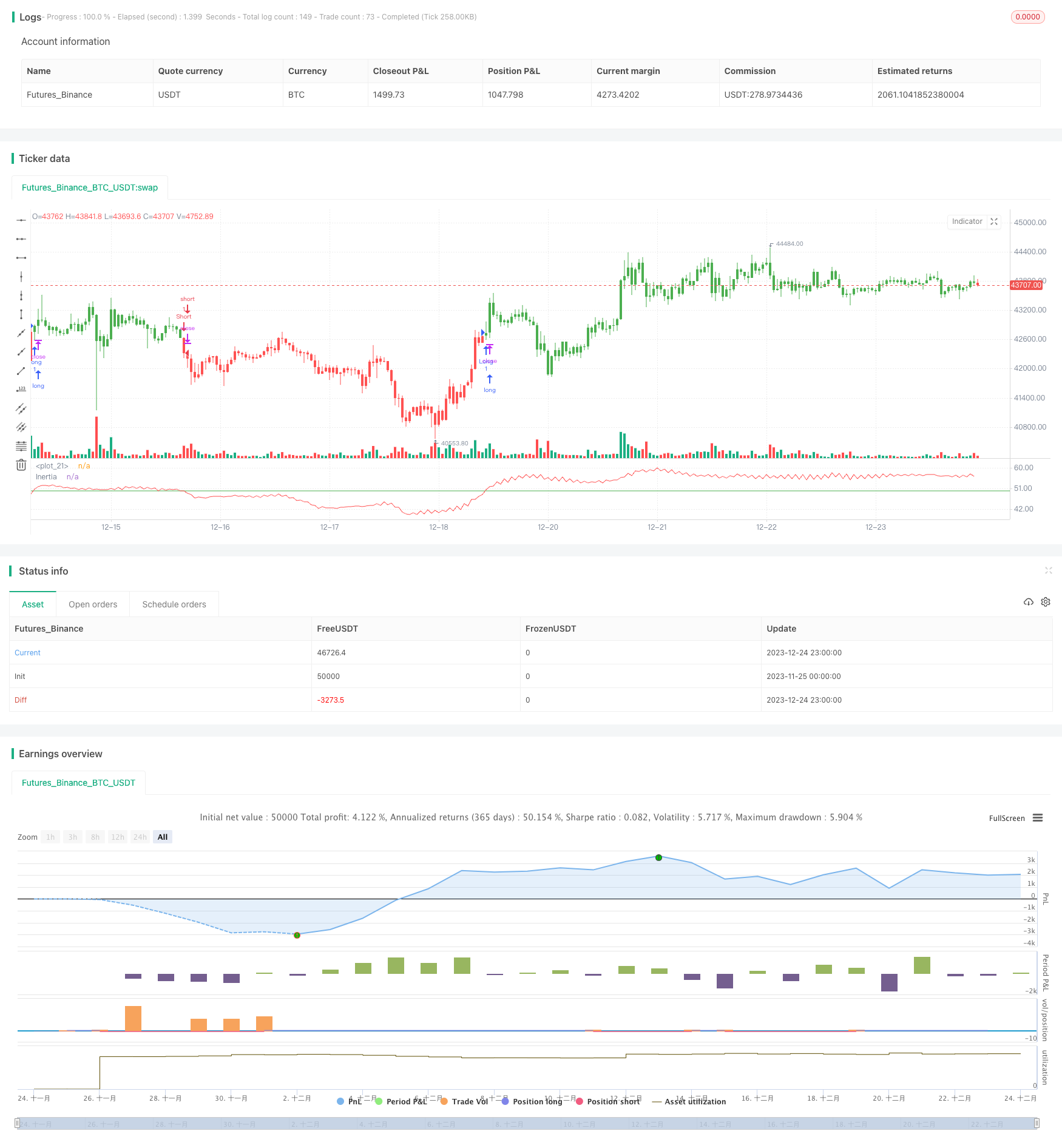
Overview
The inertia indicator trading strategy is a trend-following algorithmic trading strategy based on the Relative Volatility Index (RVI). It measures market, stock or currency pair momentum and trend by calculating the RVI of securities. It can determine the direction of long-term trends and generate trading signals.
Strategy Logic
The core indicator of this strategy is the Inertia Indicator. Its value ranges from 0 to 100. A reading above 50 represents positive inertia, while a reading below 50 represents negative inertia. As long as the inertia value stays above 50, it indicates an upward trend. And vice versa.
The calculation process is as follows:
- Calculate the standard deviation StdDev of closing prices for a given period
- Calculate the upward volatility u and downward volatility d based on the comparison between today's and yesterday's closing prices
- Smooth u and d to get indicators nU and nD
- Calculate Relative Volatility Index nRVI = 100 * nU / (nU + nD)
- Exponentially smooth nRVI to get the final inertia value nRes
If nRes is greater than 50, it generates a buy signal. If less than 50, it generates a sell signal.
Advantage Analysis
The biggest advantage of this strategy is that it can follow trends and avoid frequent opening during market consolidation. In addition, the simple indicator calculation requires less computing resources, making it suitable for algorithmic trading.
Risk Analysis
The biggest risk is that the indicator itself has a lag and cannot capture turning points 100%. This may result in missing better opening opportunities. In addition, the parameter settings of the indicator also affect strategy performance and need a lot of backtesting to find the optimal parameters.
To reduce risks, consider combining with other technical or fundamental indicators to determine opening using more factors. At the same time, control the position sizing of each trade.
Optimization Directions
The strategy can be optimized in the following aspects:
Parameter optimization. Change the settings of cycle parameters and smoothing parameters to find the optimal parameter combination.
Combine with other indicators. Use with moving averages, RSI and other indicators for more informed decisions.
Dynamic position sizing. Dynamically adjust the position size of each trade based on market conditions and indicator values.
Automatic stop loss. Set stop loss positions to effectively control the maximum loss per trade.
Conclusion
The inertia indicator trading strategy is a relatively simple and reliable trend following strategy. It determines the price trend direction based on the inertia indicator and follows the trend to establish trading positions. By further enhancing strategy performance through parameter optimization, indicator combinations, it is an algorithmic strategy suitable for quantitative trading.
Parameters
| Name | Default | What it controls |
|---|---|---|
| v_input_1 | 10 | Period |
| v_input_2 | 14 | Smooth |
| v_input_3 | false | Trade reverse |
Source Pine Script
/*backtest
start: 2023-11-25 00:00:00
end: 2023-12-25 00:00:00
period: 1h
basePeriod: 15m
exchanges: [{"eid":"Futures_Binance","currency":"BTC_USDT"}]
*/

//@version=2
////////////////////////////////////////////////////////////
//  Copyright by HPotter v1.0 23/05/2017
// The inertia indicator measures the market, stock or currency pair momentum and
// trend by measuring the security smoothed RVI (Relative Volatility Index).
// The RVI is a technical indicator that estimates the general direction of the
// volatility of an asset.
// The inertia indicator returns a value that is comprised between 0 and 100.
// Positive inertia occurs when the indicator value is higher than 50. As long as
// the inertia value is above 50, the long-term trend of the security is up. The inertia
// is negative when its value is lower than 50, in this case the long-term trend is
// down and should stay down if the inertia stays below 50.
//
// You can change long to short in the Input Settings
// Please, use it only for learning or paper trading. Do not for real trading.
////////////////////////////////////////////////////////////
strategy(title="Inertia Indicator", shorttitle="Inertia")
Period = input(10, minval=1)
Smooth = input(14, minval=1)
reverse = input(false, title="Trade reverse")
hline(50, color=green, linestyle=line)
xPrice = close
StdDev = stdev(xPrice, Period)
d = iff(close > close[1], 0, StdDev)
u = iff(close > close[1], StdDev, 0)
nU = (13 * nz(nU[1],0) + u) / 14
nD = (13 * nz(nD[1],0) + d) / 14
nRVI = 100 * nU / (nU + nD)
nRes = ema(nRVI, Smooth)
pos = iff(nRes > 50, 1,
	     iff(nRes < 50, -1, nz(pos[1], 0)))
possig = iff(reverse and pos == 1, -1,
          iff(reverse and pos == -1, 1, pos))
if (possig == 1)
    strategy.entry("Long", strategy.long)
if (possig == -1)
    strategy.entry("Short", strategy.short)
barcolor(possig == -1 ? red: possig == 1 ? green : blue )
plot(nRes, color=red, title="Inertia")
Published by ChaoZhang on the FMZ strategy square · last modified 2023-12-26. Collected in the Quant Trading Vault. Unvalidated research: re-test with your own data and costs before trusting it.
Build this with AgenKit
A spec is not a trading system. Paste this into your coding agent and AgenKit runs a specialist team — architecture, test-first build, risk gates, review — with paper trading on by default.
/agenkit build a production-grade trading bot with a backtest engine, risk controls and paper trading by default from strategies/Inertia-Indicator-Trading-Strategy.md- npx agenkit install engineering-kit in your project
- Paste the command into your agent and approve each phase
- Get tests, backtest, risk controls and a paper-trading switch
Understand it first
Before you run this, read the lesson behind the idea and how to backtest it honestly. Specs like this one are the survivors of an unknown number of trials; deflate their results accordingly.
Related specs
- ADX Momentum Trend StrategyPine Script · Momentum · 10m
- Advanced Multi Indicator Trend Following and Momentum Quantitative Trading StrategyPine Script · Momentum · 1h
- Bollinger Bands Momentum Trend Following Quantitative StrategyPine Script · Momentum · 1d
- Cross Period Momentum EMA Strategy with RSI and Dynamic ATR Stop LossPine Script · Momentum · 1d
- Dual EMA Crossover with RSI Momentum Enhanced Trading StrategyPine Script · Momentum · 1d
- Dynamic Trend Channel and Relative Strength Momentum Trading StrategyPine Script · Momentum · 3h