Strategy vault / Market making
Khaled Tamims Avellaneda Stoikov Strategy Khaled Tamims Avellaneda Stoikov Strategy
Khaled Tamim's Avellaneda-Stoikov Strategy is a quantitative trading strategy based on the Avellaneda-Stoikov model. The strategy determines buy and sell signals by calculating the mid-price, bid price, and ask price…
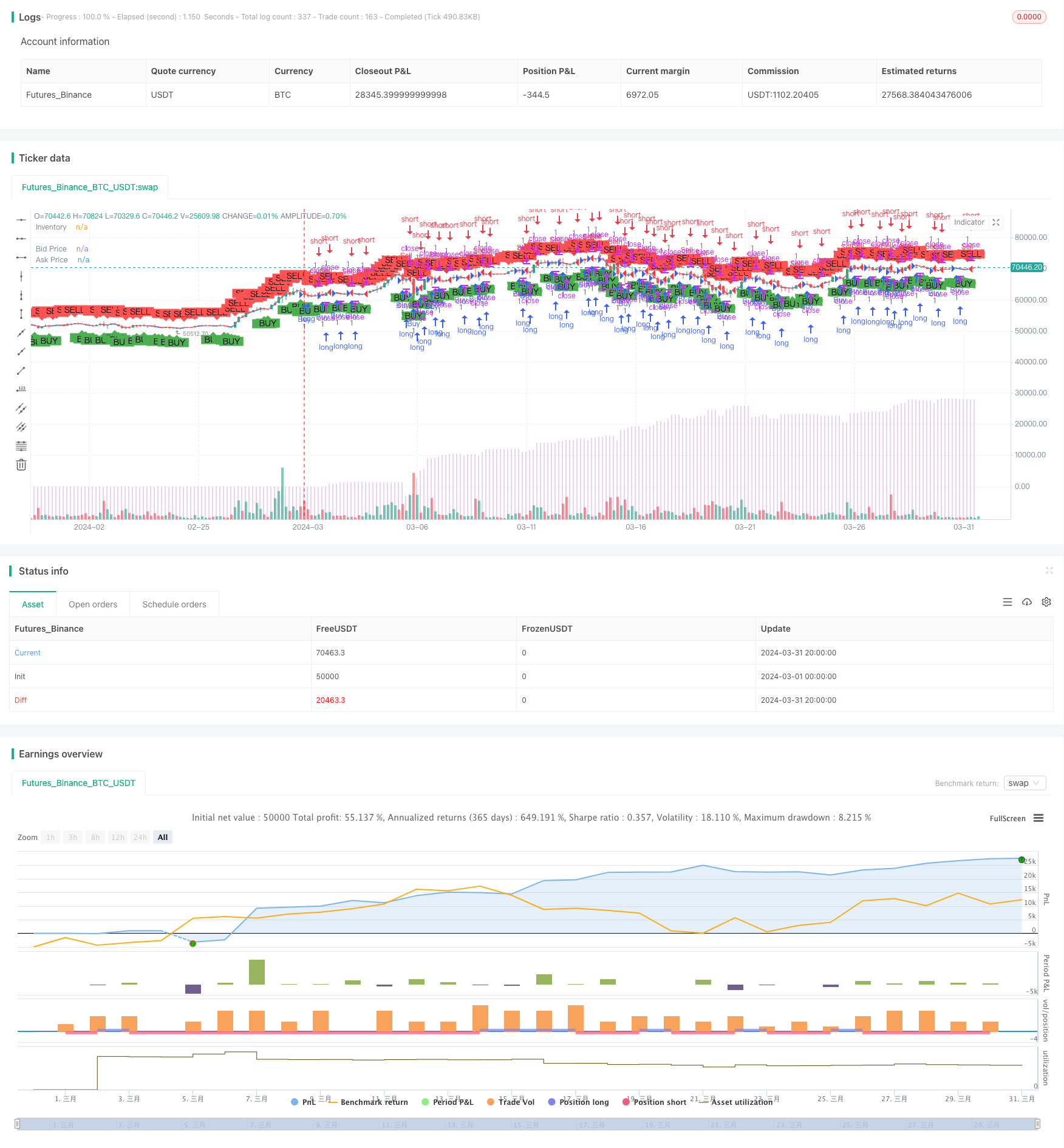
Overview
Khaled Tamim's Avellaneda-Stoikov Strategy is a quantitative trading strategy based on the Avellaneda-Stoikov model. The strategy determines buy and sell signals by calculating the mid-price, bid price, and ask price while considering transaction costs. The main idea of the strategy is to buy when the price is below the bid price by a certain threshold and sell when the price is above the ask price by a certain threshold, thereby capturing the spread profit.
Strategy Principle
The core of this strategy is the Avellaneda-Stoikov model, which calculates the bid and ask prices through the following steps:
- Calculate the mid-price, which is the average of the current price and the previous price.
- Calculate the bid price by subtracting a square root term containing Gamma, Sigma, T, and k from the mid-price, and then subtracting the transaction cost.
- Calculate the ask price by adding a square root term containing Gamma, Sigma, T, and k to the mid-price, and then adding the transaction cost.
- Generate a buy signal when the price is below the bid price minus the threshold M; generate a sell signal when the price is above the ask price plus the threshold M.
Strategy Advantages
- This strategy is based on the Avellaneda-Stoikov model, which is a classic market-making strategy with a solid theoretical foundation.
- The strategy takes into account the impact of transaction costs, making it more realistic to actual trading situations.
- By setting the threshold M, the sensitivity of the strategy can be flexibly adjusted to adapt to different market environments.
- The strategy logic is clear and easy to understand and implement.
Strategy Risks
- The performance of the strategy depends on the choice of parameters such as Gamma, Sigma, T, k, and M. Improper parameter settings may lead to poor strategy performance.
- The strategy does not consider the impact of market liquidity. In cases of insufficient liquidity, it may not be possible to trade at the expected price.
- This strategy is a high-frequency trading strategy that requires low trading latency and high execution efficiency, making it difficult to implement.
Strategy Optimization Directions
- Introduce machine learning algorithms to dynamically adjust strategy parameters to adapt to different market conditions.
- Combine other technical indicators or market microstructure information to improve signal accuracy.
- Optimize the trading execution algorithm to reduce transaction costs and improve strategy returns.
- Consider introducing a risk management module to control strategy drawdowns and risk exposure.
Summary
Khaled Tamim's Avellaneda-Stoikov Strategy is a quantitative trading strategy based on the classic market-making model. It generates trading signals by calculating bid and ask prices while considering transaction costs. The strategy's advantages lie in its solid theoretical foundation, clear logic, and consideration of transaction costs. However, the strategy's performance depends on parameter selection and requires high execution efficiency. In the future, the strategy can be further optimized by introducing machine learning algorithms, optimizing trade execution, introducing risk management, and other methods.
Parameters
| Name | Default | What it controls |
|---|---|---|
| v_input_float_1 | 2 | Gamma |
| v_input_float_2 | 8 | Sigma |
| v_input_float_3 | 0.0833 | T |
| v_input_float_4 | 5 | k |
| v_input_float_5 | 0.5 | M |
Source Pine Script
/*backtest
start: 2024-03-01 00:00:00
end: 2024-03-31 23:59:59
period: 4h
basePeriod: 15m
exchanges: [{"eid":"Futures_Binance","currency":"BTC_USDT"}]
*/

//@version=5
strategy("Khaled Tamim's Avellaneda-Stoikov Strategy", overlay=true)

// Avellaneda-Stoikov model logic
avellanedaStoikov(src, gamma, sigma, T, k, M) =>
    midPrice = (src + src[1]) / 2
    sqrtTerm = gamma * sigma * sigma * T
    // Add 0.1% fee to bid and ask quotes
    fee = 0 // 0.1% fee
    bidQuote = midPrice - k * sqrtTerm - (midPrice * fee)
    askQuote = midPrice + k * sqrtTerm + (midPrice * fee)
    longCondition = src < bidQuote - M
    shortCondition = src > askQuote + M
    [bidQuote, askQuote]

// Define strategy parameters
gamma = input.float(2, title="Gamma")
sigma = input.float(8, title="Sigma")
T = input.float(0.0833, title="T")
k = input.float(5, title="k")
M = input.float(0.5, title="M")

// Calculate signals
[bidQuote, askQuote] = avellanedaStoikov(close, gamma, sigma, T, k, M)
longCondition = close < bidQuote - M
shortCondition = close > askQuote + M

// Plot signals
plotshape(series=longCondition ? low : na, title="Buy Signal", location=location.belowbar, color=color.green, style=shape.labelup, text="BUY")
plotshape(series=shortCondition ? high : na, title="Sell Signal", location=location.abovebar, color=color.red, style=shape.labeldown, text="SELL")

// Plot bid and ask prices
plot(bidQuote, title="Bid Price", color=color.blue, linewidth=1)
plot(askQuote, title="Ask Price", color=color.red, linewidth=1)

// Plot inventory level as bars in a separate graph
plot(strategy.netprofit, title="Inventory", color=color.new(color.purple, 80), style=plot.style_columns)


// Strategy logic
if (longCondition)
    strategy.entry("Buy", strategy.long)

if (shortCondition)
    strategy.entry("Sell", strategy.short)
Published by ChaoZhang on the FMZ strategy square · last modified 2024-04-30. Collected in the Quant Trading Vault. Unvalidated research: re-test with your own data and costs before trusting it.
Build this with AgenKit
A spec is not a trading system. Paste this into your coding agent and AgenKit runs a specialist team — architecture, test-first build, risk gates, review — with paper trading on by default.
/agenkit build a market making bot with inventory skew limits and order deduplication from strategies/Khaled-Tamims-Avellaneda-Stoikov-Strategy-Khaled-Tamims-Avellaneda-Stoikov-Strategy.md- npx agenkit install engineering-kit in your project
- Paste the command into your agent and approve each phase
- Get tests, backtest, risk controls and a paper-trading switch
Understand it first
Before you run this, read the lesson behind the idea and how to backtest it honestly. Specs like this one are the survivors of an unknown number of trials; deflate their results accordingly.
Related specs
- Multi Indicator High Frequency Range Trading StrategyPine Script · Market making · 1d
- Dynamic Spread Market Making StrategyPine Script · Market making
- Institutional Market Maker Tracking Strategy with Dynamic Cost Averaging and Liquidity Flow AnalysisPine Script · Market making · 1d
- Bollinger Band Limit Market Maker StrategyPine Script · Market making · 1h
- Deep Market Making Handicap Control Trading Robot Market Making ToolsPython · Market making
- Dynamic Balance Market Making Strategy Xiao GaoJavaScript · Market making