Strategy vault / Mean reversion
Moment Reversal Strategy Based on Multi factor Model
The Moment Reversal Strategy Based on Multi-factor Model combines multi-factor model and momentum reversal strategy to achieve more stable and higher returns. The strategy uses the 123 reversal and confluence…
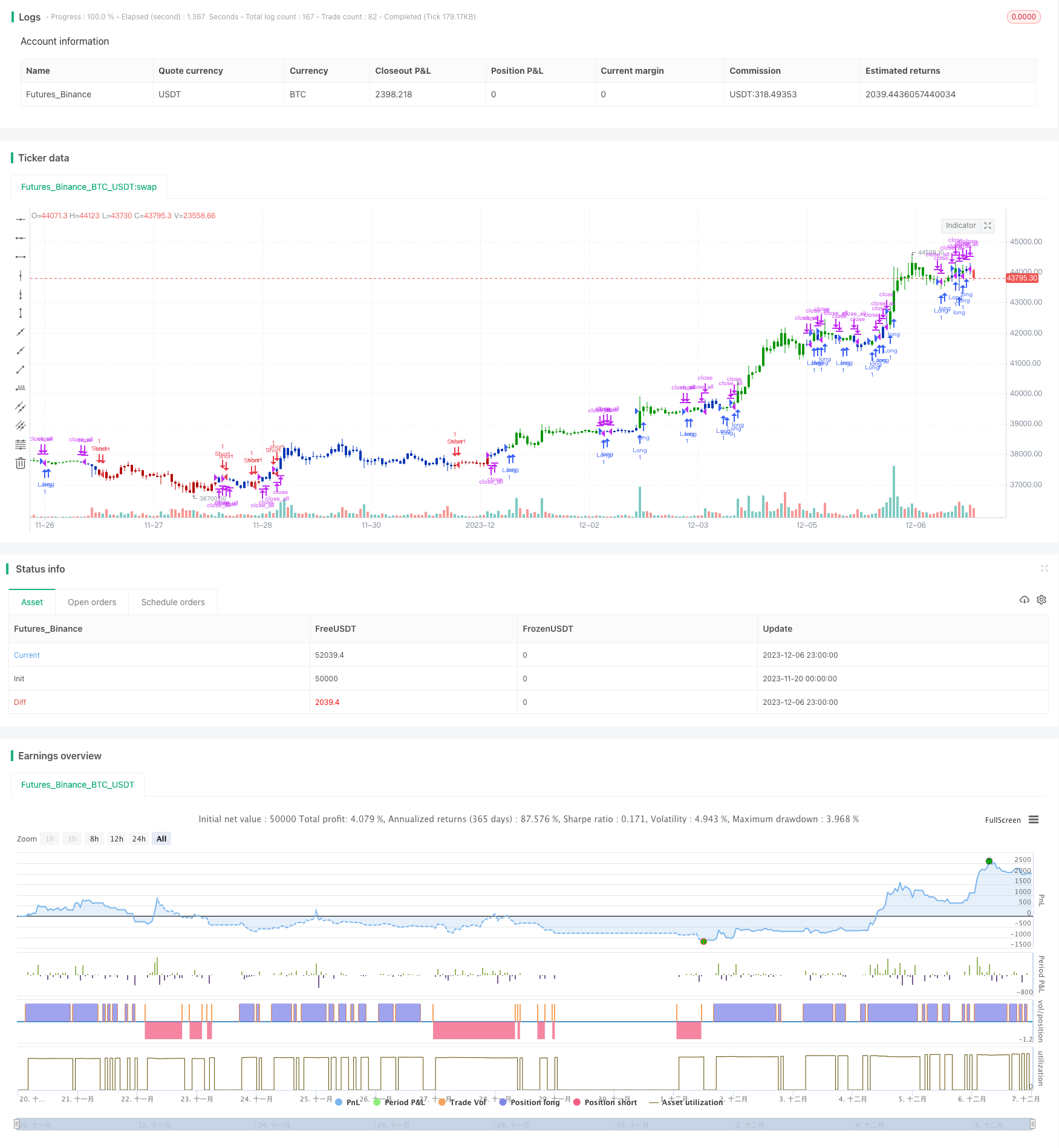
Overview
The Moment Reversal Strategy Based on Multi-factor Model combines multi-factor model and momentum reversal strategy to achieve more stable and higher returns. The strategy uses the 123 reversal and confluence indicators as two independent signals and establishes a position when the two signals are consistent.
Strategy Principle
The strategy consists of two sub-strategies: 123 reversal strategy and confluence indicator strategy.
The 123 reversal strategy generates trading signals based on whether the price has risen or fallen continuously for 2 days, combined with the STOCH indicator to judge whether the market is overcooled or overheated. Specifically, when the price rises continuously for 2 days and the 9-day STOCH slow line is below 50, it is bullish. When the price falls continuously for 2 days and the 9-day STOCH fast line is above 50, it is bearish.
The confluence indicator strategy utilizes the superposition of moving averages and oscillators of different cycles to determine the trend direction and strength. Including linear weighting, sine addition and other methods to comprehensively judge the long and short momentum. The indicator is graded and returns 1 to 9 indicating strong bullish momentum and -1 to -9 indicating strong bearish momentum.
Finally, the strategy establishes long or short positions when both signals are consistent.
Advantage Analysis
The Moment Reversal Strategy Based on Multi-factor Model combines reversal factors and momentum factors to capture reversal opportunities while following the trend to avoid false breakouts, thus having higher win rates. The advantages of the strategy are specifically reflected in:
As a reversal signal source, the 123 reversal strategy can capture excess returns from short-term reversals.
The confluence indicator judges the trend direction and strength to avoid the risk of loss caused by too large reversal space.
The combination of the two strategies complements each other's strengths and weaknesses to some extent and improves signal quality.
Compared with a single model, the combination of multiple factors can improve the stability of strategies.
Risk Analysis
Although the Moment Reversal Strategy Based on Multi-factor Model has certain advantages, there are still some risks:
The risk of loss caused by reversal not being completed and prices turning around again. Appropriate stop loss can be set to guard against this.
Unable to determine direction when two signals are inconsistent. Parameter adjustment can be made to increase the matching degree.
The model is too complex with too many parameters, which is difficult to adjust and optimize.
Multiple submodels need to be monitored simultaneously, resulting in greater difficulty in operation and psychological pressure. Automatic trading elements can be introduced to reduce operational burden.
Optimization Directions
The Moment Reversal Strategy Based on Multi-factor Model can be optimized in the following aspects:
Adjust the parameters of the 123 reversal strategy to make reversal signals more accurate and reliable.
Adjust the parameters of the confluence indicator to make the determined trends closer to the actual ones.
Introduce machine learning algorithms to automatically optimize parameter combinations.
Add position management module to make position adjustment more quantitative and systematic.
Add stop loss module. Effectively control single loss by presetting stop loss price.
Summary
The Moment Reversal Strategy Based on Multi-factor Model comprehensively employs reversal factors and momentum factors. On the basis of ensuring relatively high signal quality, it obtains higher win rate through multi-factor stacking. The strategy has the dual advantages of capturing reversal opportunities and following the trend. It is an efficient and stable quantitative strategy. Follow-up optimizations can be made in aspects such as parameter adjustment and risk control to further improve the strategy's risk-reward ratio.
Parameters
| Name | Default | What it controls |
|---|---|---|
| v_input_1 | 14 | Length |
| v_input_2 | true | KSmoothing |
| v_input_3 | 3 | DLength |
| v_input_4 | 50 | Level |
| v_input_5 | 10 | Harmonic |
| v_input_6 | 9 | BuyBand |
| v_input_7 | -9 | SellBand |
| v_input_8 | false | Trade reverse |
Source Pine Script
/*backtest
start: 2023-11-20 00:00:00
end: 2023-12-07 00:00:00
period: 1h
basePeriod: 15m
exchanges: [{"eid":"Futures_Binance","currency":"BTC_USDT"}]
*/

//@version=4
////////////////////////////////////////////////////////////
//  Copyright by HPotter v1.0 11/11/2019
// This is combo strategies for get a cumulative signal.
//
// First strategy
// This System was created from the Book "How I Tripled My Money In The
// Futures Market" by Ulf Jensen, Page 183. This is reverse type of strategies.
// The strategy buys at market, if close price is higher than the previous close
// during 2 days and the meaning of 9-days Stochastic Slow Oscillator is lower than 50.
// The strategy sells at market, if close price is lower than the previous close price
// during 2 days and the meaning of 9-days Stochastic Fast Oscillator is higher than 50.
//
// Second strategy
// This is modified version of Dale Legan's "Confluence" indicator written by Gary Fritz.
// ================================================================
// Here is Gary`s commentary:
// Since the Confluence indicator returned several "states" (bull, bear, grey, and zero),
// he modified the return value a bit:
// -9 to -1 = Bearish
// -0.9 to 0.9 = "grey" (and zero)
// 1 to 9 = Bullish
// The "grey" range corresponds to the "grey" values plotted by Dale's indicator, but
// they're divided by 10.
//
// WARNING:
// - For purpose educate only
// - This script to change bars colors.
////////////////////////////////////////////////////////////
Reversal123(Length, KSmoothing, DLength, Level) =>
    vFast = sma(stoch(close, high, low, Length), KSmoothing)
    vSlow = sma(vFast, DLength)
    pos = 0.0
    pos := iff(close[2] < close[1] and close > close[1] and vFast < vSlow and vFast > Level, 1,
	         iff(close[2] > close[1] and close < close[1] and vFast > vSlow and vFast < Level, -1, nz(pos[1], 0)))
	pos

Confluence(Harmonic, BuyBand, SellBand) =>
    pos = 0.0
    Price = close
    STL = round((Harmonic * 2) - 1 - 0.5)
    ITL = round((STL * 2) - 1 - 0.5)
    LTL = round((ITL * 2) - 1 - 0.5)
    HOFF = round(Harmonic / 2 - 0.5)
    SOFF = round(STL / 2 - 0.5)
    IOFF = round(ITL / 2 - 0.5)
    xHavg = sma(Price, Harmonic)
    xSavg = sma(Price, STL)
    xIavg = sma(Price, ITL)
    xLavg = sma(Price, LTL)
    xvalue2 = xSavg - xHavg[HOFF]
    xvalue3 = xIavg - xSavg[SOFF]
    xvalue12 = xLavg - xIavg[IOFF]
    xmomsig = xvalue2 + xvalue3 + xvalue12
    xLavgOHLC = sma(ohlc4, LTL - 1)
    xH2 = sma(Price, Harmonic - 1)
    xS2 = sma(Price, STL - 1)
    xI2 = sma(Price, ITL - 1)
    xL2 = sma(Price, LTL - 1)
    DerivH = (xHavg * 2) - xHavg[1]
    DerivS = (xSavg * 2) - xSavg[1]
    DerivI = (xIavg * 2) - xIavg[1]
    DerivL = (xLavg * 2) - xLavg[1]
    SumDH = Harmonic * DerivH
    SumDS = STL * DerivS
    SumDI = ITL * DerivI
    SumDL = LTL * DerivL
    LengH = Harmonic - 1
    LengS = STL - 1
    LengI = ITL - 1
    LengL = LTL - 1
    N1H = xH2 * LengH
    N1S = xS2 * LengS
    N1I = xI2 * LengI
    N1L = xL2 * LengL
    DRH = SumDH - N1H
    DRS = SumDS - N1S
    DRI = SumDI - N1I
    DRL = SumDL - N1L
    SumH = xH2 * (Harmonic - 1)
    SumS = xS2 * (STL - 1)
    SumI = xI2 * (ITL - 1)
    SumL = xLavgOHLC * (LTL - 1)
    xvalue5 = (SumH + DRH) / Harmonic
    xvalue6 = (SumS + DRS) / STL
    xvalue7 = (SumI + DRI) / ITL
    xvalue13 = (SumL + DRL) / LTL
    value9 = xvalue6 - xvalue5[HOFF]
    value10 = xvalue7 - xvalue6[SOFF]
    value14 = xvalue13 - xvalue7[IOFF]
    xmom = value9 + value10 + value14
    HT = sin(xvalue5 * 2 * 3.14 / 360) + cos(xvalue5 * 2 * 3.14 / 360)
    HTA = sin(xHavg * 2 * 3.14 / 360) + cos(xHavg * 2 * 3.14 / 360)
    ST = sin(xvalue6 * 2 * 3.14 / 360) + cos(xvalue6 * 2 * 3.14 / 360)
    STA = sin(xSavg * 2 * 3.14 / 360) + cos(xSavg * 2 * 3.14 / 360)
    IT = sin(xvalue7 * 2 * 3.14 / 360) + cos(xvalue7 * 2 * 3.14 / 360)
    ITA = sin(xIavg * 2 * 3.14 / 360) + cos(xIavg * 2 * 3.14 / 360)
    xSum = HT + ST + IT
    xErr = HTA + STA + ITA
    Condition2 = (((xSum > xSum[SOFF]) and (xHavg < xHavg[SOFF])) or ((xSum < xSum[SOFF]) and (xHavg > xHavg[SOFF])))
    Phase = iff(Condition2 , -1 , 1)
    xErrSum = (xSum - xErr) * Phase
    xErrSig = sma(xErrSum, SOFF)
    xvalue70 = xvalue5 - xvalue13
    xvalue71 = sma(xvalue70, Harmonic)
    ErrNum = iff (xErrSum > 0 and xErrSum < xErrSum[1] and xErrSum < xErrSig, 1,
                  iff (xErrSum > 0 and xErrSum < xErrSum[1] and xErrSum > xErrSig, 2,
                     iff (xErrSum > 0 and xErrSum > xErrSum[1] and xErrSum < xErrSig, 2,
                         iff (xErrSum > 0 and xErrSum > xErrSum[1] and xErrSum > xErrSig, 3,
                          iff (xErrSum < 0 and xErrSum > xErrSum[1] and xErrSum > xErrSig, -1,
                             iff (xErrSum < 0 and xErrSum < xErrSum[1] and xErrSum > xErrSig, -2,
                              iff (xErrSum < 0 and xErrSum > xErrSum[1] and xErrSum < xErrSig, -2,
                                 iff (xErrSum < 0 and xErrSum < xErrSum[1] and xErrSum < xErrSig, -3, 0))))))))

    momNum = iff (xmom > 0 and xmom < xmom[1] and xmom < xmomsig , 1,
              iff (xmom > 0 and xmom < xmom[1] and xmom > xmomsig, 2,
               iff (xmom > 0 and xmom > xmom[1] and xmom < xmomsig, 2,
                 iff (xmom > 0 and xmom > xmom[1] and xmom > xmomsig, 3,
                  iff (xmom < 0 and xmom > xmom[1] and xmom > xmomsig, -1,
                   iff (xmom < 0 and xmom < xmom[1] and xmom > xmomsig, -2,
                     iff (xmom < 0 and xmom > xmom[1] and xmom < xmomsig, -2,
                      iff (xmom < 0 and xmom < xmom[1] and xmom < xmomsig, -3, 0))))))))

    TCNum =  iff (xvalue70 > 0 and xvalue70 < xvalue70[1] and xvalue70 < xvalue71, 1,
              iff (xvalue70 > 0 and xvalue70 < xvalue70[1] and xvalue70 > xvalue71, 2,
               iff (xvalue70 > 0 and xvalue70 > xvalue70[1] and xvalue70 < xvalue71, 2,
                 iff (xvalue70 > 0 and xvalue70 > xvalue70[1] and xvalue70 > xvalue71, 3,
                  iff (xvalue70 < 0 and xvalue70 > xvalue70[1] and xvalue70 > xvalue71, -1,
                   iff (xvalue70 < 0 and xvalue70 < xvalue70[1] and xvalue70 > xvalue71, -2,
                     iff (xvalue70 < 0 and xvalue70 > xvalue70[1] and xvalue70 < xvalue71, -2,
                      iff (xvalue70 < 0 and xvalue70 < xvalue70[1] and xvalue70 < xvalue71, -3,0))))))))

    value42 = ErrNum + momNum + TCNum
    Confluence = iff (value42 > 0 and xvalue70 > 0, value42,
                  iff (value42 < 0 and xvalue70 < 0, value42,
                   iff ((value42 > 0 and xvalue70 < 0) or (value42 < 0 and xvalue70 > 0), value42 / 10, 0)))
    Res1 = iff (Confluence >= 1, Confluence, 0)
    Res2 = iff (Confluence <= -1, Confluence, 0)
    Res3 = iff (Confluence == 0, 0, iff (Confluence > -1 and Confluence < 1, 10 * Confluence, 0))
    pos := iff(Res2 >= SellBand and Res2 != 0, -1,
	         iff(Res1 <= BuyBand and Res1 != 0, 1,
    	      iff(Res3 != 0, 2, nz(pos[1], 0))))
    pos

strategy(title="Combo Backtest 123 Reversal & Confluence", shorttitle="Combo", overlay = true)
Length = input(14, minval=1)
KSmoothing = input(1, minval=1)
DLength = input(3, minval=1)
Level = input(50, minval=1)
//-------------------------
Harmonic = input(10, minval=1)
BuyBand = input(9)
SellBand = input(-9)
reverse = input(false, title="Trade reverse")
posReversal123 = Reversal123(Length, KSmoothing, DLength, Level)
posConfluence = Confluence(Harmonic, BuyBand, SellBand)
pos = iff(posReversal123 == 1 and posConfluence == 1 , 1,
	   iff(posReversal123 == -1 and posConfluence == -1, -1, 0))
possig = iff(reverse and pos == 1, -1,
          iff(reverse and pos == -1 , 1, pos))
if (possig == 1)
    strategy.entry("Long", strategy.long)
if (possig == -1)
    strategy.entry("Short", strategy.short)
if (possig == 0)
    strategy.close_all()
barcolor(possig == -1 ? #b50404: possig == 1 ? #079605 : #0536b3 )Published by ChaoZhang on the FMZ strategy square · last modified 2023-12-21. Collected in the Quant Trading Vault. Unvalidated research: re-test with your own data and costs before trusting it.
Build this with AgenKit
A spec is not a trading system. Paste this into your coding agent and AgenKit runs a specialist team — architecture, test-first build, risk gates, review — with paper trading on by default.
/agenkit build a production-grade trading bot with a backtest engine, risk controls and paper trading by default from strategies/Moment-Reversal-Strategy-Based-on-Multi-factor-Model.md- npx agenkit install engineering-kit in your project
- Paste the command into your agent and approve each phase
- Get tests, backtest, risk controls and a paper-trading switch
Understand it first
Before you run this, read the lesson behind the idea and how to backtest it honestly. Specs like this one are the survivors of an unknown number of trials; deflate their results accordingly.
Related specs
- Adaptive Trading Strategy Combining Dynamic Trend Reversal and Stochastic IndicatorPine Script · Mean reversion · 1d
- Advanced 15 Minute Chart Trading Signal StrategyPine Script · Mean reversion · 3h
- Bollinger Bands Stochastic RSI Extreme Strategy BBSR Extreme StrategyPine Script · Mean reversion · 1h
- BuySell Strategy depends on AOStochRSIATRPine Script · Mean reversion · 30m
- Byron Serpent Cloud Quant StrategyPine Script · Mean reversion · 1h
- Dual Momentum Trend Reversal Strategy Based on RSI and Stochastic RSIPine Script · Mean reversion · 1h