Multi Filter Trend Breakthrough Smart Moving Average Trading Strategy
This strategy is a trend breakthrough trading system based on multiple technical indicator filters. It combines multiple technical indicators including Exponential Moving Average (EMA), Volume Weighted Average Price…
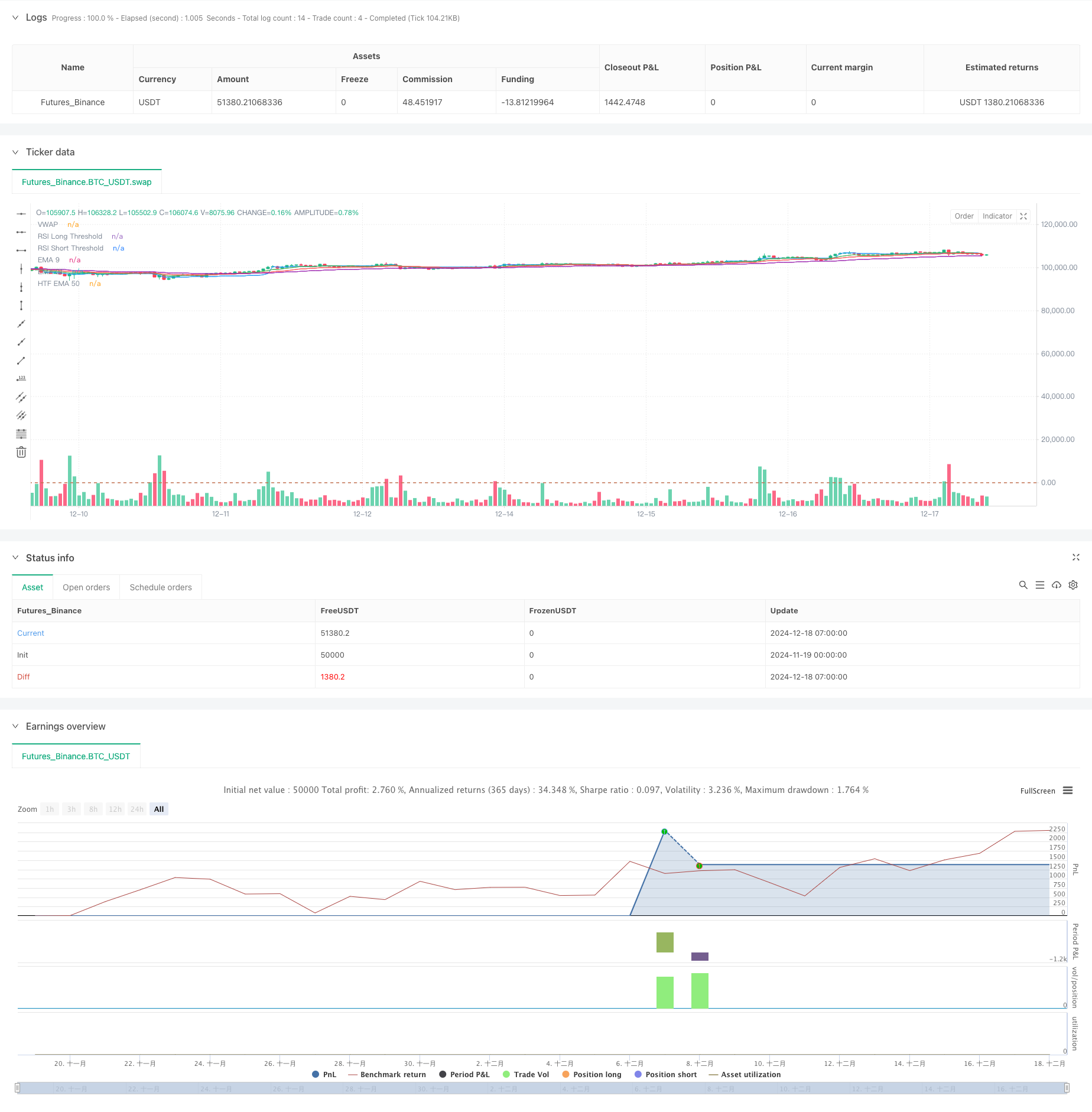
Overview
This strategy is a trend breakthrough trading system based on multiple technical indicator filters. It combines multiple technical indicators including Exponential Moving Average (EMA), Volume Weighted Average Price (VWAP), Relative Strength Index (RSI), Average Directional Index (ADX), etc., to filter false breakouts through multiple signal confirmations and improve trading accuracy. The strategy also incorporates higher timeframe trend judgment and employs an ATR-based dynamic stop-loss and take-profit scheme for effective risk control.
Strategy Principles
The core logic of the strategy is based on the following key elements:
- Trend Judgment System: Uses 9-period and 21-period EMA crossovers to capture short-term trend changes, while referencing 15-minute timeframe 50-period EMA to confirm larger trend direction.
- Price Momentum Confirmation: Uses RSI indicator for momentum confirmation, requiring RSI>55 for longs and RSI<45 for shorts.
- Trend Strength Verification: Incorporates ADX indicator to judge trend strength, requiring ADX>25 to ensure trend validity.
- Price Position Verification: Uses VWAP as a reference for price position, requiring price to be in the correct VWAP position.
- Volume Confirmation: Requires trading volume to be 1.5 times greater than 10-period average volume to ensure sufficient market participation.
- Risk Management: Dynamically calculates position size based on fixed percentage of account equity and ATR, using 1.5x ATR for stop-loss and 3x ATR for take-profit.
Strategy Advantages
- Multiple signal confirmation mechanism greatly reduces interference from false signals.
- Combination of higher and lower timeframe analysis improves trend judgment accuracy.
- Dynamic position management and stop-loss/take-profit settings achieve good risk control.
- Usage of volume breakout as trade confirmation improves trading reliability.
- Strong parameter adjustability facilitates optimization for different market conditions.
Strategy Risks
- Multiple filters may cause missing some valid trading opportunities.
- May generate frequent trading signals in ranging markets.
- Parameter optimization may lead to overfitting historical data.
- ATR stops may be too wide in highly volatile markets.
Strategy Optimization Directions
- Introduce adaptive parameter mechanism to dynamically adjust parameters based on market conditions.
- Add market environment recognition module to use different parameter combinations in different market environments.
- Include trading time filters to avoid highly volatile periods.
- Optimize stop-loss and take-profit ratios, considering dynamic adjustment based on market volatility.
- Add trend strength grading to adopt different position management strategies at different strength levels.
Summary
This strategy constructs a relatively complete trading system through the synergy of multiple technical indicators. Its core advantage lies in improving trading accuracy through multi-dimensional signal confirmation while employing scientific risk management methods to protect capital safety. Although certain limitations exist, through continuous optimization and improvement, this strategy has the potential to achieve stable returns in actual trading.
Source Pine Script
/*backtest
start: 2024-11-19 00:00:00
end: 2024-12-18 08:00:00
period: 1h
basePeriod: 1h
exchanges: [{"eid":"Futures_Binance","currency":"BTC_USDT"}]
*/

//@version=5
strategy("Trend-Filtered Scalping Strategy", overlay=true, shorttitle="TFSS")

// Inputs
emaShort     = input.int(9, title="EMA Short", minval=1)
emaLong      = input.int(21, title="EMA Long", minval=1)
rsiLength    = input.int(14, title="RSI Length", minval=1)
atrLength    = input.int(14, title="ATR Length", minval=1)
adxLength    = input.int(20, title="ADX Length", minval=1)
adxSmoothing = input.int(14, title="ADX Smoothing", minval=1)
volMultiplier = input.float(1.5, title="Volume Spike Multiplier", minval=1.0)
riskPercent  = input.float(1, title="Risk % of Equity", minval=0.1, step=0.1)

// Higher Time Frame for Trend Filter
htfTimeframe = input.timeframe("15", title="Higher Time Frame")
ema50HTF     = request.security(syminfo.tickerid, htfTimeframe, ta.ema(close, 50))

// Indicators
ema9  = ta.ema(close, emaShort)
ema21 = ta.ema(close, emaLong)
vwap  = ta.vwap(close)
rsi   = ta.rsi(close, rsiLength)
atr   = ta.atr(atrLength)
volAvg = ta.sma(volume, 10)

// ADX Calculation with Smoothing
[_, _, adx] = ta.dmi(adxLength, adxSmoothing)

// Entry Conditions
longCondition = (ta.crossover(ema9, ema21) and close > vwap and rsi > 55 and adx > 25 and close > ema50HTF and volume > volAvg * volMultiplier)
shortCondition = (ta.crossunder(ema9, ema21) and close < vwap and rsi < 45 and adx > 25 and close < ema50HTF and volume > volAvg * volMultiplier)

// Position Sizing Based on Risk %
capitalPerTrade = (strategy.equity * (riskPercent / 100)) / atr
longStop  = close - 1.5 * atr
longTarget = close + 3 * atr
shortStop = close + 1.5 * atr
shortTarget = close - 3 * atr

// Entry Logic
if longCondition and not strategy.opentrades
    strategy.entry("Long", strategy.long, qty=capitalPerTrade)
    strategy.exit("Exit Long", from_entry="Long", stop=longStop, limit=longTarget)

if shortCondition and not strategy.opentrades
    strategy.entry("Short", strategy.short, qty=capitalPerTrade)
    strategy.exit("Exit Short", from_entry="Short", stop=shortStop, limit=shortTarget)

// Alerts
alertcondition(longCondition, title="Long Entry Alert", message="Long Condition Triggered!")
alertcondition(shortCondition, title="Short Entry Alert", message="Short Condition Triggered!")

// Plot Indicators
plot(ema9, title="EMA 9", color=color.green)
plot(ema21, title="EMA 21", color=color.red)
plot(vwap, title="VWAP", color=color.blue)
plot(ema50HTF, title="HTF EMA 50", color=color.purple)
hline(55, "RSI Long Threshold", color=color.green)
hline(45, "RSI Short Threshold", color=color.red)
Published by ChaoZhang on the FMZ strategy square · last modified 2024-12-20. Collected in the Quant Trading Vault. Unvalidated research: re-test with your own data and costs before trusting it.
Build this with AgenKit
A spec is not a trading system. Paste this into your coding agent and AgenKit runs a specialist team — architecture, test-first build, risk gates, review — with paper trading on by default.
/agenkit build a production-grade trading bot with a backtest engine, risk controls and paper trading by default from strategies/Multi-Filter-Trend-Breakthrough-Smart-Moving-Average-Trading-Strategy.md- npx agenkit install engineering-kit in your project
- Paste the command into your agent and approve each phase
- Get tests, backtest, risk controls and a paper-trading switch
Understand it first
Before you run this, read the lesson behind the idea and how to backtest it honestly. Specs like this one are the survivors of an unknown number of trials; deflate their results accordingly.
Related specs
- Dynamic Multi indicator Quantitative Trading StrategyPine Script · Breakout · 1d
- Multi Strategy Adaptive Trend Following and Breakout Trading SystemPine Script · Breakout · 1d
- Multi Dimensional Technical Indicator Fusion Trend Breakthrough StrategyPine Script · Breakout · 1h
- Multi Indicator Trend Following and Volatility Breakout StrategyPine Script · Breakout · 2h
- Multi Timeframe Trend Confirmed Quantitative Breakout Trading StrategyPine Script · Breakout · 1d
- Momentum Breakout Trading Strategy 440964Pine Script · Breakout · 5m