Strategy vault / Trend following
Multi Step Volatility Adjusted Dynamic SuperTrend Strategy
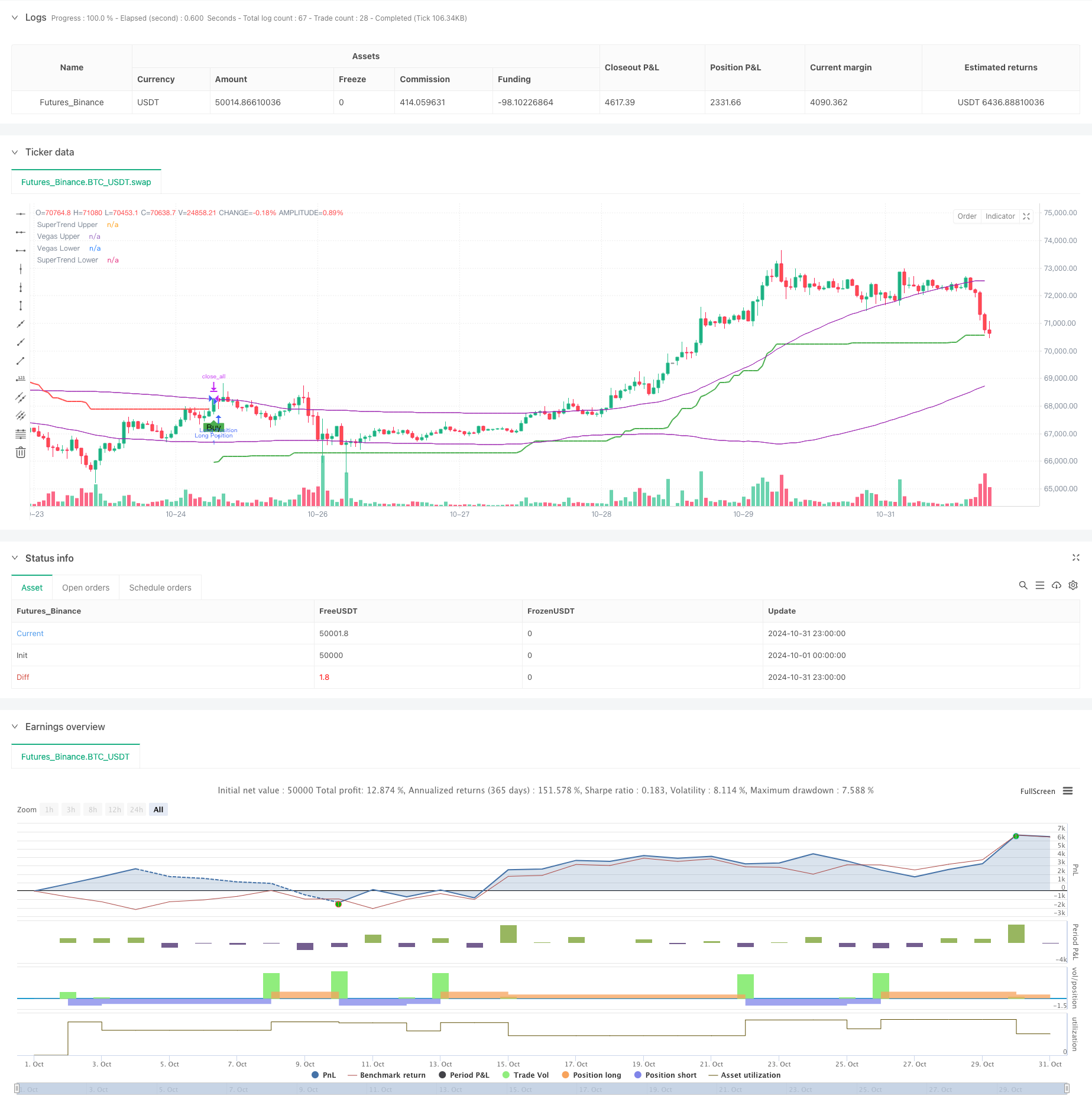
The Multi-Step Volatility-Adjusted Dynamic SuperTrend Strategy is an innovative trading system that combines the Vegas Channel and SuperTrend indicators. The strategy's uniqueness lies in its ability to dynamically…
Overview
The Multi-Step Volatility-Adjusted Dynamic SuperTrend Strategy is an innovative trading system that combines the Vegas Channel and SuperTrend indicators. The strategy's uniqueness lies in its ability to dynamically adapt to market volatility and its multi-step take-profit mechanism to optimize risk-reward ratios. By combining the volatility analysis of the Vegas Channel with the trend-following capabilities of SuperTrend, the strategy automatically adjusts its parameters as market conditions change, providing more accurate trading signals.
Strategy Principle
The strategy operates on three core components: Vegas Channel calculation, trend detection, and multi-step take-profit mechanism. The Vegas Channel uses Simple Moving Average (SMA) and Standard Deviation (STD) to define price volatility ranges, while the SuperTrend indicator determines trend direction based on adjusted ATR values. Trading signals are generated when market trends change. The multi-step take-profit mechanism allows for partial exits at different price levels, a method that both locks in profits and allows remaining positions to capture potential gains. The strategy's uniqueness lies in its volatility adjustment factor, which dynamically adjusts the SuperTrend multiplier based on the Vegas Channel width.
Strategy Advantages
- Dynamic Adaptability: The strategy automatically adapts to different market conditions through the volatility adjustment factor.
- Risk Management: Multi-step take-profit mechanism provides a systematic approach to profit realization.
- Customizability: Offers multiple parameter settings to accommodate different trading styles.
- Comprehensive Market Coverage: Supports both long and short trading.
- Visual Feedback: Provides clear graphical interface for analysis and decision-making.
Strategy Risks
- Parameter Sensitivity: Different parameter combinations may lead to significant performance variations.
- Lag: Indicators based on moving averages have inherent lag.
- False Breakout Risk: May generate false signals in ranging markets.
- Take-Profit Trade-offs: Early take-profits might miss major trends, late take-profits risk losing accumulated gains.
Strategy Optimization Directions
- Introduce market environment filters to adjust strategy parameters under different market conditions.
- Add volume analysis to improve signal reliability.
- Develop adaptive take-profit mechanisms that dynamically adjust profit levels based on market volatility.
- Integrate additional technical indicators for signal confirmation.
- Implement dynamic position sizing based on market risk.
Summary
The Multi-Step Volatility-Adjusted Dynamic SuperTrend Strategy represents an advanced quantitative trading approach, combining multiple technical indicators and innovative take-profit mechanisms to provide traders with a comprehensive trading system. Its dynamic adaptability and risk management features make it particularly suitable for operation in various market environments, with good scalability and optimization potential. Through continuous improvement and optimization, the strategy shows promise for delivering more stable trading performance in the future.
Source Pine Script
/*backtest
start: 2024-10-01 00:00:00
end: 2024-10-31 23:59:59
period: 1h
basePeriod: 1h
exchanges: [{"eid":"Futures_Binance","currency":"BTC_USDT"}]
*/

//@version=5
strategy("Multi-Step Vegas SuperTrend - strategy [presentTrading]", shorttitle="Multi-Step Vegas SuperTrend - strategy [presentTrading]", overlay=true, precision=3, commission_value=0.1, commission_type=strategy.commission.percent, slippage=1, currency=currency.USD)

// Input settings allow the user to customize the strategy's parameters.
tradeDirectionChoice = input.string(title="Trade Direction", defval="Both", options=["Long", "Short", "Both"]) // Option to select the trading direction
atrPeriod = input(10, "ATR Period for SuperTrend") // Length of the ATR for volatility measurement
vegasWindow = input(100, "Vegas Window Length") // Length of the moving average for the Vegas Channel
superTrendMultiplier = input(5, "SuperTrend Multiplier Base") // Base multiplier for the SuperTrend calculation
volatilityAdjustment = input.float(5, "Volatility Adjustment Factor") // Factor to adjust the SuperTrend sensitivity to the Vegas Channel width

// User inputs for take profit settings
useTakeProfit = input.bool(true, title="Use Take Profit", group="Take Profit Settings")
takeProfitPercent1 = input.float(3.0, title="Take Profit % Step 1", group="Take Profit Settings")
takeProfitPercent2 = input.float(6.0, title="Take Profit % Step 2", group="Take Profit Settings")
takeProfitPercent3 = input.float(12.0, title="Take Profit % Step 3", group="Take Profit Settings")
takeProfitPercent4 = input.float(21.0, title="Take Profit % Step 4", group="Take Profit Settings")

takeProfitAmount1 = input.float(25, title="Take Profit Amount % Step 1", group="Take Profit Settings")
takeProfitAmount2 = input.float(20, title="Take Profit Amount % Step 2", group="Take Profit Settings")
takeProfitAmount3 = input.float(10, title="Take Profit Amount % Step 3", group="Take Profit Settings")
takeProfitAmount4 = input.float(15, title="Take Profit Amount % Step 4", group="Take Profit Settings")

numberOfSteps = input.int(4, title="Number of Take Profit Steps", minval=1, maxval=4, group="Take Profit Settings")

// Calculate the Vegas Channel using a simple moving average and standard deviation.
vegasMovingAverage = ta.sma(close, vegasWindow)
vegasChannelStdDev = ta.stdev(close, vegasWindow)
vegasChannelUpper = vegasMovingAverage + vegasChannelStdDev
vegasChannelLower = vegasMovingAverage - vegasChannelStdDev

// Adjust the SuperTrend multiplier based on the width of the Vegas Channel.
channelVolatilityWidth = vegasChannelUpper - vegasChannelLower
adjustedMultiplier = superTrendMultiplier + volatilityAdjustment * (channelVolatilityWidth / vegasMovingAverage)

// Calculate the SuperTrend indicator values.
averageTrueRange = ta.atr(atrPeriod)
superTrendUpper = hlc3 - (adjustedMultiplier * averageTrueRange)
superTrendLower = hlc3 + (adjustedMultiplier * averageTrueRange)
var float superTrendPrevUpper = na
var float superTrendPrevLower = na
var int marketTrend = 1

// Update SuperTrend values and determine the current trend direction.
superTrendPrevUpper := nz(superTrendPrevUpper[1], superTrendUpper)
superTrendPrevLower := nz(superTrendPrevLower[1], superTrendLower)
marketTrend := close > superTrendPrevLower ? 1 : close < superTrendPrevUpper ? -1 : nz(marketTrend[1], 1)
superTrendUpper := marketTrend == 1 ? math.max(superTrendUpper, superTrendPrevUpper) : superTrendUpper
superTrendLower := marketTrend == -1 ? math.min(superTrendLower, superTrendPrevLower) : superTrendLower
superTrendPrevUpper := superTrendUpper
superTrendPrevLower := superTrendLower

// Enhanced Visualization
// Plot the SuperTrend and Vegas Channel for visual analysis.
plot(marketTrend == 1 ? superTrendUpper : na, "SuperTrend Upper", color=color.green, linewidth=2)
plot(marketTrend == -1 ? superTrendLower : na, "SuperTrend Lower", color=color.red, linewidth=2)
plot(vegasChannelUpper, "Vegas Upper", color=color.purple, linewidth=1)
plot(vegasChannelLower, "Vegas Lower", color=color.purple, linewidth=1)

// Apply a color to the price bars based on the current market trend.
barcolor(marketTrend == 1 ? color.green : marketTrend == -1 ? color.red : na)

// Detect trend direction changes and plot entry/exit signals.
trendShiftToBullish = marketTrend == 1 and marketTrend[1] == -1
trendShiftToBearish = marketTrend == -1 and marketTrend[1] == 1

plotshape(series=trendShiftToBullish, title="Enter Long", location=location.belowbar, color=color.green, style=shape.labelup, text="Buy")
plotshape(series=trendShiftToBearish, title="Enter Short", location=location.abovebar, color=color.red, style=shape.labeldown, text="Sell")

// Define conditions for entering long or short positions, and execute trades based on these conditions.
enterLongCondition = marketTrend == 1
enterShortCondition = marketTrend == -1

// Check trade direction choice before executing trade entries.
if enterLongCondition and (tradeDirectionChoice == "Long" or tradeDirectionChoice == "Both")
    strategy.entry("Long Position", strategy.long)

if enterShortCondition and (tradeDirectionChoice == "Short" or tradeDirectionChoice == "Both")
    strategy.entry("Short Position", strategy.short)

// Close all positions when the market trend changes.
if marketTrend != marketTrend[1]
    strategy.close_all()

// Multi-Stage Take Profit Logic
if (strategy.position_size > 0)
    entryPrice = strategy.opentrades.entry_price(strategy.opentrades - 1)
    if numberOfSteps >= 1
        strategy.exit("Take Profit 1", from_entry="Long Position", qty_percent=takeProfitAmount1, limit=entryPrice * (1 + takeProfitPercent1 / 100))
    if numberOfSteps >= 2
        strategy.exit("Take Profit 2", from_entry="Long Position", qty_percent=takeProfitAmount2, limit=entryPrice * (1 + takeProfitPercent2 / 100))
    if numberOfSteps >= 3
        strategy.exit("Take Profit 3", from_entry="Long Position", qty_percent=takeProfitAmount3, limit=entryPrice * (1 + takeProfitPercent3 / 100))
    if numberOfSteps >= 4
        strategy.exit("Take Profit 4", from_entry="Long Position", qty_percent=takeProfitAmount4, limit=entryPrice * (1 + takeProfitPercent4 / 100))

if (strategy.position_size < 0)
    entryPrice = strategy.opentrades.entry_price(strategy.opentrades - 1)
    if numberOfSteps >= 1
        strategy.exit("Take Profit 1", from_entry="Short Position", qty_percent=takeProfitAmount1, limit=entryPrice * (1 - takeProfitPercent1 / 100))
    if numberOfSteps >= 2
        strategy.exit("Take Profit 2", from_entry="Short Position", qty_percent=takeProfitAmount2, limit=entryPrice * (1 - takeProfitPercent2 / 100))
    if numberOfSteps >= 3
        strategy.exit("Take Profit 3", from_entry="Short Position", qty_percent=takeProfitAmount3, limit=entryPrice * (1 - takeProfitPercent3 / 100))
    if numberOfSteps >= 4
        strategy.exit("Take Profit 4", from_entry="Short Position", qty_percent=takeProfitAmount4, limit=entryPrice * (1 - takeProfitPercent4 / 100))
Published by ChaoZhang on the FMZ strategy square · last modified 2024-11-29. Collected in the Quant Trading Vault. Unvalidated research: re-test with your own data and costs before trusting it.
Build this with AgenKit
A spec is not a trading system. Paste this into your coding agent and AgenKit runs a specialist team — architecture, test-first build, risk gates, review — with paper trading on by default.
/agenkit build a production-grade trading bot with a backtest engine, risk controls and paper trading by default from strategies/Multi-Step-Volatility-Adjusted-Dynamic-SuperTrend-Strategy.md- npx agenkit install engineering-kit in your project
- Paste the command into your agent and approve each phase
- Get tests, backtest, risk controls and a paper-trading switch
Understand it first
Before you run this, read the lesson behind the idea and how to backtest it honestly. Specs like this one are the survivors of an unknown number of trials; deflate their results accordingly.
Related specs
- Multi Indicator Dynamic Trend Following Strategy Based on EMA and SMAPine Script · Trend following · 1d
- Super trend BPine Script · Trend following · 4h
- SuperTrend Dual Direction StrategyPine Script · Trend following · 3d
- Supertrend Advance StrategyPine Script · Trend following · 5m
- Supertrend and Moving Average Crossover StrategyPine Script · Trend following · 2h
- Trading the Equity Curve Position Sizing ExamplePine Script · Trend following · 15m