Relative Momentum Index Strategy
The Relative Momentum Index (RMI) strategy is an improved version based on the momentum index. It calculates price momentum over a period to determine if the market is overbought or oversold, in order to capture…
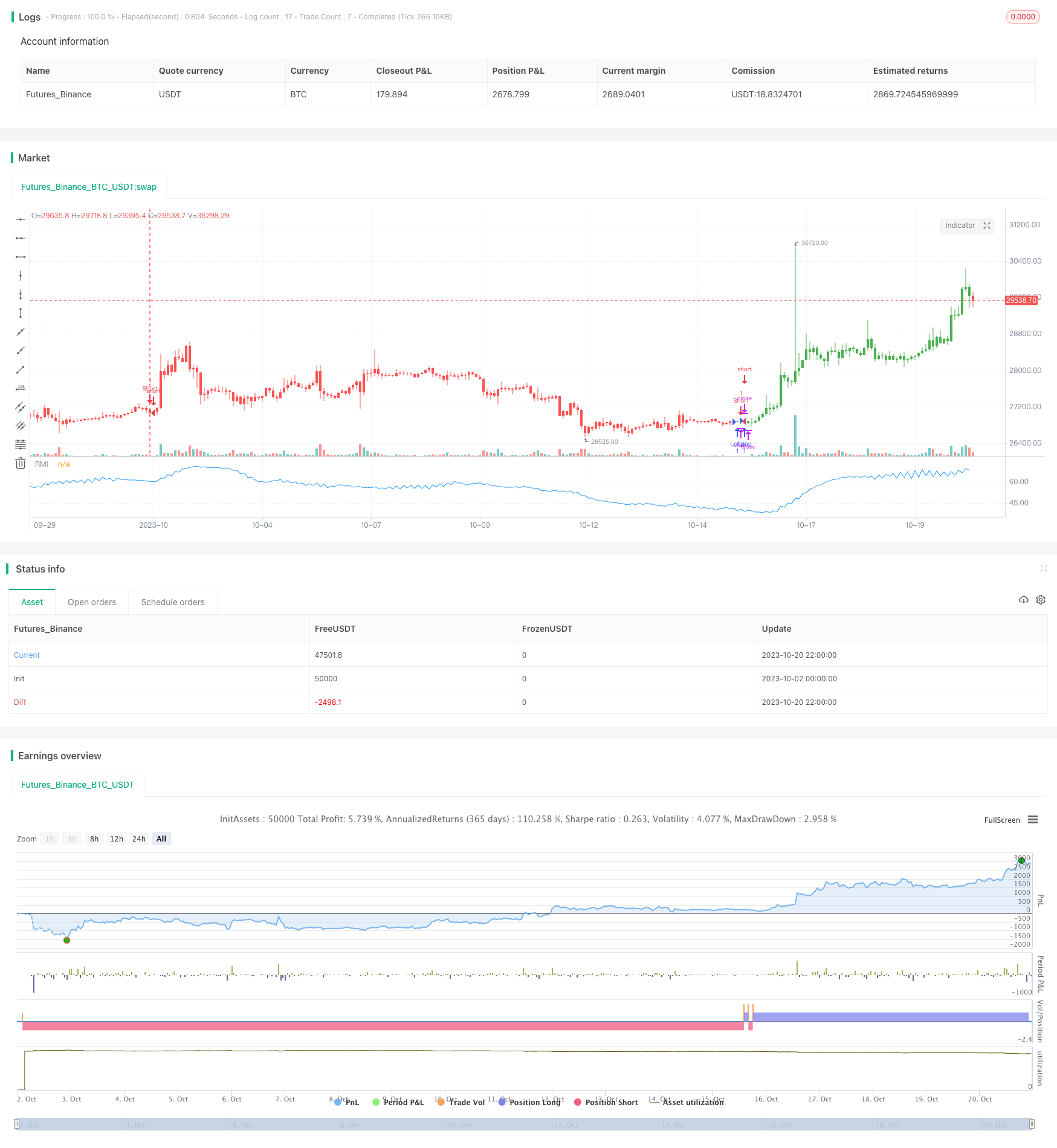
Overview
The Relative Momentum Index (RMI) strategy is an improved version based on the momentum index. It calculates price momentum over a period to determine if the market is overbought or oversold, in order to capture reversal opportunities.
Strategy Logic
The RMI calculation formula is as follows:
xMom = xPrice - xPrice[Length]  // Price change over Length periods
xMU = If xMom >= 0: previous xMU minus xMU/Length plus xMom; else: previous xMU
xMD = If xMom <= 0: previous xMD minus xMD/Length plus absolute value of xMom; else: 0
RM = xMU / xMD
RMI = 100 * (RM / (1 + RM))
First calculate the price change xMom over Length periods. If xMom>=0, meaning price rises, accumulate it into xMU; if xMom<0, meaning price drops, accumulate its absolute value into xMD. RM is the ratio between xMU and xMD, representing the momentum of ups and downs. RMI normalizes RM into the range of 0-100.
When RMI is higher than the threshold SellZone, the market is overbought, go short. When RMI is lower than BuyZone, the market is oversold, go long.
Advantages
- Compared to RSI, RMI is more sensitive and can capture reversal opportunities earlier.
- RMI measures the momentum of ups and downs, less affected by consolidation.
- Based on momentum, RMI can better determine overbought/oversold status.
Risks
- Like other reversal strategies, RMI has the risk of being stopped out by strong trends. Long signals may get breached.
- RMI parameters need to be optimized for different products, otherwise the results may be poor.
- Overbought/oversold thresholds need to be set reasonably, otherwise too many false signals may occur.
Risks can be reduced by widening stop loss, optimizing parameters, combining with trend strategies etc.
Improvement
RMI strategy can be improved from the following aspects:
- Optimize Length parameter to maximize return.
- Optimize overbought/oversold thresholds to reduce false signals.
- Add stop loss to control single loss.
- Combine with trend following or moving average strategies to increase winning rate.
- Select appropriate trading sessions based on product characteristics to improve stability.
Conclusion
RMI strategy captures short-term pullback opportunities by measuring price momentum change. Compared to RSI, RMI is more sensitive and robust to consolidation. But risks of being stopped out exist. Parameters need to be optimized and combined with trend strategies to maximize performance.
Parameters
| Name | Default | What it controls |
|---|---|---|
| v_input_1 | 20 | Length |
| v_input_2 | 40 | BuyZone |
| v_input_3 | 70 | SellZone |
| v_input_4 | false | Trade reverse |
Source Pine Script
/*backtest
start: 2023-10-02 00:00:00
end: 2023-10-21 00:00:00
period: 2h
basePeriod: 15m
exchanges: [{"eid":"Futures_Binance","currency":"BTC_USDT"}]
*/

//@version=2
////////////////////////////////////////////////////////////
//  Copyright by HPotter v1.0 19/10/2017
// The Relative Momentum Index (RMI) was developed by Roger Altman. Impressed
// with the Relative Strength Index's sensitivity to the number of look-back
// periods, yet frustrated with it's inconsistent oscillation between defined
// overbought and oversold levels, Mr. Altman added a momentum component to the RSI.
// As mentioned, the RMI is a variation of the RSI indicator. Instead of counting
// up and down days from close to close as the RSI does, the RMI counts up and down
// days from the close relative to the close x-days ago where x is not necessarily
// 1 as required by the RSI). So as the name of the indicator reflects, "momentum" is
// substituted for "strength".
//
// You can change long to short in the Input Settings
// WARNING:
// - For purpose educate only
// - This script to change bars colors.
////////////////////////////////////////////////////////////
strategy(title="Relative Momentum Index", shorttitle="RMI")
xPrice = close
Length = input(20, minval=1)
BuyZone = input(40, minval=1)
SellZone = input(70, minval=1)
reverse = input(false, title="Trade reverse")
// hline(0, color=gray, linestyle=dashed)
// hline(SellZone, color=red, linestyle=line)
// hline(BuyZone, color=green, linestyle=line)
xMom = xPrice - xPrice[Length]
xMU = iff(xMom >= 0, nz(xMU[1], 1) - (nz(xMU[1],1) / Length) + xMom, nz(xMU[1], 1))
xMD = iff(xMom <= 0, nz(xMD[1], 1) - (nz(xMD[1],1) / Length) + abs(xMom), nz(xMD[1], 0))
RM = xMU / xMD
nRes = 100 * (RM / (1+RM))
pos = iff(nRes < BuyZone, 1,
	   iff(nRes > SellZone, -1, nz(pos[1], 0)))
possig = iff(reverse and pos == 1, -1,
          iff(reverse and pos == -1, 1, pos))
if (possig == 1)
    strategy.entry("Long", strategy.long)
if (possig == -1)
    strategy.entry("Short", strategy.short)
barcolor(possig == -1 ? red: possig == 1 ? green : blue )
plot(nRes, color=blue, title="RMI")
Published by ChaoZhang on the FMZ strategy square · last modified 2023-11-02. Collected in the Quant Trading Vault. Unvalidated research: re-test with your own data and costs before trusting it.
Build this with AgenKit
A spec is not a trading system. Paste this into your coding agent and AgenKit runs a specialist team — architecture, test-first build, risk gates, review — with paper trading on by default.
/agenkit build a production-grade trading bot with a backtest engine, risk controls and paper trading by default from strategies/Relative-Momentum-Index-Strategy.md- npx agenkit install engineering-kit in your project
- Paste the command into your agent and approve each phase
- Get tests, backtest, risk controls and a paper-trading switch
Understand it first
Before you run this, read the lesson behind the idea and how to backtest it honestly. Specs like this one are the survivors of an unknown number of trials; deflate their results accordingly.
Related specs
- ADX Momentum Trend StrategyPine Script · Momentum · 10m
- Advanced Multi Indicator Trend Following and Momentum Quantitative Trading StrategyPine Script · Momentum · 1h
- Bollinger Bands Momentum Trend Following Quantitative StrategyPine Script · Momentum · 1d
- Cross Momentum Trend Following Strategy SMA RSI Cross Momentum SystemPine Script · Momentum · 1h
- Cross Period Momentum EMA Strategy with RSI and Dynamic ATR Stop LossPine Script · Momentum · 1d
- Dual EMA Crossover with RSI Momentum Enhanced Trading StrategyPine Script · Momentum · 1d