Strategy vault / Trend following
TEMA Dual Moving Average Crossover Strategy
The TEMA Dual Moving Average Crossover Strategy is a quantitative trading strategy that generates trading signals based on the crossover of two Triple Exponential Moving Averages (TEMA) with different periods. The…
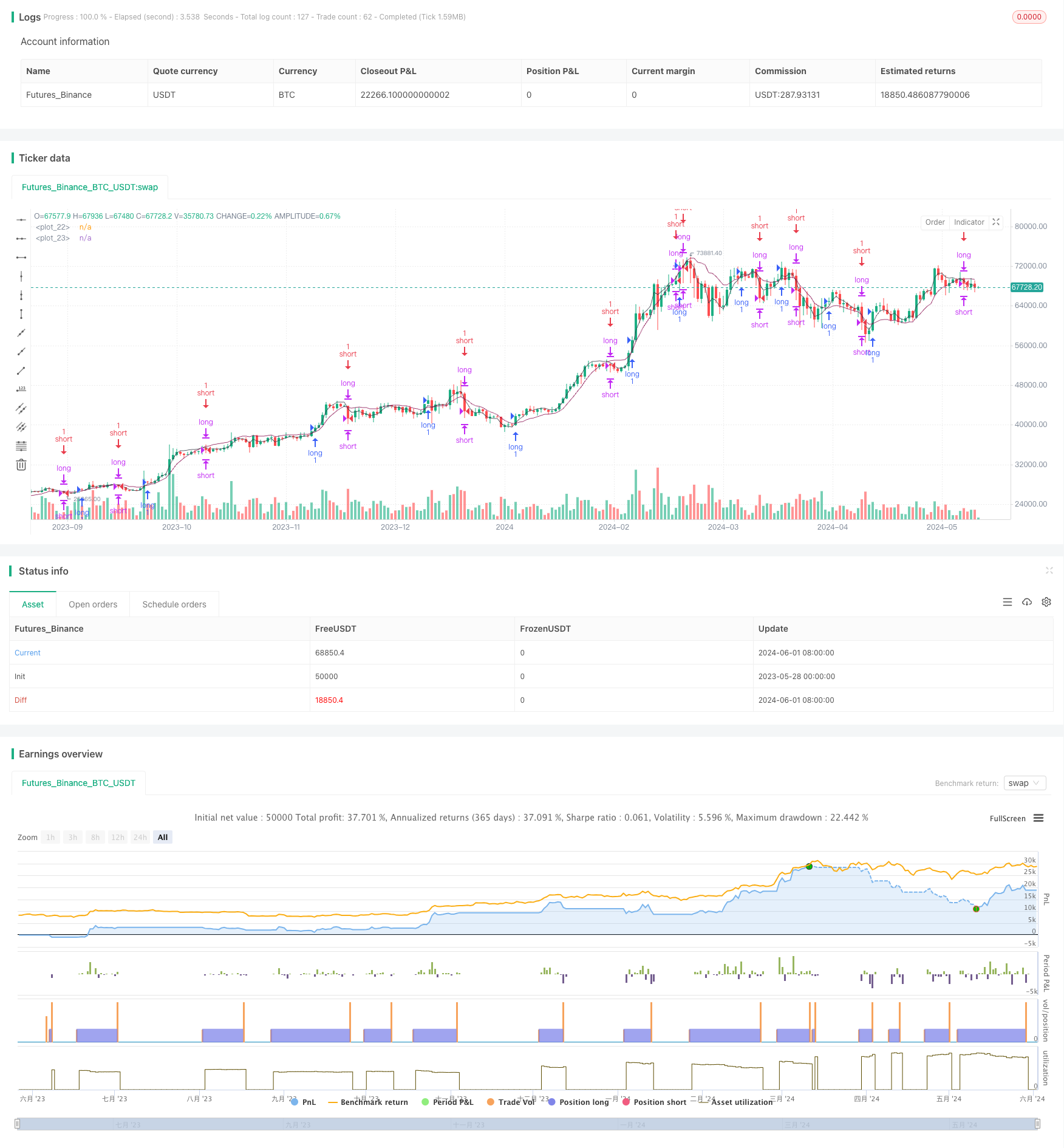
Overview
The TEMA Dual Moving Average Crossover Strategy is a quantitative trading strategy that generates trading signals based on the crossover of two Triple Exponential Moving Averages (TEMA) with different periods. The strategy compares the relative positions of the two TEMA lines. It opens a long position when the short-term TEMA line crosses above the long-term TEMA line and opens a short position when the short-term TEMA line crosses below the long-term TEMA line. The positions are closed when the opposite crossover signals occur. This strategy is suitable for capturing short-term trends in a ranging market.
Strategy Principle
The core of the TEMA Dual Moving Average Crossover Strategy is to construct two TEMA lines with different periods. TEMA is an improvement over the Exponential Moving Average (EMA). It is calculated by applying EMA to the EMA of the EMA, resulting in less lag compared to EMA and Simple Moving Average (SMA). TEMA is more responsive to price movements and more sensitive to short-term trends.
The strategy generates trading signals by comparing the positions of the short-term and long-term TEMA lines:
- When the short-term TEMA line crosses above the long-term TEMA line and the short-term TEMA line is above the long-term TEMA line, it opens a long position.
- When the short-term TEMA line crosses below the long-term TEMA line and the short-term TEMA line is below the long-term TEMA line, it opens a short position.
- When holding a long position, if the short-term TEMA line crosses below the long-term TEMA line, it closes the long position. When holding a short position, if the short-term TEMA line crosses above the long-term TEMA line, it closes the short position.
By using the crossover signals of two TEMA lines with different periods, it can capture short-term price trends in a ranging market.
Strategy Advantages
- TEMA indicator has less lag compared to EMA and SMA, providing more responsive signals and better alignment with price movements.
- By using the crossover signals of two TEMA lines with different periods to open and close positions, the signals are clear and effective in capturing short-term trends.
- The strategy logic and code implementation are simple and clear, easy to understand and optimize.
- Suitable for use in ranging markets, potentially generating stable returns.
Strategy Risks
- In strong trending markets, the strategy may generate frequent trades, leading to increased transaction costs and affecting profitability.
- TEMA indicator is more sensitive to price compared to EMA and SMA, potentially generating frequent false signals during high market volatility.
- The strategy's performance depends on parameter selection based on historical data. If future market characteristics change, it may impact the strategy's performance.
- The strategy does not include stop-loss, potentially incurring significant risks in extreme market conditions.
Strategy Optimization Directions
- Optimize the parameters of the TEMA indicator to improve strategy performance, such as using parameter optimization methods to find the optimal periods for the two TEMA lines.
- When generating trading signals, incorporate other technical indicators or market sentiment indicators as filters to improve signal reliability and reduce false signals.
- Set dynamic stop-loss and trailing stop-loss based on market volatility characteristics to control risks.
- Analyze holding periods and trading frequency, optimize entry and exit timing and trading frequency based on market characteristics and transaction costs.
- Consider combining this strategy with other types of strategies to leverage the strengths of different strategies and improve overall robustness.
Summary
The TEMA Dual Moving Average Crossover Strategy is a simple and easy-to-use quantitative trading strategy that captures short-term price trends using crossover signals of two TEMA indicators with different periods. The strategy has a clear logic and is suitable for use in ranging markets. However, the strategy also has some risks, such as frequent trading, false signals, and extreme market risks. The strategy performance can be improved by optimizing parameters, adding filter conditions, setting stop-losses, and combining with other strategies to enhance its robustness and practicality.
Source Pine Script
/*backtest
start: 2023-05-28 00:00:00
end: 2024-06-02 00:00:00
period: 1d
basePeriod: 1h
exchanges: [{"eid":"Futures_Binance","currency":"BTC_USDT"}]
*/

//@version=5
strategy('2 TEMA Cross Strategy', shorttitle='2 TEMA Cross Strat', overlay=true, initial_capital=25000, currency=currency.USD)
//My backtesting showed best results on a 5 min chart
//Create 2 TEMA Input and pre-populate
len1 = input.int(9, minval=1, title='Length 1')
len2 = input.int(26, minval=2, title='Length 2')

//Calculate Tema values for each Input
//Tema 1
ema1 = ta.ema(close, len1)
ema11 = ta.ema(ema1, len1)
ema111 = ta.ema(ema11, len1)
tema1 = 3 * (ema1 - ema11) + ema111

//Tema 2
ema2 = ta.ema(close, len2)
ema22 = ta.ema(ema2, len2)
ema222 = ta.ema(ema22, len2)
tema2 = 3 * (ema2 - ema22) + ema222

//Plot the MAs
plot(tema1, color=color.new(color.black, 20))
plot(tema2, color=color.new(color.maroon, 20))

// Define long/short conditions
long = ta.crossover(tema1, tema2) and tema1 > tema2
short = ta.crossunder(tema1, tema2) and tema1 < tema2
exitLong = ta.crossunder(tema1, tema2)
exitShort = ta.cross(tema1, tema2)

// Buys when buy condition met
strategy.entry('long', strategy.long, when=long)
strategy.close('long', when=exitLong)

// Closes position when sell condition met
strategy.entry('short', strategy.short, when=short)
strategy.close('short', when=exitShort)
Published by ChaoZhang on the FMZ strategy square · last modified 2024-06-03. Collected in the Quant Trading Vault. Unvalidated research: re-test with your own data and costs before trusting it.
Build this with AgenKit
A spec is not a trading system. Paste this into your coding agent and AgenKit runs a specialist team — architecture, test-first build, risk gates, review — with paper trading on by default.
/agenkit build a production-grade trading bot with a backtest engine, risk controls and paper trading by default from strategies/TEMA-Dual-Moving-Average-Crossover-Strategy.md- npx agenkit install engineering-kit in your project
- Paste the command into your agent and approve each phase
- Get tests, backtest, risk controls and a paper-trading switch
Understand it first
Before you run this, read the lesson behind the idea and how to backtest it honestly. Specs like this one are the survivors of an unknown number of trials; deflate their results accordingly.
Related specs
- ADX MA and EMA Long Only Trend Tracking StrategyPine Script · Trend following · 1d
- ATR and Moving Average Crossover Hybrid StrategyPine Script · Trend following · 1h
- Bollinger Band Moving Average Crossover StrategyPine Script · Trend following · 1h
- Bollinger Bands and EMA Trend Following StrategyPine Script · Trend following · 1h
- Bollinger Bands and RSI Trend Following StrategyPine Script · Trend following · 1h
- Candlestick Pattern Trend Filter StrategyPine Script · Trend following · 1d