VWMA EMA Crossover Martingale Strategy Progressive Position Scaling Optimized Quantitative Trading System
The VWMA-EMA Crossover Martingale Strategy is a quantitative trading system based on technical analysis, combining volume-weighted moving average (VWMA) and exponential moving average (EMA) crossover signals with a…
Overview
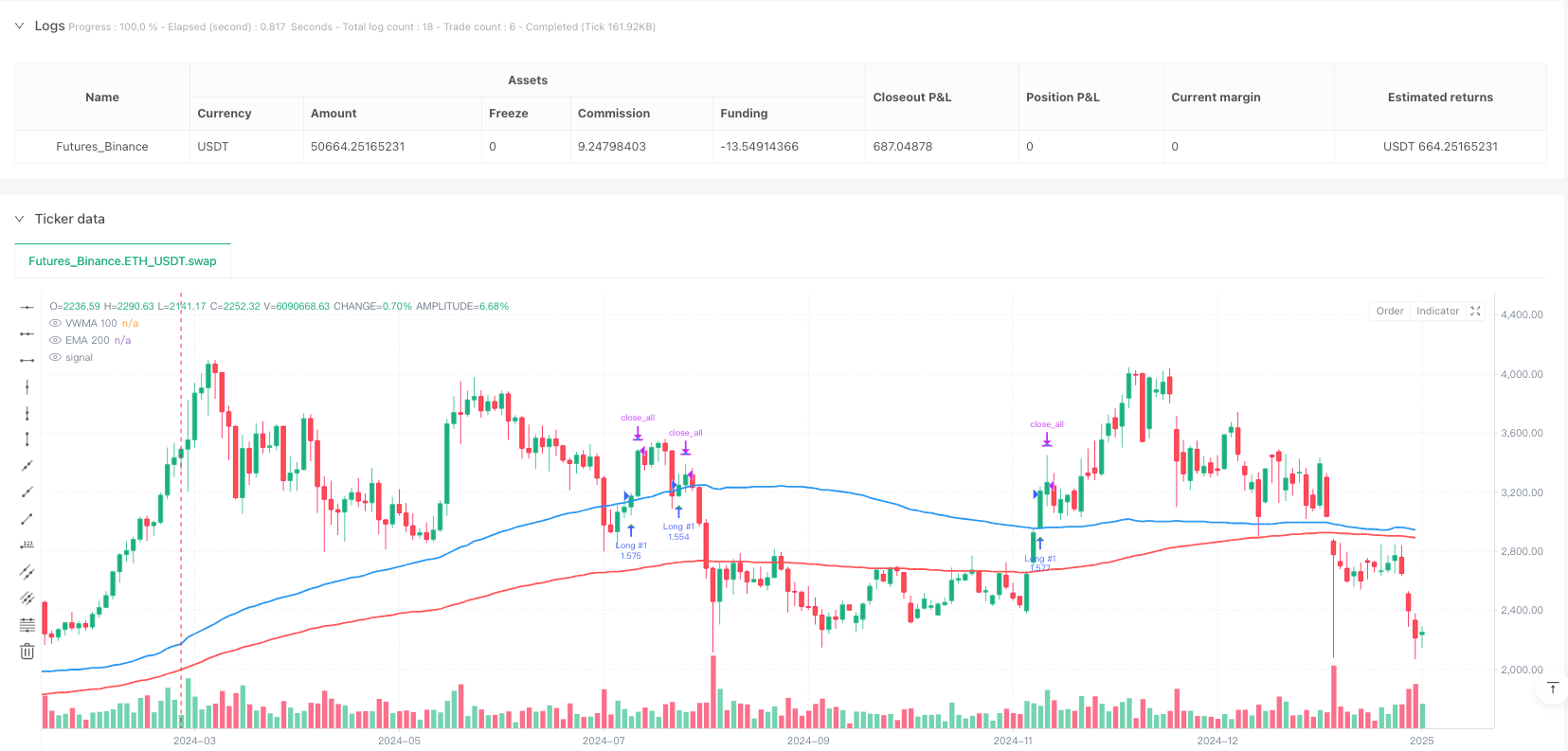
The VWMA-EMA Crossover Martingale Strategy is a quantitative trading system based on technical analysis, combining volume-weighted moving average (VWMA) and exponential moving average (EMA) crossover signals with a Fibonacci-based Martingale money management approach. This strategy primarily utilizes the bullish alignment of VWMA (shorter period) and EMA (longer period), along with price breakouts above VWMA to determine market trend direction. It implements a Martingale method to progressively increase positions during price retracements to lower average cost, ultimately achieving profit through a fixed percentage profit target.
Strategy Principles
The core principles of this strategy can be divided into three main components: signal generation, position management, and profit taking.
Signal Generation:
- The strategy calculates VWMA (default period 100) and EMA (default period 200)
- Entry conditions consist of two key factors: a) VWMA positioned above EMA (bullish alignment) b) Price breaking above VWMA (momentum confirmation)
- This combination ensures entries only occur in an overall uptrend and uses price breakouts as trigger signals
Position Management (Martingale System):
- Initial entry uses a set percentage of capital (default 10%)
- Additional buy orders are triggered when price drops by specific percentages
- Implements Fibonacci-style percentage drops: 1%, 2%, 3%, 6%, 12%, 24%
- Each additional position increases in size by a set multiplier (default 2x)
- System limits maximum Martingale operations (default 7) to control risk
- Average position cost is recalculated after each buy
Profit Taking:
- All positions are closed when price rises to a specific percentage (default 1%) above average entry cost
- All state variables are reset after closing positions, preparing for the next trading cycle
Strategy Advantages
Through deep analysis of the code implementation, this strategy demonstrates the following significant advantages:
Dual Trend Confirmation Mechanism: The combination of VWMA-EMA relative positioning and price breakouts above VWMA effectively filters false breakouts and improves entry quality.
Intelligent Risk Management: The Fibonacci sequence-style percentage drops progressively raise the threshold for additional buys as retracement magnitude increases, aligning with market volatility characteristics and avoiding premature additions.
High Capital Efficiency: Initially uses only a portion of funds (default 10%), reserving the majority for potential additional positions and preventing premature capital depletion.
Low Psychological Burden: The strategy operates fully automatically, eliminating psychological pressure during drawdowns and avoiding emotional interference.
Flexible Parameter System: Provides multiple adjustable parameters (moving average periods, profit targets, Martingale multipliers, etc.) that can be optimized for different market environments and trading instruments.
Visual Monitoring: Incorporates a built-in status table displaying real-time key information (current positions, average cost, profit/loss status, next trigger price, etc.), facilitating strategy execution monitoring.
Clear Trade Markers: Annotates all operation points on the chart (initial entries, additional buys, profit-taking), aiding backtest analysis and strategy optimization.
Strategy Risks
Despite its sophisticated design, the strategy still presents the following potential risks:
Trend Reversal Risk: In strong trend reversal scenarios, even with the Martingale mechanism, significant losses may occur. Solutions include adding trend confirmation indicators like MACD or RSI, or implementing stop-loss mechanisms.
Capital Depletion Risk: In extreme market conditions, if prices continue to fall beyond the preset maximum Martingale iterations, the strategy cannot add more positions. It's advisable to set a total capital usage limit and maintain emergency funds.
Parameter Sensitivity: Strategy performance is highly sensitive to parameter settings (especially moving average periods and Martingale multipliers), with different market environments potentially requiring different parameters. Backtesting is recommended to determine optimal parameter combinations with periodic validation.
Slippage and Commission Impact: In live trading, slippage and commissions can significantly affect profitability, especially with frequent position additions. Including reasonable transaction cost estimates in backtests is advised.
Liquidity Risk: In low-liquidity markets, large orders may cause severe slippage or fail to execute. This strategy is best implemented in highly liquid markets, or with limited transaction sizes.
Strategy Optimization Directions
Based on the current implementation, the strategy can be optimized in the following ways:
Dynamic Stop-Loss Mechanism: Introduce ATR (Average True Range) based dynamic stop-losses to limit maximum losses in extreme market conditions, protecting capital. This optimization provides a safety net while preserving Martingale advantages.
Dynamic Profit Targets: The current fixed 1% profit target is relatively conservative. Consider automatically adjusting profit targets based on market volatility – maintaining conservatism in low-volatility markets and increasing targets in high-volatility markets.
Trend Strength Filtering: Add trend strength assessment mechanisms, such as the ADX indicator, to activate the strategy only during clear trends, avoiding frequent signals in ranging markets.
Market Environment Adaptability: Incorporate market environment recognition modules to automatically adjust strategy parameters or pause operations in different market phases (trending, ranging, extreme volatility).
Money Management Optimization: Improve the current fixed multiplier position sizing model by adopting more flexible capital allocation methods, such as the Kelly formula or dynamic adjustments based on account equity.
Multi-timeframe Confirmation: Add multi-timeframe confirmation mechanisms, requiring bullish alignment in higher timeframes as well, improving entry signal reliability.
Machine Learning Optimization: Utilize machine learning techniques to automatically identify optimal parameter combinations and predict strategy performance across different market environments based on historical patterns.
Summary
The VWMA-EMA Crossover Martingale Strategy is a quantitative trading system combining technical analysis signals with advanced money management. It confirms trend direction through VWMA-EMA bullish alignment and price breakouts, intelligently increases positions during retracements using a Fibonacci-based Martingale method, and takes profits at fixed targets. The strategy design emphasizes risk control by limiting maximum additional entries and implementing exit mechanisms to protect capital.
Despite potential risks such as trend reversals and capital depletion, the strategy's robustness and adaptability can be significantly enhanced by introducing dynamic stop-losses, trend strength filtering, and other optimization measures. Particularly in well-defined uptrends, this strategy effectively captures buying opportunities during retracements and improves overall profitability by lowering average costs.
For quantitative trading practitioners, this strategy provides a framework balancing risk and reward. With appropriate parameter optimization and risk controls, it can serve as an effective component of medium to long-term investment portfolios. The strategy's clear logic and flexible parameter settings also make it an excellent example for learning quantitative trading and money management principles.
Source Pine Script
/*backtest
start: 2024-03-04 00:00:00
end: 2025-03-03 08:00:00
period: 2d
basePeriod: 2d
exchanges: [{"eid":"Futures_Binance","currency":"ETH_USDT"}]
*/

// VWMA-EMA Martingale Long Strategy
// @version=5
strategy("VWMA-EMA Martingale Long Strategy", overlay=true, initial_capital=10000, default_qty_type=strategy.percent_of_equity, default_qty_value=10)

// Parameter settings
vwmaLength = input.int(100, "VWMA Period", minval=1)
emaLength = input.int(200, "EMA Period", minval=1)
profitPercent = input.float(1.0, "Take Profit (%)", minval=0.1, step=0.1)
maxMartingaleEntries = input.int(7, "Max Martingale Entries", minval=1, maxval=10)
martingaleMultiplier = input.float(2.0, "Martingale Multiplier", minval=1.1, step=0.1)
initialPositionSize = input.float(10.0, "Initial Position Size (%)", minval=1.0, maxval=100.0, step=1.0)

// Indicator calculations
vwma100 = ta.vwma(close, vwmaLength)
ema200 = ta.ema(close, emaLength)

// Plot indicators
plot(vwma100, "VWMA 100", color=color.blue, linewidth=2)
plot(ema200, "EMA 200", color=color.red, linewidth=2)

// Entry conditions - modified!
vwmaAboveEma = vwma100 > ema200  // VWMA and EMA in bullish alignment
vwmaCrossover = ta.crossover(close, vwma100)  // Close crosses above VWMA

// Variables for managing Martingale state
var int martingaleCount = 0
var float entryPrice = 0.0
var float averageEntryPrice = 0.0
var float totalQuantity = 0.0
var float totalCost = 0.0
var bool inPosition = false
var float positionSize = initialPositionSize

// Long entry condition - modified!
longCondition = vwmaAboveEma and vwmaCrossover and martingaleCount < maxMartingaleEntries

// Take profit condition
takeProfitCondition = inPosition and close >= averageEntryPrice * (1 + profitPercent / 100)

// Additional entry conditions (Martingale)
// Fibonacci-based drop percentage (1%, 2%, 3%, 6%, 12%, 24%)
getFibDropPercent(count) =>
    if count == 1
        1.0  // 1% drop
    else if count == 2
        2.0  // 2% drop
    else if count == 3
        3.0  // 3% drop
    else if count == 4
        6.0  // 6% drop
    else if count == 5
        12.0  // 12% drop
    else if count == 6
        24.0  // 24% drop
    else
        100.0  // High value (failsafe)

// Calculate drop threshold for the current Martingale step
currentDropPercent = getFibDropPercent(martingaleCount)
dropThreshold = entryPrice * (1 - currentDropPercent / 100)

// Define additional buy conditions
martingaleAddCondition = inPosition and close < dropThreshold and martingaleCount < maxMartingaleEntries

// Order execution
if (longCondition and not inPosition)
    // Initial entry
    entryPrice := close
    averageEntryPrice := close
    totalQuantity := strategy.equity * positionSize / 100 / close
    totalCost := totalQuantity * close
    martingaleCount := 1
    inPosition := true
    strategy.entry("Long #" + str.tostring(martingaleCount), strategy.long, qty=totalQuantity)
    positionSize := initialPositionSize

if (martingaleAddCondition)
    // Martingale additional buy
    martingaleCount := martingaleCount + 1
    positionSize := positionSize * martingaleMultiplier

    // Calculate additional quantity
    additionalQuantity = strategy.equity * positionSize / 100 / close

    // Recalculate average entry price
    totalQuantity := totalQuantity + additionalQuantity
    totalCost := totalCost + (additionalQuantity * close)
    averageEntryPrice := totalCost / totalQuantity
    entryPrice := close

    // Place additional buy order
    strategy.entry("Long #" + str.tostring(martingaleCount), strategy.long, qty=additionalQuantity)

if (takeProfitCondition)
    // Take profit
    strategy.close_all("Take Profit +1%")
    martingaleCount := 0
    inPosition := false
    positionSize := initialPositionSize

// Display current status in a table
var table statusTable = table.new(position.top_right, 2, 9, bgcolor = color.new(color.black, 70))

// Table update function
updateTable() =>
    table.cell(statusTable, 0, 0, "Status", text_color = color.white, bgcolor = color.new(color.blue, 90))
    table.cell(statusTable, 1, 0, inPosition ? "In Position" : "No Position", text_color = inPosition ? color.green : color.white)

    table.cell(statusTable, 0, 1, "Martingale Count", text_color = color.white)
    table.cell(statusTable, 1, 1, str.tostring(martingaleCount) + "/" + str.tostring(maxMartingaleEntries), text_color = color.white)

    table.cell(statusTable, 0, 2, "Avg Entry Price", text_color = color.white)
    table.cell(statusTable, 1, 2, inPosition ? str.tostring(averageEntryPrice, "#.##") : "-", text_color = color.white)

    table.cell(statusTable, 0, 3, "Current Profit", text_color = color.white)
    if inPosition
        currentProfit = (close - averageEntryPrice) / averageEntryPrice * 100
        profitColor = currentProfit >= 0 ? color.green : color.red
        table.cell(statusTable, 1, 3, str.tostring(currentProfit, "#.##") + "%", text_color = profitColor)
    else
        table.cell(statusTable, 1, 3, "-", text_color = color.white)

    table.cell(statusTable, 0, 4, "Take Profit Target", text_color = color.white)
    table.cell(statusTable, 1, 4, inPosition ? str.tostring(averageEntryPrice * (1 + profitPercent / 100), "#.##") : "-", text_color = color.white)

    table.cell(statusTable, 0, 5, "Total Quantity", text_color = color.white)
    table.cell(statusTable, 1, 5, inPosition ? str.tostring(totalQuantity, "#.##") : "-", text_color = color.white)

    table.cell(statusTable, 0, 6, "Next Buy Size", text_color = color.white)
    table.cell(statusTable, 1, 6, inPosition ? str.tostring(positionSize, "#.##") + "%" : "-", text_color = color.white)

    // Display next buy trigger price
    table.cell(statusTable, 0, 7, "Next Buy Trigger", text_color = color.white)
    if inPosition and martingaleCount < maxMartingaleEntries
        nextDropPercent = getFibDropPercent(martingaleCount)
        nextTriggerPrice = entryPrice * (1 - nextDropPercent / 100)
        table.cell(statusTable, 1, 7, str.tostring(nextTriggerPrice, "#.##") + " (" + str.tostring(nextDropPercent) + "%↓)", text_color = color.orange)
    else
        table.cell(statusTable, 1, 7, "-", text_color = color.white)

    // Display bullish alignment status
    table.cell(statusTable, 0, 8, "Bullish Alignment", text_color = color.white)
    table.cell(statusTable, 1, 8, vwmaAboveEma ? "Bullish ✓" : "Bearish ✗", text_color = vwmaAboveEma ? color.green : color.red)

// Update the table on every bar
updateTable()

// Entry/Take profit markers
plotshape(series=longCondition and not inPosition[1], title="Long Entry", location=location.belowbar, color=color.green, style=shape.triangleup, size=size.small)
plotshape(series=takeProfitCondition, title="Take Profit", location=location.abovebar, color=color.blue, style=shape.triangledown, size=size.small)
plotshape(series=martingaleAddCondition, title="Martingale Add", location=location.belowbar, color=color.yellow, style=shape.circle, size=size.tiny)
Published by ianzeng123 on the FMZ strategy square · last modified 2025-03-05. Collected in the Quant Trading Vault. Unvalidated research: re-test with your own data and costs before trusting it.
Build this with AgenKit
A spec is not a trading system. Paste this into your coding agent and AgenKit runs a specialist team — architecture, test-first build, risk gates, review — with paper trading on by default.
/agenkit build a production-grade trading bot with a backtest engine, risk controls and paper trading by default from strategies/VWMA-EMA-Crossover-Martingale-Strategy-Progressive-Position-Scaling-Optimized-Quantitative-Trading-System.md- npx agenkit install engineering-kit in your project
- Paste the command into your agent and approve each phase
- Get tests, backtest, risk controls and a paper-trading switch
Understand it first
Before you run this, read the lesson behind the idea and how to backtest it honestly. Specs like this one are the survivors of an unknown number of trials; deflate their results accordingly.
Related specs
- Multiple Indicator Quantitative Trading StrategyPine Script · Martingale · 1h
- Martingale Strategy with Expanded Moving Average Range for Stock TradingPine Script · Martingale · 1h
- Bollinger Bands and RSI indicators strategyPine Script · Martingale · 2h
- Diversified Indicators Aggregation StrategyPine Script · Martingale · 1d
- Fibonacci Sequence StrategyJavaScript · Martingale · 1d
- Binance Multi Product Trend Martingale and Counter Trend Martingale Strategy SharingJavaScript · Martingale