Strategy vault / Trend following
Dual MA Crossover Trend Tracking Strategy
This strategy adopts the typical trend tracking method of dual moving average crossover, combined with risk management mechanisms such as stop loss, take profit, and trailing stop loss, aiming to capture large…
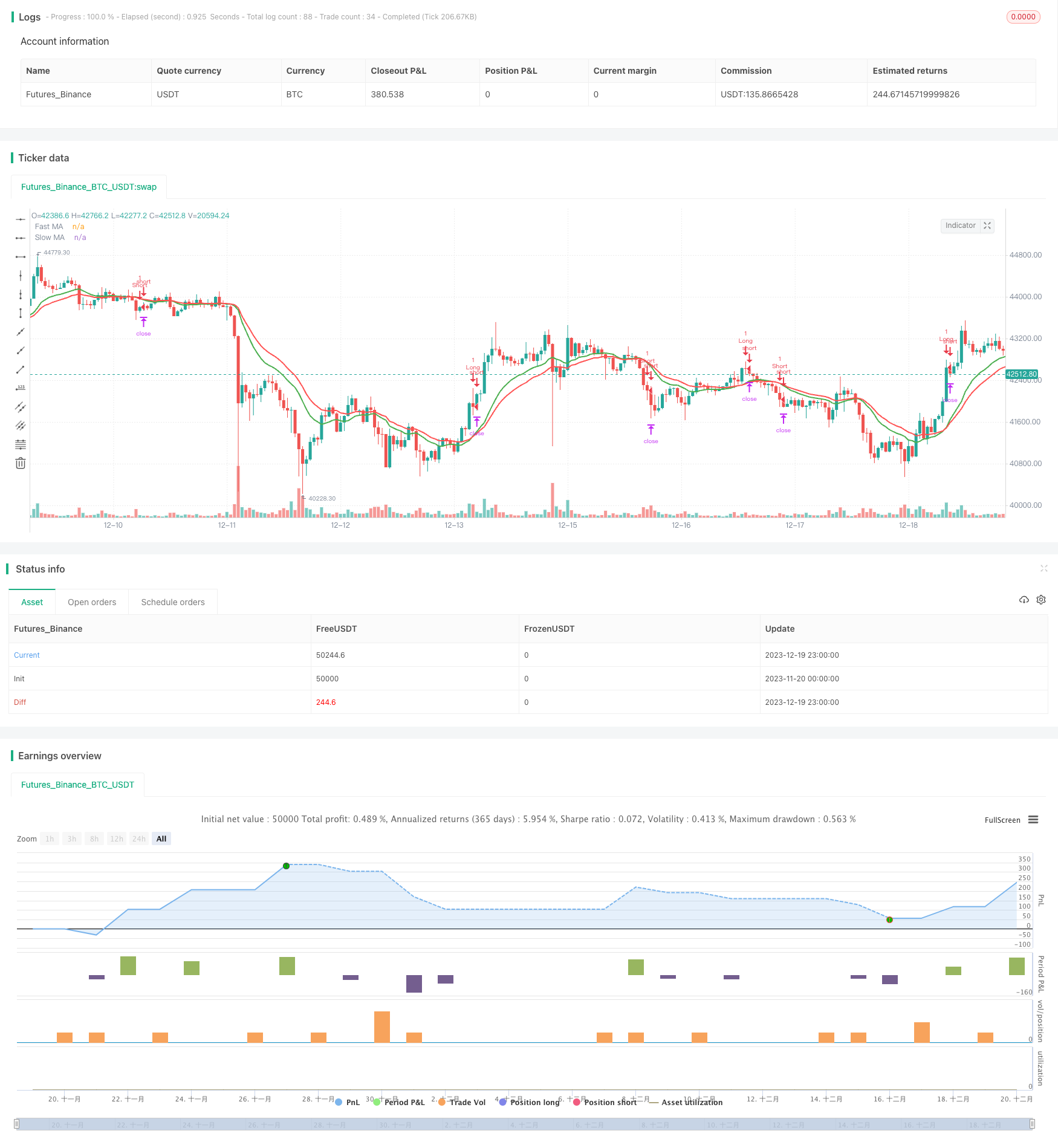
Overview
This strategy adopts the typical trend tracking method of dual moving average crossover, combined with risk management mechanisms such as stop loss, take profit, and trailing stop loss, aiming to capture large profits from trending markets.
Strategy Logic
- Calculate the n-day EMA as the fast line for short term;
- Calculate the m-day EMA as the slow line for long term;
- Go long when the fast line breaks through the slow line upwards, and go short when breaks downwards;
- Exit signal: reverse crossover (e.g. exit long when long crossover occurs).
- Use stop loss, take profit, trailing stop loss to manage risks.
Advantage Analysis
- Adopting dual EMA lines can better determine price trend reversal points and capture trending moves.
- Combining stop loss, take profit and trailing stop helps limit single trade loss, lock in profits and reduce drawdown.
- There are many customizable parameters to adjust and optimize for different products and market environments.
- The strategy logic is simple and clear, easy to understand and modify.
- Support both long and short operations, adaptable to different market conditions.
Risk Analysis
- Dual MA strategies are very sensitive to false breakouts and prone to being trapped.
- Improper parameter settings may lead to frequent trading, increasing trading costs and slippage losses.
- The strategy itself cannot determine trend reversal points, needs to be combined with other indicators.
- It's easy to generate trading signals in ranging markets, but actual profitability tends to be low.
- Parameters need to be optimized for different products and market environments.
Risks can be reduced by:
- Filtering false signals with other indicators.
- Optimizing parameters to lower trading frequency.
- Adding trend-judging indicators to avoid range-bound market trades.
- Adjusting position sizing to lower single trade risks.
Optimization Directions
The strategy can be optimized in the following aspects:
- Optimize fast and slow MA periods for different products and markets.
- Add other indicators to determine trends and filter false signals, e.g MACD, KDJ etc.
- Consider replacing EMA with SMA or WMA.
- Dynamically adjust stop loss based on ATR.
- Flexibly adjust single position sizes based on position sizing methodology.
- Parameter self-adaptive optimization based on correlation and volatility metrics.
Summary
In summary, this is a typical dual EMA crossover trend tracking strategy. It has the advantage of capturing trending moves, integrated with risk management mechanisms like stop loss, take profit and trailing stop loss. But it also has some typical weaknesses, like high sensitivity toward noise and range-bound markets, prone to being trapped. Further improvements can be made by introducing additional indicators, parameters optimization, dynamic adjustments and portfolio usage to enhance the strategy's performance. Overall speaking, with proper parameter tuning and good fitness with product and market conditions, this strategy can achieve decent results.
Parameters
| Name | Default | What it controls |
|---|---|---|
| v_input_1_open | 0 | Fast MA Source: open | high | low | close | hl2 | hlc3 | hlcc4 | ohlc4 |
| v_input_2 | 14 | Fast MA Period |
| v_input_3_open | 0 | Slow MA Source: open | high | low | close | hl2 | hlc3 | hlcc4 | ohlc4 |
| v_input_4 | 21 | Slow MA Period |
| v_input_5 | false | Invert Trade Direction? |
| v_input_6 | 1000 | Take Profit |
| v_input_7 | 200 | Stop Loss |
| v_input_8 | 200 | Trailing Stop Loss |
| v_input_9 | false | Trailing Stop Loss Offset |
Source Pine Script
/*backtest
start: 2023-11-20 00:00:00
end: 2023-12-20 00:00:00
period: 1h
basePeriod: 15m
exchanges: [{"eid":"Futures_Binance","currency":"BTC_USDT"}]
*/

//@version=2

strategy(title = "Strategy Code Example", shorttitle = "Strategy Code Example", overlay = true)

// Revision:        1
// Author:          @JayRogers
//
// *** THIS IS JUST AN EXAMPLE OF STRATEGY RISK MANAGEMENT CODE IMPLEMENTATION ***

// === GENERAL INPUTS ===
// short ma
maFastSource   = input(defval = open, title = "Fast MA Source")
maFastLength   = input(defval = 14, title = "Fast MA Period", minval = 1)
// long ma
maSlowSource   = input(defval = open, title = "Slow MA Source")
maSlowLength   = input(defval = 21, title = "Slow MA Period", minval = 1)

// === STRATEGY RELATED INPUTS ===
tradeInvert     = input(defval = false, title = "Invert Trade Direction?")
// the risk management inputs
inpTakeProfit   = input(defval = 1000, title = "Take Profit", minval = 0)
inpStopLoss     = input(defval = 200, title = "Stop Loss", minval = 0)
inpTrailStop    = input(defval = 200, title = "Trailing Stop Loss", minval = 0)
inpTrailOffset  = input(defval = 0, title = "Trailing Stop Loss Offset", minval = 0)

// === RISK MANAGEMENT VALUE PREP ===
// if an input is less than 1, assuming not wanted so we assign 'na' value to disable it.
useTakeProfit   = inpTakeProfit  >= 1 ? inpTakeProfit  : na
useStopLoss     = inpStopLoss    >= 1 ? inpStopLoss    : na
useTrailStop    = inpTrailStop   >= 1 ? inpTrailStop   : na
useTrailOffset  = inpTrailOffset >= 1 ? inpTrailOffset : na

// === SERIES SETUP ===
/// a couple of ma's..
maFast = ema(maFastSource, maFastLength)
maSlow = ema(maSlowSource, maSlowLength)

// === PLOTTING ===
fast = plot(maFast, title = "Fast MA", color = green, linewidth = 2, style = line, transp = 50)
slow = plot(maSlow, title = "Slow MA", color = red, linewidth = 2, style = line, transp = 50)

// === LOGIC ===
// is fast ma above slow ma?
aboveBelow = maFast >= maSlow ? true : false
// are we inverting our trade direction?
tradeDirection = tradeInvert ? aboveBelow ? false : true : aboveBelow ? true : false

// === STRATEGY - LONG POSITION EXECUTION ===
enterLong() => not tradeDirection[1] and tradeDirection // functions can be used to wrap up and work out complex conditions
exitLong() => tradeDirection[1] and not tradeDirection
strategy.entry(id = "Long", long = true, when = enterLong()) // use function or simple condition to decide when to get in
strategy.close(id = "Long", when = exitLong()) // ...and when to get out
// === STRATEGY - SHORT POSITION EXECUTION ===
enterShort() => tradeDirection[1] and not tradeDirection
exitShort() => not tradeDirection[1] and tradeDirection
strategy.entry(id = "Short", long = false, when = enterShort())
strategy.close(id = "Short", when = exitShort())

// === STRATEGY RISK MANAGEMENT EXECUTION ===
// finally, make use of all the earlier values we got prepped
strategy.exit("Exit Long", from_entry = "Long", profit = useTakeProfit, loss = useStopLoss, trail_points = useTrailStop, trail_offset = useTrailOffset)
strategy.exit("Exit Short", from_entry = "Short", profit = useTakeProfit, loss = useStopLoss, trail_points = useTrailStop, trail_offset = useTrailOffset)
Published by ChaoZhang on the FMZ strategy square · last modified 2023-12-21. Collected in the Quant Trading Vault. Unvalidated research: re-test with your own data and costs before trusting it.
Build this with AgenKit
A spec is not a trading system. Paste this into your coding agent and AgenKit runs a specialist team — architecture, test-first build, risk gates, review — with paper trading on by default.
/agenkit build a production-grade trading bot with a backtest engine, risk controls and paper trading by default from strategies/Dual-MA-Crossover-Trend-Tracking-Strategy.md- npx agenkit install engineering-kit in your project
- Paste the command into your agent and approve each phase
- Get tests, backtest, risk controls and a paper-trading switch
Understand it first
Before you run this, read the lesson behind the idea and how to backtest it honestly. Specs like this one are the survivors of an unknown number of trials; deflate their results accordingly.
Related specs
- Bollinger Bands and RSI Trend Following StrategyPine Script · Trend following · 1h
- Dual ATR Channel Trend Following StrategyPine Script · Trend following · 15m
- Dynamic Dual EMA Crossover Strategy with Adaptive Profit Loss ControlPine Script · Trend following · 1d
- EMA and RSI Trend Trading StrategyPine Script · Trend following · 1d
- Fixed Range Volume Profile And Anchored VWAP Trend Identification Strategy With Dynamic Stop LossPine Script · Trend following · 1h
- Multi Indicator Dynamic Trend Following Strategy Based on EMA and SMAPine Script · Trend following · 1d