Dual Moving Average Turning Point Strategy
The double moving average turning point trading strategy is a trading strategy based on moving average crossover. It uses two moving averages with different parameter settings to determine the timing of entry and…
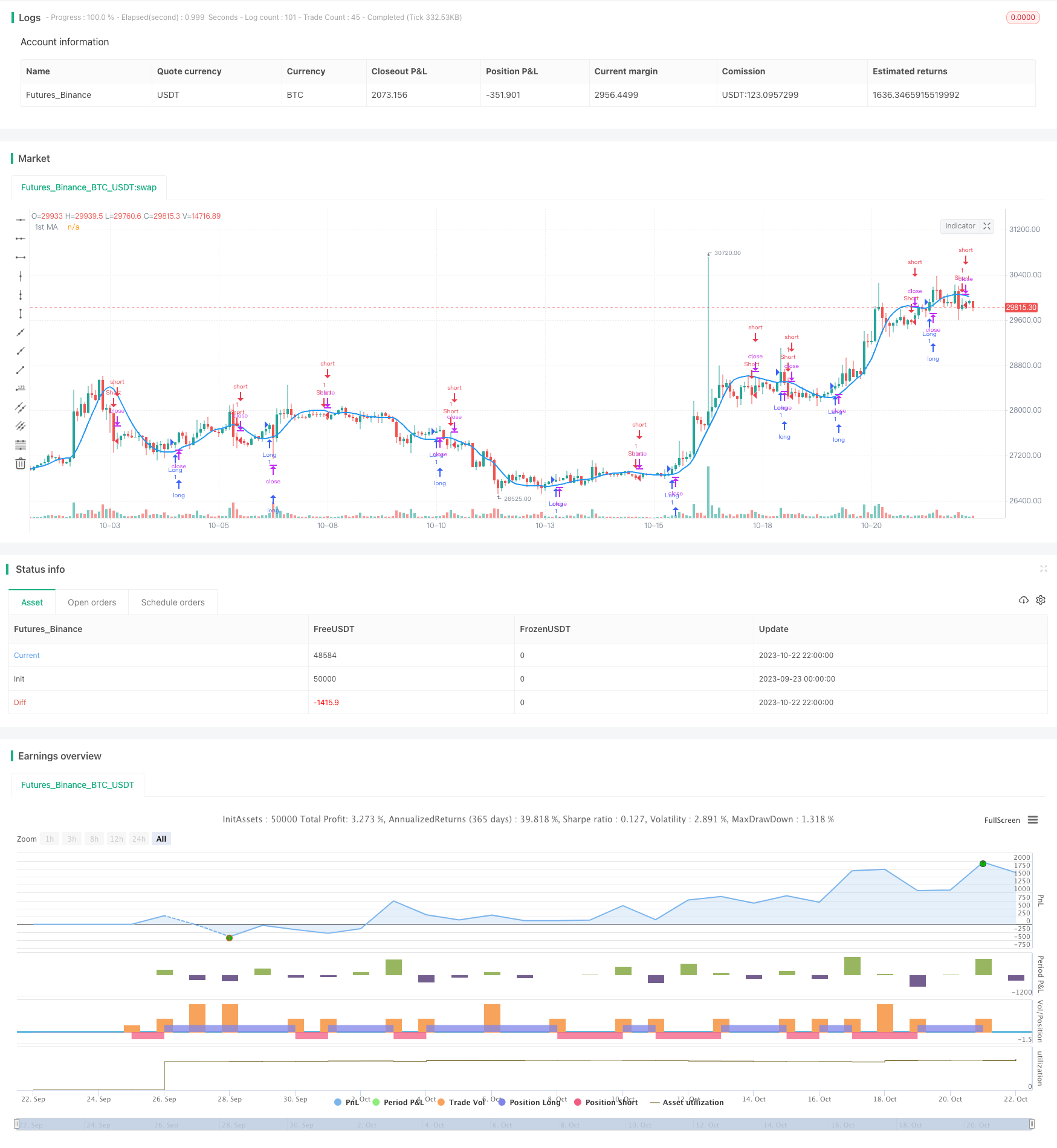
Overview
The double moving average turning point trading strategy is a trading strategy based on moving average crossover. It uses two moving averages with different parameter settings to determine the timing of entry and exit based on their turns. This strategy is simple, intuitive, easy to implement, and suitable for medium and long-term transactions.
Strategy Principle
This strategy uses Price as the price input source and calculates two moving averages with different parameters, SMA1 and SMA2. The strategy uses the ROC indicator to determine the reversal of the moving average. When the ROC value of SMA1 exceeds the set positive threshold, SMA1 is considered to be turning upward, and an upward signal of SMA1 is recorded; when the ROC value of SMA1 falls below the set negative threshold, SMA1 is considered to be turning downward, and a downward signal of SMA1 is recorded. The judgment logic of SMA2 is similar to.
When SMA1 turns upward and the previous candlestick SMA2 turns downward, a buy signal is generated, and you go long; when SMA1 turns downward, and the previous candlestick SMA2 turns upward, a sell signal is generated, and you go short.
This strategy uses the turning of two moving averages to determine the trading direction, the turning of one moving average to confirm the entry time, and the crossover of the two moving averages to ensure that the trend changes at the time of entry, which can effectively filter out false breakthroughs.
Advantage Analysis
Using double moving average crossover and turning judgment can effectively filter out false breakthroughs and improve the accuracy of entry.
Moving average reversal combined with ROC indicator can clearly judge the reversal timing and avoid frequent trading.
uses medium- to long-term dual moving averages to track the main trend and gain significant profit from the trend.
The strategy logic is simple and clear, easy to understand and implement, suitable for quantitative trading beginners.
Customizable parameters to adapt to different market environments and strong adaptability.
Risk Analysis
A double moving average crossover during a volatile market may generate a large number of false signals, leading to losses.
ROCparameters need to be precisely optimized; otherwise, there will be errors in turn recognition, affecting strategy performance.
Large-cycle oscillation markets may trigger multiple stop-losses, which can be avoided by widening the stop-loss range.
Based solely on moving average indicators, it is difficult to respond to sudden events such as major news, which may lead to losses.
It is necessary to pay attention to the problem of over-fitting in parameter optimization. The test period must be long enough and include different market conditions.
Optimization Direction
Optimize moving average parameters and find the best moving average cycle combination
Optimize ROC parameters and improve steering recognition accuracy
Increase the stop-loss mechanism; a dynamic stop-loss based on breaking a custom price level can be used
Add additional conditions, such as trading volume indicator triggering, to avoid false breakthroughs
Combine with other indicators such as MACD and BOLL to improve decision-making effectiveness
Automatically optimize parameters using machine learning and other methods to adapt to market changes
Summary
The double moving average turning point strategy is generally a simple and practical trend following strategy. It only requires basic moving average indicators to implement, and its logic is clear and easy to understand, making it very suitable for quantitative trading beginners to learn and practice. Through parameter optimization and stop-loss mechanism optimization, the stability of the strategy can be greatly improved. Combined with other auxiliary indicators, the strategy can be further enhanced. This strategy is highly customizable and can be flexibly applied in different market environments. It is a recommended double moving average trading strategy.
Overview
The Dual Moving Average Turning Point strategy is a trend following strategy based on moving average crossovers. It uses two moving averages with different parameter settings and determines entry and exit points according to their turning directions. This strategy is simple and intuitive, easy to implement, and suitable for medium-to-long term trading.
Strategy Logic
The strategy uses Price as the price input source and calculates two moving averages, SMA1 and SMA2, with different parameters. It uses the ROC indicator to determine the turning directions of the moving averages. When SMA1's ROC value exceeds the positive threshold, it is considered an upward turn of SMA1 and an upward signal is recorded. When SMA1's ROC value breaks the negative threshold, it is considered a downward turn of SMA1 and a downward signal is recorded. The judgment logic for SMA2 is similar.
When SMA1 turns upward and the previous bar's SMA2 turns downward, a buy signal is generated to go long. When SMA1 turns downward and the previous bar's SMA2 turns upward, a sell signal is generated to go short.
The strategy uses the turning directions of two moving averages to determine the trading direction and the turning of one moving average to confirm entry timing. The dual moving average crossover ensures the trend has changed when entering the market, which helps avoid false breakouts.
Advantage Analysis
Using dual moving average crossover and turning points can effectively filter out false breakouts and improve entry accuracy.
Combining moving average turning points with the ROC indicator can clearly identify turning points and avoid frequent trading.
Adopting medium-to-long-term dual moving averages can track the main trend and achieve sizable trend profits.
The strategy logic is simple and clear, easy to understand and implement, suitable for quant trading beginners.
Customizable parameters suit different market environments with strong adaptability.
Risk Analysis
Dual moving average crossovers may generate many false signals in ranging markets, leading to losses.
The ROC parameters need precise optimization, otherwise turn recognition will have errors, affecting strategy performance.
Large periodic ranging markets may trigger stop loss multiple times. Expanding stop loss range can avoid it.
Relying solely on moving averages, it's hard to respond to sudden events like major news, which may lead to losses.
Note the overfitting problem in parameter optimization. Test period should be long enough to include different market conditions.
Optimization Directions
Optimize moving average parameters to find the best moving average period combination.
Optimize ROC parameters to improve turning point recognition accuracy.
Add stop loss mechanisms such as dynamic stop loss based on breaking customized price levels.
Add additional conditions like volume indicators to avoid false breakouts.
Incorporate other indicators like MACD, BOLL to improve decision making.
Use machine learning etc. to auto optimize parameters and adapt to market changes.
Summary
In summary, the Dual Moving Average Turning Point strategy is a simple and practical trend following strategy. It can be implemented with basic moving average indicators and has clear, easy-to-understand logic, making it very suitable for quant trading beginners to learn and practice. With parameter optimization and stop loss optimization, the strategy stability can be greatly improved. Combining with other auxiliary indicators can further enhance the strategy. The highly customizable strategy can be flexibly applied to different market environments and is a recommended dual moving average trading strategy.
Parameters
| Name | Default | What it controls |
|---|---|---|
| v_input_1_close | 0 | Source: close | high | low | open | hl2 | hlc3 | hlcc4 | ohlc4 |
| v_input_2 | 25 | 1st MA Length |
| v_input_3 | 0 | 1st MA Type: HMA | EMA | SMA | VWMA |
| v_input_4 | true | Lookback 1 |
| v_input_5 | 2.5 | Minimum slope magnitude * 100 |
Source Pine Script
/*backtest
start: 2023-09-23 00:00:00
end: 2023-10-23 00:00:00
period: 2h
basePeriod: 15m
exchanges: [{"eid":"Futures_Binance","currency":"BTC_USDT"}]
*/

//@version=3
strategy("MA Turning Point Strategy", overlay=true)
src = input(close, title="Source")

price = request.security(syminfo.tickerid, timeframe.period, src)
ma1 = input(25, title="1st MA Length")
type1 = input("HMA", "1st MA Type", options=["SMA", "EMA", "HMA", "VWMA"])
f_hma(_src, _length)=>
    _return = wma((2*wma(_src, _length/2))-wma(_src, _length), round(sqrt(_length)))

price1 = if (type1 == "SMA")
    sma(price, ma1)
else
    if (type1 == "EMA")
        ema(price, ma1)
    else
        if (type1 == "VWMA")
            vwma(price, ma1)
        else
            f_hma(price, ma1)

plot(series=price1, style=line,  title="1st MA", color=blue, linewidth=2, transp=0)

lookback1 = input(1, "Lookback 1")
roc1 = roc(price1, lookback1)

ma1up = false
ma1down = false
ma2up = false
ma2down = false

ma1up := nz(ma1up[1])
ma1down := nz(ma1down[1])
ma2up := nz(ma2up[1])
ma2down := nz(ma2down[1])

trendStrength1 = input(2.5, title="Minimum slope magnitude * 100", type=float) * 0.01

if crossover(roc1, trendStrength1)
    ma1up := true
    ma1down := false

if crossunder(roc1, -trendStrength1)
    ma1up := false
    ma1down := true

longCondition = ma1up and ma1down[1]
if (longCondition)
    strategy.entry("Long", strategy.long)

shortCondition = ma1down and ma1up[1]
if (shortCondition)
    strategy.entry("Short", strategy.short)
Published by ChaoZhang on the FMZ strategy square · last modified 2023-10-24. Collected in the Quant Trading Vault. Unvalidated research: re-test with your own data and costs before trusting it.
Build this with AgenKit
A spec is not a trading system. Paste this into your coding agent and AgenKit runs a specialist team — architecture, test-first build, risk gates, review — with paper trading on by default.
/agenkit build a production-grade trading bot with a backtest engine, risk controls and paper trading by default from strategies/Dual-Moving-Average-Turning-Point-Strategy.md- npx agenkit install engineering-kit in your project
- Paste the command into your agent and approve each phase
- Get tests, backtest, risk controls and a paper-trading switch
Understand it first
Before you run this, read the lesson behind the idea and how to backtest it honestly. Specs like this one are the survivors of an unknown number of trials; deflate their results accordingly.
Related specs
- Adaptive Multi Period Trading Strategy Based on Wave Trend Momentum BreakoutPine Script · Breakout · 2h
- BB Breakout StrategyPine Script · Breakout · 1d
- BMSB Breakout Strategy BMSBPine Script · Breakout · 1h
- Bollinger Band T3 Moving Average StrategyPine Script · Breakout · 10m
- Bollinger Bands Dual track Breakthrough StrategyPine Script · Breakout · 30m
- Bollinger Breakout StrategyPine Script · Breakout · 30m