Dynamic Multi indicator Quantitative Trading Strategy
This strategy utilizes the combination signals of multiple technical indicators to dynamically trade the underlying assets like stocks and cryptocurrencies. The strategy can automatically identify market trends and…
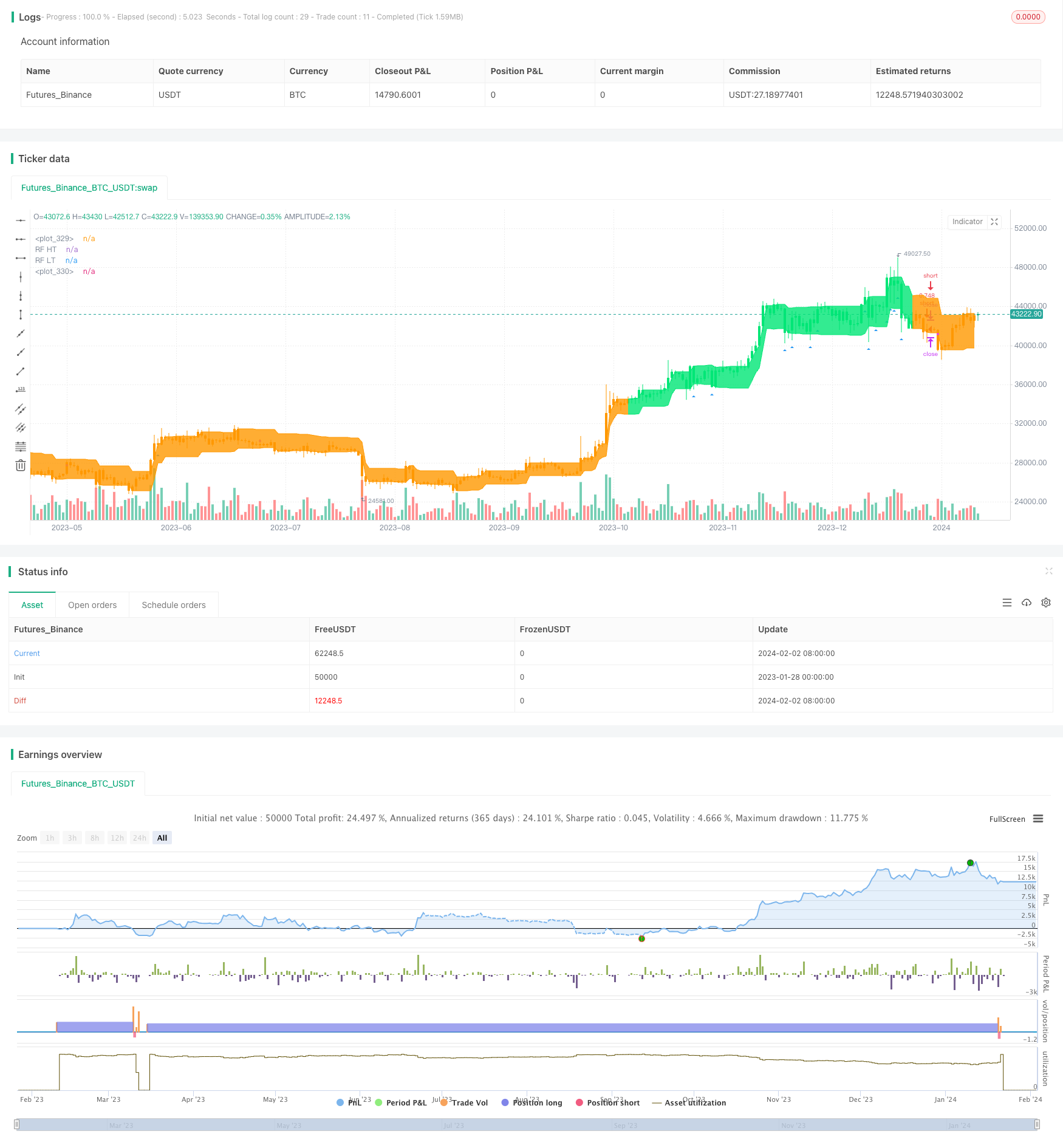
Overview
This strategy utilizes the combination signals of multiple technical indicators to dynamically trade the underlying assets like stocks and cryptocurrencies. The strategy can automatically identify market trends and track them. Also, stop loss mechanism is incorporated to control risks.
Principles
This strategy mainly leverages moving averages, relative strength index (RSI), average true range (ATR) and directional movement index (ADX) to generate trading signals.
Specifically, it first adopts double moving average crossovers to form signals. The fast line has a length of 10 days and the slow line has a length of 50 days. Golden crossovers (fast line breaking above slow line from below) generate buy signals while dead crossovers generate sell signals. This system can effectively identify reversals in long-term trends.
On top of double MAs, RSI is introduced to confirm the trend signals and avoid false breakouts. RSI judges the market strength by the divergence between the fast and slow line. When RSI breaks above 30, buy signal is generated. When breaking below 70, sell signal is generated.
In addition, ATR is used to automatically adjust the stop loss level. ATR can effectively reflect the volatility of markets. When volatility rises, wider stop loss will be set to reduce the probability of being stopped out.
Finally, ADX gauges the strength of the trend. ADX uses the divergence between the positive indicator DI+ and negative indicator DI- to measure trend strength. Only when ADX breaks above 20, the trend is considered to be established and actual trading signals are generated.
By combining signals from multiple indicators, the strategy can be more prudent in sending trading signals, avoiding the interference from false signals and hence achieving higher win rate.
Advantages
The advantages of this strategy include:
- Combination of multiple indicators improves decision accuracy
The combination of MA, RSI, ATR, ADX and more can improve the accuracy and avoid faulty judgements due to single indicator.
- Automatic stop loss adjustment controls risks
Adjusting stop loss based on market volatility can reduce the probability of being stopped out and effectively manage risks.
- Judging trend strength avoids trading against trends
By judging trend strength with ADX before actual trading, losses from trading against trends can be reduced.
- Large parameter tuning space
Parameters like MA lengths, RSI length, ATR period and ADX period can all be adjusted and optimized for different markets. Hence the strategy has strong adaptability.
- Protecting long-term profits
Identifying long-term trends using the fast and slow MA system and reducing short-term noises with indicators like RSI, long-term holding in trends becomes possible for higher profits.
Risks & Solutions
There are also a few risks associated with this strategy:
- Parameter optimization difficulty
More parameters means greater difficulty in optimization. Unsuitable parameter sets may deteriorate strategy performance. More adequate backtesting and parameter tuning can alleviate this risk.
- Indicator failure risk
All technical indicators have applicable market states. When markets enter peculiar states, indicators used may fail simultaneously. Risks from such BLACK SWAN events need attention.
- Unlimited loss risk from shorting
The strategy allows short trading. Short positions inherently have the risk of unlimited losses. This can be reduced by setting proper stop loss.
- Trend reversal risk
Indicators cannot promptly respond to reversals. Wrong directional positions often incur losses during reversals. Shortening parameters of some indicators may improve sensitivities.
Optimization
There is room for further optimization:
- Adaptive indicator weighting
Analyze correlations between indicators/market states and design mechanisms to dynamically adjust indicator weights based on changing market conditions to improve decisions.
- Augmentation by deep learning
Use deep learning models to forecast price movement directions and augment the rules-based system to improve accuracy.
- Adaptive parameter tuning
Design adaptive tuning modules for indicator parameters based on sliding window historical data so that the strategy can better adapt.
- Incorporate variable-period analysis
Integrate variable-period analysis like Elliott Waves Theory to assist judging mid-long term trends and improve profitability.
Conclusion
In summary, this strategy integrates MA, RSI, ATR, ADX and more into a relatively comprehensive system, which can identify longer-term trends via the MA system and reduce noise interference with short-term indicators like RSI. Also, large optimization space exists for performance improvement. The strategy improves decisions by combining indicators and controls risks. It deserves further research and application.
Parameters
| Name | Default | What it controls |
|---|---|---|
| v_input_1_open | 0 | src: open | high | low | close | hl2 | hlc3 | hlcc4 | ohlc4 |
| v_input_2 | 25 | Rsi vwap lenght |
| v_input_float_6 | 0.4 | StopLoss |
| v_input_string_1 | 0 | (?ADX)Adx Type: MASANAKAMURA | CLASSIC |
| v_input_int_1 | 38 | Adx lenght |
| v_input_float_1 | 23 | Adx Treshold |
| v_input_float_2 | 1.2 | (?Volume)Volume mult. |
| v_input_int_2 | 35 | Volume lenght |
| v_input_int_3 | 25 | (?Relative Strenght Indeks)RSI lenght |
| v_input_source_1_low | 0 | RSI Source: low | high | close | open | hl2 | hlc3 | hlcc4 | ohlc4 |
| v_input_int_4 | 26 | (?Range Filter)SAMPLING PERIOD |
| v_input_float_3 | 2.3 | RANGE MULTIPLIER |
| v_input_int_5 | true | (?Cloud)Cloud Length |
| v_input_int_6 | 26 | (?Relative Momentum Index)Rmi Lenght |
| v_input_int_7 | 17 | Rmi Momentum |
| v_input_int_8 | 33 | Rmi oversold |
| v_input_int_9 | 68 | Rmi overbought |
| v_input_float_4 | 2 | (?strategy settings)Swap % period |
| v_input_float_5 | 1.2 | Tp-1 |
Source Pine Script
/*backtest
start: 2023-01-28 00:00:00
end: 2024-02-03 00:00:00
period: 1d
basePeriod: 1h
exchanges: [{"eid":"Futures_Binance","currency":"BTC_USDT"}]
*/

// This source code to my testing
// © sgb

//@version=5


strategy(title='Soren test 2', overlay=true, initial_capital=100, pyramiding=1, calc_on_order_fills=true, calc_on_every_tick=true, default_qty_type=strategy.percent_of_equity, default_qty_value=50, commission_value=0.04)

//SOURCE =============================================================================================================================================================================================================================================================================================================

src = input(open)

// INPUTS ============================================================================================================================================================================================================================================================================================================


//ADX --------------------------------------------------------------------------------------------------------------------------------------------------------------------------------------------------------------------------------------------------------------------------------------------------------------------

ADX_options = input.string('MASANAKAMURA', title='Adx Type', options=['CLASSIC', 'MASANAKAMURA'], group='ADX')
ADX_len = input.int(38, title='Adx lenght', minval=1, group='ADX')
th = input.float(23, title='Adx Treshold', minval=0, step=0.5, group='ADX')

// Volume ------------------------------------------------------------------------------------------------------------------------------------------------------------------------------------------------------------------------------------------------------------------------------------------------------------

volume_f = input.float(1.2, title='Volume mult.', minval=0, step=0.1, group='Volume')
sma_length = input.int(35, title='Volume lenght', minval=1, group='Volume')

//RSI----------------------------------------------------------------------------------------------------------------------------------------------------------------------------------------------------------------------------------------------------------------------------------------------------------------------

len_3 = input.int(25, title='RSI lenght', group='Relative Strenght Indeks')
src_3 = input.source(low, title='RSI Source', group='Relative Strenght Indeks')
RSI_VWAP_length = input(25, title='Rsi vwap lenght')

// Range Filter ---------------------------------------------------------------------------------------------------------------------------------------------------------------------------------------------------------------------------------------------------------------------------------------------------------

per_ = input.int(26, title='SAMPLING PERIOD', minval=1, group='Range Filter')
mult = input.float(2.3, title='RANGE MULTIPLIER', minval=0.1, step=0.1, group='Range Filter')

// Cloud --------------------------------------------------------------------------------------------------------------------------------------------------------------------------------------------------------------------------------------------------------------------------------------------------------------------

len = input.int(1, title='Cloud Length', group='Cloud')

//RMI ----------------------------------------------------------------------------------------------------------------------------------------------------------------------------------------------------------------------------------------------------------------------------------------------------------------------

RMI_len = input.int(26, title='Rmi Lenght', minval=1, group='Relative Momentum Index')
mom = input.int(17, title='Rmi Momentum', minval=1, group='Relative Momentum Index')
RMI_os = input.int(33, title='Rmi oversold', minval=0, group='Relative Momentum Index')
RMI_ob = input.int(68, title='Rmi overbought', minval=0, group='Relative Momentum Index')


// Indicators Calculations ========================================================================================================================================================================================================================================================================================================

// Range Filter ----------------------------------------------------------------------------------------------------------------------------------------------------------------------------------------------------------------------------------------------------------------------------------------------------

var bool L_RF = na
var bool S_RF = na

Range_filter(_src, _per_, _mult) =>
    var float _upward = 0.0
    var float _downward = 0.0
    wper = _per_ * 2 - 1
    avrng = ta.ema(math.abs(_src - _src[1]), _per_)
    _smoothrng = ta.ema(avrng, wper) * _mult
    _filt = _src
    _filt := _src > nz(_filt[1]) ? _src - _smoothrng < nz(_filt[1]) ? nz(_filt[1]) : _src - _smoothrng : _src + _smoothrng > nz(_filt[1]) ? nz(_filt[1]) : _src + _smoothrng
    _upward := _filt > _filt[1] ? nz(_upward[1]) + 1 : _filt < _filt[1] ? 0 : nz(_upward[1])
    _downward := _filt < _filt[1] ? nz(_downward[1]) + 1 : _filt > _filt[1] ? 0 : nz(_downward[1])
    [_smoothrng, _filt, _upward, _downward]
[smoothrng, filt, upward, downward] = Range_filter(src, per_, mult)
hband = filt + smoothrng
lband = filt - smoothrng
L_RF := high > hband and upward > 0
S_RF := low < lband and downward > 0

//ADX-------------------------------------------------------------------------------------------------------------------------------------------------------------------------------------------------------------------------------------------------------------------------------------------------------------------

calcADX(_len) =>
    up = ta.change(high)
    down = -ta.change(low)
    plusDM = na(up) ? na : up > down and up > 0 ? up : 0
    minusDM = na(down) ? na : down > up and down > 0 ? down : 0
    truerange = ta.rma(ta.tr, _len)
    _plus = fixnan(100 * ta.rma(plusDM, _len) / truerange)
    _minus = fixnan(100 * ta.rma(minusDM, _len) / truerange)
    sum = _plus + _minus
    _adx = 100 * ta.rma(math.abs(_plus - _minus) / (sum == 0 ? 1 : sum), _len)
    [_plus, _minus, _adx]
calcADX_Masanakamura(_len) =>
    SmoothedTrueRange = 0.0
    SmoothedDirectionalMovementPlus = 0.0
    SmoothedDirectionalMovementMinus = 0.0
    TrueRange = math.max(math.max(high - low, math.abs(high - nz(close[1]))), math.abs(low - nz(close[1])))
    DirectionalMovementPlus = high - nz(high[1]) > nz(low[1]) - low ? math.max(high - nz(high[1]), 0) : 0
    DirectionalMovementMinus = nz(low[1]) - low > high - nz(high[1]) ? math.max(nz(low[1]) - low, 0) : 0
    SmoothedTrueRange := nz(SmoothedTrueRange[1]) - nz(SmoothedTrueRange[1]) / _len + TrueRange
    SmoothedDirectionalMovementPlus := nz(SmoothedDirectionalMovementPlus[1]) - nz(SmoothedDirectionalMovementPlus[1]) / _len + DirectionalMovementPlus
    SmoothedDirectionalMovementMinus := nz(SmoothedDirectionalMovementMinus[1]) - nz(SmoothedDirectionalMovementMinus[1]) / _len + DirectionalMovementMinus
    DIP = SmoothedDirectionalMovementPlus / SmoothedTrueRange * 100
    DIM = SmoothedDirectionalMovementMinus / SmoothedTrueRange * 100
    DX = math.abs(DIP - DIM) / (DIP + DIM) * 100
    adx = ta.sma(DX, _len)
    [DIP, DIM, adx]
[DIPlusC, DIMinusC, ADXC] = calcADX(ADX_len)
[DIPlusM, DIMinusM, ADXM] = calcADX_Masanakamura(ADX_len)

DIPlus = ADX_options == 'CLASSIC' ? DIPlusC : DIPlusM
DIMinus = ADX_options == 'CLASSIC' ? DIMinusC : DIMinusM
ADX = ADX_options == 'CLASSIC' ? ADXC : ADXM
L_adx = DIPlus > DIMinus and ADX > th
S_adx = DIPlus < DIMinus and ADX > th

// Volume -------------------------------------------------------------------------------------------------------------------------------------------------------------------------------------------------------------------------------------------------------------------------------------------------------------

Volume_condt = volume > ta.sma(volume, sma_length) * volume_f

//RSI------------------------------------------------------------------------------------------------------------------------------------------------------------------------------------------------------------------------------------------------------------------------------------------------------------------

up_3 = ta.rma(math.max(ta.change(src_3), 0), len_3)
down_3 = ta.rma(-math.min(ta.change(src_3), 0), len_3)
rsi_3 = down_3 == 0 ? 100 : up_3 == 0 ? 0 : 100 - 100 / (1 + up_3 / down_3)
L_rsi = rsi_3 < 70
S_rsi = rsi_3 > 30
RSI_VWAP = ta.rsi(ta.vwap(close), RSI_VWAP_length)
RSI_VWAP_overSold = 13
RSI_VWAP_overBought = 68

L_VAP = ta.crossover(RSI_VWAP, RSI_VWAP_overSold)
S_VAP = ta.crossunder(RSI_VWAP, RSI_VWAP_overBought)

//Cloud --------------------------------------------------------------------------------------------------------------------------------------------------------------------------------------------------------------------------------------------------------------------------------------------------------------

PI = 2 * math.asin(1)
hilbertTransform(src) =>
    0.0962 * src + 0.5769 * nz(src[2]) - 0.5769 * nz(src[4]) - 0.0962 * nz(src[6])
computeComponent(src, mesaPeriodMult) =>
    hilbertTransform(src) * mesaPeriodMult
computeAlpha(src, fastLimit, slowLimit) =>
    mesaPeriod = 0.0
    mesaPeriodMult = 0.075 * nz(mesaPeriod[1]) + 0.54
    smooth = 0.0
    smooth := (4 * src + 3 * nz(src[1]) + 2 * nz(src[2]) + nz(src[3])) / 10
    detrender = 0.0
    detrender := computeComponent(smooth, mesaPeriodMult)
    I1 = nz(detrender[3])
    Q1 = computeComponent(detrender, mesaPeriodMult)
    jI = computeComponent(I1, mesaPeriodMult)
    jQ = computeComponent(Q1, mesaPeriodMult)
    I2 = 0.0
    Q2 = 0.0
    I2 := I1 - jQ
    Q2 := Q1 + jI
    I2 := 0.2 * I2 + 0.8 * nz(I2[1])
    Q2 := 0.2 * Q2 + 0.8 * nz(Q2[1])
    Re = I2 * nz(I2[1]) + Q2 * nz(Q2[1])
    Im = I2 * nz(Q2[1]) - Q2 * nz(I2[1])
    Re := 0.2 * Re + 0.8 * nz(Re[1])
    Im := 0.2 * Im + 0.8 * nz(Im[1])
    if Re != 0 and Im != 0
        mesaPeriod := 2 * PI / math.atan(Im / Re)
        mesaPeriod
    if mesaPeriod > 1.5 * nz(mesaPeriod[1])
        mesaPeriod := 1.5 * nz(mesaPeriod[1])
        mesaPeriod
    if mesaPeriod < 0.67 * nz(mesaPeriod[1])
        mesaPeriod := 0.67 * nz(mesaPeriod[1])
        mesaPeriod
    if mesaPeriod < 6
        mesaPeriod := 6
        mesaPeriod
    if mesaPeriod > 50
        mesaPeriod := 50
        mesaPeriod
    mesaPeriod := 0.2 * mesaPeriod + 0.8 * nz(mesaPeriod[1])
    phase = 0.0
    if I1 != 0
        phase := 180 / PI * math.atan(Q1 / I1)
        phase
    deltaPhase = nz(phase[1]) - phase
    if deltaPhase < 1
        deltaPhase := 1
        deltaPhase
    alpha = fastLimit / deltaPhase
    if alpha < slowLimit
        alpha := slowLimit
        alpha
    [alpha, alpha / 2.0]
er = math.abs(ta.change(src, len)) / math.sum(math.abs(ta.change(src)), len)
[a, b] = computeAlpha(src, er, er * 0.1)
mama = 0.0
mama := a * src + (1 - a) * nz(mama[1])
fama = 0.0
fama := b * mama + (1 - b) * nz(fama[1])
alpha = math.pow(er * (b - a) + a, 2)
kama = 0.0
kama := alpha * src + (1 - alpha) * nz(kama[1])

L_cloud = kama > kama[1]
S_cloud = kama < kama[1]

// RMI -----------------------------------------------------------------------------------------------------------------------------------------------------------------------------------------------------------------------------------------------------------------------------------------------------------------------

RMI(len, m) =>
    up = ta.ema(math.max(close - close[m], 0), len)
    dn = ta.ema(math.max(close[m] - close, 0), len)
    RMI = dn == 0 ? 0 : 100 - 100 / (1 + up / dn)
    RMI
L_rmi = ta.crossover(RMI(RMI_len, mom), RMI_os)
S_rmi = ta.crossunder(RMI(RMI_len, mom), RMI_ob)


//STRATEGY ==========================================================================================================================================================================================================================================================================================================

L_1 = L_VAP and L_RF and not S_adx
S_1 = S_VAP and S_RF and not L_adx
L_2 = L_adx and Volume_condt and L_rsi and L_cloud
S_2 = S_adx and Volume_condt and S_rsi and S_cloud
L_3 = L_rmi and L_RF and not S_adx
S_3 = S_rmi and S_RF and not L_adx
L_basic_condt = L_1 or L_2 or L_3
S_basic_condt = S_1 or S_2 or S_3

var bool longCondition = na
var bool shortCondition = na
var float last_open_longCondition = na
var float last_open_shortCondition = na
var int last_longCondition = 0
var int last_shortCondition = 0
longCondition := L_basic_condt
shortCondition := S_basic_condt
last_open_longCondition := longCondition ? close : nz(last_open_longCondition[1])
last_open_shortCondition := shortCondition ? close : nz(last_open_shortCondition[1])
last_longCondition := longCondition ? time : nz(last_longCondition[1])
last_shortCondition := shortCondition ? time : nz(last_shortCondition[1])
in_longCondition = last_longCondition > last_shortCondition
in_shortCondition = last_shortCondition > last_longCondition

// SWAP-SL ---------------------------------------------------------------------------------------------------------------------------------------------------------------------------------

var int last_long_sl = na
var int last_short_sl = na
sl = input.float(2, 'Swap % period', minval=0, step=0.1, group='strategy settings')
long_sl = ta.crossunder(low, (1 - sl / 100) * last_open_longCondition) and in_longCondition and not longCondition
short_sl = ta.crossover(high, (1 + sl / 100) * last_open_shortCondition) and in_shortCondition and not shortCondition
last_long_sl := long_sl ? time : nz(last_long_sl[1])
last_short_sl := short_sl ? time : nz(last_short_sl[1])
var bool CondIni_long_sl = 0
CondIni_long_sl := long_sl ? 1 : longCondition ? -1 : nz(CondIni_long_sl[1])
var bool CondIni_short_sl = 0
CondIni_short_sl := short_sl ? 1 : shortCondition ? -1 : nz(CondIni_short_sl[1])
Final_Long_sl = long_sl and nz(CondIni_long_sl[1]) == -1 and in_longCondition and not longCondition
Final_Short_sl = short_sl and nz(CondIni_short_sl[1]) == -1 and in_shortCondition and not shortCondition
var int sectionLongs = 0
sectionLongs := nz(sectionLongs[1])
var int sectionShorts = 0
sectionShorts := nz(sectionShorts[1])

// RE-ENTRY ---------------------------------------------------------------------------------------------------------------------------------------------------------------------------------------

if longCondition or Final_Long_sl
    sectionLongs += 1
    sectionShorts := 0
    sectionShorts
if shortCondition or Final_Short_sl
    sectionLongs := 0
    sectionShorts += 1
    sectionShorts
var float sum_long = 0.0
var float sum_short = 0.0

if longCondition
    sum_long := nz(last_open_longCondition) + nz(sum_long[1])
    sum_short := 0.0
    sum_short
if Final_Long_sl
    sum_long := (1 - sl / 100) * last_open_longCondition + nz(sum_long[1])
    sum_short := 0.0
    sum_short
if shortCondition
    sum_short := nz(last_open_shortCondition) + nz(sum_short[1])
    sum_long := 0.0
    sum_long
if Final_Short_sl
    sum_long := 0.0
    sum_short := (1 + sl / 100) * last_open_shortCondition + nz(sum_short[1])
    sum_short

var float Position_Price = 0.0
Position_Price := nz(Position_Price[1])
Position_Price := longCondition or Final_Long_sl ? sum_long / sectionLongs : shortCondition or Final_Short_sl ? sum_short / sectionShorts : na

//TP_1 -------------------------------------------------------------------------------------------------------------------------------------------------------------------------------------------------------------------------------------------------------------------------------------------------------------------

tp = input.float(1.2, 'Tp-1 ', minval=0, step=0.1, group='strategy settings')
long_tp = ta.crossover(high, (1 + tp / 100) * fixnan(Position_Price)) and in_longCondition and not longCondition
short_tp = ta.crossunder(low, (1 - tp / 100) * fixnan(Position_Price)) and in_shortCondition and not shortCondition
var int last_long_tp = na
var int last_short_tp = na
last_long_tp := long_tp ? time : nz(last_long_tp[1])
last_short_tp := short_tp ? time : nz(last_short_tp[1])
Final_Long_tp = long_tp and last_longCondition > nz(last_long_tp[1])
Final_Short_tp = short_tp and last_shortCondition > nz(last_short_tp[1])
fixnan_1 = fixnan(Position_Price)
ltp = Final_Long_tp ? fixnan_1 * (1 + tp / 100) : na
fixnan_2 = fixnan(Position_Price)
stp = Final_Short_tp ? fixnan_2 * (1 - tp / 100) : na
if Final_Short_tp or Final_Long_tp
    sum_long := 0.0
    sum_short := 0.0
    sectionLongs := 0
    sectionShorts := 0
    sectionShorts
if Final_Long_tp
    CondIni_long_sl == 1
if Final_Short_tp
    CondIni_short_sl == 1


// COLORS & PLOTS --------------------------------------------------------------------------------------------------------------------------------------------------------------------------------------------------------------------------------------------------------------------------------------------------------

ADX_COLOR = L_adx ? color.lime : S_adx ? color.red : color.orange
barcolor(color=ADX_COLOR)
hbandplot = plot(hband, title='RF HT', color=ADX_COLOR, transp=50)
lbandplot = plot(lband, title='RF LT', color=ADX_COLOR, transp=50)
fill(hbandplot, lbandplot, title='RF TR', color=ADX_COLOR, transp=90)
plotshape(longCondition, title='Long', style=shape.triangleup, location=location.belowbar, color=color.new(color.blue, 0), size=size.tiny)
plotshape(shortCondition, title='Short', style=shape.triangledown, location=location.abovebar, color=color.new(color.red, 0), size=size.tiny)

plot(ltp, style=plot.style_circles, linewidth=5, color=color.new(color.fuchsia, 0), editable=false)
plot(stp, style=plot.style_circles, linewidth=5, color=color.new(color.fuchsia, 0), editable=false)

//BACKTESTING--------------------------------------------------------------------------------------------------------------------------------------------------------------------------------------------------------------------------------------------------------------------------------------------------------


Q = 50
SL = input.float(0.4, 'StopLoss ', minval=0, step=0.1)

strategy.entry('long', strategy.long, when=longCondition)
strategy.entry('short', strategy.short, when=shortCondition)

strategy.exit('TP', 'long', qty_percent=Q, limit=fixnan(Position_Price) * (1 + tp / 100))
strategy.exit('TP', 'short', qty_percent=Q, limit=fixnan(Position_Price) * (1 - tp / 100))


strategy.exit('SL', 'long', stop=fixnan(Position_Price) * (1 - SL / 100))
strategy.exit('SL', 'short', stop=fixnan(Position_Price) * (1 + SL / 100))


//
//
//
//
//
//

// By SGB
Published by ChaoZhang on the FMZ strategy square · last modified 2024-02-04. Collected in the Quant Trading Vault. Unvalidated research: re-test with your own data and costs before trusting it.
Build this with AgenKit
A spec is not a trading system. Paste this into your coding agent and AgenKit runs a specialist team — architecture, test-first build, risk gates, review — with paper trading on by default.
/agenkit build a production-grade trading bot with a backtest engine, risk controls and paper trading by default from strategies/Dynamic-Multi-indicator-Quantitative-Trading-Strategy.md- npx agenkit install engineering-kit in your project
- Paste the command into your agent and approve each phase
- Get tests, backtest, risk controls and a paper-trading switch
Understand it first
Before you run this, read the lesson behind the idea and how to backtest it honestly. Specs like this one are the survivors of an unknown number of trials; deflate their results accordingly.
Related specs
- Multi Filter Trend Breakthrough Smart Moving Average Trading StrategyPine Script · Breakout · 1h
- Momentum Breakout Trading Strategy 440964Pine Script · Breakout · 5m
- Moving Average Crossover and Upper Rail Breakthrough Impulse StrategyPine Script · Breakout · 1m
- Quantitative Trading Strategy Based on Ichimoku with Multiple SignalsPine Script · Breakout · 1h
- Multi Strategy Adaptive Trend Following and Breakout Trading SystemPine Script · Breakout · 1d
- Momentum Breakthrough ATR Volatility StrategyPine Script · Breakout · 1m