Strategy vault / Mean reversion
Gap Trading Moving Average Strategy
This article provides an in-depth analysis of the moving average gap trading strategy coded by Noro. The strategy identifies trend reversals by calculating the deviation between closing price and simple moving…
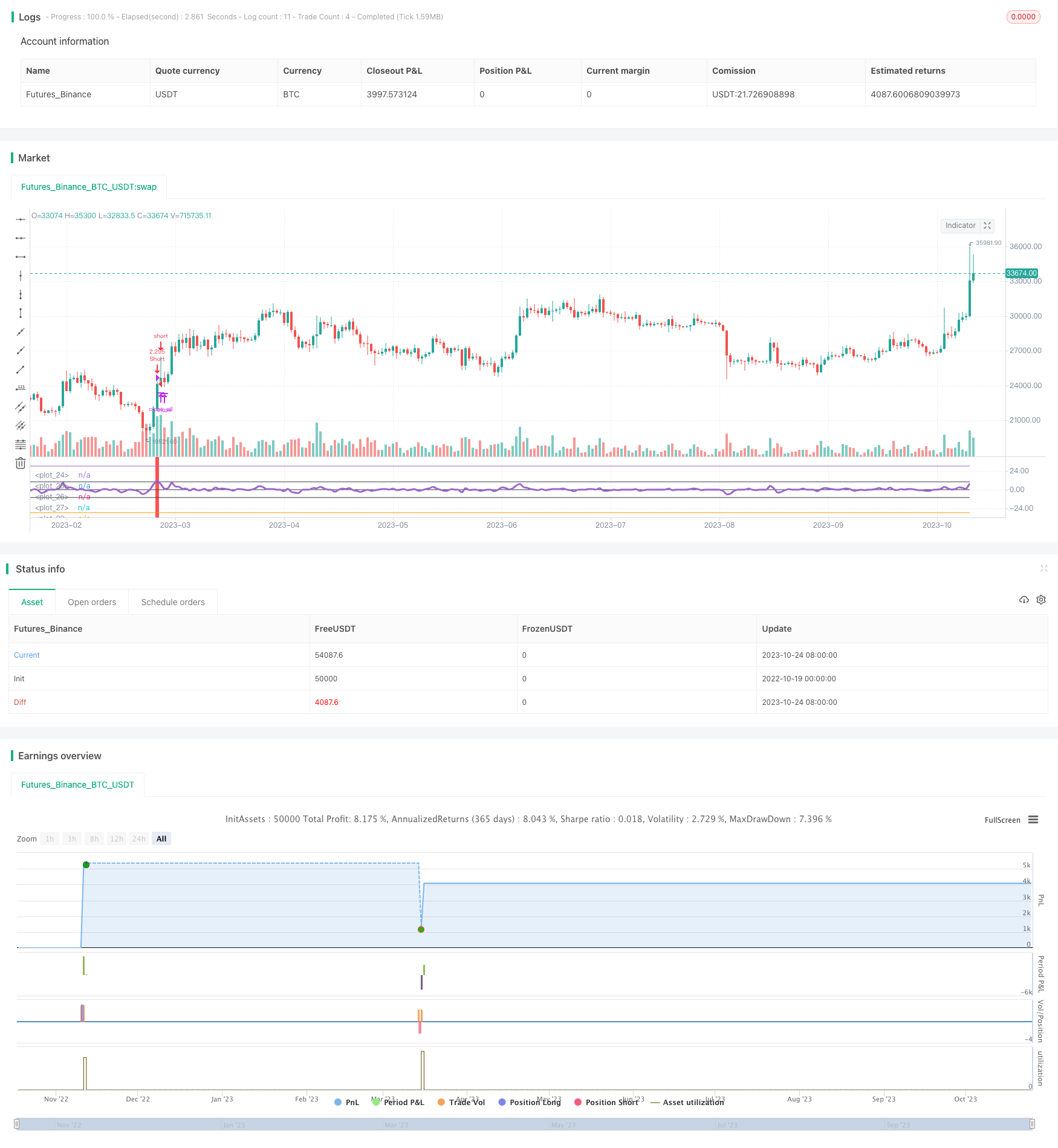
This article provides an in-depth analysis of the moving average gap trading strategy coded by Noro. The strategy identifies trend reversals by calculating the deviation between closing price and simple moving average, and achieves buy low and sell high.
Strategy Logic
The strategy first calculates the 3-day simple moving average (SMA). Then it computes the ratio of closing price (close) to SMA minus one as an indicator (ind). When ind crosses above the preset parameter limit, it means the closing price has surpassed SMA significantly and long position is considered. When ind crosses below -limit, it means the closing price has fallen far below SMA and short position is considered.
The strategy also plots the 0 axis, limit axis and -limit axis. The ind indicator is colored differently in separate areas to assist judgement. When ind crosses over limit or -limit, it signals long or short entry.
Upon long/short signal, the strategy will close opposite position first, then open long/short position. When ind returns between 0 axes, all positions will be closed.
Advantages
Adopting gap trading principle to catch trend reversals, unlike trend following strategies.
Plotting indicator axes for intuitive judgment of indicator position and crossover.
Optimized close logic, closing existing position before reversing direction. Avoid unnecessary opposite positions.
Defined trading time range to avoid unnecessary overnight positions.
Flexibility to enable/disable long/short trading.
Risks
Moving average strategies tend to generate multiple losing trades, requiring patience in holding.
Moving averages lack flexibility in capturing real-time price changes.
Preset limit parameter is static, requiring adjustments for different products and market environments.
Unable to identify fluctuations within trends, requiring combining with volatility indicators.
Need to optimize holding rules e.g. stop loss, take profit; or only catch initial gaps.
Enhancement Directions
Test different parameter settings e.g. SMA period, or adaptive moving averages like EMA.
Add moving average direction and slope validation to avoid meaningless trades.
Consider combining with volatility indicators like Bollinger Bands to pause trading when volatility rises.
Implement position sizing rules e.g. fixed quantity, incremental pyramiding, money management.
Set stop loss/take profit lines, or pause new orders when fixed percentage stop loss triggered, to control per trade risk.
Summary
This article comprehensively analyzed Noro's moving average gap trading strategy. It utilizes the price gap from moving average feature and implements indicator axes and colors for entry timing. It also optimizes the close logic and defines trading time range. However, inherent weaknesses of moving average tracking remains, requiring further optimizations in parameters, stop loss rules, combining indicators etc. to improve robustness.
Parameters
| Name | Default | What it controls |
|---|---|---|
| v_input_1 | true | Long |
| v_input_2 | true | Short |
| v_input_3 | 100 | Lot, % |
| v_input_4 | 10 | limit |
| v_input_5 | 1900 | From Year |
| v_input_6 | 2100 | To Year |
| v_input_7 | true | From Month |
| v_input_8 | 12 | To Month |
| v_input_9 | true | From Day |
| v_input_10 | 31 | To Day |
Source Pine Script
/*backtest
start: 2022-10-19 00:00:00
end: 2023-10-25 00:00:00
period: 1d
basePeriod: 1h
exchanges: [{"eid":"Futures_Binance","currency":"BTC_USDT"}]
*/

//Noro
//2018

//@version=3
strategy(title = "Noro's Shift Close Strategy v1.0", shorttitle = "Shift Close 1.0", default_qty_type = strategy.percent_of_equity, default_qty_value = 100, pyramiding = 5)

//Settings
needlong = input(true, defval = true, title = "Long")
needshort = input(true, defval = true, title = "Short")
capital = input(100, defval = 100, minval = 1, maxval = 10000, title = "Lot, %")
limit = input(10)
fromyear = input(1900, defval = 1900, minval = 1900, maxval = 2100, title = "From Year")
toyear = input(2100, defval = 2100, minval = 1900, maxval = 2100, title = "To Year")
frommonth = input(01, defval = 01, minval = 01, maxval = 12, title = "From Month")
tomonth = input(12, defval = 12, minval = 01, maxval = 12, title = "To Month")
fromday = input(01, defval = 01, minval = 01, maxval = 31, title = "From Day")
today = input(31, defval = 31, minval = 01, maxval = 31, title = "To Day")

//Shift MA
sma = sma(ohlc4, 3)
ind = ((close / sma) - 1) * 100

//Oscilator
plot(3 * limit, color = na, transp = 0)
plot(limit, color = black, transp = 0)
plot(0, color = black, transp = 0)
plot(-1 * limit, color = black, transp = 0)
plot(-3 * limit, color = na, transp = 0)
plot(ind, linewidth = 3, transp = 0)
col = ind > limit ? red : ind < -1 * limit ? lime : na
bgcolor(col, transp = 0)

//Signals
size = strategy.position_size
up = ind < -1 * limit
dn = ind > limit
exit = ind > -1 * limit and ind < limit

//Trading
lot = 0.0
lot := size == 0 ? strategy.equity / close * capital / 100 : lot[1]

if up
    if strategy.position_size < 0
        strategy.close_all()

    strategy.entry("Long", strategy.long, needlong == false ? 0 : lot, when=(time > timestamp(fromyear, frommonth, fromday, 00, 00) and time < timestamp(toyear, tomonth, today, 23, 59)))

if dn
    if strategy.position_size > 0
        strategy.close_all()

    strategy.entry("Short", strategy.short, needshort == false ? 0 : lot, when=(time > timestamp(fromyear, frommonth, fromday, 00, 00) and time < timestamp(toyear, tomonth, today, 23, 59)))

if exit
strategy.close_all()Published by ChaoZhang on the FMZ strategy square · last modified 2023-10-26. Collected in the Quant Trading Vault. Unvalidated research: re-test with your own data and costs before trusting it.
Build this with AgenKit
A spec is not a trading system. Paste this into your coding agent and AgenKit runs a specialist team — architecture, test-first build, risk gates, review — with paper trading on by default.
/agenkit build a production-grade trading bot with a backtest engine, risk controls and paper trading by default from strategies/Gap-Trading-Moving-Average-Strategy.md- npx agenkit install engineering-kit in your project
- Paste the command into your agent and approve each phase
- Get tests, backtest, risk controls and a paper-trading switch
Understand it first
Before you run this, read the lesson behind the idea and how to backtest it honestly. Specs like this one are the survivors of an unknown number of trials; deflate their results accordingly.
Related specs
- Advanced 15 Minute Chart Trading Signal StrategyPine Script · Mean reversion · 3h
- Advanced Quantitative Trading Strategy Combining RSI Divergence and Moving AveragesPine Script · Mean reversion · 1h
- Enhanced Bollinger Mean Reversion Quantitative StrategyPine Script · Mean reversion · 1d
- Reversal Trading Strategy with Bollinger Bands RSI ADX and ATRPine Script · Mean reversion · 1h
- The Smooth Moving Average Ribbon StrategyPine Script · Mean reversion · 1h
- Bollinger Band Mean Reversion Strategy with Intraday Intensity IndexPine Script · Mean reversion · 2h