Strategy vault / Trend following
Hull Filter Moving Average Strategy
This strategy uses short-term and long-term Hull moving averages to generate and filter trading signals. The short-term Hull moving average is used to generate signals, while the long-term Hull moving average is used…
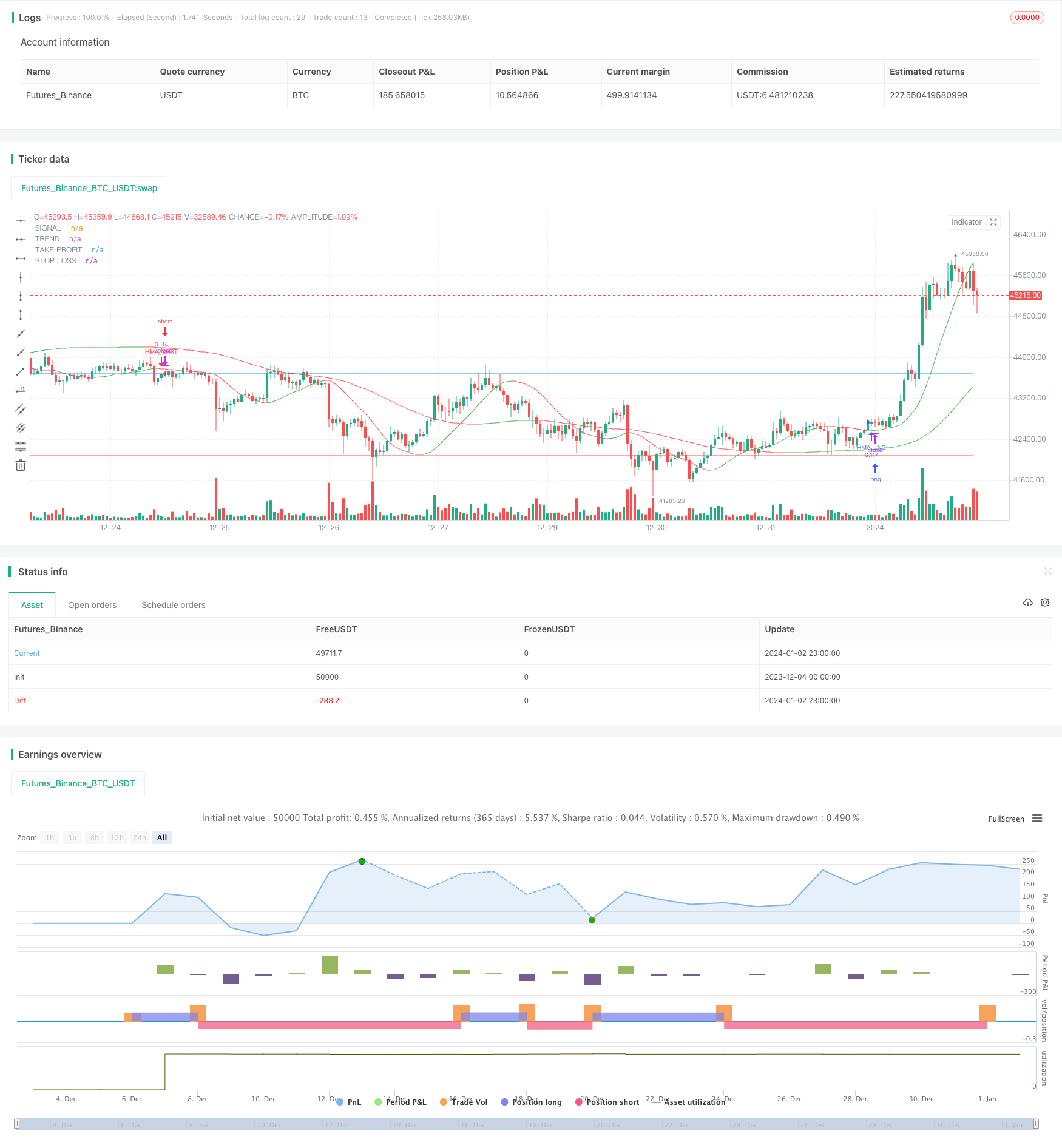
Overview
This strategy uses short-term and long-term Hull moving averages to generate and filter trading signals. The short-term Hull moving average is used to generate signals, while the long-term Hull moving average is used for filtering signals. Trades are only taken when the short-term Hull moving average changes direction and the long-term Hull moving average is moving in the same overall direction.
The strategy also uses the ATR indicator to dynamically set stop loss and take profit levels when entering trades.
Strategy Logic
The short-term Hull moving average captures short-term price trends and turning points. When it changes direction, it signals a shift in the short-term price trend.
The long-term Hull moving average determines the overall price trend. For example, when it is rising, prices are in an overall upward trend.
Trades are only taken when the short-term Hull moving average turns direction, and its new direction aligns with the direction of the long-term Hull moving average. This filters out signals that go against the overall trend and may just be short-term market noise.
After entering positions, stop loss and take profit levels are set based on the ATR indicator value. The ATR reflects market volatility and risk levels. The stop loss is placed below price lows while take profit targets price highs, with ranges tied to the current ATR reading.
Advantage Analysis
Combining short-term signals and long-term filters effectively identifies mid-term trends and turning points, avoiding false signals from market noise.
Dynamic stop loss and take profit based on ATR sets reasonable ranges based on current volatility, balancing profit taking and loss prevention.
The Hull moving average has flexibility and accuracy advantages over standard moving averages, with better trend tracking.
Risk Analysis
The strategy relies on crosses between the Hull moving averages to generate signals. False crosses can result in bad trades, requiring analysis of overall market structure.
In ranging, choppy markets with price oscillating in a trading range, signal errors and unnecessary trades may pile up. This can be avoided by filtering signals with wider conditions during such markets.
Stop loss and take profit reliance on ATR means inaccurate volatility reads will result in bad placement. Other volatility measures can augment ATR to correct this.
Optimization
Additional short-term indicators like RSI can improve signal accuracy through convergence.
The filter logic between the Hull moving averages can be enhanced to have more strict entry requirements, avoiding false signals.
Parameter tuning research can uncover stability and profitability improvements from changes to moving average lengths, ATR periods, etc.
Summary
This strategy combines short-term signal generation, long-term signal filtering, and ATR-based stop loss/take profit in a robust mid-term trend following framework. It capably identifies mid-term inflection points while filtering out short-term noise. With parametric optimizations and added filters, it can achieve even better performance.
Parameters
| Name | Default | What it controls |
|---|---|---|
| v_input_1_close | 0 | Source: close | high | low | open | hl2 | hlc3 | hlcc4 | ohlc4 |
| v_input_2 | 50 | Period of signal HMA |
| v_input_3 | 200 | Period of filter HMA |
| v_input_4 | 0 | Strategy Direction: all | short | long |
| v_input_5 | 2 | Stop Loss Factor |
| v_input_6 | 3 | Take Profit Factor |
| v_input_7 | 14 | ATR Period (SL/TP) |
| v_input_8 | 2010 | Backtest Start Year |
| v_input_9 | true | Backtest Start Month |
| v_input_10 | true | Backtest Start Day |
| v_input_11 | 2030 | Backtest Stop Year |
| v_input_12 | 12 | Backtest Stop Month |
| v_input_13 | 31 | Backtest Stop Day |
Source Pine Script
/*backtest
start: 2023-12-04 00:00:00
end: 2024-01-03 00:00:00
period: 1h
basePeriod: 15m
exchanges: [{"eid":"Futures_Binance","currency":"BTC_USDT"}]
*/

//@version=4
strategy("Hull Filtered Strategy", overlay=true, pyramiding=0, default_qty_type= strategy.percent_of_equity, default_qty_value = 10, calc_on_order_fills=false, slippage=0,commission_type=strategy.commission.percent,commission_value=0)

// Parameters for Hull Moving Averages
src = input(close, title="Source")
signal_period = input(50, title="Period of signal HMA")
filter_period = input(200, title="Period of filter HMA")

strat_dir_input = input(title="Strategy Direction", defval="all", options=["long", "short", "all"])

// Set allowed trading directions
strat_dir_value = strat_dir_input == "long" ? strategy.direction.long : strat_dir_input == "short" ? strategy.direction.short : strategy.direction.all
strategy.risk.allow_entry_in(strat_dir_value)

// stop loss and take profit
sl_factor = input(2,title="Stop Loss Factor")
tp_factor = input(3,title="Take Profit Factor")
atr_period = input(14, title="ATR Period (SL/TP)")

// Testing Start dates
testStartYear = input(2010, "Backtest Start Year")
testStartMonth = input(1, "Backtest Start Month")
testStartDay = input(1, "Backtest Start Day")
testPeriodStart = timestamp(testStartYear,testStartMonth,testStartDay,0,0)

//Stop date if you want to use a specific range of dates
testStopYear = input(2030, "Backtest Stop Year")
testStopMonth = input(12, "Backtest Stop Month")
testStopDay = input(31, "Backtest Stop Day")
testPeriodStop = timestamp(testStopYear,testStopMonth,testStopDay,0,0)


// -----------------------------------------------------------------------------
// Global variables
// -----------------------------------------------------------------------------
var float tp = na
var float sl = na
var float position = na


// -----------------------------------------------------------------------------
// Functions
// -----------------------------------------------------------------------------
testWindow() =>
    time >= testPeriodStart and time <= testPeriodStop ? true : false


// -----------------------------------------------------------------------------
// The engine
// -----------------------------------------------------------------------------
hma_signal = hma(src, signal_period)
hma_filter = hma(src, filter_period)

// Used to determine exits and stop losses
atr_e = atr(atr_period)

// if hma_filter increases hma_trend is set to 1, if it decreases hma_trend is set to -1. If no trend is available, hma_trend is set to ß0
trend = hma_filter > hma_filter[1]  ?  1 : hma_filter < hma_filter[1] ? -1 : 0
signal = hma_signal > hma_signal[1] ? 1 : hma_signal  < hma_signal[1] ? -1 : 0


// -----------------------------------------------------------------------------
// signals
// -----------------------------------------------------------------------------
if signal[0] == 1 and signal[1] != 1 and trend == 1 and testWindow()
    sl := close - sl_factor*atr_e
    tp := close + tp_factor*atr_e
    strategy.entry("HMA_LNG", strategy.long)
    strategy.exit("LE", "HMA_LNG", profit=100*tp_factor*atr_e, loss=100*sl_factor*atr_e)

if signal[0] == -1 and signal[1] != -1 and trend == -1 and testWindow()
    sl := close + sl_factor*atr_e
    tp := close - tp_factor*atr_e
    strategy.entry("HMA_SHRT", strategy.short)
    strategy.exit("SE", "HMA_SHRT", profit=100*tp_factor*atr_e, loss=100*sl_factor*atr_e)


if strategy.position_size != 0
    sl := sl[1]
    tp := tp[1]

// -----------------------------------------------------------------------------
// PLOT
// -----------------------------------------------------------------------------
hma_s = plot(hma_signal, title="SIGNAL", color = signal == 1 ? color.green : color.red)
hma_l = plot(hma_filter, title="TREND", color = trend == 1 ? color.green : color.red)

plot(tp, title="TAKE PROFIT", color= strategy.position_size != 0 ? color.blue: na, linewidth=1)
plot(sl, title="STOP LOSS", color= strategy.position_size != 0 ? color.red: na, linewidth = 1)
Published by ChaoZhang on the FMZ strategy square · last modified 2024-01-04. Collected in the Quant Trading Vault. Unvalidated research: re-test with your own data and costs before trusting it.
Build this with AgenKit
A spec is not a trading system. Paste this into your coding agent and AgenKit runs a specialist team — architecture, test-first build, risk gates, review — with paper trading on by default.
/agenkit build a production-grade trading bot with a backtest engine, risk controls and paper trading by default from strategies/Hull-Filter-Moving-Average-Strategy.md- npx agenkit install engineering-kit in your project
- Paste the command into your agent and approve each phase
- Get tests, backtest, risk controls and a paper-trading switch
Understand it first
Before you run this, read the lesson behind the idea and how to backtest it honestly. Specs like this one are the survivors of an unknown number of trials; deflate their results accordingly.
Related specs
- Adaptive ATR and RSI Trend Following Strategy with Trailing Stop LossPine Script · Trend following · 1h
- Advanced Supertrend Indicator Trading Mechanism Optimization StrategyPine Script · Trend following · 1d
- BB Percentage Index Trend Fading StrategyPine Script · Trend following · 1h
- Bollinger Bands and RSI Trend Following StrategyPine Script · Trend following · 1h
- Dual ATR Channel Trend Following StrategyPine Script · Trend following · 15m
- Dual Indicator Dynamic Trend Trading Strategy Multi dimensional Technical Analysis System Based on RSI and MACDPine Script · Trend following