Strategy vault / Trend following
MACD Trend Following Strategy 432361
This strategy implements trend following trading on the MACD indicator. It identifies trend direction using MACD and with dynamic stop loss to lock in profits.
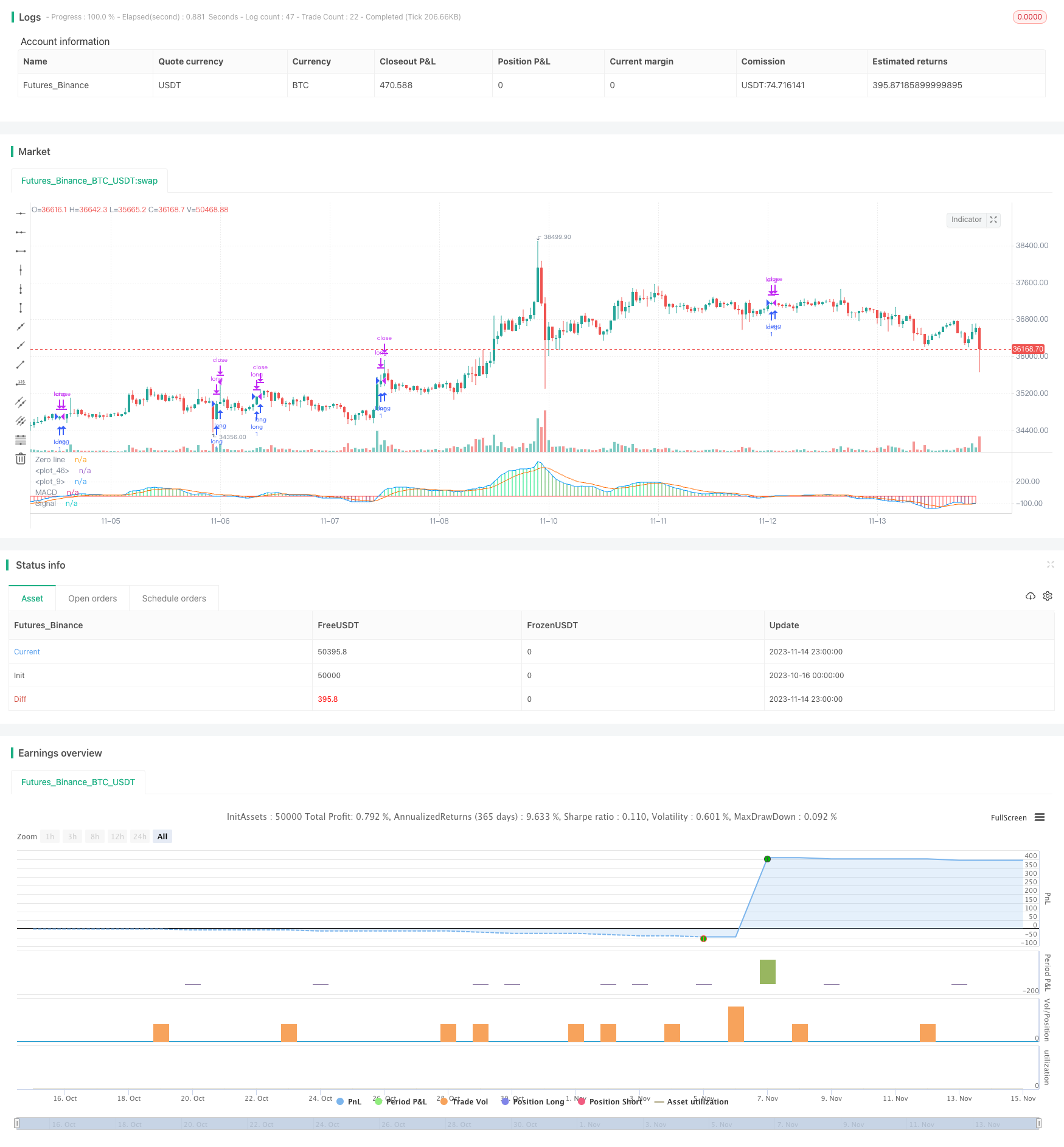
Overview
This strategy implements trend following trading on the MACD indicator. It identifies trend direction using MACD and with dynamic stop loss to lock in profits.
Strategy Logic
Calculate Fast MA, Slow MA and MACD indicator. Fast MA uses 12-period EMA, Slow MA uses 26-period EMA. MACD is the difference between Fast and Slow MA.
Set buy and sell lines. Generate buy signal when MACD crosses over buy line, generate sell signal when MACD crosses below sell line.
Set dynamic stop loss after opening position. The initial stop loss is set at 95% of entry price, and will trail upwards as price runs.
Close position when stop loss is triggered or reverse signal appears.
Advantage Analysis
Using MACD to identify trend direction can effectively track trends.
The dynamic stop loss can continuously lock in profits and avoid enlarged losses.
The strategy logic is simple and clear, easy to understand and automate for quant trading.
Risk Analysis
MACD has lagging effect, may miss short term trend reversal.
Stop loss set too loose may miss some profits, too tight may stop out early.
Parameter tuning issue. MACD parameters and buy/sell lines need constant testing and optimization.
Works better in trending market, may have losses in choppy market.
Optimization Directions
Optimize MACD parameters to find best combination.
Test different stop loss methods, like fixed points, ATR-based etc.
Add filter conditions using other indicators to avoid false signals, e.g. Bollinger Bands, RSI etc.
Combine with trend identification tools, dynamically adjust strategy parameters based on trend vs range-bound market.
Summary
The strategy has clear logic of using MACD to track trends and dynamic stop loss to lock in profits. It can effectively track trending markets. But MACD has lagging issue, and stop loss points need to be optimized. Next step is to further test parameters, optimize stop loss mechanism, add filters with other indicators, to make it robust across different market conditions, improving stability.
Parameters
| Name | Default | What it controls |
|---|---|---|
| v_input_1 | 12 | Fast moving average |
| v_input_2 | 26 | Slow moving average |
| v_input_3 | 12 | Fast Length |
| v_input_4 | 26 | Slow Length |
| v_input_5_close | 0 | Source: close | high | low | open | hl2 | hlc3 | hlcc4 | ohlc4 |
| v_input_6 | 9 | Signal Smoothing |
| v_input_7 | false | Simple MA(Oscillator) |
| v_input_8 | false | Simple MA(Signal Line) |
| v_input_9 | -0.0002 | Enter Long |
| v_input_10 | 0.0001 | Close Long |
| v_input_11 | 0.05 | Stop Loss % |
Source Pine Script
/*backtest
start: 2023-10-16 00:00:00
end: 2023-11-15 00:00:00
period: 1h
basePeriod: 15m
exchanges: [{"eid":"Futures_Binance","currency":"BTC_USDT"}]
*/

//@version=3
strategy(shorttitle = "EURUSD MACD", title = "EURUSD MACD")
fastMA = input(title="Fast moving average",  defval = 12, minval = 7)
slowMA = input(title="Slow moving average",  defval = 26, minval = 7)
lastColor = yellow
[currMacd,_,_] = macd(close[0], fastMA, slowMA, 9)
[prevMacd,_,_] = macd(close[1], fastMA, slowMA, 9)
plotColor = currMacd > 0 ? currMacd > prevMacd ? lime : green : currMacd < prevMacd ? maroon : red
plot(currMacd, style = histogram, color = plotColor, linewidth = 3)
plot(0, title = "Zero line", linewidth = 1, color = gray)

//MACD
// Getting inputs
fast_length = input(title="Fast Length",  defval=12)
slow_length = input(title="Slow Length",  defval=26)
src = input(title="Source",  defval=close)
signal_length = input(title="Signal Smoothing",  minval = 1, maxval = 50, defval =9)
sma_source = input(title="Simple MA(Oscillator)", type=bool, defval=false)
sma_signal = input(title="Simple MA(Signal Line)", type=bool, defval=false)

// Plot colors
col_grow_above = #26A69A
col_grow_below = #FFCDD2
col_fall_above = #B2DFDB
col_fall_below = #EF5350
col_macd = #0094ff
col_signal = #ff6a00

// Calculating
fast_ma = sma_source ? sma(src, fast_length) : ema(src, fast_length)
slow_ma = sma_source ? sma(src, slow_length) : ema(src, slow_length)
macd = fast_ma - slow_ma
signal = sma_signal ? sma(macd, signal_length) : ema(macd, signal_length)
hist = macd - signal

//plot(hist, title="Histogram", style=columns, color=(hist>=0 ? (hist[1] < hist ? col_grow_above : col_fall_above) : (hist[1] < hist ? col_grow_below : col_fall_below) ), transp=0 )
plot(macd, title="MACD", color=col_macd, transp=0)
plot(signal, title="Signal", color=col_signal, transp=0)
///END OF MACD

//Long and Close Long Lines
linebuy = input(title="Enter Long", type=float, defval=-0.0002)
linesell = input(title="Close Long", type=float, defval=0.0001)

//Plot Long and Close Long Lines
plot(linebuy,color=green),plot(linesell,color=red)


//Stop Loss Input
sl_inp = input(0.05, title='Stop Loss %', type=float)/100


//Order Conditions
longCond = crossover(currMacd, linebuy)
exitLong = crossover(currMacd, linesell)
stop_level = strategy.position_avg_price * (1 - sl_inp)


//Order Entries
strategy.entry("long", strategy.long,  when=longCond==true)
strategy.close("long", when=exitLong==true)
strategy.exit("Stop Loss", stop=stop_level)Published by ChaoZhang on the FMZ strategy square · last modified 2023-11-16. Collected in the Quant Trading Vault. Unvalidated research: re-test with your own data and costs before trusting it.
Build this with AgenKit
A spec is not a trading system. Paste this into your coding agent and AgenKit runs a specialist team — architecture, test-first build, risk gates, review — with paper trading on by default.
/agenkit build a production-grade trading bot with a backtest engine, risk controls and paper trading by default from strategies/MACD-Trend-Following-Strategy-432361.md- npx agenkit install engineering-kit in your project
- Paste the command into your agent and approve each phase
- Get tests, backtest, risk controls and a paper-trading switch
Understand it first
Before you run this, read the lesson behind the idea and how to backtest it honestly. Specs like this one are the survivors of an unknown number of trials; deflate their results accordingly.
Related specs
- Bollinger Bands and RSI Trend Following StrategyPine Script · Trend following · 1h
- EMA and RSI Trend Trading StrategyPine Script · Trend following · 1d
- Indicator Verification Automated Trading StrategyPine Script · Trend following · 10m
- SuperTrend Trading Strategy with Multiple FiltersPine Script · Trend following · 1h
- Dual ATR Channel Trend Following StrategyPine Script · Trend following · 15m
- Dynamic Dual EMA Crossover Strategy with Adaptive Profit Loss ControlPine Script · Trend following · 1d