Strategy vault / Machine learning
Multi Factor Regression and Dynamic Price Band Quantitative Trading System
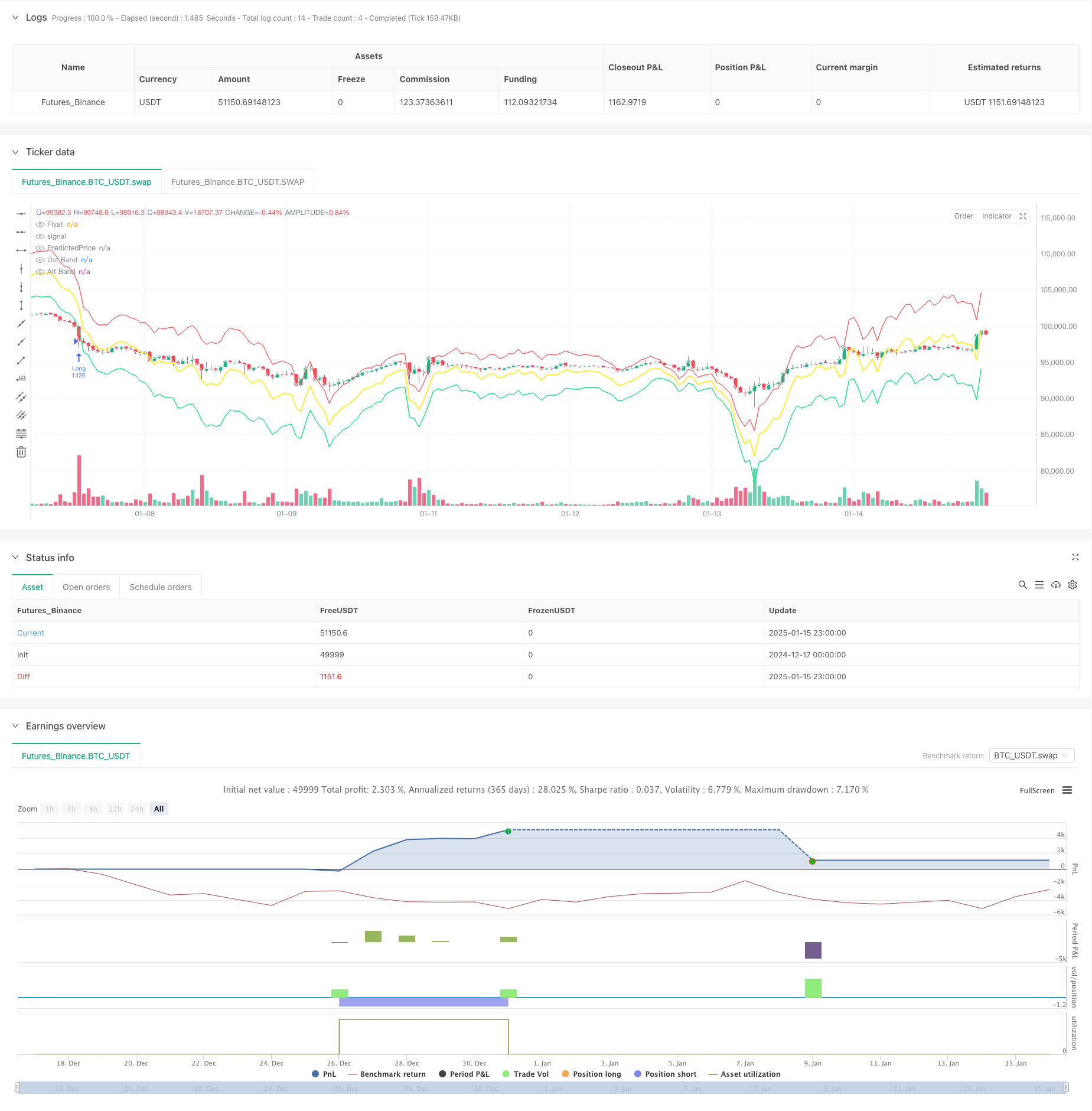
This strategy is a quantitative trading system based on multi-factor regression and dynamic price bands. The core logic is to predict price movements through a multi-factor regression model, combining multiple market…
Overview
This strategy is a quantitative trading system based on multi-factor regression and dynamic price bands. The core logic is to predict price movements through a multi-factor regression model, combining multiple market factors such as BTC dominance, trading volume, and lagged prices to construct price bands for signal generation. The strategy integrates multiple risk management modules including outlier filtering, dynamic position management, and trailing stops, making it a comprehensive and robust trading system.
Strategy Principles
The strategy includes the following core components:
- Regression Prediction Module: Uses multi-factor linear regression to predict prices. Factors include BTC dominance, volume, price lags, and interaction terms. Beta coefficients measure each factor's impact on price.
- Dynamic Price Bands: Constructs upper and lower price bands based on predicted price and residual standard deviation to identify overbought/oversold conditions.
- Signal Generation: Generates long signals when price breaks below lower band with oversold RSI; short signals when price breaks above upper band with overbought RSI.
- Risk Management: Multiple protection mechanisms including outlier filtering (Z-score method), stop-loss/take-profit, and ATR-based trailing stops.
- Dynamic Positioning: Adjusts position size dynamically based on ATR and preset risk ratio.
Strategy Advantages
- Multi-factor Integration: Provides comprehensive market perspective by considering multiple market factors.
- Strong Adaptability: Price bands adjust dynamically to market volatility, adapting to different market conditions.
- Comprehensive Risk Control: Multi-layered risk management ensures capital safety.
- Flexible Configuration: Numerous adjustable parameters for optimization across different markets.
- High Signal Reliability: Multiple filtering mechanisms improve signal quality.
Strategy Risks
- Model Risk: Regression model relies on historical data, may fail during dramatic market changes.
- Parameter Sensitivity: Multiple parameters require careful tuning, improper settings affect strategy performance.
- Computational Complexity: Multi-factor calculations may impact real-time performance.
- Market Environment Dependency: May perform better in ranging markets than trending markets.
Optimization Directions
- Factor Selection Optimization: Introduce additional market factors like sentiment indicators and on-chain data.
- Dynamic Parameter Adjustment: Develop adaptive parameter adjustment mechanisms.
- Machine Learning Enhancement: Incorporate machine learning methods to optimize prediction model.
- Signal Filter Enhancement: Develop additional signal filtering conditions to improve accuracy.
- Strategy Integration: Combine with other strategies to improve stability.
Summary
This strategy is a theoretically sound and well-designed quantitative trading system. It predicts prices through a multi-factor regression model, generates trading signals using dynamic price bands, and features comprehensive risk management mechanisms. The strategy demonstrates strong adaptability and configurability, suitable for various market environments. Through continuous optimization and improvement, this strategy shows promise for achieving stable returns in live trading.
Source Pine Script
/*backtest
start: 2024-12-17 00:00:00
end: 2025-01-16 00:00:00
period: 1h
basePeriod: 1h
exchanges: [{"eid":"Futures_Binance","currency":"BTC_USDT","balance":49999}]
*/

//@version=5
strategy(  title           = "CorrAlgoX", overlay         = true,pyramiding      = 1, initial_capital = 10000, default_qty_type= strategy.percent_of_equity, default_qty_value=200)

//====================================================================
//=========================== GİRİŞLER ================================
//====================================================================

// --- (1) REGRESYON VE OUTLIER AYARLARI
int   lengthReg         = input.int(300, "Regression Window",   minval=50)
bool  useOutlierFilter  = input.bool(false, "Z-skoru ile Outlier Filtrele")

// --- (2) FİYAT GECİKMELERİ
bool  usePriceLag2      = input.bool(false, "2 Bar Gecikmeli Fiyatı Kullan")

// --- (3) STOP-LOSS & TAKE-PROFIT
float stopLossPerc      = input.float(3.0,  "Stop Loss (%)",   step=0.1)
float takeProfitPerc    = input.float(5.0,  "Take Profit (%)", step=0.1)

// --- (4) REZİDÜEL STD BANTI
int   lengthForStd      = input.int(50, "StdDev Length (residual)", minval=2)
float stdevFactor       = input.float(2.0, "Stdev Factor", step=0.1)

// --- (5) RSI FİLTRESİ
bool  useRsiFilter      = input.bool(true, "RSI Filtresi Kullan")
int   rsiLen            = input.int(14, "RSI Length",   minval=1)
float rsiOB             = input.float(70, "RSI Overbought", step=1)
float rsiOS             = input.float(30, "RSI Oversold",   step=1)

// --- (6) TRAILING STOP
bool  useTrailingStop   = input.bool(false, "ATR Tabanlı Trailing Stop")
int   atrLen            = input.int(14, "ATR Length",   minval=1)
float trailMult         = input.float(1.0, "ATR multiplier", step=0.1)

// --- (7) DİNAMİK POZİSYON BÜYÜKLÜĞÜ (ATR tabanlı)
bool  useDynamicPos     = input.bool(false, "Dinamik Pozisyon Büyüklüğü Kullan")
float capitalRiskedPerc = input.float(1.0, "Sermaye Risk Yüzdesi", step=0.1, tooltip="Her işlemde risk alınacak sermaye yüzdesi")

// --- (8) ETKİLEŞİM VE LOG(HACİM) KULLANIMI
bool  useSynergyTerm    = input.bool(true, "BTC.D * Hacim Etkileşim Terimi")
bool  useLogVolume      = input.bool(true, "Hacmi Logaritmik Kullan")

//====================================================================
//======================= VERİLERİ AL & HAZIRLA =======================
//====================================================================

// Mevcut enstrüman fiyatı
float realClose = close

// BTC Dominance (aynı TF)
float btcDom    = request.security("SWAP", timeframe.period, close)

// Hacim
float vol       = volume

// Gecikmeli fiyatlar
float priceLag1 = close[1]
float priceLag2 = close[2]  // (isteğe bağlı)

//----------------- Outlier Filtrelemesi (Z-Skoru) ------------------//
float priceMean  = ta.sma(realClose, lengthReg)
float priceStdev = ta.stdev(realClose, lengthReg)

float zScore     = (priceStdev != 0) ? (realClose - priceMean) / priceStdev : 0
bool  isOutlier  = math.abs(zScore) > 3.0

float filteredClose = (useOutlierFilter and isOutlier) ? na : realClose

// Fiyatın stdev'i (filtrelenmiş)
float fCloseStdev = ta.stdev(filteredClose, lengthReg)

//====================================================================
//=============== ORTALAMA, STDEV, KORELASYON HESAPLARI ==============
//====================================================================

// BTC.D
float btcDomMean    = ta.sma(btcDom, lengthReg)
float btcDomStdev   = ta.stdev(btcDom, lengthReg)
float corrBtcDom    = ta.correlation(btcDom, filteredClose, lengthReg)

// Hacim
float volMean       = ta.sma(vol, lengthReg)
float volStdev      = ta.stdev(vol, lengthReg)
float corrVol       = ta.correlation(vol, filteredClose, lengthReg)

// Fiyat Lag1
float plag1Mean     = ta.sma(priceLag1, lengthReg)
float plag1Stdev    = ta.stdev(priceLag1, lengthReg)
float corrPLag1     = ta.correlation(priceLag1, filteredClose, lengthReg)

// Fiyat Lag2 (isteğe bağlı)
float plag2Mean     = ta.sma(priceLag2, lengthReg)
float plag2Stdev    = ta.stdev(priceLag2, lengthReg)
float corrPLag2     = ta.correlation(priceLag2, filteredClose, lengthReg)

// BTC.D * Hacim (synergyTerm)
float synergyTerm   = btcDom * vol
float synergyMean   = ta.sma(synergyTerm, lengthReg)
float synergyStdev  = ta.stdev(synergyTerm, lengthReg)
float corrSynergy   = ta.correlation(synergyTerm, filteredClose, lengthReg)

// Log(Hacim)
float logVolume     = math.log(vol + 1.0)
float logVolMean    = ta.sma(logVolume, lengthReg)
float logVolStdev   = ta.stdev(logVolume, lengthReg)
float corrLogVol    = ta.correlation(logVolume, filteredClose, lengthReg)

//====================================================================
//===================== FONKSIYON: BETA HESAPLAMA =====================
//====================================================================
// Pine Script'te fonksiyonlar şöyle tanımlanır (tip bildirmeyiz):
getBeta(corrVal, stdevX) =>
    (stdevX != 0 and not na(corrVal) and fCloseStdev != 0)? corrVal * (fCloseStdev / stdevX)  : 0.0

//====================================================================
//======================== BETA KATSAYILARI ===========================
//====================================================================

// BTC Dominance
float betaBtcDom  = getBeta(corrBtcDom,  btcDomStdev)
// Hacim
float betaVol     = getBeta(corrVol,     volStdev)
// Fiyat Lag1
float betaPLag1   = getBeta(corrPLag1,   plag1Stdev)
// Fiyat Lag2
float betaPLag2   = getBeta(corrPLag2,   plag2Stdev)
// synergy
float betaSynergy = getBeta(corrSynergy, synergyStdev)
// logVol
float betaLogVol  = getBeta(corrLogVol,  logVolStdev)

//====================================================================
//===================== TAHMİNİ FİYAT OLUŞTURMA ======================
//====================================================================

float alpha  = priceMean
bool canCalc = not na(filteredClose) and not na(priceMean)

float predictedPrice = na
if canCalc
    // Farklar
    float dBtcDom   = (btcDom - btcDomMean)
    float dVol      = (vol    - volMean)
    float dPLag1    = (priceLag1 - plag1Mean)
    float dPLag2    = (priceLag2 - plag2Mean)
    float dSynergy  = (synergyTerm - synergyMean)
    float dLogVol   = (logVolume   - logVolMean)

    float sumBeta   = 0.0
    sumBeta += betaBtcDom  * dBtcDom
    sumBeta += betaVol     * dVol
    sumBeta += betaPLag1   * dPLag1

    if usePriceLag2
        sumBeta += betaPLag2 * dPLag2

    if useSynergyTerm
        sumBeta += betaSynergy * dSynergy

    if useLogVolume
        sumBeta += betaLogVol * dLogVol

    predictedPrice := alpha + sumBeta

//====================================================================
//======================= REZİDÜEL & BANT ============================
//====================================================================

float residual   = filteredClose - predictedPrice
float residStdev = ta.stdev(residual, lengthForStd)

float upperBand  = predictedPrice + stdevFactor * residStdev
float lowerBand  = predictedPrice - stdevFactor * residStdev

//====================================================================
//========================= SİNYAL ÜRETİMİ ===========================
//====================================================================

bool longSignal  = (realClose < lowerBand)
bool shortSignal = (realClose > upperBand)

//------------------ RSI Filtresi (opsiyonel) -----------------------//
float rsiVal       = ta.rsi(realClose, rsiLen)
bool rsiOversold   = (rsiVal < rsiOS)
bool rsiOverbought = (rsiVal > rsiOB)

if useRsiFilter
    longSignal  := longSignal  and rsiOversold
    shortSignal := shortSignal and rsiOverbought

//====================================================================
//=============== DİNAMİK POZİSYON & GİRİŞ/ÇIKIŞ EMİRLERİ ============
//====================================================================

float myAtr      = ta.atr(atrLen)
float positionSize = na

if useDynamicPos
    float capitalRisked   = strategy.equity * (capitalRiskedPerc / 100.0)
    float riskPerUnit     = (stopLossPerc/100.0) * myAtr
    positionSize          := (riskPerUnit != 0.0) ? (capitalRisked / riskPerUnit) : na

// Long
if longSignal
    if useDynamicPos and not na(positionSize)
        strategy.entry("Long", strategy.long, qty=positionSize)
    else
        strategy.entry("Long", strategy.long)

// Short
if shortSignal
    if useDynamicPos and not na(positionSize)
        strategy.entry("Short", strategy.short, qty=positionSize)
    else
        strategy.entry("Short", strategy.short)

// Stop-Loss & Take-Profit
if strategy.position_size > 0
    strategy.exit( "Long Exit", "Long",stop  = strategy.position_avg_price * (1 - stopLossPerc/100),  limit = strategy.position_avg_price * (1 + takeProfitPerc/100))

if strategy.position_size < 0
    strategy.exit("Short Exit", "Short", stop  = strategy.position_avg_price * (1 + stopLossPerc/100),limit = strategy.position_avg_price * (1 - takeProfitPerc/100))

//------------------ TRAILING STOP (opsiyonel) ----------------------//
if useTrailingStop
    if strategy.position_size > 0
        strategy.exit(  "Long Exit TS", "Long",  trail_points = myAtr * trailMult,  trail_offset = myAtr * trailMult )
    if strategy.position_size < 0
        strategy.exit( "Short Exit TS", "Short", trail_points = myAtr * trailMult, trail_offset = myAtr * trailMult)

//====================================================================
//======================== GRAFİK ÇİZİMLER ===========================
//====================================================================
plot(realClose,      color=color.white,  linewidth=1, title="Fiyat")
plot(predictedPrice, color=color.yellow, linewidth=2, title="PredictedPrice")
plot(upperBand,      color=color.red,    linewidth=1, title="Üst Band")
plot(lowerBand,      color=color.lime,   linewidth=1, title="Alt Band")

plotshape( useOutlierFilter and isOutlier, style=shape.circle, color=color.red, size=size.tiny, location=location.abovebar, title="Outlier", text="Outlier")Published by ChaoZhang on the FMZ strategy square · last modified 2025-01-17. Collected in the Quant Trading Vault. Unvalidated research: re-test with your own data and costs before trusting it.
Build this with AgenKit
A spec is not a trading system. Paste this into your coding agent and AgenKit runs a specialist team — architecture, test-first build, risk gates, review — with paper trading on by default.
/agenkit build a production-grade trading bot with a backtest engine, risk controls and paper trading by default from strategies/Multi-Factor-Regression-and-Dynamic-Price-Band-Quantitative-Trading-System.md- npx agenkit install engineering-kit in your project
- Paste the command into your agent and approve each phase
- Get tests, backtest, risk controls and a paper-trading switch
Understand it first
Before you run this, read the lesson behind the idea and how to backtest it honestly. Specs like this one are the survivors of an unknown number of trials; deflate their results accordingly.
Related specs
- AI Driven Dynamic Volatility Adaptive Trend Breakout Trading StrategyPine Script · Machine learning · 2d
- AI Powered Volatility Price System Divergence Trading StrategyPine Script · Machine learning · 1h
- High Frequency Hybrid Technical Analysis Quantitative StrategyPine Script · Machine learning · 15m
- Multi Indicator Dynamic Adaptive Quantitative Trading StrategyPine Script · Machine learning · 1h
- kNN based Trend Following StrategyPine Script · Machine learning · 1h
- Dual Indicator Stochastic RSI and EMA Trading StrategyPine Script · Machine learning · 1d