Strategy vault / Trend following
Multi Indicator Trend Crossing Strategy Bull Market Support Band Trading System
This strategy is a trend-following trading system based on the Bull Market Support Band. It primarily uses crossover signals between the 20-week Simple Moving Average (SMA) and 21-week Exponential Moving Average…
Overview
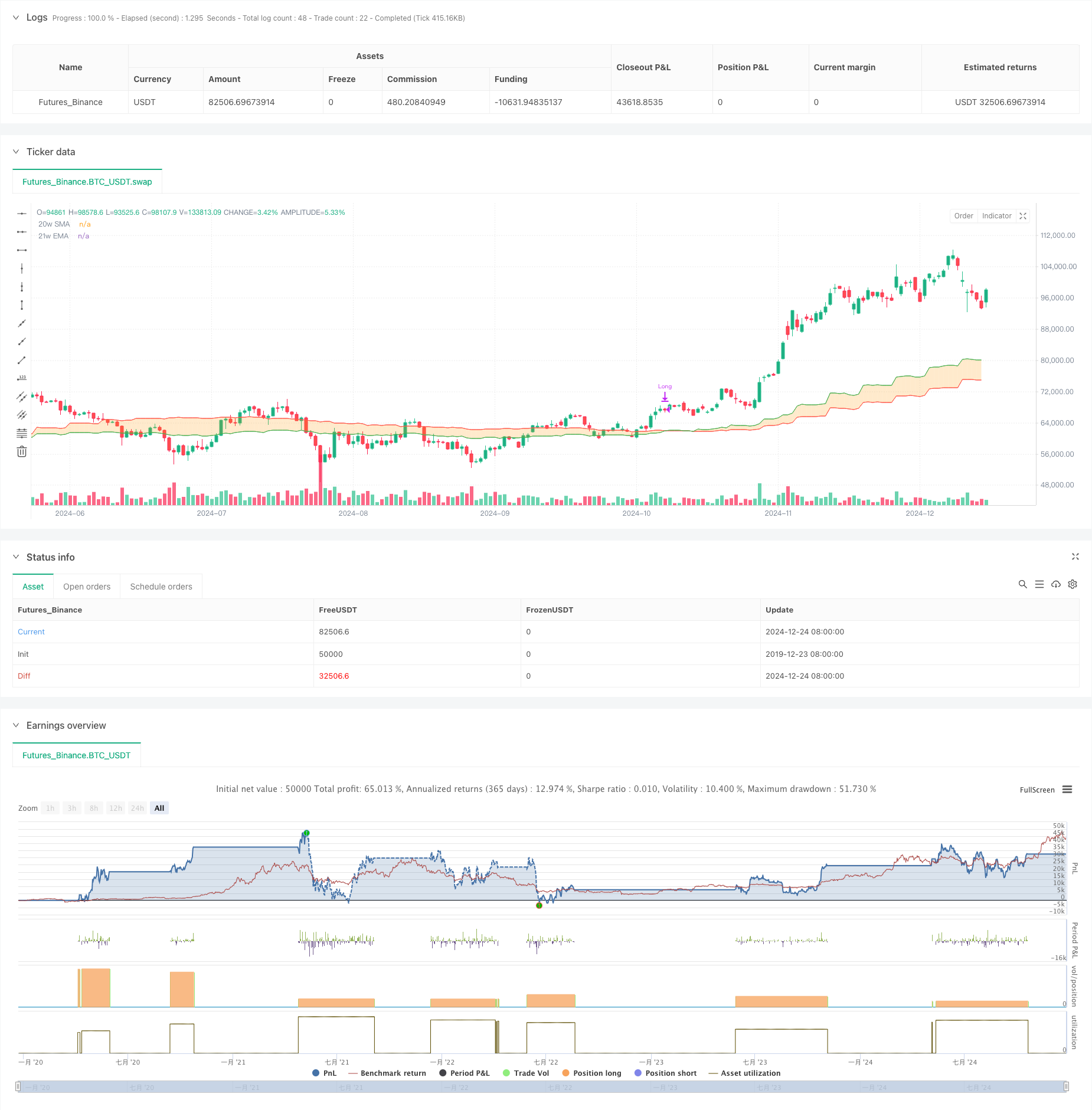
This strategy is a trend-following trading system based on the Bull Market Support Band. It primarily uses crossover signals between the 20-week Simple Moving Average (SMA) and 21-week Exponential Moving Average (EMA) to determine market trend direction and make trading decisions. The strategy generates long signals when the moving averages cross upward and exits when they cross downward, aiming to capture medium to long-term trend opportunities.
Strategy Principles
The core logic of the strategy is to monitor the relative position of the 20-week SMA and 21-week EMA to judge market trends. When the shorter-term average (20-week SMA) breaks above the longer-term average (21-week EMA), it indicates a potential uptrend, triggering a long position entry. When the shorter-term average falls below the longer-term average, it signals a potential end to the uptrend, triggering position closure. The strategy employs percent_of_equity position management, with a trading commission of 0.1% and slippage of 3 basis points.
Strategy Advantages
- Strong trend following: Uses weekly timeframe moving average crossovers to filter short-term market noise and capture medium to long-term trend opportunities
- Reasonable risk control: Uses dynamic moving averages as stop-loss references for timely market exits
- Scientific parameter setting: 20-week and 21-week parameters ensure signal stability without excessive lag
- Clear execution logic: Entry and exit signals are explicit, eliminating subjective judgment
- Flexible capital management: Supports position sizing based on account equity, allowing dynamic position adjustment
Strategy Risks
- Ineffective in ranging markets: Frequent crossovers during sideways markets can lead to false breakouts and consecutive losses
- Significant slippage impact: Weekly timeframe trades may face substantial slippage in real trading
- Delayed entry timing: Moving average crossover signals are inherently lagging, potentially missing optimal entry points
- Insufficient drawdown control: Relying solely on moving average crossovers for stop-loss can lead to large drawdowns
- High capital requirements: Weekly timeframe trading demands substantial capital and psychological resilience
Optimization Directions
- Add filtering indicators: Incorporate RSI, MACD, etc., to confirm trends and improve signal reliability
- Optimize stop-loss mechanism: Implement dynamic stop-loss using ATR indicator to enhance risk control
- Improve position management: Dynamically adjust position sizes based on market volatility
- Add trend filtering: Introduce longer-term trend judgment to trade only in the primary trend direction
- Enhance trade execution: Optimize trading rules to reduce slippage impact and improve strategy stability
Summary
The Bull Market Support Band trading strategy is a trend-following system based on classical technical analysis theory. It captures medium to long-term trend opportunities through weekly timeframe moving average crossovers, featuring clear logic and controllable risk. However, the strategy performs poorly in ranging markets and exhibits some lag. Through the addition of auxiliary indicators, stop-loss optimization, and improved capital management, the strategy has significant room for optimization. It is suitable for investors with substantial capital and risk tolerance.
Source Pine Script
/*backtest
start: 2019-12-23 08:00:00
end: 2024-12-25 08:00:00
period: 1d
basePeriod: 1d
exchanges: [{"eid":"Futures_Binance","currency":"BTC_USDT"}]
*/

// This source code is subject to the terms of the Mozilla Public License 2.0
// © zkdev

//@version=6
strategy(title='Demo GPT - Bull Market Support Band',
     overlay=true,
     default_qty_type=strategy.percent_of_equity,
     default_qty_value=100,
     commission_type=strategy.commission.percent,
     commission_value=0.1,
     slippage=3)

// -------------------------------------------------------------------------
// Compile-time timestamp constants for default date range
// (2018-01-01 00:00:00 UTC -> 1514764800000
//  2069-12-31 23:59:59 UTC -> 3155759999000)
// -------------------------------------------------------------------------
const int defaultFromDate = 1514764800000
const int defaultToDate   = 3155759999000

// -------------------------------------------------------------------------
// Inputs: date range
// -------------------------------------------------------------------------
fromDate = input(title='Start Date', defval=defaultFromDate)
toDate   = input(title='End Date',   defval=defaultToDate)

// -------------------------------------------------------------------------
// Indicator settings & calculations
// -------------------------------------------------------------------------
smaLength = 20
emaLength = 21

source = close
sma    = ta.sma(source, smaLength)
ema    = ta.ema(source, emaLength)

// -------------------------------------------------------------------------
// Fetch weekly SMA & EMA
// -------------------------------------------------------------------------
outSma = request.security(syminfo.tickerid, 'W', sma, gaps=barmerge.gaps_on, lookahead=barmerge.lookahead_off)
outEma = request.security(syminfo.tickerid, 'W', ema, gaps=barmerge.gaps_on, lookahead=barmerge.lookahead_off)

// -------------------------------------------------------------------------
// Plot visuals (20w SMA, 21w EMA, fill in between)
// -------------------------------------------------------------------------
smaPlot = plot(outSma, color=color.new(color.red,   0), title='20w SMA')
emaPlot = plot(outEma, color=color.new(color.green, 0), title='21w EMA')
fill(smaPlot, emaPlot, color=color.new(color.orange, 75), fillgaps=true)

// -------------------------------------------------------------------------
// We evaluate crossover/crossunder on *every bar* and store the result
// -------------------------------------------------------------------------
crossUp   = ta.crossover(outSma, outEma)
crossDown = ta.crossunder(outSma, outEma)

// -------------------------------------------------------------------------
// Trade logic: only operate within chosen date range
// Buy when outSma crosses above outEma; Sell (close) when outSma crosses below outEma
// -------------------------------------------------------------------------
inDateRange = true

if inDateRange
    // If we have a crossUp event on this bar, buy (go Long)
    if crossUp
        strategy.entry('Long', strategy.long)

    // If we have a crossDown event on this bar, sell (close Long)
    if crossDown
        strategy.close('Long')
Published by ChaoZhang on the FMZ strategy square · last modified 2024-12-27. Collected in the Quant Trading Vault. Unvalidated research: re-test with your own data and costs before trusting it.
Build this with AgenKit
A spec is not a trading system. Paste this into your coding agent and AgenKit runs a specialist team — architecture, test-first build, risk gates, review — with paper trading on by default.
/agenkit build a production-grade trading bot with a backtest engine, risk controls and paper trading by default from strategies/Multi-Indicator-Trend-Crossing-Strategy-Bull-Market-Support-Band-Trading-System.md- npx agenkit install engineering-kit in your project
- Paste the command into your agent and approve each phase
- Get tests, backtest, risk controls and a paper-trading switch
Understand it first
Before you run this, read the lesson behind the idea and how to backtest it honestly. Specs like this one are the survivors of an unknown number of trials; deflate their results accordingly.
Related specs
- Bollinger Bands and RSI Trend Following StrategyPine Script · Trend following · 1h
- Dual ATR Channel Trend Following StrategyPine Script · Trend following · 15m
- Dynamic Dual EMA Crossover Strategy with Adaptive Profit Loss ControlPine Script · Trend following · 1d
- EMA and RSI Trend Trading StrategyPine Script · Trend following · 1d
- Fixed Range Volume Profile And Anchored VWAP Trend Identification Strategy With Dynamic Stop LossPine Script · Trend following · 1h
- Multi Moving Average Trend Capture and Crossover Confirmation Trading SystemPine Script · Trend following · 1m