Oscillation Spectrum Moving Average Trading Strategy
This strategy is based on the spectrum moving average, generating trading signals through the golden cross and death cross of the fast and slow moving averages. The spectrum moving average covers a variety of types…
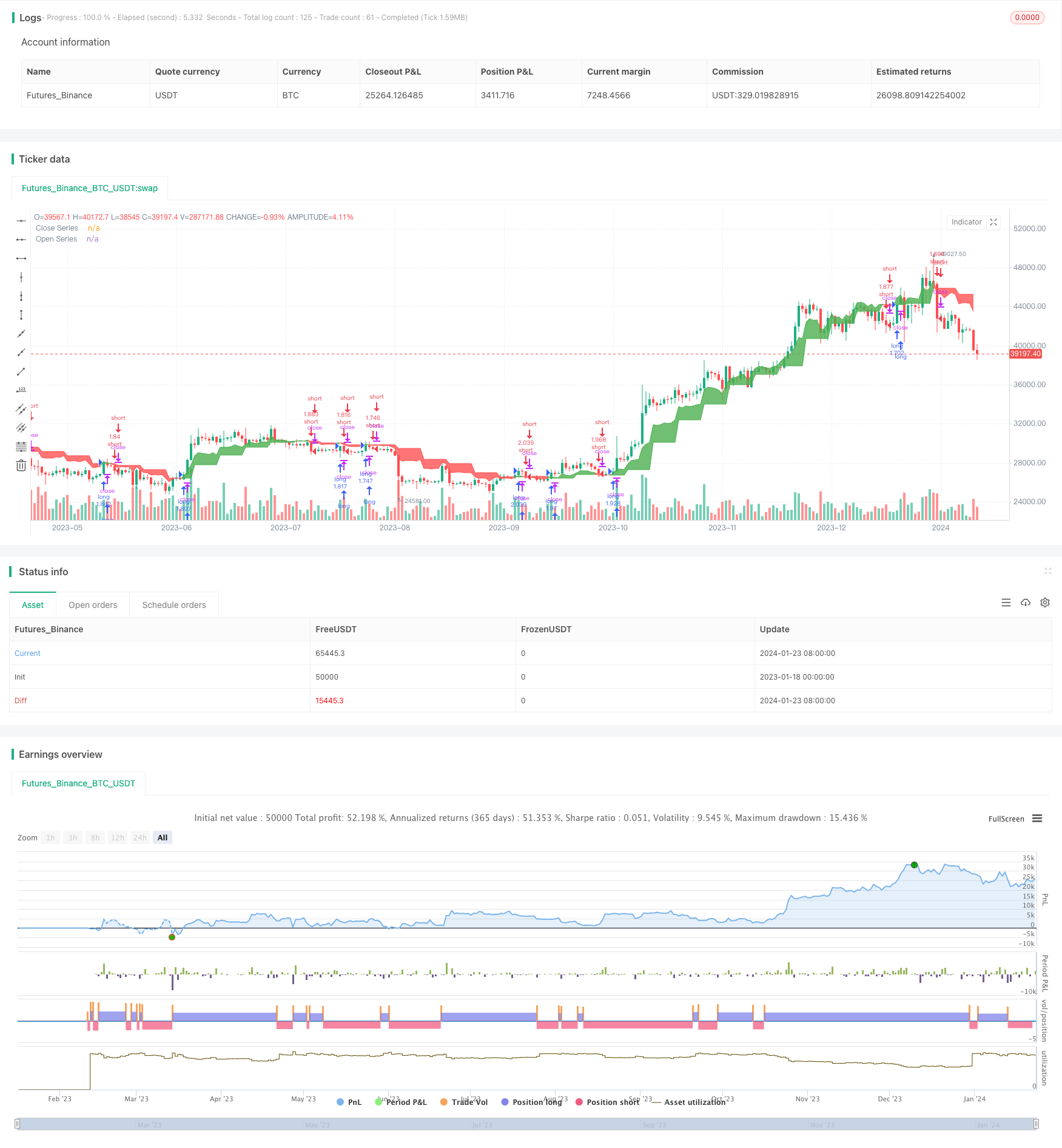
Overview
This strategy is based on the spectrum moving average, generating trading signals through the golden cross and death cross of the fast and slow moving averages. The spectrum moving average covers a variety of types from simple moving average to oscillating moving average, which can be freely combined through parameter adjustment for strong adaptability.
Strategy Principle
This strategy uses a variant moving average function that can generate 12 different types of moving averages. The basic principle is to calculate two moving average lines, the fast line (Close MA) and the slow line (Open MA). When the fast line crosses above the slow line, a buy signal is generated. When the fast line crosses below the slow line, a sell signal is generated. Stop loss and take profit parameters are also set to achieve automatic stop loss and take profit.
The key logic is to generate two moving average lines through the variant function: closeSeries = variant(basisType, close, basisLen, offsetSigma, offsetALMA) and openSeries = variant(basisType, open, basisLen, offsetSigma, offsetALMA). The variant function encapsulates calculation methods for 12 different types of moving averages. Users can freely select the type through the basisType parameter. This implements the combination of spectrum moving averages.
The basic logic for generating trading signals is: longCond = xlong and shortCond = xshort. That means when the fast line crosses above the slow line, long position is taken, and when the fast line crosses below the slow line, short position is taken.
The entry rule is to go long or go short when the longCond or shortCond condition is met. The exit rule is to close the position for stop loss or take profit when the price movement reaches the preset stop loss/profit points.
Advantage Analysis
The biggest advantage of this strategy is that it can freely combine a variety of different types of moving averages. It is indefinite which types of moving averages are best suited for different markets and timeframes. This strategy provides powerful customizability. Users can determine the optimal parameter combination through repeated testing, thereby formulating the best solution for the specific market.
Another advantage is that the strategy logic is simple and clear, but provides powerful functionality. It is easy for users to understand and use this strategy. At the same time, the abundant input parameters also provide sufficient optimization space for advanced users.
Risk Analysis
The biggest risk with this strategy is that the spectrum moving average itself has a certain degree of lagging. Abnormal price breakthroughs may cause larger losses. In addition, improper parameter selection may also lead to excessive trading frequency or redundant signals.
To reduce the risk, it is recommended to use other indicators to determine the validity of signals and avoid false breakouts. In addition, parameter optimization and backtesting are also essential to find the best parameter combination through repeated testing. In live trading, the position sizing should be appropriately reduced to control single loss.
Optimization Directions
The main optimization directions for this strategy include:
- Test more types of moving average combinations to find the best combination
- Add filters to avoid false signals, such as combining trading volume indicators, etc.
- Optimize the length parameters of the moving averages to find the optimal parameters
- Optimize position sizing, stop loss and take profit parameters
- Try different products and timeframes
By optimizing in these directions above, the live trading performance of the strategy can be continuously improved.
Summary
This trading strategy implements high flexibility based on the spectrum moving average. It provides powerful customizability for users to freely choose and combine different types of moving averages. The strategy logic is simple and clear, easy to use, and also offers abundant optimization space. Through parameter optimization and risk control, this strategy can adapt to different market environments and obtain steady returns. It is an efficient and flexible trend tracking strategy.
Parameters
| Name | Default | What it controls |
|---|---|---|
| v_input_1 | true | Use Alternate Resolution? |
| v_input_2 | 7 | Multiplier for Alernate Resolution |
| v_input_3 | 0 | MA Type: : DEMA | EMA | SMA | TEMA | WMA | VWMA | SMMA | HullMA | LSMA | ALMA | SSMA | TMA |
| v_input_4 | 8 | MA Period |
| v_input_5 | 6 | Offset for LSMA / Sigma for ALMA |
| v_input_6 | 0.85 | Offset for ALMA |
| v_input_7 | false | Show coloured Bars to indicate Trend? |
| v_input_8 | false | Delay Open/Close MA (Forces Non-Repainting) |
| v_input_9 | 0 | What trades should be taken : : BOTH | SHORT | LONG | NONE |
| v_input_10 | false | Initial Stop Loss Points (zero to disable) |
| v_input_11 | false | Initial Target Profit Points (zero for disable) |
| v_input_12 | 1000 | Number of Bars for Back Testing |
| v_input_13 | false | - SET to ZERO for Daily or Longer Timeframes |
Source Pine Script
/*backtest
start: 2023-01-18 00:00:00
end: 2024-01-24 00:00:00
period: 1d
basePeriod: 1h
exchanges: [{"eid":"Futures_Binance","currency":"BTC_USDT"}]
*/

//@version=4
//

strategy(title="Long/Short", shorttitle="Banana Maker", overlay=true, pyramiding=0, default_qty_type=strategy.percent_of_equity, default_qty_value=100, calc_on_every_tick=false)


// === INPUTS ===
useRes = input(defval=true, title="Use Alternate Resolution?")
intRes = input(defval=7, title="Multiplier for Alernate Resolution")
stratRes = timeframe.ismonthly ? tostring(timeframe.multiplier * intRes, "###M") :
   timeframe.isweekly ? tostring(timeframe.multiplier * intRes, "###W") :
   timeframe.isdaily ? tostring(timeframe.multiplier * intRes, "###D") :
   timeframe.isintraday ? tostring(timeframe.multiplier * intRes, "####") : '60'
basisType = input(defval="DEMA", title="MA Type: ", options=["SMA", "EMA", "DEMA", "TEMA", "WMA", "VWMA", "SMMA", "HullMA", "LSMA", "ALMA", "SSMA", "TMA"])
basisLen = input(defval=8, title="MA Period", minval=1)
offsetSigma = input(defval=6, title="Offset for LSMA / Sigma for ALMA", minval=0)
offsetALMA = input(defval=0.85, title="Offset for ALMA", minval=0, step=0.01)
scolor = input(false, title="Show coloured Bars to indicate Trend?")
delayOffset = input(defval=0, title="Delay Open/Close MA (Forces Non-Repainting)", minval=0, step=1)
tradeType = input("BOTH", title="What trades should be taken : ", options=["LONG", "SHORT", "BOTH", "NONE"])
// === /INPUTS ===

// Constants colours that include fully non-transparent option.
green100 = #008000FF
lime100 = #6ad279
red100 = #FF0000FF
blue100 = #0000FFFF
aqua100 = #00FFFFFF
darkred100 = #8B0000FF
gray100 = #808080FF

// === BASE FUNCTIONS ===
variant(type, src, len, offSig, offALMA) =>
    v1 = sma(src, len)  // Simple
    v2 = ema(src, len)  // Exponential
    v3 = 2 * v2 - ema(v2, len)  // Double Exponential
    v4 = 3 * (v2 - ema(v2, len)) + ema(ema(v2, len), len)  // Triple Exponential
    v5 = wma(src, len)  // Weighted
    v6 = vwma(src, len)  // Volume Weighted
    v7 = 0.0
    sma_1 = sma(src, len)  // Smoothed
    v7 := na(v7[1]) ? sma_1 : (v7[1] * (len - 1) + src) / len
    v8 = wma(2 * wma(src, len / 2) - wma(src, len), round(sqrt(len)))  // Hull
    v9 = linreg(src, len, offSig)  // Least Squares
    v10 = alma(src, len, offALMA, offSig)  // Arnaud Legoux
    v11 = sma(v1, len)  // Triangular (extreme smooth)
    // SuperSmoother filter
    // © 2013  John F. Ehlers
    a1 = exp(-1.414 * 3.14159 / len)
    b1 = 2 * a1 * cos(1.414 * 3.14159 / len)
    c2 = b1
    c3 = -a1 * a1
    c1 = 1 - c2 - c3
    v12 = 0.0
    v12 := c1 * (src + nz(src[1])) / 2 + c2 * nz(v12[1]) + c3 * nz(v12[2])
    type == "EMA" ? v2 : type == "DEMA" ? v3 :
       type == "TEMA" ? v4 : type == "WMA" ? v5 : type == "VWMA" ? v6 :
       type == "SMMA" ? v7 : type == "HullMA" ? v8 : type == "LSMA" ? v9 :
       type == "ALMA" ? v10 : type == "TMA" ? v11 : type == "SSMA" ? v12 : v1

// security wrapper for repeat calls* NEEDS REFINEMENT- backtesting this shows repaint. need new wrapper
reso(exp, use, res) =>
    security_1 = security(syminfo.tickerid, res, exp, gaps=barmerge.gaps_off, lookahead=barmerge.lookahead_on)
    use ? security_1 : exp


// === /BASE FUNCTIONS ===

// === SERIES SETUP ===
closeSeries = variant(basisType, close[delayOffset], basisLen, offsetSigma, offsetALMA)
openSeries = variant(basisType, open[delayOffset], basisLen, offsetSigma, offsetALMA)
// === /SERIES ===

// === PLOTTING ===

// alt resulution
closeSeriesAlt = reso(closeSeries, useRes, stratRes)
openSeriesAlt = reso(openSeries, useRes, stratRes)
//
trendColour = closeSeriesAlt > openSeriesAlt ? color.green : color.red
bcolour = closeSeries > openSeriesAlt ? lime100 : red100
barcolor(scolor ? bcolour : na, title="Bar Colours")
closeP = plot(closeSeriesAlt, title="Close Series", color=trendColour, linewidth=0, style=plot.style_line, transp=1)
openP = plot(openSeriesAlt, title="Open Series", color=trendColour, linewidth=0, style=plot.style_line, transp=1)
fill(closeP, openP, color=trendColour, transp=80)

// === /PLOTTING ===
//

//
// === ALERT conditions

xlong = crossover(closeSeriesAlt, openSeriesAlt)
xshort = crossunder(closeSeriesAlt, openSeriesAlt)
longCond = xlong  // alternative: longCond[1]? false : (xlong or xlong[1]) and close>closeSeriesAlt and close>=open
shortCond = xshort  // alternative: shortCond[1]? false : (xshort or xshort[1]) and close<closeSeriesAlt and close<=open


// === /ALERT conditions. needs work in study mode. the banana maker is the study script.
// Create alert for cross, shunt back 1 if source is not 'open', this should prevent repaint issue.
//shunt = RSIsrc == open ? 0 : 1
//shunt = 0
//c_alert = (buy[shunt]==1 or sell[shunt]==1)
//alertcondition(c_alert, title="QQECROSS Alert", message="QQECROSS Alert")
// show only when alert condition is met and bar closed.
//plotshape(c_alert,title= "Alert Indicator Closed", location=location.bottom, color=sell[shunt]==1?red:green, transp=0, style=shape.circle)

//Repaint city, study mode will help but wont trigger the alerts


// === STRATEGY ===
// stop loss
slPoints = input(defval=0, title="Initial Stop Loss Points (zero to disable)", minval=0)
tpPoints = input(defval=0, title="Initial Target Profit Points (zero for disable)", minval=0)
// Include bar limiting algorithm
ebar = input(defval=1000, title="Number of Bars for Back Testing", minval=0)
dummy = input(false, title="- SET to ZERO for Daily or Longer Timeframes")
//
// Calculate how many mars since last bar
tdays = (timenow - time) / 60000.0  // number of minutes since last bar
tdays := timeframe.ismonthly ? tdays / 1440.0 / 5.0 / 4.3 / timeframe.multiplier :
   timeframe.isweekly ? tdays / 1440.0 / 5.0 / timeframe.multiplier :
   timeframe.isdaily ? tdays / 1440.0 / timeframe.multiplier :
   tdays / timeframe.multiplier  // number of bars since last bar
//
//set up exit parameters
TP = tpPoints > 0 ? tpPoints : na
SL = slPoints > 0 ? slPoints : na

// Make sure we are within the bar range, Set up entries and exit conditions
if (ebar == 0 or tdays <= ebar) and tradeType != "NONE"
    strategy.entry("long", strategy.long, when=longCond == true and tradeType != "SHORT")
    strategy.entry("short", strategy.short, when=shortCond == true and tradeType != "LONG")
    strategy.close("long", when=shortCond == true and tradeType == "LONG")
    strategy.close("short", when=longCond == true and tradeType == "SHORT")
    strategy.exit("XL", from_entry="long", profit=TP, loss=SL)
    strategy.exit("XS", from_entry="short", profit=TP, loss=SL)


// === /STRATEGY ===
// eof
Published by ChaoZhang on the FMZ strategy square · last modified 2024-01-25. Collected in the Quant Trading Vault. Unvalidated research: re-test with your own data and costs before trusting it.
Build this with AgenKit
A spec is not a trading system. Paste this into your coding agent and AgenKit runs a specialist team — architecture, test-first build, risk gates, review — with paper trading on by default.
/agenkit build a production-grade trading bot with a backtest engine, risk controls and paper trading by default from strategies/Oscillation-Spectrum-Moving-Average-Trading-Strategy.md- npx agenkit install engineering-kit in your project
- Paste the command into your agent and approve each phase
- Get tests, backtest, risk controls and a paper-trading switch
Understand it first
Before you run this, read the lesson behind the idea and how to backtest it honestly. Specs like this one are the survivors of an unknown number of trials; deflate their results accordingly.
Related specs
- Adaptive Multi Period Trading Strategy Based on Wave Trend Momentum BreakoutPine Script · Breakout · 2h
- BB Breakout StrategyPine Script · Breakout · 1d
- BMSB Breakout Strategy BMSBPine Script · Breakout · 1h
- Bollinger Band T3 Moving Average StrategyPine Script · Breakout · 10m
- Bollinger Bands Dual track Breakthrough StrategyPine Script · Breakout · 30m
- Bollinger Breakout StrategyPine Script · Breakout · 30m