Single Side Trend Shock Breakout Strategy
The Single Side Trend Shock Breakout Strategy is a breakout strategy that utilizes price channels and trend judgment. It aims to identify trend direction, enter on breakouts during range-bound periods, and exit when…
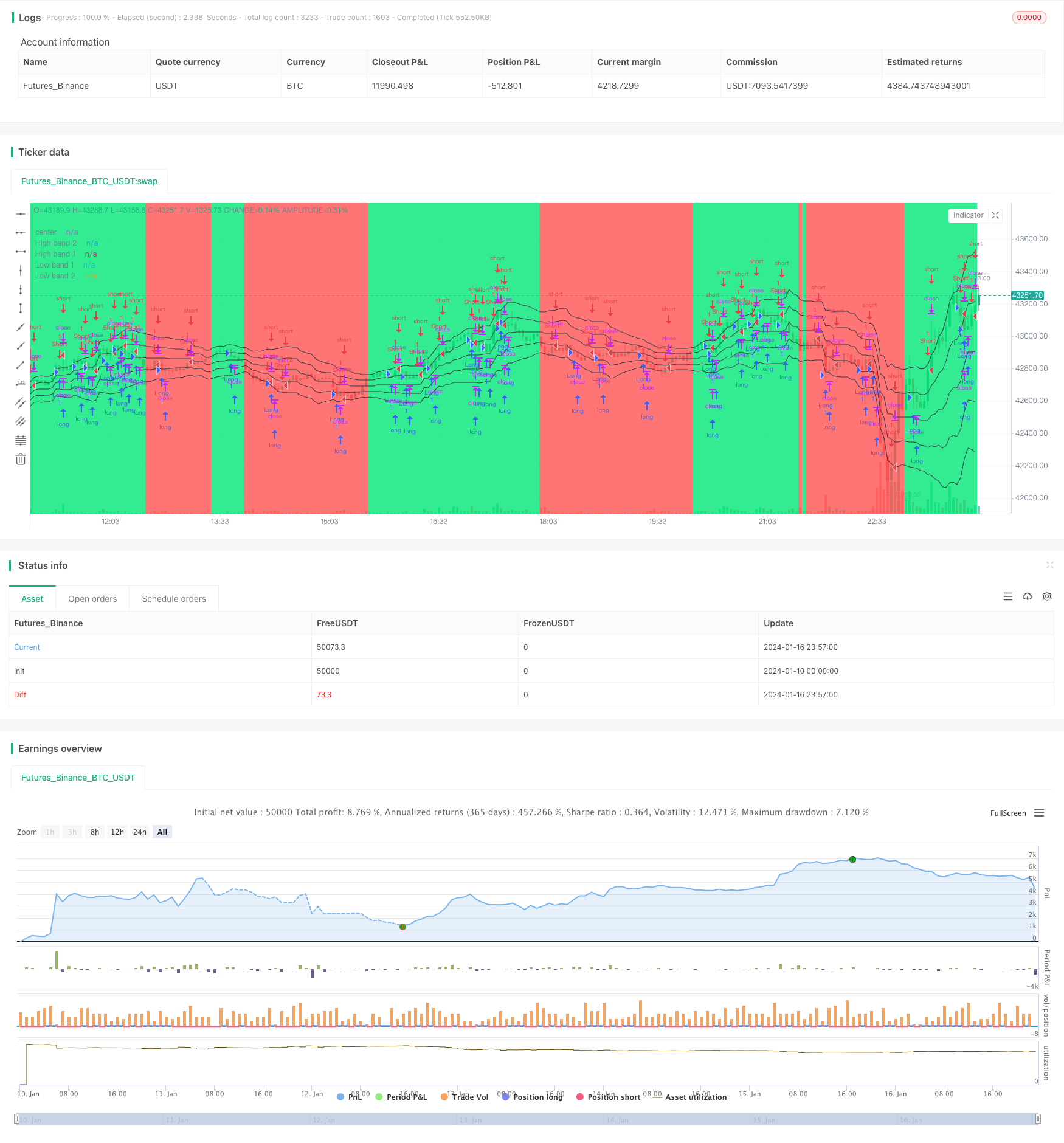
Overview
The Single Side Trend Shock Breakout Strategy is a breakout strategy that utilizes price channels and trend judgment. It aims to identify trend direction, enter on breakouts during range-bound periods, and exit when a profit target is reached.
Strategy Logic
The strategy calculates upper and lower bands of a price channel using highest and lowest prices over a recent N periods. It then computes a price midline. Distances between prices and midline are averaged to obtain the channel bands.
For trend detection, the strategy checks if recent candles all close above (bullish) or below (bearish) the channel. Upon trend confirmation, it awaits price shocks near the bands and enters in reverse direction.
Body breakouts supplement the entry signals when body length exceeds a multiple of average body length. The strategy sets a profit target after entry and takes profit when price reaches it.
Advantage Analysis
The main advantages of this strategy are:
- Price channel filters reduce false breakout risks
- Reverse entries profit from trend shocks
- Body breakouts improve entry accuracy
- Profit target allows taking gains actively
Risk Analysis
There are also some risks:
- Improper channel parameter may widen/narrow the channel excessively
- Reversals against strong trends can lead to large losses
- Body breakouts tend to generate false signals on tops
- Rigid profit target may leave profits on the table
These can be addressed via parameter tuning, avoiding reversals during strong trends, optimizing exit logic etc.
Enhancement Opportunities
Some ways to improve the strategy:
- Add trend indicators to confirm trends
- Optimize body breakout parameters to reduce false signals
- Additional filters on entry timing
- Dynamic adjustment of profit target
Conclusion
The Single Side Trend Shock Breakout Strategy profits from breakouts against the trend in ranging periods. It has the advantage of trend identification and active profit-taking, but also has some risks. These risks can be reduced through multi-factor confirmation, parameter optimization etc. The strategy suits short-term trading and can complement trend-following strategies.
Parameters
| Name | Default | What it controls |
|---|---|---|
| v_input_1 | true | Long |
| v_input_2 | true | Short |
| v_input_3 | false | take, % |
| v_input_4 | true | Bands Entry |
| v_input_5 | false | Counter-trend entry |
| v_input_6 | 10 | Body length |
| v_input_7 | true | Trend bars |
| v_input_8 | 20 | Period |
| v_input_9 | true | Show Bands |
| v_input_10 | true | Show Background |
Source Pine Script
/*backtest
start: 2024-01-10 00:00:00
end: 2024-01-17 00:00:00
period: 3m
basePeriod: 1m
exchanges: [{"eid":"Futures_Binance","currency":"BTC_USDT"}]
*/


//@version=2
strategy("Noro's Bands Scalper Strategy v1.5", shorttitle = "Scalper str 1.5", overlay=true, default_qty_type = strategy.percent_of_equity, default_qty_value=100.0, pyramiding=0)

//Settings
needlong = input(true, defval = true, title = "Long")
needshort = input(true, defval = true, title = "Short")
takepercent = input(0, defval = 0, minval = 0, maxval = 1000, title = "take, %")
needbe = input(true, defval = true, title = "Bands Entry")
needct = input(false, defval = false, title = "Counter-trend entry")
bodylen = input(10, defval = 10, minval = 0, maxval = 50, title = "Body length")
trb = input(1, defval = 1, minval = 1, maxval = 5, title = "Trend bars")
len = input(20, defval = 20, minval = 2, maxval = 200, title = "Period")
needbb = input(true, defval = true, title = "Show Bands")
needbg = input(true, defval = true, title = "Show Background")
src = close

//PriceChannel 1
lasthigh = highest(src, len)
lastlow = lowest(src, len)
center = (lasthigh + lastlow) / 2

//Distance
dist = abs(src - center)
distsma = sma(dist, len)
hd = center + distsma
ld = center - distsma
hd2 = center + distsma * 2
ld2 = center - distsma * 2

//Trend
chd = close > hd
cld = close < ld
uptrend = trb == 1 and chd ? 1 : trb == 2 and chd and chd[1] ? 1 : trb == 3 and chd and chd[1] and chd[2] ? 1 : trb == 4 and chd and chd[1] and chd[2] and chd[3] ? 1 : trb == 5 and chd and chd[1] and chd[2] and chd[3] and chd[4] ? 1 : 0
dntrend = trb == 1 and cld ? 1 : trb == 2 and cld and cld[1] ? 1 : trb == 3 and cld and cld[1] and cld[2] ? 1 : trb == 4 and cld and cld[1] and cld[2] and cld[3] ? 1 : trb == 5 and cld and cld[1] and cld[2] and cld[3] and cld[4] ? 1 : 0
trend = dntrend == 1 and high < center ? -1 : uptrend == 1 and low > center ? 1 : trend[1]

//trend = close < ld and high < center ? -1 : close > hd and low > center ? 1 : trend[1]

//Lines
colo = needbb == false ? na : black
plot(hd2, color = colo, linewidth = 1, transp = 0, title = "High band 2")
plot(hd, color = colo, linewidth = 1, transp = 0, title = "High band 1")
plot(center, color = colo, linewidth = 1, transp = 0, title = "center")
plot(ld, color = colo, linewidth = 1, transp = 0, title = "Low band 1")
plot(ld2, color = colo, linewidth = 1, transp = 0, title = "Low band 2")

//Background
col = needbg == false ? na : trend == 1 ? lime : red
bgcolor(col, transp = 80)

//Body
body = abs(close - open)
smabody = ema(body, 30) / 10 * bodylen

//Signals
bar = close > open ? 1 : close < open ? -1 : 0
up7 = trend == 1 and ((bar == -1 and bar[1] == -1) or (body > smabody and bar == -1)) ? 1 : 0
dn7 = trend == 1 and ((bar == 1 and bar[1] == 1) or (close > hd and needbe == true)) and close > strategy.position_avg_price * (100 + takepercent) / 100 ? 1 : 0
up8 = trend == -1 and ((bar == -1 and bar[1] == -1) or (close < ld2 and needbe == true)) and close < strategy.position_avg_price * (100 - takepercent) / 100 ? 1 : 0
dn8 = trend == -1 and ((bar == 1 and bar[1] == 1) or (body > smabody and bar == 1)) ? 1 : 0

if up7 == 1 or up8 == 1
    strategy.entry("Long", strategy.long, needlong == false ? 0 : trend == -1 and needct == false ? 0 : na)

if dn7 == 1 or dn8 == 1
strategy.entry("Short", strategy.short, needshort == false ? 0 : trend == 1 and needct == false ? 0 : na)Published by ChaoZhang on the FMZ strategy square · last modified 2024-01-18. Collected in the Quant Trading Vault. Unvalidated research: re-test with your own data and costs before trusting it.
Build this with AgenKit
A spec is not a trading system. Paste this into your coding agent and AgenKit runs a specialist team — architecture, test-first build, risk gates, review — with paper trading on by default.
/agenkit build a production-grade trading bot with a backtest engine, risk controls and paper trading by default from strategies/Single-Side-Trend-Shock-Breakout-Strategy.md- npx agenkit install engineering-kit in your project
- Paste the command into your agent and approve each phase
- Get tests, backtest, risk controls and a paper-trading switch
Understand it first
Before you run this, read the lesson behind the idea and how to backtest it honestly. Specs like this one are the survivors of an unknown number of trials; deflate their results accordingly.
Related specs
- Adaptive Multi Period Trading Strategy Based on Wave Trend Momentum BreakoutPine Script · Breakout · 2h
- BB Breakout StrategyPine Script · Breakout · 1d
- BMSB Breakout Strategy BMSBPine Script · Breakout · 1h
- Bollinger Band T3 Moving Average StrategyPine Script · Breakout · 10m
- Bollinger Bands Dual track Breakthrough StrategyPine Script · Breakout · 30m
- Bollinger Breakout StrategyPine Script · Breakout · 30m