Strategy vault / Trend following
TFO and ATR Based Trend Tracking Stop Loss Strategy
This strategy is designed based on Dr. John Ehlers' Trend Flex Oscillator (TFO) and Average True Range (ATR) indicators. It is suitable for bull markets and will open long positions when oversold price action appears…
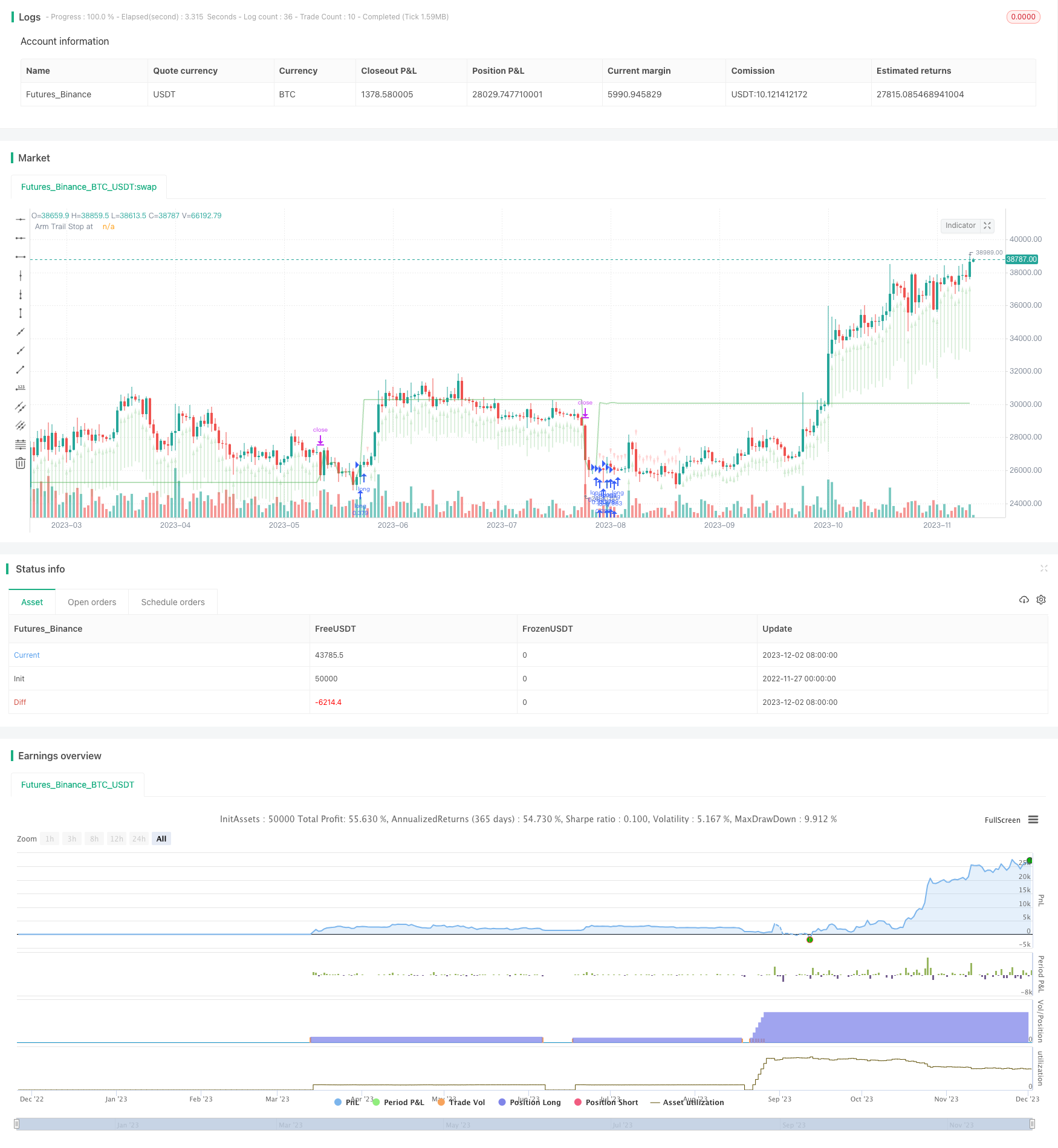
Overview
This strategy is designed based on Dr. John Ehlers' Trend Flex Oscillator (TFO) and Average True Range (ATR) indicators. It is suitable for bull markets and will open long positions when oversold price action appears to reverse. It typically closes positions within a few days unless caught in a bear market, in which case it holds on. This strategy simplifies backtesting by making parameters configurable, but backtest results should never be fully trusted.
Strategy Logic
This strategy combines the TFO and ATR indicators to determine entries and exits.
Entry conditions: When TFO drops below a threshold (indicating oversold levels) and TFO has risen from the previous bar (indicating TFO reversal upwards), and ATR is above a set volatility threshold (indicating increasing market volatility), long positions are opened.
Exit conditions: When TFO rises above a threshold (indicating overbought levels) and ATR is above a set threshold, all long positions are closed. In addition, a trailing stop loss exits all positions when price drops below the trailing stop level. Users can choose to allow the strategy to exit based on indicator signals or based solely on the stop loss.
The strategy allows up to 15 simultaneous long positions. Parameters can be adjusted for different timeframes.
Advantages
Combining trend and volatility analysis provides steady signals. TFO captures early trend reversal signals and ATR identifies surge in volatility.
Adjustable entry, exit and stop loss parameters provide flexibility. Users can optimize based on market conditions.
Built-in stop loss protects against extreme moves. Stop losses are essential in quant trading.
Support for pyramiding and partial exits allows profit compounding in bull markets.
Risks
Long only, no shorting mechanism. Cannot profit from falling markets. Severe bear markets can cause huge losses.
Poor parameter tuning can cause over trading or missed entries and exits. Extensive testing is needed to find optimal parameters.
In extreme moves, stop loss can fail and not prevent huge losses. A limitation of all stop loss strategies.
Backtest does not fully reflect live performance. Expect some deviation.
Enhancement Opportunities
A moving stop loss line can be added for timely exits and better downside protection.
Shorting mechanism can be added to allow profits during market drops when TFO reverses downwards and ATR is high enough.
More filters like volume change can reduce impacts of erratic price moves.
Different timeframes and parameters can be tested to find the best performing combination.
Conclusion
This strategy combines the strengths of trend and volatility analysis using TFO and ATR to determine market direction. Mechanisms like pyramiding, partial close and trailing stop loss allow profit compounding while controlling risk during bull markets. There is room for improvements via more indicators filters and parameter optimization. It achieves the basic goals of a quant strategy and merits further research and application.
Parameters
| Name | Default | What it controls |
|---|---|---|
| v_input_int_1 | 9 | (?Back-Testing Start Date)From Month |
| v_input_int_2 | true | From Day |
| v_input_int_3 | 2021 | From Year |
| v_input_int_4 | 3 | (?Average True Range)Min Volatility for Buy |
| v_input_int_5 | 13 | Min Volatility for Sell |
| v_input_bool_1 | false | Average the Volatility over 3 bars |
| v_input_float_1 | 1.2 | (?Trend Flex Ocillator)TFO Upper Level |
| v_input_float_2 | -0.9 | TFO Lower Level |
| v_input_int_6 | 14 | TrendFlex Period |
| v_input_bool_2 | true | (?Selling Conditions)Allow Stategy to close positions |
| v_input_int_7 | false | Value (%) must exceed |
| v_input_bool_3 | true | Set Trailing Stop Loss on avg positon value |
| v_input_float_3 | 15 | Trailing Stop Arms At (%) |
| v_input_float_4 | 2 | Trailing Stop Loss (%) |
Source Pine Script
/*backtest
start: 2022-11-27 00:00:00
end: 2023-12-03 00:00:00
period: 1d
basePeriod: 1h
exchanges: [{"eid":"Futures_Binance","currency":"BTC_USDT"}]
*/

// This source code is subject to the terms of the Mozilla Public License 2.0 at https://mozilla.org/MPL/2.0/
// © Chart0bserver
//
// Open Source attributions:
// portions © allanster (date window code)
// portions © Dr. John Ehlers (Trend Flex Oscillator)
//
// READ THIS CAREFULLY!!! ----------------//
// This code is provided for educational purposes only.  The results of this strategy should not be considered investment advice.
// The user of this script acknolwedges that it can cause serious financial loss when used as a trading tool
// This strategy has a bias for HODL (Holds on to Losses) meaning that it provides NO STOP LOSS protection!
// Also note that the default behavior is designed for up to 15 open long orders, and executes one order to close them all at once.
// Opening a long position is predicated on The Trend Flex Oscillator (TFO) rising after being oversold, and ATR above a certain volatility threshold.
// Closing a long is handled either by TFO showing overbought while above a certain ATR level, or the Trailing Stop Loss.  Pick one or both.
// If the strategy is allowed to sell before a Trailing Stop Loss is triggered, you can set a "must exceed %".  Do not mistake this for a stop loss.
// Short positions are not supported in this version.  Back-testing should NEVER be considered an accurate representation of actual trading results.

//@version=5
strategy('TFO + ATR Strategy with Trailing Stop Loss', 'TFO ATR Trailing Stop Loss', overlay=true, pyramiding=15, default_qty_type=strategy.cash, default_qty_value=10000, initial_capital=150000, currency='USD', commission_type=strategy.commission.percent, commission_value=0.5)
strategy.risk.allow_entry_in(strategy.direction.long)  // There will be no short entries, only exits from long.

// -----------------------------------------------------------------------------------------------------------//
// Back-testing Date Range code  ----------------------------------------------------------------------------//
// ---------------------------------------------------------------------------------------------------------//
fromMonth = input.int(defval=9, title='From Month', minval=1, maxval=12, group='Back-Testing Start Date')
fromDay = input.int(defval=1, title='From Day', minval=1, maxval=31, group='Back-Testing Start Date')
fromYear = input.int(defval=2021, title='From Year', minval=1970, group='Back-Testing Start Date')
thruMonth = 1       //input(defval = 1,    title = "Thru Month",      type = input.integer, minval = 1, maxval = 12, group="Back-Testing Date Range")
thruDay = 1         //input(defval = 1,    title = "Thru Day",        type = input.integer, minval = 1, maxval = 31, group="Back-Testing Date Range")
thruYear = 2112     //input(defval = 2112, title = "Thru Year",       type = input.integer, minval = 1970, group="Back-Testing Date Range")

// === FUNCTION EXAMPLE ===
start = timestamp(fromYear, fromMonth, fromDay, 00, 00)  // backtest start window
finish = timestamp(thruYear, thruMonth, thruDay, 23, 59)  // backtest finish window
window() =>  // create function "within window of time
    time >= start and time <= finish ? true : false
// Date range code -----//


// -----------------------------------------------------------------------------------------------------------//
// ATR Indicator Code  --------------------------------------------------------------------------------------//
// ---------------------------------------------------------------------------------------------------------//
length = 18  //input(title="ATR Length", defval=18, minval=1)
Period = 18  //input(18,title="ATR EMA Period")

basicEMA = ta.ema(close, length)
ATR_Function = ta.ema(ta.tr(true), length)
EMA_ATR = ta.ema(ATR_Function, Period)
ATR = ta.ema(ta.tr(true), length)
ATR_diff = ATR - EMA_ATR
volatility = 100 * ATR_diff / EMA_ATR  // measure of spread between ATR and EMA
volatilityAVG = math.round((volatility + volatility[1] + volatility[2]) / 3)
buyVolatility = input.int(3, 'Min Volatility for Buy', minval=-20, maxval=20, step=1, group='Average True Range')
sellVolatility = input.int(13, 'Min Volatility for Sell', minval=-10, maxval=20, step=1, group='Average True Range')
useAvgVolatility = input.bool(defval=false, title='Average the Volatility over 3 bars', group='Average True Range')
// End of ATR  ------------/


// -----------------------------------------------------------------------------------------------------------//
// TFO Indicator code  --------------------------------------------------------------------------------------//
// ---------------------------------------------------------------------------------------------------------//
trendflex(Series, PeriodSS, PeriodTrendFlex, PeriodEMA) =>
    var SQRT2xPI = math.sqrt(8.0) * math.asin(1.0)  // 4.44288293815 Constant
    alpha = SQRT2xPI / PeriodSS
    beta = math.exp(-alpha)
    gamma = -beta * beta
    delta = 2.0 * beta * math.cos(alpha)
    float superSmooth = na
    superSmooth := (1.0 - delta - gamma) * (Series + nz(Series[1])) * 0.5 + delta * nz(superSmooth[1]) + gamma * nz(superSmooth[2])
    E = 0.0
    for i = 1 to PeriodTrendFlex by 1
        E += superSmooth - nz(superSmooth[i])
        E
    epsilon = E / PeriodTrendFlex
    zeta = 2.0 / (PeriodEMA + 1.0)
    float EMA = na
    EMA := zeta * epsilon * epsilon + (1.0 - zeta) * nz(EMA[1])
    return_1 = EMA == 0.0 ? 0.0 : epsilon / math.sqrt(EMA)
    return_1

upperLevel = input.float(1.2, 'TFO Upper Level', minval=0.1, maxval=2.0, step=0.1, group='Trend Flex Ocillator')
lowerLevel = input.float(-0.9, 'TFO Lower Level', minval=-2.0, maxval=-0.1, step=0.1, group='Trend Flex Ocillator')
periodTrendFlex = input.int(14, 'TrendFlex Period', minval=2, group='Trend Flex Ocillator')
useSuperSmootherOveride = true  //input( true, "Apply SuperSmoother Override Below*", input.bool, group="Trend Flex Ocillator")
periodSuperSmoother = 8.0       //input(8.0, "SuperSmoother Period*", input.float  , minval=4.0, step=0.5, group="Trend Flex Ocillator")
postSmooth = 33                 //input(33.0, "Post Smooth Period**", input.float  , minval=1.0, step=0.5, group="Trend Flex Ocillator")

trendFlexOscillator = trendflex(close, periodSuperSmoother, periodTrendFlex, postSmooth)
// End of TFO -------------//


// -----------------------------------------------------------------------------------------------------------//
// HODL Don't sell if losing n% ---------------------------------------------------------------------------- //
// ---------------------------------------------------------------------------------------------------------//
sellOnStrategy = input.bool(defval=true, title='Allow Stategy to close positions', group='Selling Conditions')
doHoldLoss = true       // input(defval = true, title = "Strategy can sell for a loss", type = input.bool, group="Selling Conditions")
holdLoss = input.int(defval=0, title='Value (%) must exceed ', minval=-25, maxval=10, step=1, group='Selling Conditions')
totalInvest = strategy.position_avg_price * strategy.position_size
openProfitPerc = strategy.openprofit / totalInvest
bool acceptableROI = openProfitPerc * 100 > holdLoss
// -----------------------//


// -----------------------------------------------------------------------------------------------------------//
// Buying and Selling conditions  -------------------------------------------------------------------------- //
// ---------------------------------------------------------------------------------------------------------//
if useAvgVolatility
    volatility := volatilityAVG
    volatility
tfoBuy = trendFlexOscillator < lowerLevel and trendFlexOscillator[1] < trendFlexOscillator  // Always make a purchase if TFO is in this lowest range
atrBuy = volatility > buyVolatility
tfoSell = ta.crossunder(trendFlexOscillator, upperLevel)
consensusBuy = tfoBuy and atrBuy
consensusSell = tfoSell and volatility > sellVolatility
if doHoldLoss
    consensusSell := consensusSell and acceptableROI
    consensusSell
// --------------------//


// -----------------------------------------------------------------------------------------------------------//
// Tracing & Debugging --------------------------------------------------------------------------------------//
// ---------------------------------------------------------------------------------------------------------//

plotchar(strategy.opentrades, 'Number of open trades', ' ', location.top)
plotarrow(100 * openProfitPerc, 'Profit on open longs', color.new(color.green, 75), color.new(color.red, 75))
// plotchar(strategy.position_size, "Shares on hand", " ", location.top)
// plotchar(totalInvest, "Total Invested", " ", location.top)
// plotarrow(strategy.openprofit, "Open profit dollar amount", color.new(color.green,100), color.new(color.red, 100))
// plotarrow(strategy.netprofit, "Net profit for session", color.new(color.green,100), color.new(color.red, 100))
// plotchar(acceptableROI, "Acceptable ROI", " ", location.top)
// plotarrow(volatility, "ATR volatility value", color.new(color.green,75), color.new(color.red, 75))
// plotchar(strategy.position_avg_price, "Avgerage price of holdings", " ", location.top)
// plotchar(volatilityAVG, "AVG volatility", " ", location.top)
// plotchar(fiveBarsVal, "change in 5bars", " ", location.top)
// plotchar(crossingUp, "crossingUp", "x",  location.belowbar, textcolor=color.white)
// plotchar(crossingDown, "crossingDn", "x",  location.abovebar, textcolor=color.white)
// plotchar(strategy.closedtrades, "closedtrades", " ", location.top)
// plotchar(strategy.wintrades, "wintrades", " ", location.top)
// plotchar(strategy.losstrades, "losstrades", " ", location.top)
// plotchar(close, "close", " ", location.top)
//--------------------//

// -----------------------------------------------------------------------------------------------------------//
// Trade Alert Execution ------------------------------------------------------------------------------------//
// ---------------------------------------------------------------------------------------------------------//

strategy.entry('long', strategy.long, when=window() and consensusBuy, comment='long')
if sellOnStrategy
    strategy.close('long', when=window() and consensusSell, qty_percent=100, comment='Strat')


// -----------------------------------------------------------------------------------------------------------//
// Trailing Stop Loss logic -------------------------------------------------------------------------------- //
// ---------------------------------------------------------------------------------------------------------//
useTrailStop = input.bool(defval=true, title='Set Trailing Stop Loss on avg positon value', group='Selling Conditions')
arm = input.float(defval=15, title='Trailing Stop Arms At (%)', minval=1, maxval=30, step=1, group='Selling Conditions') * 0.01
trail = input.float(defval=2, title='Trailing Stop Loss (%)', minval=0.25, maxval=9, step=0.25, group='Selling Conditions') * 0.1

longStopPrice = 0.0
stopLossPrice = 0.0

if strategy.position_size > 0
    longStopPrice := strategy.position_avg_price * (1 + arm)
    stopLossPrice := strategy.position_avg_price * ((100 - math.abs(holdLoss)) / 100)  // for use with 'stop' in strategy.exit
    stopLossPrice
else
    longStopPrice := close
    longStopPrice

// If you want to hide the Trailing Stop Loss threshold (green line), comment this out
plot(longStopPrice, 'Arm Trail Stop at', color.new(color.green, 60), linewidth=2)

if strategy.position_size > 0 and useTrailStop
    strategy.exit('exit', 'long', when=window(), qty_percent=100, trail_price=longStopPrice, trail_offset=trail * close / syminfo.mintick, comment='Trail')

//-----------------------------------------------------------------------------------------------------------//
Published by ChaoZhang on the FMZ strategy square · last modified 2023-12-04. Collected in the Quant Trading Vault. Unvalidated research: re-test with your own data and costs before trusting it.
Build this with AgenKit
A spec is not a trading system. Paste this into your coding agent and AgenKit runs a specialist team — architecture, test-first build, risk gates, review — with paper trading on by default.
/agenkit build a production-grade trading bot with a backtest engine, risk controls and paper trading by default from strategies/TFO-and-ATR-Based-Trend-Tracking-Stop-Loss-Strategy.md- npx agenkit install engineering-kit in your project
- Paste the command into your agent and approve each phase
- Get tests, backtest, risk controls and a paper-trading switch
Understand it first
Before you run this, read the lesson behind the idea and how to backtest it honestly. Specs like this one are the survivors of an unknown number of trials; deflate their results accordingly.
Related specs
- ATR Dynamic Trend Following and EMA Crossover Trading StrategyPine Script · Trend following · 1d
- ATR and Moving Average Crossover Hybrid StrategyPine Script · Trend following · 1h
- ATR and T3 Moving Average StrategyPine Script · Trend following · 5m
- Adaptive ATR and RSI Trend Following Strategy with Trailing Stop LossPine Script · Trend following · 1h
- Bollinger Bands and RSI Trend Following StrategyPine Script · Trend following · 1h
- Dual ATR Channel Trend Following StrategyPine Script · Trend following · 15m