Trend Breakout Trading Strategy Based on Dual Moving Averages and Volume
This is a long-only trend trading strategy that combines dual moving average crossover with volume analysis. The strategy makes trading decisions by comparing short-term and long-term moving average crossover signals…
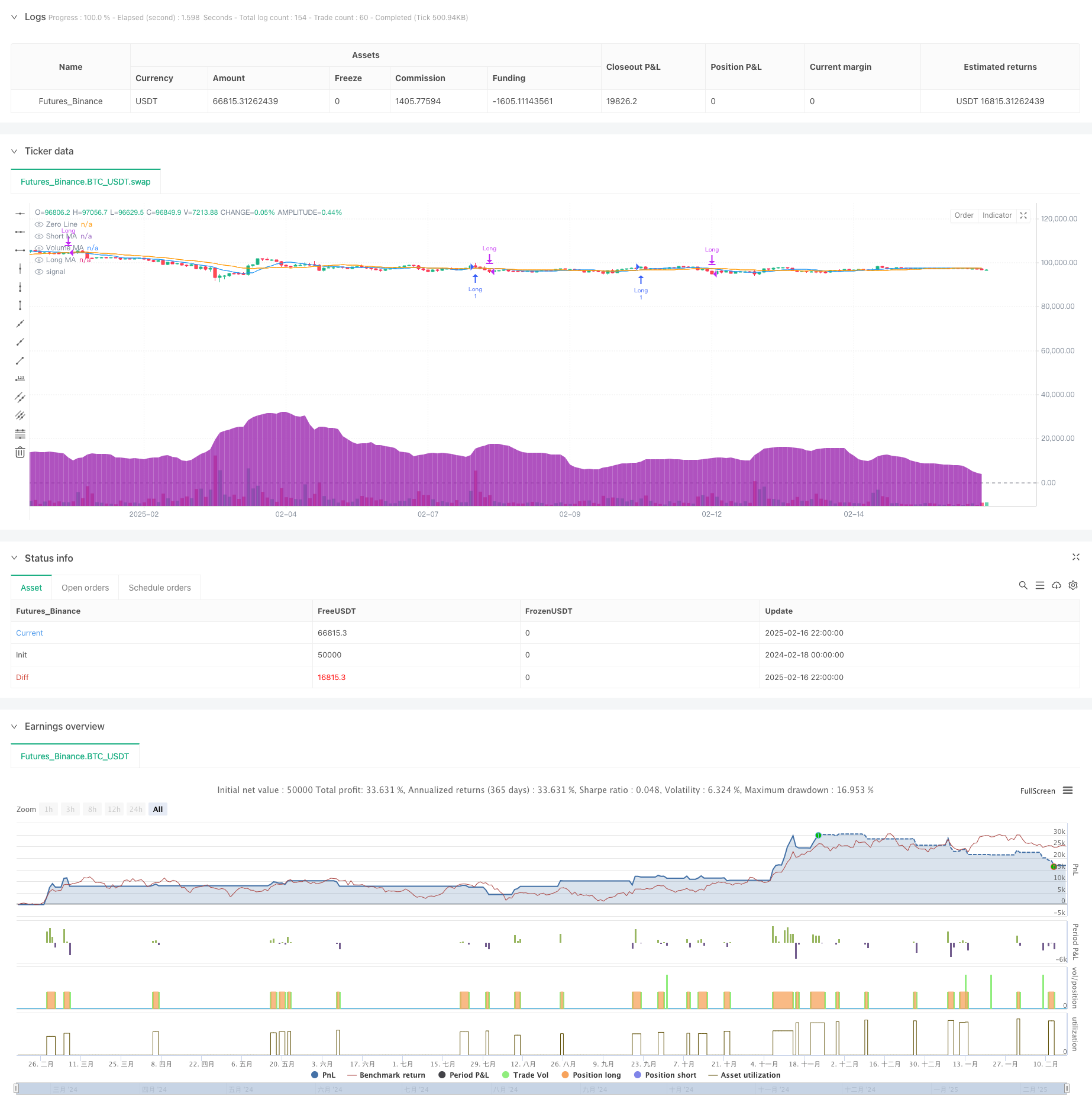
Overview
This is a long-only trend trading strategy that combines dual moving average crossover with volume analysis. The strategy makes trading decisions by comparing short-term and long-term moving average crossover signals while incorporating volume indicators. A long signal is generated when the short-term moving average crosses above the long-term moving average with significant volume expansion. The strategy also includes a stop-loss mechanism for risk control.
Strategy Principles
The core logic of the strategy is based on the following key elements:
- Dual Moving Average System: Uses 9-day and 21-day Simple Moving Averages (SMA) as signal indicators. The short-term MA represents recent price trends, while the long-term MA represents medium-term price trends.
- Volume Analysis: Uses a 20-day volume moving average to measure normal trading volume levels, requiring entry volume to be at least 1.5 times the average level and increasing compared to the previous period.
- Stop-Loss Mechanism: Sets a 2% stop-loss level from the entry price to control maximum loss per trade.
- Exit Mechanism: Automatically closes positions when the short-term MA crosses below the long-term MA.
Strategy Advantages
- Multiple Confirmation Mechanism: Improves signal reliability through dual confirmation of price trends and volume.
- Comprehensive Risk Control: Fixed percentage stop-loss effectively controls risk exposure per trade.
- Trend-Following Characteristics: Captures trend changes using MA crossovers, enabling early trend entry.
- Objective Quantitative Indicators: All trading signals are based on objective technical indicators, avoiding subjective judgment interference.
- High Adaptability: Parameters can be adjusted according to different market characteristics.
Strategy Risks
Choppy Market Risk: Frequent MA crossovers in sideways markets may lead to multiple false breakouts. Solution: Add trend confirmation indicators such as ADX or trend strength indicators.
Slippage Risk: May face significant slippage losses during volume surges. Solution: Set reasonable slippage tolerance and use limit orders for entries.
Stop-Loss Trigger Risk: Fixed percentage stops may be too sensitive in high volatility markets. Solution: Consider using ATR-based dynamic stops or volatility-adjusted stop-loss methods.
Strategy Optimization Directions
- Dynamic Parameter Optimization
- Dynamically adjust MA periods based on market volatility
- Implement adaptive volume thresholds
- Introduce volatility factors for stop-loss adjustment
- Signal Optimization
- Add trend strength filters
- Incorporate price pattern confirmation
- Include volume pattern analysis
- Risk Management Optimization
- Implement dynamic position sizing
- Add profit target management
- Optimize stop-loss methods
Summary
This strategy builds a relatively complete trading system by combining price trends and volume changes. Its strengths lie in multiple confirmation mechanisms and comprehensive risk control, though it may face false breakout risks in choppy markets. There is significant room for improvement through dynamic parameter optimization and signal enhancement. Overall, it's a fundamentally sound trend-following strategy with clear logic, suitable for application in trending markets.
Source Pine Script
/*backtest
start: 2024-02-18 00:00:00
end: 2025-02-17 00:00:00
period: 2h
basePeriod: 2h
exchanges: [{"eid":"Futures_Binance","currency":"BTC_USDT"}]
*/

//@version=5
strategy("MA Crossover with Volume (Long Only) + Stop Loss", overlay=true)

// Input settings for Moving Averages
shortMaLength = input.int(9, title="Short MA Length", minval=1)
longMaLength = input.int(21, title="Long MA Length", minval=1)

// Input settings for Volume
volumeMaLength = input.int(20, title="Volume MA Length", minval=1)
volumeThresholdMultiplier = input.float(1.5, title="Volume Multiplier (x times the average)", step=0.1)

// Input settings for Stop Loss
stopLossPercent = input.float(2.0, title="Stop Loss (%)", minval=0.1, step=0.1) / 100  // Stop loss in percentage

// Calculating Moving Averages
shortMa = ta.sma(close, shortMaLength)
longMa = ta.sma(close, longMaLength)

// Calculating Volume Metrics
volumeMa = ta.sma(volume, volumeMaLength)  // Average volume
isVolumeAboveAverage = volume > (volumeMa * volumeThresholdMultiplier)  // Volume above threshold
isVolumeIncreasing = volume > volume[1]  // Volume increasing compared to the previous bar

// Plotting Moving Averages
plot(shortMa, color=color.blue, title="Short MA")
plot(longMa, color=color.orange, title="Long MA")

// Buy Condition with Volume
longCondition = ta.crossover(shortMa, longMa) and isVolumeAboveAverage and isVolumeIncreasing
exitCondition = ta.crossunder(shortMa, longMa)  // Exit when the MAs cross downward

// Calculate Stop Loss Level
var float entryPrice = na  // Variable to store entry price
if (strategy.position_size > 0 and na(entryPrice))  // Update entry price only when entering a new trade
    entryPrice := strategy.position_avg_price

stopLossLevel = entryPrice * (1 - stopLossPercent)  // Stop-loss level based on entry price

// Strategy Entry (Long Only)
if (longCondition)
    strategy.entry("Long", strategy.long)

// Close position on Stop Loss or Exit Condition
if (strategy.position_size > 0)
    if (low < stopLossLevel)  // If the price drops below the stop-loss level
        strategy.close("Long", comment="Stop Loss Hit")

if (exitCondition)
    strategy.close("Long", comment="Exit Signal Hit")

// Debugging Plots
plot(volumeMa, color=color.purple, title="Volume MA", style=plot.style_area, transp=80)
hline(0, "Zero Line", color=color.gray)
Published by ChaoZhang on the FMZ strategy square · last modified 2025-02-18. Collected in the Quant Trading Vault. Unvalidated research: re-test with your own data and costs before trusting it.
Build this with AgenKit
A spec is not a trading system. Paste this into your coding agent and AgenKit runs a specialist team — architecture, test-first build, risk gates, review — with paper trading on by default.
/agenkit build a production-grade trading bot with a backtest engine, risk controls and paper trading by default from strategies/Trend-Breakout-Trading-Strategy-Based-on-Dual-Moving-Averages-and-Volume.md- npx agenkit install engineering-kit in your project
- Paste the command into your agent and approve each phase
- Get tests, backtest, risk controls and a paper-trading switch
Understand it first
Before you run this, read the lesson behind the idea and how to backtest it honestly. Specs like this one are the survivors of an unknown number of trials; deflate their results accordingly.
Related specs
- Dual Breakout Volatility Channel StrategyPine Script · Breakout · 1h
- Momentum Breakout Trading Strategy 440964Pine Script · Breakout · 5m
- Moving Average Crossover and Upper Rail Breakthrough Impulse StrategyPine Script · Breakout · 1m
- Multi Filter Trend Breakthrough Smart Moving Average Trading StrategyPine Script · Breakout · 1h
- Quantitative Trading Strategy Based on Ichimoku with Multiple SignalsPine Script · Breakout · 1h
- Multi Technical Indicator Trend Following Channel Breakout Trading Strategy with Candlestick Pattern Filtering SystemPine Script · Breakout · 1h