Strategy vault / Trend following
Dual Moving Average Cross Timeframe Trading Strategy
This strategy generates buy and sell signals by calculating two different types of moving averages across two different timeframes. It is a very good sandbox strategy to experiment with different moving averages and…
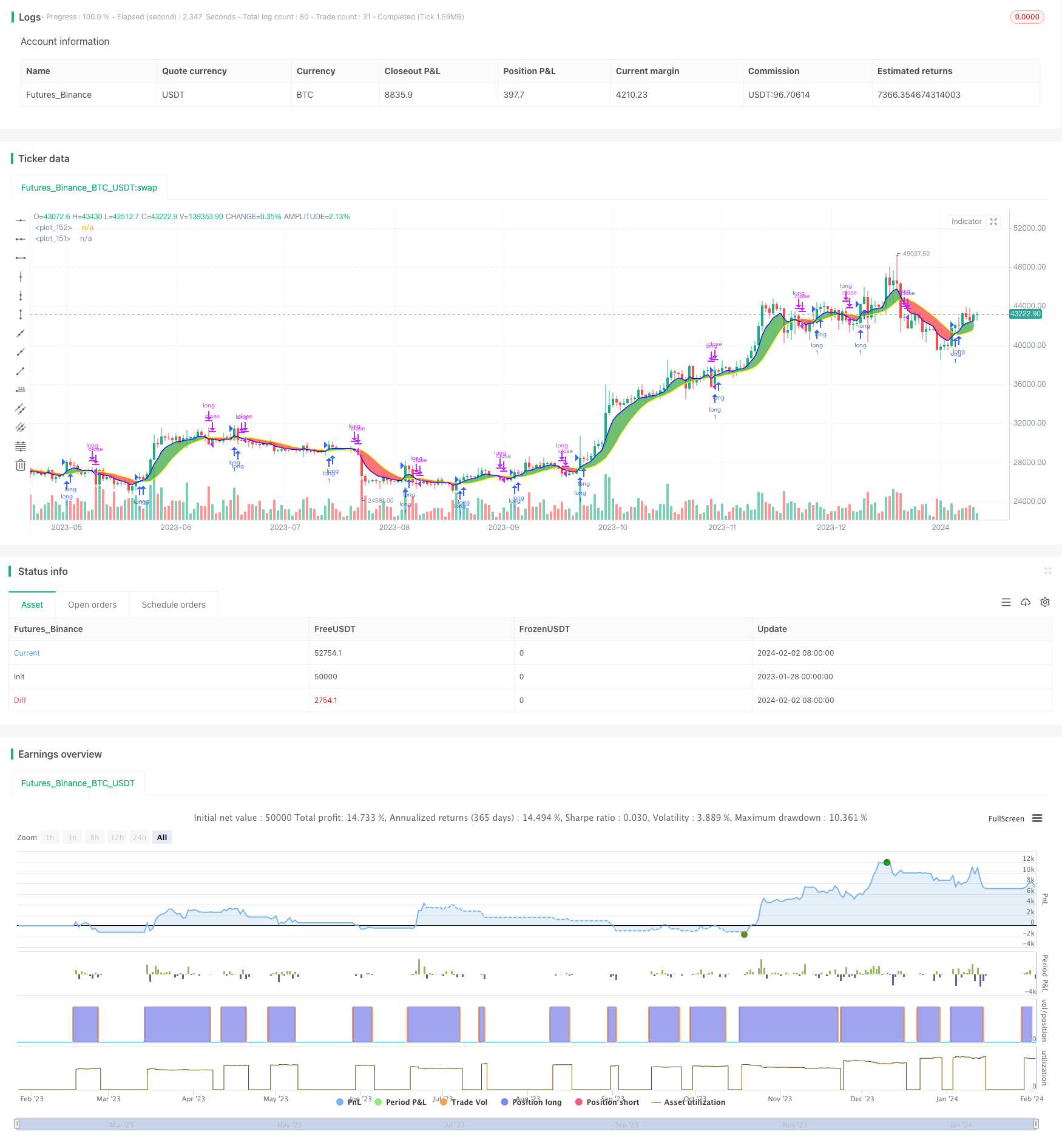
Overview
This strategy generates buy and sell signals by calculating two different types of moving averages across two different timeframes. It is a very good sandbox strategy to experiment with different moving averages and timeframe combinations.
Strategy Logic
This strategy uses two moving averages, a fast moving average and a slow moving average. The timeframe of the fast moving average should be greater than or equal to the chart timeframe. When the fast moving average crosses above the slow moving average, a buy signal is generated. When the fast moving average crosses below the slow moving average, a sell signal is generated.
Users can choose from various types of moving averages like SMA, EMA, KAMA etc, and the timeframes can be different. This allows experimenting with different combinations to find the optimal parameters.
Advantage Analysis
The biggest advantage of this strategy is that it allows easy adjustment of parameters to experiment with different combinations to find the best parameter settings.
Users can freely choose the type, length, timeframe of the two moving averages. The system calculates and displays results in real time. This is much easier than testing strategies with different parameter combinations.
Also, the built-in stop loss/take profit functionality helps to reduce risk and increase profitability.
Risk Analysis
The biggest risk of this strategy is that improper parameter settings may result in too frequent trading signals, thus increasing trading costs and slippage losses.
Also, dual moving averages themselves tend to give false signals. If parameters are not chosen correctly, buy/sell signals may not be reliable.
These risks can be reduced by optimizing parameters and combining with other indicators.
Optimization Directions
Consider adding other indicators like RSI to filter buy/sell signals on top of the dual moving averages. This can help reduce false signals.
Parameters of moving averages can also be optimized via training to find the best combinations. Machine learning methods may also be used to dynamically optimize the parameters.
Conclusion
This is an excellent sandbox for experimenting with dual moving averages. Its biggest advantage is fast iteration of different parameter combinations to find the best trading strategy. Of course there are also risks of improper parameter settings, which can be reduced by adding filtering indicators. Further optimizations of this strategy can potentially lead to even better trading performance.
Parameters
| Name | Default | What it controls |
|---|---|---|
| v_input_1 | 0 | What trades should be taken:: LONG | SHORT | BOTH | NONE |
| v_input_2 | true | ---------------- Fast Moving Average (BLUE)---------------- |
| v_input_3 | 0 | First Slow moving average: EMA | SMA | WMA | HMA | JMA | KAMA | TMA | VAMA | SMMA | DEMA | VMA | WWMA | EMA_NO_LAG | TSF | ALMA |
| v_input_4 | First Time Frame | |
| v_input_5 | 6 | First MA Length |
| v_input_6 | true | ---------------- Slow Moving Average (YELLOW)---------------- |
| v_input_7 | 0 | Second Fast moving average: JMA | EMA | WMA | HMA | SMA | KAMA | TMA | VAMA | SMMA | DEMA | VMA | WWMA | EMA_NO_LAG | TSF | ALMA |
| v_input_8 | Second time frame | |
| v_input_9 | 14 | Second MA length |
| v_input_10 | true | ---------------- Other Settings ---------------- |
| v_input_11 | 2 | Line Width |
| v_input_12 | 50 | Color Transparency |
| v_input_13 | blue | color_fast |
| v_input_14 | yellow | color_slow |
| v_input_15 | true | Fill Color |
| v_input_16 | true | ---------------- Indicators Settings ---------------- |
| v_input_17 | 0.85 | Alma Offset (only for ALMA) |
| v_input_18 | 12 | Volatility lookback (only for VAMA) |
| v_input_19 | 1.25 | KAMA's alpha (only for KAMA) |
| v_input_20 | false | ----- Add Stop Loss / Take profit ----- |
| v_input_21 | 2.5 | Stop Loss % |
| v_input_22 | 5 | Take Profit % |
Source Pine Script
/*backtest
start: 2023-01-28 00:00:00
end: 2024-02-03 00:00:00
period: 1d
basePeriod: 1h
exchanges: [{"eid":"Futures_Binance","currency":"BTC_USDT"}]
*/

// This work is licensed under a Creative Commons Attribution-ShareAlike 4.0 International License https://creativecommons.org/licenses/by-sa/4.0/
// © dman103
// A moving averages SandBox strategy where you can experiment using two different moving averages (like KAMA, ALMA, HMA, JMA, VAMA and more) on different time frames to generate BUY and SELL signals, when they cross.
// Great sandbox for experimenting with different moving averages and different time frames.
//
// == How to use ==
// We select two types of moving averages on two different time frames:
//
// First is the FAST moving average that should be at the same time frame or higher.
// Second is the SLOW moving average that should be on the same time frame or higher.
// When FAST moving average cross over the SLOW moving average we have a BUY signal (for LONG)
// When FAST moving average cross under the SLOW moving average we have a SELL signal (for SHORT)


// WARNING: Using a lower time frame than your chart time frame will result in unrealistic results in your backtesting and bar replay.
// == NOTES ==
// You can select BOTH, LONG, SHORT or NONE in the strategy settings.
// You can also enable Stop Loss and Take Profit.
// More sandboxes to come, Follow to get notified.
// Can also act as indicator by settings 'What trades should be taken' to 'NONE'

//@version=4
strategy("Multi MA MTF SandBox Strategy","Multi MA SandBox",overlay=true)
tradeType = input("LONG", title="What trades should be taken:", options=["LONG", "SHORT", "BOTH", "NONE"])
fast_title = input(true,     title='---------------- Fast Moving Average (BLUE)----------------', type=input.bool)
ma_select1 = input(title="First Slow moving average", defval="EMA", options=["SMA", "EMA", "WMA", "HMA", "JMA", "KAMA", "TMA", "VAMA", "SMMA", "DEMA" , "VMA", "WWMA", "EMA_NO_LAG", "TSF","ALMA"])
resma_fast = input(title="First Time Frame", type=input.resolution, defval="")
lenma_fast = input(title="First MA Length", type=input.integer, defval=6)
slow_title = input(true,     title='---------------- Slow Moving Average (YELLOW)----------------', type=input.bool)
ma_select2 = input(title="Second Fast moving average", defval="JMA", options=["SMA", "EMA", "WMA", "HMA", "JMA", "KAMA", "TMA", "VAMA", "SMMA", "DEMA" , "VMA", "WWMA", "EMA_NO_LAG", "TSF","ALMA"])
resma_slow = input(title="Second time frame", type=input.resolution, defval="")
lenma_slow = input(title="Second MA length", type=input.integer, defval=14)

settings = input(true,     title='---------------- Other Settings ----------------', type=input.bool)
lineWidth = input(2,title="Line Width")
colorTransparency=input(50,title="Color Transparency",step=10,minval=0,maxval=100)
color_fast=input(color.blue,type=input.color)
color_slow=input(color.yellow,type=input.color)
fillColor = input(title="Fill Color", type=input.bool, defval=true)
IndicatorSettings = input(true,     title='---------------- Indicators Settings ----------------', type=input.bool)
offset=input(title="Alma Offset (only for ALMA)",defval=0.85, step=0.05)
volatility_lookback =input(title="Volatility lookback (only for VAMA)",defval=12)
i_fastAlpha = input(1.25,"KAMA's alpha (only for KAMA)", minval=1,step=0.25)
fastAlpha = 2.0 / (i_fastAlpha + 1)
slowAlpha = 2.0 / (31)
///////Moving Averages
MA_selector(src, length,ma_select) =>
    ma = 0.0
    if ma_select == "SMA"
        ma := sma(src, length)
        ma

    if ma_select == "EMA"
        ma := ema(src, length)
        ma

    if ma_select == "WMA"
        ma := wma(src, length)
        ma
    if ma_select == "HMA"
        ma := hma(src,length)
        ma
    if ma_select == "JMA"
        beta = 0.45*(length-1)/(0.45*(length-1)+2)
        alpha = beta
        tmp0 = 0.0, tmp1 = 0.0, tmp2 = 0.0, tmp3 = 0.0, tmp4 = 0.0
        tmp0 := (1-alpha)*src + alpha*nz(tmp0[1])
        tmp1 := (src - tmp0[0])*(1-beta) + beta*nz(tmp1[1])
        tmp2 := tmp0[0] + tmp1[0]
        tmp3 := (tmp2[0] - nz(tmp4[1]))*((1-alpha)*(1-alpha)) + (alpha*alpha)*nz(tmp3[1])
        tmp4 := nz(tmp4[1]) + tmp3[0]
        ma := tmp4
        ma
    if ma_select == "KAMA"
        momentum = abs(change(src, length))
        volatility = sum(abs(change(src)), length)
        efficiencyRatio = volatility != 0 ? momentum / volatility : 0
        smoothingConstant = pow((efficiencyRatio * (fastAlpha - slowAlpha)) + slowAlpha, 2)
        var kama = 0.0
        kama := nz(kama[1], src) + smoothingConstant * (src - nz(kama[1], src))
        ma:=kama
        ma
    if ma_select == "TMA"
        ma := sma(sma(src, ceil(length / 2)), floor(length / 2) + 1)
        ma

    if ma_select == "VMA"
        valpha=2/(length+1)
        vud1=src>src[1] ? src-src[1] : 0
        vdd1=src<src[1] ? src[1]-src : 0
        vUD=sum(vud1,9)
        vDD=sum(vdd1,9)
        vCMO=nz((vUD-vDD)/(vUD+vDD))
        VAR=0.0
        VAR:=nz(valpha*abs(vCMO)*src)+(1-valpha*abs(vCMO))*nz(VAR[1])
        ma := VAR
        ma

    if ma_select == "WWMA"
        wwalpha = 1/ length
        WWMA = 0.0
        WWMA := wwalpha*src + (1-wwalpha)*nz(WWMA[1])
        ma := WWMA
        ma

    if ma_select == "EMA_NO_LAG"
        EMA1= ema(src,length)
        EMA2= ema(EMA1,length)
        Difference= EMA1 - EMA2
        ma := EMA1 + Difference
        ma

    if ma_select == "TSF"
        lrc = linreg(src, length, 0)
        lrc1 = linreg(src,length,1)
        lrs = (lrc-lrc1)
        TSF = linreg(src, length, 0)+lrs
        ma := TSF
        ma

    if ma_select =="VAMA" // Volatility Adjusted from @fractured
        mid=ema(src,length)
        dev=src-mid
        vol_up=highest(dev,volatility_lookback)
        vol_down=lowest(dev,volatility_lookback)
        ma := mid+avg(vol_up,vol_down)
        ma
    if ma_select == "SMMA"
        smma = float (0.0)
        smaval=sma(src, length)
        smma := na(smma[1]) ? smaval : (smma[1] * (length - 1) + src) / length
        ma := smma

    if ma_select == "DEMA"
        e1 = ema(src, length)
        e2 = ema(e1, length)
        ma := 2 * e1 - e2
        ma
    if ma_select == "ALMA"
        ma := alma(src, length,offset, 6)
        ma
    ma

// Calculate EMA
ma_fast = MA_selector(close, lenma_fast,ma_select1)
ma_slow = MA_selector(close, lenma_slow,ma_select2)

maFastStep = security(syminfo.tickerid, resma_fast, ma_fast)
maSlowStep = security(syminfo.tickerid, resma_slow, ma_slow)

ma1_plot=plot(maFastStep, color=color_fast,linewidth=lineWidth,transp=colorTransparency)
ma2_plot=plot(maSlowStep, color=color_slow,linewidth=lineWidth,transp=colorTransparency)
colors=ma_fast>ma_slow ? color.green : color.red
fill(ma1_plot,ma2_plot, color=fillColor? colors: na,transp=colorTransparency+15)

closeStatus = strategy.openprofit > 0 ? "win" : "lose"
////////Long Rules
long = crossover(maFastStep,maSlowStep) and (tradeType == "LONG" or tradeType == "BOTH")
longClose =crossunder(maFastStep,maSlowStep)//and falling(maSlowStep,1)
///////Short Rules
short =crossunder(maFastStep,maSlowStep) and (tradeType == "SHORT" or tradeType == "BOTH")
shortClose =  crossover(maFastStep,maSlowStep)


longShape= crossover(maFastStep,maSlowStep) and tradeType == "NONE"
shortShape = crossunder(maFastStep,maSlowStep) and tradeType == "NONE"
plotshape(longShape, style=shape.triangleup,location=location.belowbar, color=color.lime,size=size.small)
plotshape(shortShape,style=shape.triangledown,location=location.abovebar, color=color.red,size=size.small)
// === Stop LOSS ===
useStopLoss = input(false, title='----- Add Stop Loss / Take profit -----', type=input.bool)

sl_inp = input(2.5, title='Stop Loss %', type=input.float, step=0.1)/100
tp_inp = input(5, title='Take Profit %', type=input.float, step=0.1)/100
stop_level = strategy.position_avg_price * (1 - sl_inp)
take_level = strategy.position_avg_price * (1 + tp_inp)
stop_level_short = strategy.position_avg_price * (1 + sl_inp)
take_level_short = strategy.position_avg_price * (1 - tp_inp)
if (long)
    strategy.entry("long", strategy.long)
if (short)
    strategy.entry("short", strategy.short)

strategy.close ("long", when = longClose, comment=closeStatus)
strategy.close ("short", when = shortClose, comment=closeStatus)

if (useStopLoss)
    strategy.exit("Stop Loss/Profit Long","long", stop=stop_level, limit=take_level,comment =closeStatus )
    strategy.exit("Stop Loss/Profit Short","short", stop=stop_level_short, limit=take_level_short, comment = closeStatus)
Published by ChaoZhang on the FMZ strategy square · last modified 2024-02-04. Collected in the Quant Trading Vault. Unvalidated research: re-test with your own data and costs before trusting it.
Build this with AgenKit
A spec is not a trading system. Paste this into your coding agent and AgenKit runs a specialist team — architecture, test-first build, risk gates, review — with paper trading on by default.
/agenkit build a production-grade trading bot with a backtest engine, risk controls and paper trading by default from strategies/Dual-Moving-Average-Cross-Timeframe-Trading-Strategy.md- npx agenkit install engineering-kit in your project
- Paste the command into your agent and approve each phase
- Get tests, backtest, risk controls and a paper-trading switch
Understand it first
Before you run this, read the lesson behind the idea and how to backtest it honestly. Specs like this one are the survivors of an unknown number of trials; deflate their results accordingly.
Related specs
- Bollinger Bands and RSI Trend Following StrategyPine Script · Trend following · 1h
- Dual ATR Channel Trend Following StrategyPine Script · Trend following · 15m
- Dual Mode Adaptive Trend Trading Strategy EMA Crossover with ATR Volatility Based Risk Management SystemPine Script · Trend following · 1d
- Dynamic Dual EMA Crossover Strategy with Adaptive Profit Loss ControlPine Script · Trend following · 1d
- Dynamic Signal Line Trend Following and Volatility Filtering StrategyPine Script · Trend following · 1h
- EMA AROON ASHPine Script · Trend following · 3m