Strategy vault / Trend following
Super Trend Following Strategy Based on Moving Averages
This strategy is a typical trend following strategy. It uses multiple sets of moving averages with different periods to determine the market trend. It enters the market when the trend is established and exits when…
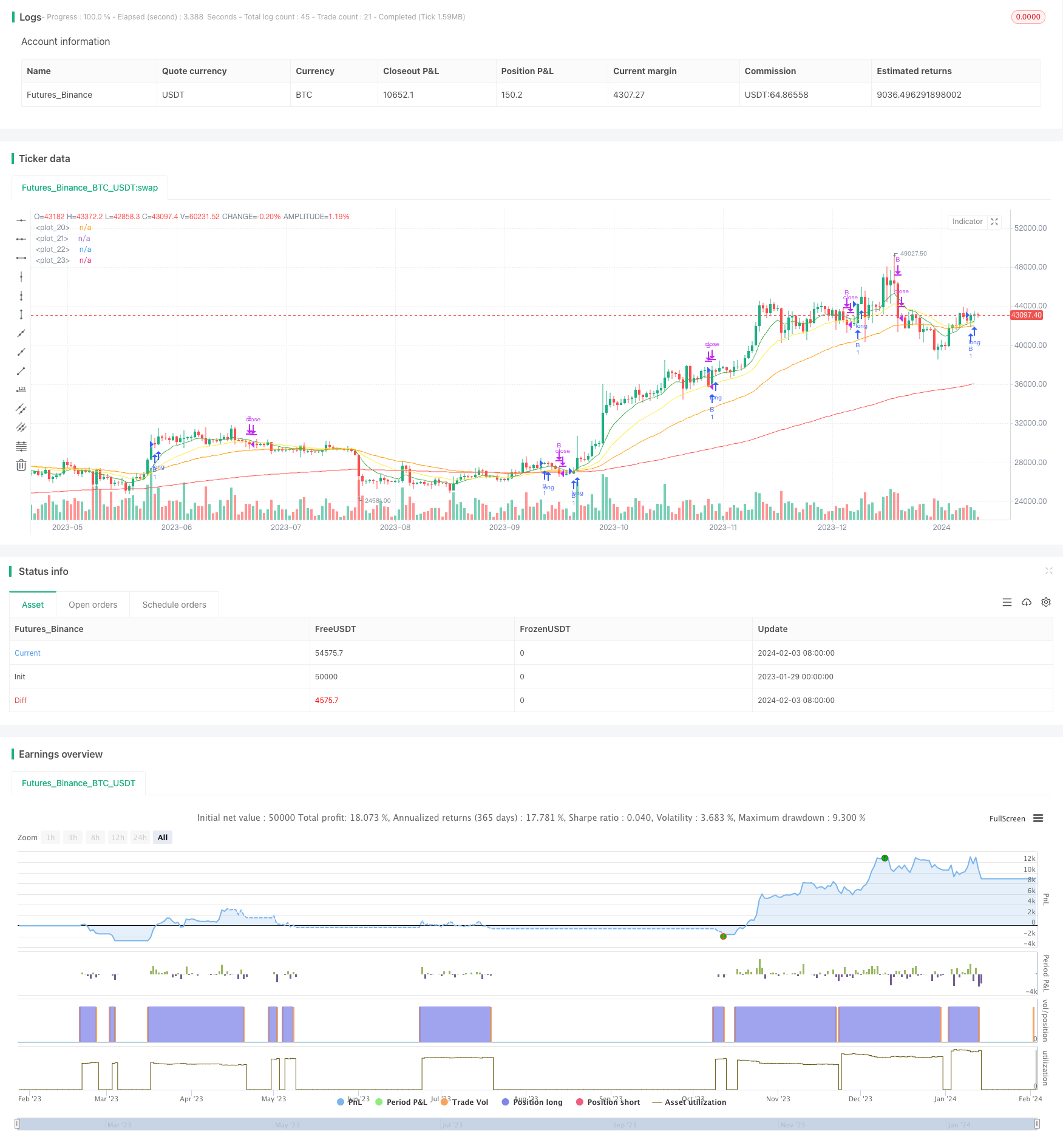
Overview
This strategy is a typical trend following strategy. It uses multiple sets of moving averages with different periods to determine the market trend. It enters the market when the trend is established and exits when the short-term trend reverses.
Strategy Principle
The strategy employs 4 groups of moving averages: 9-day, 21-day, 50-day and 200-day lines. They represent different timeframes respectively.
When the short-term moving average crosses over the long-term one upwards, it is determined that the market enters an uptrend. When it crosses downwards, the market is seen to be in a downtrend.
The strategy takes the 9-day MA as a reference to observe the alignment of the other MAs, thereby judging the overall trend direction. Specifically, the logic is:
Long entry conditions: Close > 9-day MA and 9-day MA > 21-day MA and 21-day MA > 50-day MA and 50-day MA > 200-day MA.
Short entry conditions: Close < 9-day MA and 9-day MA < 21-day MA and 21-day MA < 50-day MA and 50-day MA < 200-day MA.
Here the relationship between close price and 9-day MA determines the shortest-term trend, while that between 9-day and 21-day MA judges short-term trend, 21-day and 50-day medium-term trend, 50-day and 200-day long-term trend. Only when the relationships of all the four MA pairs conform can a valid trend be established to generate trading signals.
Exit conditions: close price crosses below 21-day MA, flatten all long positions; crosses above 21-day MA, flatten all short positions.
Advantages of the Strategy
Adopting multiple MAs to determine the trend can filter out market noises from non-mainstream moves and capture medium-to-long term trends.
Strict entry conditions require valid judgments across different timeframes, avoiding being trapped by short-term corrections.
Timely stop loss helps effectively control risks.
Risks and Solutions
In long-term rangebound markets, excessive false signals may occur and increase trading risks. This can be avoided by optimizing parameters and adjusting MA periods to filter out some noises.
During violent trends, MA crosses happen frequently. Other factors are needed then to determine real trend, e.g. combining indicators like RSI and MACD for confirmation, in case strong moves are missed.
Optimization Directions
Parameter optimization. Test different parameter combinations to find out the optimum. Such as adjusting MA periods, adding or modifying stop loss criteria etc.
Improve quality filter. For instance, check if volume surges on entry to avoid insufficient momentum, or examine volatility to avoid oscillations.
Introduce confirmation from more technical indicators to avoid wrong signals amid fierce market moves. Consider applying tools like RSI and MACD for multi-factor decision-making.
Summary
Overall this is a typical and practical trend following strategy. It adopts multiple MAs to determine trends, has strict entry rules to lock in medium-to-long term trends. Together with timely stop loss, it helps control risks. Further improvements on stability and profitability can be achieved through ways like parameter optimization and adding confirmation indicators. It suits investors who prefer following the trend for long-term trading.
Parameters
| Name | Default | What it controls |
|---|---|---|
| v_input_int_1 | 14 | rsi-length |
Source Pine Script
/*backtest
start: 2023-01-29 00:00:00
end: 2024-02-04 00:00:00
period: 1d
basePeriod: 1h
exchanges: [{"eid":"Futures_Binance","currency":"BTC_USDT"}]
*/

// This source code is subject to the terms of the Mozilla Public License 2.0 at https://mozilla.org/MPL/2.0/
// © shayak1

//@version=5
strategy('Super SR', overlay=true)

r = input.int(14,"rsi-length",1,100)
rsi = ta.rsi(close,r)

len1 = 9
len2 = 21
len3 = 50
len4 = 200

ema1 = ta.ema(close, len1)
ema2 = ta.ema(close, len2)
ema3 = ta.ema(close, len3)
ema4 = ta.ema(close, len4)

plot(ema1,color= color.green)
plot(ema2,color= color.yellow)
plot(ema3,color= color.orange)
plot(ema4,color= color.red)


// *** entries
Long1 = close > ema1
Long2 = ema1 > ema2
Long3 = ema2 > ema3
Long4 = ema3 > ema4
buy_condition = Long1 and Long2 and Long3 and Long4 and strategy.position_size == 0

if (buy_condition and strategy.position_size <= 1)
    strategy.entry("B", strategy.long)

Short1 = close < ema1
Short2 = ema1< ema2
Short3 = ema2< ema3
Short4 = ema3< ema4
sell_condition = Short1 and Short2 and Short3 and Short4 and strategy.position_size == 0

//if (sell_condition)
//    strategy.entry("S", strategy.short)

// trailing SL
//Long_sl = min(strategy.position_avg_price * 0.95, strategy.pos


//EXIT CONDITIONS

exit_long = ta.crossunder(close, ema2)
exit_short = ta.crossover(close, ema2)

if(exit_long)
    strategy.close("B", "LE", qty_percent=100)
if(exit_short)
    strategy.close("S", "SE", qty_percent=100)

//==============================================================================
//INSERT SECTION
//This section is where users will be required to insert the indicators they
//would like to use for their NNFX Strategy.
//==============================================================================
//INSERT - CONFIRMATION INDICATOR 1
//==============================================================================


//==============================================================================
//INSERT - CONFIRMATION INDICATOR 2
//==============================================================================


//==============================================================================
//INSERT - VOLUME INDICATOR
//==============================================================================


//==============================================================================
//INSERT - BASELINE INDICATOR
//==============================================================================


//==============================================================================
//INSERT - EXIT INDICATOR
//==============================================================================


//==============================================================================
//INSERT - CONTINUATION TRADES INDICATOR
//==============================================================================


//==============================================================================
//COMPLETED SECTION
//This section has been optimised to work with the above indicators the user
//has inserted above. The user does not require to change any code below and
//is completed and optimised for the full NNFX strategy. Users may wish to
//customise this section of code if they wish to alter the NNFX strategy.
//==============================================================================
//COMPLETE - BACKTEST DATE RANGE
//==============================================================================
// start_day = input.int(1,"start day",1,31)
// start_month = input.int(1,"start month",1,12)
// start_year = input.int(1,"start year",2010,2023)


//==============================================================================
//COMPLETE - CURRENCY CONVERSION
//==============================================================================


//==============================================================================
//COMPLETE - ATR MONEY MANAGEMENT
//==============================================================================


//==============================================================================
//COMPLETE - USER INPUT CONDITIONS - C1
//==============================================================================


//==============================================================================
//COMPLETE - USER INPUT CONDITIONS - C2
//==============================================================================


//==============================================================================
//COMPLETE - USER INPUT CONDITIONS - Vol
//==============================================================================


//==============================================================================
//COMPLETE - USER INPUT CONDITIONS - Bl
//==============================================================================


//==============================================================================
//COMPLETE - USER INPUT CONDITIONS - Exit
//==============================================================================


//==============================================================================
//COMPLETE - CONTINUATION TRADES
//==============================================================================


//==============================================================================
//COMPLETE - ONE CANDLE RULE
//==============================================================================


//==============================================================================
//COMPLETE - BRIDGE TOO FAR
//==============================================================================


//==============================================================================
//COMPLETE - BASELINE AND ATR RULE
//==============================================================================


//==============================================================================
//COMPLETE - ENTRY CONDITIONS
//==============================================================================


//==============================================================================
//COMPLETE - ENTRY ORDERS
//==============================================================================


//==============================================================================
//COMPLETE - TAKE PROFIT AND STOP LOSS CONDITIONS
//==============================================================================


//==============================================================================
//COMPLETE - EXIT ORDERS
//==============================================================================


//==============================================================================
//COMPLETE - CLOSE ORDERS
//==============================================================================


//==============================================================================Published by ChaoZhang on the FMZ strategy square · last modified 2024-02-05. Collected in the Quant Trading Vault. Unvalidated research: re-test with your own data and costs before trusting it.
Build this with AgenKit
A spec is not a trading system. Paste this into your coding agent and AgenKit runs a specialist team — architecture, test-first build, risk gates, review — with paper trading on by default.
/agenkit build a production-grade trading bot with a backtest engine, risk controls and paper trading by default from strategies/Super-Trend-Following-Strategy-Based-on-Moving-Averages.md- npx agenkit install engineering-kit in your project
- Paste the command into your agent and approve each phase
- Get tests, backtest, risk controls and a paper-trading switch
Understand it first
Before you run this, read the lesson behind the idea and how to backtest it honestly. Specs like this one are the survivors of an unknown number of trials; deflate their results accordingly.
Related specs
- Adaptive ATR and RSI Trend Following Strategy with Trailing Stop LossPine Script · Trend following · 1h
- Bollinger Bands and RSI Trend Following StrategyPine Script · Trend following · 1h
- Dual ATR Channel Trend Following StrategyPine Script · Trend following · 15m
- Dynamic Dual EMA Crossover Strategy with Adaptive Profit Loss ControlPine Script · Trend following · 1d
- EMA and RSI Trend Trading StrategyPine Script · Trend following · 1d
- Fixed Range Volume Profile And Anchored VWAP Trend Identification Strategy With Dynamic Stop LossPine Script · Trend following · 1h