Strategy vault / Trend following
Multi indicator Combination Adaptive Trend Strategy
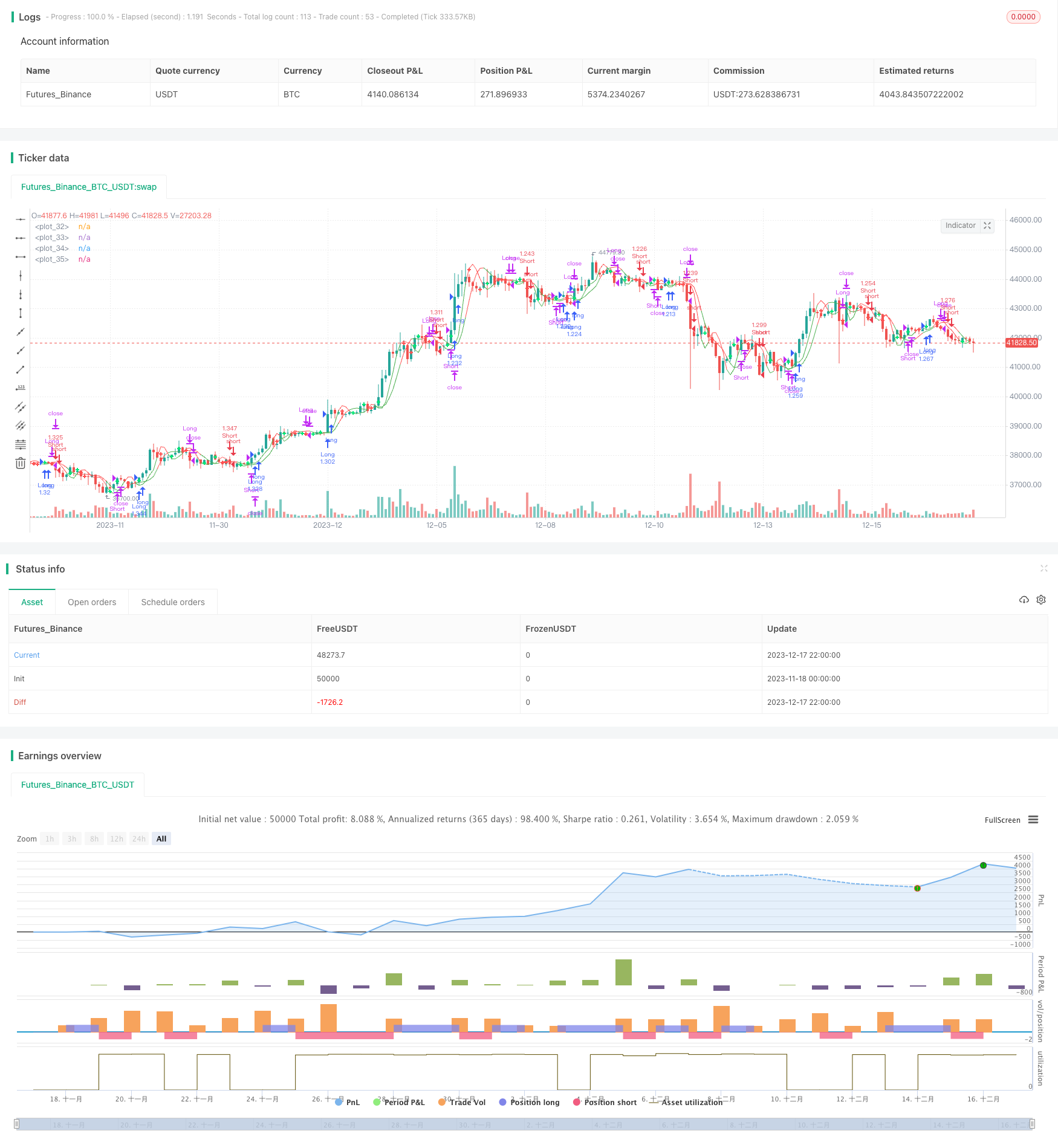
This strategy accurately judges the trend by combining the double Hull moving average indicator, volume weighted moving average indicator, MACD indicator and true strength index indicator. It can automatically adapt…
Overview
This strategy accurately judges the trend by combining the double Hull moving average indicator, volume weighted moving average indicator, MACD indicator and true strength index indicator. It can automatically adapt to changes in market conditions and has strong adaptability.
Strategy Principle
The core indicator of this strategy is the double Hull moving average, which is controlled by two parameters keh and teh. These two parameters determine the cycle of fast line and slow line respectively. The golden cross and dead cross formed by fast line and slow line judge the current trend.
The auxiliary judgment indicator is the volume weighted moving average meh1. When the price is higher than meh1, it is a bullish trend; when the price is lower than meh1, it is a bearish trend.
Another auxiliary judgment indicator is MACD. It is obtained by subtracting the fast moving average from the slow moving average to get MACD, and then using the moving average of MACD to get the signal line. When MACD is higher than the signal line, it is a bullish trend.
The last auxiliary judgment indicator is TSI, which is calculated by double smoothing the rate of change of price. Its absolute value magnitude represents the momentum of price change. In the buy and sell conditions, the signal line of TSI is judged to control the timing of Entries and Exits.
By combining the signals of these indicators, the trend can be accurately judged, and the parameters can be automatically adjusted to synchronize with the market.
Advantages
Using double Hull moving average as the main judgment indicator, combined with multiple other indicators, can improve judgment accuracy and reduce false signals.
Applying the TSI indicator to determine the timing of market entry and exit can control risks.
Multiple adjustable parameters for strong adaptability that can automatically adapt to market changes.
The idea of indicator combination and parameter self-adaptation makes the strategy stable with strong continuous profitability.
Risk Analysis
Although the TSI indicator is used to determine the timing, the indicators used in the algorithm are still trend types. If a shock and pullback market is encountered, it will increase fluctuations in profit and loss.
Improper parameter settings may cause strategy failure. Parameters need to be set reasonably based on experience.
The combination of multiple indicators increases the amount of calculation, which increases the possibility of errors in large data stocks and time periods. The data range needs to be controlled.
Need to monitor the calculation effect of indicators to prevent interference from abnormal data.
Optimization Direction
Other auxiliary indicators such as BOLL can be tested to make the signal more accurate and reliable.
Optimize entry and exit logic, set stop loss and take profit conditions to control single profit and loss.
Train and optimize parameters for different varieties to make them better suited for different varieties.
Increase the parameter self-adaptation module to automatically adjust the strategy parameters based on recent transaction effects.
Summary
This strategy integrates the advantages of multiple indicators and uses indicator combinations to judge trend direction. While controlling risks, it improves the accuracy of judgments. Through parameter optimization and logic optimization, the strategy can be better adapted to market changes, while reducing consecutive losses and gaining greater profits. This strategy is stable and can be used for stocks, cryptocurrencies and other varieties for long term.
Parameters
| Name | Default | What it controls |
|---|---|---|
| v_input_1 | 7 | Double HullMA 1 |
| v_input_2 | 14 | Double HullMA 2 |
| v_input_3 | true | VWMA |
| v_input_4 | 7 | MacD fastLength |
| v_input_5 | 14 | MacD slowlength |
| v_input_6 | 3 | MacD Length |
| v_input_7 | 5 | TSI Long Length |
| v_input_8 | 3 | TSI Short Length |
| v_input_9 | 2 | TSI Signal Length |
| v_input_10 | 4 | TSI Upper Line |
| v_input_11 | -4 | TSI Lower Line |
Source Pine Script
/*backtest
start: 2023-11-18 00:00:00
end: 2023-12-18 00:00:00
period: 2h
basePeriod: 15m
exchanges: [{"eid":"Futures_Binance","currency":"BTC_USDT"}]
*/

//@version=2
//                                                    Quad-HullMA-cross & VWMA & MacD & TSI combination  <<<<< by SeaSide420 >>>>>>
strategy("MultiCross420", overlay=true, calc_on_order_fills= true, calc_on_every_tick=true, default_qty_type=strategy.percent_of_equity, default_qty_value=100, pyramiding=0)
keh=input(title="Double HullMA 1",defval=7, minval=1)
teh=input(title="Double HullMA 2",defval=14, minval=1)
meh=input(title="VWMA",defval=1, minval=1)
meh1=vwma(close,round(meh))
n2ma=2*wma(close,round(keh/2))
nma=wma(close,keh)
diff=n2ma-nma,sqn=round(sqrt(keh))
n2ma1=2*wma(close[2],round(keh/2))
nma1=wma(close[2],keh)
diff1=n2ma1-nma1,sqn1=round(sqrt(keh))
n1=wma(diff,sqn)
n2=wma(diff1,sqn)
b=n1>n2?lime:red
c=n1>n2?green:red
n2ma3=2*wma(close,round(teh/2))
nma2=wma(close,teh)
diff2=n2ma3-nma2,sqn2=round(sqrt(teh))
n2ma4=2*wma(close[2],round(teh/2))
nma3=wma(close[2],teh)
diff3=n2ma4-nma3,sqn3=round(sqrt(teh))
n3=wma(diff2,sqn2)
n4=wma(diff3,sqn3)
fastLength = input(title="MacD fastLength", defval=7)
slowlength = input(title="MacD slowlength", defval=14)
MACDLength = input(title="MacD Length", defval=3)
MACD = ema(close, fastLength) - ema(close, slowlength)
aMACD = ema(MACD, MACDLength)
delta = MACD - aMACD
a1=plot(n1,color=c),a2=plot(n2,color=c)
plot(cross(n1, n2) ? n1 : na, style = cross, color=b, linewidth = 3)
a3=plot(n3,color=c),a4=plot(n4,color=c)
plot(cross(n3, n4) ? n1 : na, style = cross, color=b, linewidth = 3)
//a5=plot(meh1,color=c)
long = input(title="TSI Long Length",  defval=5)
short = input(title="TSI Short Length",  defval=3)
signal = input(title="TSI Signal Length",  defval=2)
linebuy = input(title="TSI Upper Line",  defval=4)
linesell = input(title="TSI Lower Line",  defval=-4)
price = close
double_smooth(src, long, short) =>
    fist_smooth = ema(src, long)
    ema(fist_smooth, short)
pc = change(price)
double_smoothed_pc = double_smooth(pc, long, short)
double_smoothed_abs_pc = double_smooth(abs(pc), long, short)
tsi_value = 100 * (double_smoothed_pc / double_smoothed_abs_pc)
closelong = n1<n2 and n3<n4 and n1>meh1
if (closelong)
    strategy.close("Long")
closeshort = n1>n2 and n3>n4 and n1<meh1
if (closeshort)
    strategy.close("Short")
longCondition = strategy.opentrades<1 and n1>n2 and MACD>aMACD and n1<meh1 and n3>n4 and ema(tsi_value, signal)>linesell
if (longCondition)
    strategy.entry("Long",strategy.long)
shortCondition = strategy.opentrades<1  and n1<n2 and MACD<aMACD and n1>meh1 and n3<n4 and ema(tsi_value, signal)<linebuy
if (shortCondition)
strategy.entry("Short",strategy.short)Published by ChaoZhang on the FMZ strategy square · last modified 2023-12-19. Collected in the Quant Trading Vault. Unvalidated research: re-test with your own data and costs before trusting it.
Build this with AgenKit
A spec is not a trading system. Paste this into your coding agent and AgenKit runs a specialist team — architecture, test-first build, risk gates, review — with paper trading on by default.
/agenkit build a production-grade trading bot with a backtest engine, risk controls and paper trading by default from strategies/Multi-indicator-Combination-Adaptive-Trend-Strategy.md- npx agenkit install engineering-kit in your project
- Paste the command into your agent and approve each phase
- Get tests, backtest, risk controls and a paper-trading switch
Understand it first
Before you run this, read the lesson behind the idea and how to backtest it honestly. Specs like this one are the survivors of an unknown number of trials; deflate their results accordingly.
Related specs
- Adaptive ATR and RSI Trend Following Strategy with Trailing Stop LossPine Script · Trend following · 1h
- Advanced Multi Indicator Multi Dimensional Trend Cross Quantitative StrategyPine Script · Trend following · 3h
- Bollinger Bands and RSI Trend Following StrategyPine Script · Trend following · 1h
- Crossover EMA Short term Trading StrategyPine Script · Trend following · 1h
- Dual ATR Channel Trend Following StrategyPine Script · Trend following · 15m
- Dual EMA Crossover Oscillation Tracking StrategyPine Script · Trend following · 5m